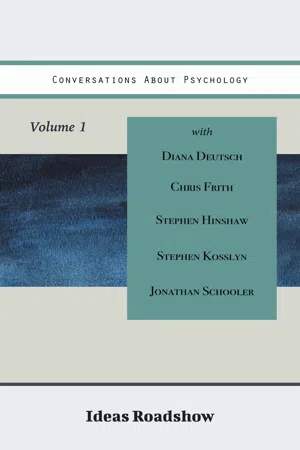
FIVE BOOKS IN ONE! This collection includes the following 5 complete Ideas Roadshow books featuring leading researchers providing fully accessible insights into cutting-edge academic research while revealing the inspirations and personal journeys behind the research. A detailed preface highlights the connections between the different books and all five books are broken into chapters with a detailed introduction and questions for discussion at the end of each chapter: 1. Believing Your Ears: Examining Auditory Illusions - A Conversation with Diana Deutsch, Professor of Psychology at UC San Diego and one of the world's leading experts on the psychology of music. This conversation provides behind the scenes insights into her discovery of a large number of auditory illusions, including the so-called Octave Illusion, which concretely illustrate how what we think we're hearing is often quite different from the actual sounds that are hitting our eardrums.2. In Search of a Mechanism: From the Brain to the Mind - A Conversation with Chris Frith, Emeritus Professor of Neuropsychology at University College London and Honorary Research Fellow at the Institute of Philosophy, School of Advanced Study, University of London. After an interesting exploration of how Chris Frith became interested in the study of schizophrenia, this detailed conversation examines topics such how our understanding of schizophrenia has evolved, the role of dopamine, how the brain works, the brain's predicting role, the phantom limb phenomenon, how the brain and mind link up, how culture affects the brain and much more.3. Understanding ADHD - A Conversation with Stephen Hinshaw, Professor of Psychology at UC Berkeley. Stephen Hinshaw is an expert in the fields of clinical child and adolescent psychology and developmental psychopathology, as well as stigma, preventive interventions and dehumanization related to mental illness. This extensive conversation examines the facts and misunderstandings surrounding ADHD, diagnosis and misdiagnosis, treatment, family responsibilities, the subtitles of medication, adult ADHD, gender, what's happening on an international level and finally the stigma of mental illness.4. Applied Psychology: Thinking Critically - A Conversation with Stephen Kosslyn, a renowned psychologist and Founder, President and Chief Academic Officer of Foundry College.This wide-ranging conversation explores Kosslyn and his colleagues' extensive analysis of research results on the differences between what the top parts of the brain and the bottom parts of the brain do and what the implications of those results are for everyday life which led to a new theory of personality called the Theory of Cognitive Modes. In addition the discussion covers how pedagogical principles were applied in the real world of learning and teaching by establishing Minerva Schools at KGI.5. Mind-Wandering & Meta-Awareness - A Conversation with Jonathan Schooler, Professor of Psychological and Brain Sciences at the University of California, Santa Barbara. This wide-ranging conversation examines how mind-wandering can serve as a window into the psychological world of meta-awareness. further topics include the nature of consciousness, mindfulness, creativity, free will, verbal overshadowing and more.Howard Burton is the founder and host of all Ideas Roadshow Conversations and was the Founding Executive Director of Perimeter Institute for Theoretical Physics. He holds a PhD in theoretical physics and an MA in philosophy.
- English
- ePUB (mobile friendly)
- Available on iOS & Android
eBook - ePub
Conversations About Psychology, Volume 1
About this book
Information
Subtopic
Abnormal PsychologyIndex
PsychologyUnderstanding ADHD
A conversation with Stephen Hinshaw
Introduction
The Last Frontier
One of the biggest problems with being intolerant is that you’re often not even aware of it.
Like most of us, I suppose, I like to think of myself as a pretty tolerant guy. I don’t judge people on the basis of their gender or sexual orientation or skin colour, and have little but disdain for those who do.
But that didn’t stop me from having a pretty strongly sceptical view about ADHD right up until I read Stephen Hinshaw’s book, The ADHD Explosion: Myths, Medication, Money and Today’s Push for Performance.
Why?
Was I familiar with current research results? Had I read much about it? Did I even know anyone who had been diagnosed with it?
No.
Yet that didn’t stop me from immediately dismissing it as yet another in a long line of pseudo-conditions that our over-medicated society routinely slaps on inattentive, under-performing kids to justify both their inherent laziness along with their irresponsible parents.
Now where, I wonder, did that judgement come from?
Well, the good news, for me at least, is that a sampling of today’s mainstream media makes it difficult for a non-specialist not to come to that conclusion.
In his book, Hinshaw, a clinical psychologist at UC Berkeley and UC San Francisco and an international authority on ADHD, points out that, “The public is likely to see splashy newspaper articles on ADHD that turn out to be inaccurate, yet the subsequent non-replications are almost never written up in the news to set the record straight.”
He demonstrates that The New York Times—hardly what anyone might naively assume as a likely bastion of uninformed and pseudoscientific journalism—has repeatedly featured articles and op-eds openly antagonistic towards the prevailing scientific consensus on ADHD: blaming the condition on maladaptive parenting, dismissing stimulants as a means of covering up underlying social causes, and even, in an op-ed by the playwright and writer Hanif Kureishi, claiming that medicating ADHD is tantamount to punishing young people for sexual exploration.
Why is this happening?
To understand the roots of this phenomenon, Steve told me, we have to look to the concept of stigma.
“What if you confess that you’ve got a mental illness? Why, even the name seems to imply, ‘You’re not stable. You’re violent. You can’t control yourself. You must have weak will.’
“It turns out that if you had to pick the three attributes in today’s society that people even consciously admit—much less what’s really going on inside —that will drive them to say, ‘I don’t want to be around those people, I stigmatize them’, we’d find: people with mental illness, people who abuse drugs and people who are homeless. Those are the bottom three.
“What do people say about them? ‘You must not have it together. Your parents must have been terrible. You’re getting handouts. You’re violent’—we have a big stereotype in the media that mental illness is always linked to violence. There are a few forms of mental illness that are, but the fact is that people with mental illness are far more likely to be victimized by violence than to perpetrate it themselves.”
But the story gets even more complicated. Because it turns out that, ironically enough, the societal stigma is far worse for people with less noticeable forms of mental disorders.
“For conditions like schizophrenia or bipolar disorder, people are often labelled as “psychotic” or “delusional”. But what about ADHD? These are kids who look pretty normal most of the time. They act pretty normal at recess, but then when it comes to reading, they’re not doing so well. They’re consistently inconsistent.
“It turns out that the stigma of “milder”, if you will, forms of mental disorder, or ones that fluctuate in their consistency, have really high stigma. They’ll tell a kid who has ADHD, ‘You got it together in period 2. What happened in period 4? It must just be bad effort or lousy parenting’.
The sense of stigma for these kids is really high.”
And then it gets worse still.
“Well, we thought we had the answer to stigma. We shifted in the 70s, 80s and 90s to behaviour genetics—biological models. Schizophrenia has a substantial genetic liability. ADHD has an even higher genetic liability.
“What if we sell that to the public? Schizophrenia, we’ll tell them, is ‘a brain disease’. ADHD is, say, ‘a dopamine disorder’? The social psychologists will tell us that if you’re behaving deviantly but I think that you can’t help it because there’s a biological cause, I’ll forgive you, and won’t hold it against you like I would if I thought it was just weak personal character. But on the other hand, if I’m convinced that there’s a biological cause to the way you’re acting, I’m more than likely going to conclude that you’re never going to get better and I definitely don’t want to be around you.
“There’s something about the biological description of mental illness where your whole behaviour, your whole being, is regarded as being an expression of flawed genes. At some level I think we tend to look at these people as almost less than human.
“We have to be able to appreciate that it’s not just biological and it’s not just socio-cultural, but a complex amalgamation of the two, which is scientifically fascinating, but makes it a lot less easy to make a banner headline about.”
Think about that the next time you pick up a newspaper and come to a strong conclusion about something you know very little about.
I know I will.
The Conversation

I. On Genes and Explorers
Different perspectives
HB: What are we talking about here? What is ADHD?
I think for a lot of people, exactly like myself, there is a tremendous amount of confusion and misunderstanding right from the very beginning as to what we’re even talking about.
SH: Well, part of the confusion is the alphabet-soup nature of this: “It’s ADHD.” “No, it’s ADD.” It used to be called hyperactivity, or hyperkinesis. Fifty years or so ago it was called Minimal Brain Dysfunction, MBD.
To get the whole story, I think we have to go back to the beginnings of compulsory education.
What changed in the 19th century? We started to make kids go to school. In America, the first state was Massachusetts in 1830. Europe had started to do this a few years before. Suddenly, for the first time, all kids—not just the elite few—had to sit in uncomfortable chairs and pay attention for long periods of time.
HB: Really uncomfortable chairs, too. In the 1800s they were super uncomfortable.
SH: That’s right. These were not today’s models. And these kids had to do things that the human brain never evolved to do: that is, learn to read.
If you want to get a kid talking, you expose that kid to a little bit of language and the genetic programs in the brain take over: everybody talks. But if you can get kids to read, it’s like an act of God—because it’s a lot of work.
When was cuneiform developed? Roughly five or six thousand years ago? Reading is a recent cult...
Table of contents
- Textual Note
- Preface
- Applied Psychology
- Believing Your Ears
- Mind-Wandering and Meta-Awareness
- In Search of a Mechanism
- Understanding ADHD
Trusted by 375,005 students
Access to over 1.5 million titles for a fair monthly price.
Study more efficiently using our study tools.
Frequently asked questions
Yes, you can cancel anytime from the Subscription tab in your account settings on the Perlego website. Your subscription will stay active until the end of your current billing period. Learn how to cancel your subscription
No, books cannot be downloaded as external files, such as PDFs, for use outside of Perlego. However, you can download books within the Perlego app for offline reading on mobile or tablet. Learn how to download books offline
Perlego offers two plans: Essential and Complete
- Essential is ideal for learners and professionals who enjoy exploring a wide range of subjects. Access the Essential Library with 800,000+ trusted titles and best-sellers across business, personal growth, and the humanities. Includes unlimited reading time and Standard Read Aloud voice.
- Complete: Perfect for advanced learners and researchers needing full, unrestricted access. Unlock 1.5M+ books across hundreds of subjects, including academic and specialized titles. The Complete Plan also includes advanced features like Premium Read Aloud and Research Assistant.
We are an online textbook subscription service, where you can get access to an entire online library for less than the price of a single book per month. With over 1.5 million books across 990+ topics, we’ve got you covered! Learn about our mission
Look out for the read-aloud symbol on your next book to see if you can listen to it. The read-aloud tool reads text aloud for you, highlighting the text as it is being read. You can pause it, speed it up and slow it down. Learn more about Read Aloud
Yes! You can use the Perlego app on both iOS and Android devices to read anytime, anywhere — even offline. Perfect for commutes or when you’re on the go.
Please note we cannot support devices running on iOS 13 and Android 7 or earlier. Learn more about using the app
Please note we cannot support devices running on iOS 13 and Android 7 or earlier. Learn more about using the app
Yes, you can access Conversations About Psychology, Volume 1 by Howard Burton in PDF and/or ePUB format, as well as other popular books in Psychology & Abnormal Psychology. We have over 1.5 million books available in our catalogue for you to explore.