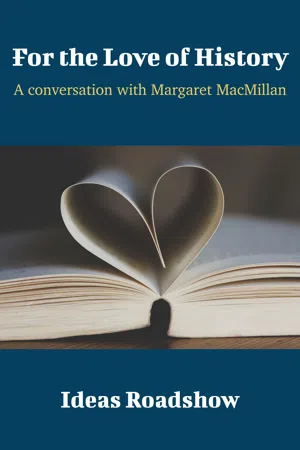
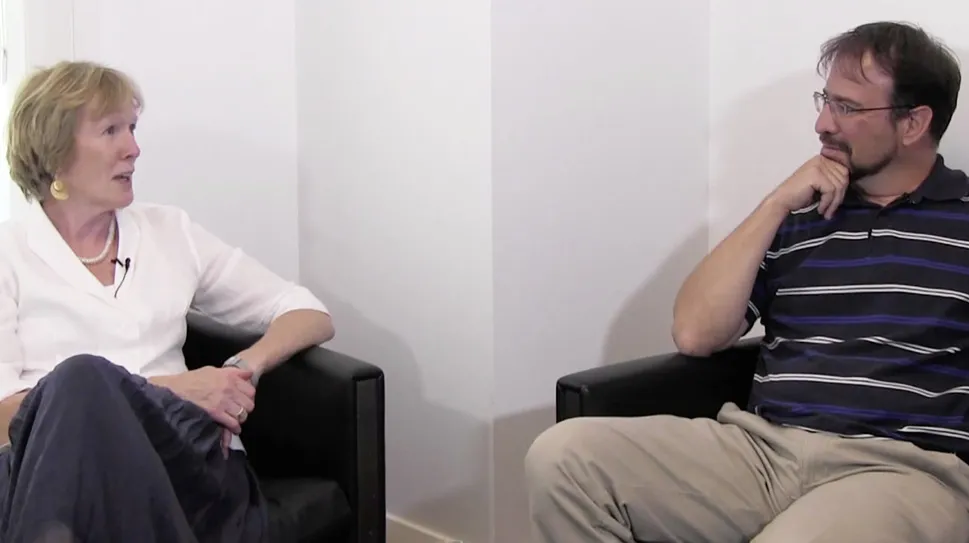
This book is based on an in-depth conversation between Howard Burton and Margaret MacMillan, Professor of History at the University of Toronto and emeritus Professor of International History and the former warden of St Antony's College at the University of Oxford. This wide-ranging conversation examines her research on patriotism and nationalism, which are essential themes of her lifelong work on 19th and 29th history. This carefully-edited book includes an introduction, Perpetual Revisionism, and questions for discussion at the end of each chapter: I. The Historical Enterprise - Investigating the subtletiesII. Historical Value - Reevaluating the present and connecting with the pastIII. Pride and Prejudice - Patriotism vs. nationalismIV. Professional Insights - An insider's viewV. Living Historically - Following your passionAbout Ideas Roadshow Conversations: This book is part of a series of 100 Ideas Roadshow Conversations. Presented in an accessible, conversational format, Ideas Roadshow books not only explore frontline academic research featuring world-leading researchers but also reveal the inspirations and personal journeys behind the research.
- English
- ePUB (mobile friendly)
- Available on iOS & Android
eBook - ePub
For the Love of History - A Conversation with Margaret MacMillan
About this book
Trusted by 375,005 students
Access to over 1.5 million titles for a fair monthly price.
Study more efficiently using our study tools.
Information
The Conversation
I. The Historical Enterprise
Investigating the subtleties
HB: It’s great to be chatting with you. Like many people, I’ve read several of your books, which brings me to my first point. There are those who regard history as some objective statement of universal truth, or at least as close as we can perhaps come to an objective statement of universal truth.
So it’s somewhat ironic to me that two of your recent books have been released with two completely different titles in two parts of the world where they speak the same language. I wonder if you’ve received any flack for this, or if anyone has even noticed.
Of course, I appreciate that this isn’t your responsibility, but I thought I’d ask.
MM Well, I blame the publishers. Occasionally I get angry emails from people saying, “I’ve just bought your book again, not realizing that it was the same one.” And I do not offer a refund. That is not my responsibility. It’s a transatlantic thing. American publishers like to put their own titles on them.
HB: And not only do they come up with their own titles, but they’re typically very aggressive ones—if you take their word for it, you always seem to be changing the world with what you’re doing.
MM: That’s right. Personally, I don’t like the trend. As you say, I did a book on the Paris Peace Conference, which was subtitled, Six Months That Changed The World, and then I did another book on President Nixon’s trip to China, that was subtitled, Six Days That Changed The World.
HB: Right, so how much time is left now to change the world?
MM: Well, I’m getting down to milliseconds. And there are not many instances where one can plausibly say that there were six milliseconds that changed the world, so I’m hoping that we can find some other subtitle.
But it’s all about marketing, of course.
HB: Sure. Well, careening into a more serious vein, our topic for today is all about the purpose, the goals, the future, the limitation and the possibilities of history. Now that I reflect upon it, perhaps that’s far too grandiose a title. And I know that, as a general rule, you are not somebody who looks for grandiose summations of history.
In your book, The Uses and Abuses of History, you are resolute in trying to eschew any fixed patterns in history, any preset orientations that people might like to impose on history. So, perhaps I should begin by simply asking you, as a professional historian, what the principal goals of history are for you? What do you feel you are doing, exactly, and why?
MM: I do it myself, because I’m curious about the past. I always have been. So I find it very pleasurable to have a look at history.
I am very leery about saying that history is very useful. I don’t think we do history because of its utility—it doesn’t give us a blueprint for the future, for example.
But I think history does do a couple things: it helps us to understand ourselves and know something about what produced us—the forces, the factors, the geography, whatever you want to think about—that produced us.
You can’t think about Canadian history, for instance, without understanding that we were once part of a much bigger empire that has helped to shape Canada and its institutions. You can’t think about Canadian history without the understanding that we live next door to one of the great powers of the world. Again, that’s just part of what has helped us to become what we are.
And I think history also helps us understand other people and makes us appreciate the sorts of things that have shaped them. I mean, how can you understand the conflict between Israelis and Palestinians unless you understand the histories of both peoples? Their histories are clearly very important to both of them.
So I think history does give us some understanding. It may also give us some warnings: if we do certain things we may run into trouble. I don’t think it will ever predict the future, of course.
But on the whole, I think we do it because of curiosity, really.
HB: But of course, there have been historians in the past who have been considerably bolder than what you’re enunciating now. I mean, there have been historians who have explicitly said things like, “I am writing this down as a guide to future generations. I’m doing this, not only because I think it’s important to bear witness, but so that it can be useful to people in the future.”
So there is this clear avowal by some past historians, at least, of this deliberate, rather more grandiose, shall we say, goal.
MM: Well, I certainly believe that bearing witness to the past is very important. There are stories that have been hidden in the past that we need to know about. And nations sometimes have to confront very unpleasant things about themselves, and that act of confronting one’s past is, I believe, a very important part of being a grown-up nation.
But the sort of history that says that there is a grand pattern in the world, or one which tries to weave together the story of the past to prove the rightness or wrongness of a particular position, or the rightness or wrongness of a particular nation doing something—that sort of history is, I think, very bad.
So I’d make a real distinction between, as you say, the history, that bears witness—that is, a record of what happened that you have to look at and be prepared to carefully examine the various ramifications of it from all angles—and the idea that there is some sort of grand pattern to things.
In my view, this grand pattern is either so vacuous and general that it doesn’t tell you much. I mean, Arnold Toynbee, who in some ways was a very interesting historian, wrote about civilizations growing and declining. I’m not sure that tells us very much—it just tells us that things have beginnings, middles and ends.
HB: Which most of us knew already.
MM: That’s right. I mean, that doesn’t tell us the reasons why that happened; and history is often so specific that I believe that the reasons why something happened or didn’t happen tend to depend on a particular situation.
The other sort of history I really dislike, and I’ve been reading a lot of nationalist history from the 19th century, is the history that says something like, “The British—or the English, or the Germans, or the French, or whichever nationality is being mentioned at the time—have always been a noble and wonderful people...”
HB: “And preordained to rule...”
MM: Yes, preordained perhaps, or at any rate just better or kinder or smarter or what have you than anyone else.
I mean, one of the most influential of the German academic historians, was a man called Heinrich von Treitschke, who lived in the 19th century.
He influenced a whole generation, not just the German historians but also the German statesmen and the German generals. They all thought he was wonderful: they went to his lectures in Berlin, where he would hold forth on his ideas that the Germans had always been an energetic and vigorous people and always on the forefront of civilization.
And that sort of history, I think, is very bad—because it’s wrong. There is no such thing as “a German nation” or “a Canadian nation”, or...
Table of contents
- A Note on the Text
- Introduction
- The Conversation
- Continuing the Conversation
Frequently asked questions
Yes, you can cancel anytime from the Subscription tab in your account settings on the Perlego website. Your subscription will stay active until the end of your current billing period. Learn how to cancel your subscription
No, books cannot be downloaded as external files, such as PDFs, for use outside of Perlego. However, you can download books within the Perlego app for offline reading on mobile or tablet. Learn how to download books offline
Perlego offers two plans: Essential and Complete
- Essential is ideal for learners and professionals who enjoy exploring a wide range of subjects. Access the Essential Library with 800,000+ trusted titles and best-sellers across business, personal growth, and the humanities. Includes unlimited reading time and Standard Read Aloud voice.
- Complete: Perfect for advanced learners and researchers needing full, unrestricted access. Unlock 1.5M+ books across hundreds of subjects, including academic and specialized titles. The Complete Plan also includes advanced features like Premium Read Aloud and Research Assistant.
We are an online textbook subscription service, where you can get access to an entire online library for less than the price of a single book per month. With over 1.5 million books across 990+ topics, we’ve got you covered! Learn about our mission
Look out for the read-aloud symbol on your next book to see if you can listen to it. The read-aloud tool reads text aloud for you, highlighting the text as it is being read. You can pause it, speed it up and slow it down. Learn more about Read Aloud
Yes! You can use the Perlego app on both iOS and Android devices to read anytime, anywhere — even offline. Perfect for commutes or when you’re on the go.
Please note we cannot support devices running on iOS 13 and Android 7 or earlier. Learn more about using the app
Please note we cannot support devices running on iOS 13 and Android 7 or earlier. Learn more about using the app
Yes, you can access For the Love of History - A Conversation with Margaret MacMillan by Howard Burton in PDF and/or ePUB format, as well as other popular books in Politics & International Relations & 19th Century History. We have over 1.5 million books available in our catalogue for you to explore.