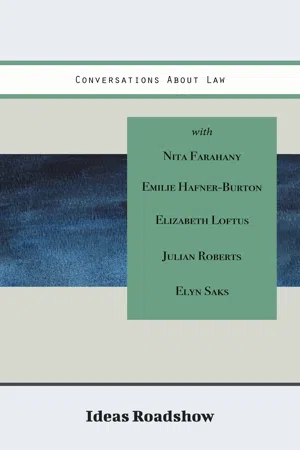
FIVE BOOKS IN ONE! This collection includes the following 5 complete Ideas Roadshow books featuring leading researchers providing fully accessible insights into cutting-edge academic research while revealing the inspirations and personal journeys behind the research. A detailed preface highlights the connections between the different books and all five books are broken into chapters with a detailed introduction and questions for discussion at the end of each chapter: 1. Neurolaw - A Conversation with Nita Farahany, Robert O. Everett Distinguished Professor of Law and Professor of Philosophy at Duke University. Nita Farahany is a leading scholar on the ethical, legal, and social implications of emerging technologies. This wide-ranging conversation examines the growing impact of modern neuroscience on the law, deepening our understanding of a wide range of issues, from legal responsibility to the American Constitution's Fifth Amendment privilege against self-incrimination.2. Improving Human Rights - A Conversation with Emilie Hafner-Burton, the John D. and Catherine T. MacArthur Professor of International Justice and Human Rights at UC San Diego. This extensive conversation covers a wide range of topics, including international law, when and why international laws work and don't work, the international human rights system and concrete measures that could be taken to improve it, the International Criminal Court, and the role of states in the protection of human rights.3. The Malleability of Memory - A Conversation with Elizabeth Loftus, a world-renowned expert on human memory and Distinguished Professor of Psychological Science; Criminology, Law, and Society; Cognitive Science and Law at UC Irvine. This in-depth conversation covers her ground-breaking work on the misinformation effect, false memories and her battles with "repressed memory" advocates, the introduction of expert memory testimony into legal proceedings and the effect of DNA evidence on convincing judges of the problematic nature of eyewitness testimony. 4. Criminal Justice: An Examination - A Conversation with Julian Roberts, Professor of Criminology at the University of Oxford. Julian Roberts is an international expert on sentencing throughout the common-law world and is strongly involved in connecting scholars with practitioners as well as promoting greater public understanding of sentencing. This thought-provoking conversation covers a wide range of topics related to criminal justice, including plea bargaining, the involvement of victims in criminal sentencing procedures, victim impact statements, parole, sentencing multiple and repeat crimes, community-based sentencing, alternate dispute resolution, rehabilitation, and more.5. Mental Health: Policies, Laws and Attitudes - A Conversation with Elyn Saks, Orrin B. Evans Distinguished Professor of Law, and Professor of Law, Psychology and Psychiatry and the Behavioral Sciences at USC. During this wide-ranging conversation Elyn Saks candidly shares her personal experiences with schizophrenia and discusses the intersection of law, mental health and ethics: the legal and ethical implications surrounding mental health. Further topics include psychotropic medication and the law, criminalization and mental illness, and an exploration of which countries are more progressive with respect to important mental health policies, laws and procedures, and more.Howard Burton is the founder and host of all Ideas Roadshow Conversations and was the Founding Executive Director of Perimeter Institute for Theoretical Physics. He holds a PhD in theoretical physics and an MA in philosophy.
- English
- ePUB (mobile friendly)
- Available on iOS & Android
eBook - ePub
Conversations About Law
About this book
Information
Subtopic
Law Theory & PracticeIndex
LawImproving Human Rights
A conversation with Emilie Hafner-Burton
Introduction
Making a Difference
To many observers, the ten core international human rights instruments and global monitoring bodies represent nothing less than a triumph of modern civilization: a rigorous, hard-fought, collection of moral norms and laws that rigorously apply to all peoples, independent of nationality, gender, ethnicity, religion, language or any other distinguishing characteristics.
It is hard not to be impressed by what has been accomplished and actively maintained by an extensive collection of diligent and dedicated international bodies, NGOs, and government agencies that make up the global human rights community.
But the key question is: does the system actually work? Are human rights really more protected on the ground now than they were twenty years ago? Are human rights abusers being punished, or at least significantly deterred from inflicting further harm?
That’s where it gets tricky.
Into this murky water boldly steps Emilie Hafner-Burton. Professor of International Justice and Human Rights at UC San Diego, she is nonetheless hardly mired in a detached ivory tower. After an enlightening stint at the United Nations Office at Geneva where she had an inside glimpse at how international policy was really developed, Emilie returned to pursue advanced degrees in political science, strongly motivated by the prospect of rigorously applying newly evolving social science techniques to concretely measure impact in these vital areas of human flourishing.
Twenty years later, as Co-director of UCSD’s Laboratory on International Law and Regulation, the passion burns brighter than ever as she enthusiastically marries her statistical expertise to get a better picture of what is actually happening on the ground:
“It’s astounding to think that we’ve invested, for almost 70 years now, in this system without really asking whether these institutions and these structures are working. Part of that has to do with the fact that it’s really hard to answer that question. You can do it with anecdotes, by cherry-picking examples of success and failure, and we’ve been doing that for 70 years. But that never gives you the full picture of what’s working and what isn’t.
“There’s been a transformation that has occurred in the social sciences over the last 15 years, where people have begun to move beyond interviews and select instances, instead collecting big data sets that will allow you to ask and answer that question a little bit more systematically: not just one particular example, but by looking at the experience of all countries over decades.”
So what has she found? Well, there has definitely been progress in some areas, but the plain truth is that we still have a very, very long way to go. Why?
“What the human rights system does so well is articulate a notion for human dignity that nobody can really argue with. We know now fundamentally what human rights are, and articulating and pursuing that, philosophically, is a very noble endeavour.
“The problem is that it’s not a guide for how you actually implement these norms. Every actor who participates in the implementation of the system has his own interests in some part of the system, and usually against other parts of the system.
“This is the inherent challenge of a system that presents us with these norms without clear indicators of how it is we’re actually going to get those norms to be taken up in practice. That means the process has to be political: it can’t be universal and it has to be divisible. We have to set priorities. We have to make choices. There’s no way to avoid that.”
Of course, once we start talking about the specifics of actually making hard choices, we’re immediately confronted with the question of who, exactly, is going to be making them. From Emilie’s perspective, a key, often-overlooked factor in the entire human rights dialogue concerns the role of individual states.
“The reality is that we have states that, for a variety of different reasons, are engaging in the promotion of human rights. They’re doing it unilaterally. They’re doing it in various forms of collectives. They’re using sanctions and military intervention. They’re using aid, trade, and diplomacy—a whole battery of tools. We want to take a step back and ask the same questions that we ask about the human rights institutions at the UN and the regional systems. Does any of this stuff actually work?”
Well, sometimes. Sometimes not so much. But the key question, as ever, is, how can we make it work better?
For Emilie, that key question naturally involves taking a brutally honest and pragmatic approach, planting one’s feet firmly on the ground and rigorously assessing the status quo. But she is also experienced to recognize that such a hard-nosed approach naturally creates tensions in a community where many people instinctively flinch from any compromise against the fundamental principle of universality.
“Many people don’t want to think about a joint role for law and power. The human rights system is universal. It’s global, and it’s supposed to be neutral. It’s not supposed to be an inherently political process. But that happens to be wrong, because it is inherently a political process.”
Focusing on states necessarily means looking at situations from the perspective of their particular interests, investigating how they might be convinced to take a position of “international stewardship” for the benefit of all, and recognizing that choices in human rights priorities— what she calls “triage”—is an inevitable part of our real world with its finite resources and conflicting interests. The good news for social scientists is that, properly focused, they can have an enormous positive impact in all of this.
“There’s a role for the social science community to play here, which I think is very important. That’s the call for triage: this reality that we have to stop pretending we don’t have to make these difficult choices.
“We’re already making these choices. We’re just doing it behind closed doors, we’re doing it in ad hoc ways, and we’re not always using the right metric.
“This also returns us to the notion that we should start the conversation, not with a specific tool—i.e. what law are we going to throw at the problem?—but with the incentive structures that are creating these behaviours in the first place. Because it’s impossible to do this type of analysis without looking at who the actors are, what they want, and why they’re doing what they’re doing.”
Through all her talk of incentives and compromise, realpolitik and pragmatism, Emilie’s idealism irrepressibly shines through.
“Can you imagine what would happen in the South American context if Brazil became a powerful advocate for human rights? That would have tremendously more impact in South America than anything the United States could ever do, given our history.
“Chile has already begun to do this, Costa Rica too. There are some examples of this emerging in these smaller countries. They have a tremendous potential to shape what happens with regard to human rights in the region.”
In order for genuine progress to be made, in other words, it’s not about systems at all: it’s all about the people. And the only thing that counts is whether or not, on the whole, their lives are actually improving.
The Conversation

I. Forging a Path
An unconventional route to the UN
HB: I’m going to start off by asking you about how you got into the field of human rights, but first I have a slightly different question prompted by reading about your personal history, which is, How on earth did you become a blacksmith?
EHB: Well, I’ll answer the blacksmith question first, and then I’ll tell you about human rights.
It was somewhat by ac...
Table of contents
- Textual Note
- Preface
- The Malleability of Memory
- Criminal Justice
- Mental Health
- Improving Human Rights
- Neurolaw
Trusted by 375,005 students
Access to over 1.5 million titles for a fair monthly price.
Study more efficiently using our study tools.
Frequently asked questions
Yes, you can cancel anytime from the Subscription tab in your account settings on the Perlego website. Your subscription will stay active until the end of your current billing period. Learn how to cancel your subscription
No, books cannot be downloaded as external files, such as PDFs, for use outside of Perlego. However, you can download books within the Perlego app for offline reading on mobile or tablet. Learn how to download books offline
Perlego offers two plans: Essential and Complete
- Essential is ideal for learners and professionals who enjoy exploring a wide range of subjects. Access the Essential Library with 800,000+ trusted titles and best-sellers across business, personal growth, and the humanities. Includes unlimited reading time and Standard Read Aloud voice.
- Complete: Perfect for advanced learners and researchers needing full, unrestricted access. Unlock 1.5M+ books across hundreds of subjects, including academic and specialized titles. The Complete Plan also includes advanced features like Premium Read Aloud and Research Assistant.
We are an online textbook subscription service, where you can get access to an entire online library for less than the price of a single book per month. With over 1.5 million books across 990+ topics, we’ve got you covered! Learn about our mission
Look out for the read-aloud symbol on your next book to see if you can listen to it. The read-aloud tool reads text aloud for you, highlighting the text as it is being read. You can pause it, speed it up and slow it down. Learn more about Read Aloud
Yes! You can use the Perlego app on both iOS and Android devices to read anytime, anywhere — even offline. Perfect for commutes or when you’re on the go.
Please note we cannot support devices running on iOS 13 and Android 7 or earlier. Learn more about using the app
Please note we cannot support devices running on iOS 13 and Android 7 or earlier. Learn more about using the app
Yes, you can access Conversations About Law by Howard Burton in PDF and/or ePUB format, as well as other popular books in Law & Law Theory & Practice. We have over 1.5 million books available in our catalogue for you to explore.