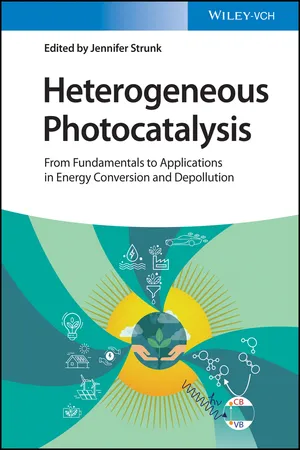
Heterogeneous Photocatalysis
eBook - ePub

Heterogeneous Photocatalysis

From Fundamentals to Applications in Energy Conversion and Depollution

  1. English
  2. ePUB (mobile friendly)
  3. Available on iOS & Android
eBook - ePub

Heterogeneous Photocatalysis

From Fundamentals to Applications in Energy Conversion and Depollution

About this book

Discover the latest research in photocatalysis combined with foundational topics in basic physical and chemical photocatalytic processes

In Heterogeneous Photocatalysis: From Fundamentals to Applications in Energy Conversion and Depollution, distinguished researcher and editor Jennifer Strunk delivers a rigorous discussion of the two main topics in her field—energy conversion and depollution reactions. The book covers topics like water splitting, CO2 reduction, NOx abatement and harmful organics degradation.

In addition to the latest research on these topics, the reference provides readers with fundamental information about elementary physical and chemical processes in photocatalysis that are extremely practical in this interdisciplinary field. It offers an excellent overview of modern heterogeneous photocatalysis and combines concepts from different viewpoints to allow researchers with backgrounds as varied as electrochemistry, material science, and semiconductor physics to begin developing solutions with photocatalysis.

In addition to subjects like metal-free photocatalysts and photocarrier loss pathways in metal oxide absorber materials for photocatalysis explored with time-resolved spectroscopy, readers will also benefit from the inclusion of:

  • Thorough introductions to kinetic and thermodynamic considerations for photocatalyst design and the logic, concepts, and methods of the design of reliable studies on photocatalysis
  • Detailed explorations of in-situ spectroscopy for mechanistic studies in semiconductor photocatalysis and the principles and limitations of photoelectrochemical fuel generation
  • Discussions of photocatalysis, including the heterogeneous catalysis perspective and insights into photocatalysis from computational chemistry
  • Treatments of selected aspects of photoreactor engineering and defects in photocatalysis

Perfect for photochemists, physical and catalytic chemists, electrochemists, and materials scientists, Heterogeneous Photocatalysis will also earn a place in the libraries of surface physicists and environmental chemists seeking up-to-date information about energy conversion and depollution reactions.

Trusted by 375,005 students

Access to over 1.5 million titles for a fair monthly price.

Study more efficiently using our study tools.

Information

Publisher
Wiley-VCH
Year
2021
Print ISBN
9783527344642
eBook ISBN
9783527815265
Edition
1
Subtopic
Biochemistry

1
Kinetic and Thermodynamic Considerations for Photocatalyst Design

Frank E. Osterloh
University of California, Department of Chemistry, One Shields Avenue, Davis, CA, 95616, USA

1.1 Introduction

Photochemical processes play a central role on Earth. While natural photosynthesis powers our biosphere and economic growth (through the use of photosynthesis-derived fossil fuels), additional photochemical processes are involved in shaping the “photogeochemistry” of our planet [1]. Light reactions play a role in the creation and function of the ozone ultraviolet (UV) filter in the atmosphere, the degradation of plant materials, man-made chemicals and plastics, and even in the chemical conversion of Earth-abundant minerals.
The potential of photochemical processes for technical applications was first demonstrated by A.E. Becquerel in 1839 when he discovered the photovoltaic effect. Interestingly, it took over a century before this knowledge was applied to practical photovoltaic cells [2]. In 1968, Gerischer's discovery of the dye sensitization effect at illuminated semiconductor surfaces [3] paved the way for Grätzel's construction of the first dye-sensitized photovoltaic cell 1991 [3] and also inspired for the production of hydrogen fuel from illuminated TiO2 photoanodes [4, 5].
Since then, the interest in photochemical reactions for environmental remediation [6–10] and for the production of sustainable fuels has gained steadily [11–17]. In 2018, over 6000 articles were published with the term photocatalytic or photocatalyst in the title. This is about 60 times as many as published on this topic in 1991 when Grätzel's dye-sensitized solar cells made headlines. In contrast, the number of papers published on photosynthesis has been relatively steady in the past three decades, with approximately 1000 publications per year.
In the science community, photochemical reaction systems are typically referred to as “photocatalysts,” or as “photosynthetic systems” or sometimes as devices for “artificial photosynthesis.” Interestingly, there is no strong differentiation between these terms. For example, the International Union of Pure and Applied Chemistry (IUPAC) defines a “photocatalyst” as a “Catalyst able to produce, upon absorption of light, chemical transformations of the reaction partners. The excited state of the photocatalyst repeatedly interacts with the reaction partners forming reaction intermediates and regenerates itself after each cycle of such interactions.” [18] This definition makes no distinction between reactions that deposit photochemical energy in the products and reactions that do not.
According to Nozik [19] and Bard [20], excitonic reactions can be divided into photosynthetic and photocatalytic processes, depending on the thermodynamics of the associated reaction: [21].
“Photoelectrolytic cells … can be classified as photosynthetic or photocatalytic. In the former case, radiant energy provides a Gibbs energy to drive a reaction such as H2O + H2 + ½ O2, and electrical or thermal energy may be later recovered by allowing the reverse, spontaneous reaction to proceed. In a photocatalytic cell the photon absorption promotes a reaction with ΔG < 0 so there is no net storage of chemical energy, but the radiant energy speeds up a slow reaction.” [22]
As we will show here, this distinction between photocatalytic and photosynthetic devices becomes very significant to the understanding of their function and also to their optimization. An overview of the fundamental processes in photochemical reaction systems is presented in the following sections.

1.2 Mechanistic Aspects of Photochemical Reaction Systems

Photochemical (excitonic) reaction systems generally rely on the creation and transfer of charge carriers to induce the transformation of reagents in the vicinity of the light absorber. Usually, the process begins with the absorption of one or several photons (step 1), as shown in Figure 1.1a. This generates photoelectrons and holes, which s...

Table of contents

  1. Cover
  2. Table of Contents
  3. Title Page
  4. Copyright
  5. Preface
  6. 1 Kinetic and Thermodynamic Considerations for Photocatalyst Design
  7. 2 Design of Reliable Studies on Photocatalysis: Logic, Concepts, and Methods
  8. 3 In Situ Spectroscopy for Mechanistic Studies in Semiconductor Photocatalysis
  9. 4 Principles and Limitations of Photoelectrochemical Fuel Generation
  10. 5 Photocatalysis – The Heterogeneous Catalysis Perspective
  11. 6 Insights into Photocatalysis from Computational Chemistry
  12. 7 Selected Aspects of Photoreactor Engineering
  13. 8 Defects in Photocatalysis
  14. 9 Photocarrier Loss Pathways in Metal Oxide Absorber Materials for Photocatalysis Explored with Time-Resolved Spectroscopy: The Case of BiVO4
  15. 10 Metal-free Photocatalysts
  16. 11 Photocatalytic Water Splitting: Fundamentals and Current Concepts
  17. 12 Photocatalytic CO2 Reduction and Beyond
  18. 13 Photocatalytic NOx Abatement
  19. 14 Photoactive Nanomaterials: Applications in Wastewater Treatment and Their Environmental Fate
  20. Index
  21. End User License Agreement

Frequently asked questions

Yes, you can cancel anytime from the Subscription tab in your account settings on the Perlego website. Your subscription will stay active until the end of your current billing period. Learn how to cancel your subscription
No, books cannot be downloaded as external files, such as PDFs, for use outside of Perlego. However, you can download books within the Perlego app for offline reading on mobile or tablet. Learn how to download books offline
Perlego offers two plans: Essential and Complete
  • Essential is ideal for learners and professionals who enjoy exploring a wide range of subjects. Access the Essential Library with 800,000+ trusted titles and best-sellers across business, personal growth, and the humanities. Includes unlimited reading time and Standard Read Aloud voice.
  • Complete: Perfect for advanced learners and researchers needing full, unrestricted access. Unlock 1.5M+ books across hundreds of subjects, including academic and specialized titles. The Complete Plan also includes advanced features like Premium Read Aloud and Research Assistant.
Both plans are available with monthly, semester, or annual billing cycles.
We are an online textbook subscription service, where you can get access to an entire online library for less than the price of a single book per month. With over 1.5 million books across 990+ topics, we’ve got you covered! Learn about our mission
Look out for the read-aloud symbol on your next book to see if you can listen to it. The read-aloud tool reads text aloud for you, highlighting the text as it is being read. You can pause it, speed it up and slow it down. Learn more about Read Aloud
Yes! You can use the Perlego app on both iOS and Android devices to read anytime, anywhere — even offline. Perfect for commutes or when you’re on the go.
Please note we cannot support devices running on iOS 13 and Android 7 or earlier. Learn more about using the app
Yes, you can access Heterogeneous Photocatalysis by Jennifer Strunk in PDF and/or ePUB format, as well as other popular books in Physical Sciences & Biochemistry. We have over 1.5 million books available in our catalogue for you to explore.