Digital System Design using FSMs
eBook - ePub

Digital System Design using FSMs

A Practical Learning Approach

  1. English
  2. ePUB (mobile friendly)
  3. Available on iOS & Android
eBook - ePub

Digital System Design using FSMs

A Practical Learning Approach

About this book

DIGITAL SYSTEM DESIGN USING FSMS

Explore this concise guide perfect for digital designers and students of electronic engineering who work in or study embedded systems

Digital System Design using FSMs: A Practical Learning Approach delivers a thorough update on the author's earlier work, FSM-Based Digital Design using Verilog HDL. The new book retains the foundational content from the first book while including refreshed content to cover the design of Finite State Machines delivered in a linear programmed learning format. The author describes a different form of State Machines based on ToggleFlip Flops and Data Flip Flops.

The book includes many figures of which 15 are Verilog HDL simulations that readers can use to test out the design methods described in the book, as well as 19 Logisim simulation files with figures. Additional circuits are also contained within the Wiley web folder. It has tutorials and exercises, including comprehensive coverage of real-world examples demonstrated alongside the frame-by-frame presentations of the techniques used.

In addition to covering the necessary Boolean algebra in sufficient detail for the reader to implement the FSM based systems used in the book, readers will also benefit from the inclusion of:

  • A thorough introduction to finite-state machines and state diagrams for the design of electronic circuits and systems
  • An exploration of using state diagrams to control external hardware subsystems
  • Discussions of synthesizing hardware from a state diagram, synchronous and asynchronous finite-state machine designs, and testing finite-state machines using a test-bench module
  • A treatment of the One Hot Technique in finite-state machine design
  • An examination of Verilog HDL, including its elements
  • An analysis of Petri-Nets including both sequential and parallel system design

Suitable for design engineers and senior technicians seeking to enhance their skills in developing digital systems, Digital System Design using FSMs: A Practical Learning Approach will also earn a place in the libraries of undergraduate and graduate electrical and electronic engineering students and researchers.
Frequently asked questions

Yes, you can cancel anytime from the Subscription tab in your account settings on the Perlego website. Your subscription will stay active until the end of your current billing period. Learn how to cancel your subscription.
No, books cannot be downloaded as external files, such as PDFs, for use outside of Perlego. However, you can download books within the Perlego app for offline reading on mobile or tablet. Learn more here.
Perlego offers two plans: Essential and Complete
  • Essential is ideal for learners and professionals who enjoy exploring a wide range of subjects. Access the Essential Library with 800,000+ trusted titles and best-sellers across business, personal growth, and the humanities. Includes unlimited reading time and Standard Read Aloud voice.
  • Complete: Perfect for advanced learners and researchers needing full, unrestricted access. Unlock 1.4M+ books across hundreds of subjects, including academic and specialized titles. The Complete Plan also includes advanced features like Premium Read Aloud and Research Assistant.
Both plans are available with monthly, semester, or annual billing cycles.
We are an online textbook subscription service, where you can get access to an entire online library for less than the price of a single book per month. With over 1 million books across 1000+ topics, we’ve got you covered! Learn more here.
Look out for the read-aloud symbol on your next book to see if you can listen to it. The read-aloud tool reads text aloud for you, highlighting the text as it is being read. You can pause it, speed it up and slow it down. Learn more here.
Yes! You can use the Perlego app on both iOS or Android devices to read anytime, anywhere — even offline. Perfect for commutes or when you’re on the go.
Please note we cannot support devices running on iOS 13 and Android 7 or earlier. Learn more about using the app.
Yes, you can access Digital System Design using FSMs by Peter D. Minns in PDF and/or ePUB format, as well as other popular books in Tecnologia e ingegneria & Hardware. We have over one million books available in our catalogue for you to explore.

Information

Publisher
Wiley
Year
2021
Print ISBN
9781119782704
eBook ISBN
9781119782728

1
Introduction to Finite State Machines

This chapter (like all other chapters) is written in the form of a linear frame, programmed learning text. This is to help you learn the basic skills required to design clocked finite state machines (FMSs) so that you can develop your own designs based on traditional T flip‐flops and D flip‐flops. Later, other techniques will be introduced, such as ā€˜one hot’ and ā€˜asynchronous finite state machines’, but these will be developed along the same lines as the work covered in this chapter.
The text is organized into ā€˜frames’. Each frame follows on consecutively from the previous one, but at times you may be redirected to other frames, depending upon your response to the questions you are asked. Do not cheat, but follow the frames as indicated.

1.1 SOME NOTES ON STYLE

Bold denotes questions for you to answer to check your understanding of the material, highlights important points, or indicates an aside when further ideas are presented.
Please read this chapter first, and attempt all the questions before moving on to the later chapters. Note that the book can be read as a textbook. The programmed aspect of the book makes it more suitable for individuals to read and learn in their own time.

Frame 1.1 What is a Finite State Machine?

A finite state machine (FSM) is a digital sequential circuit that can follow a number of predefined states under the control of one or more inputs. Each state is a stable entity that the machine can occupy. It can move from this state to another state under the control of an outside world input.
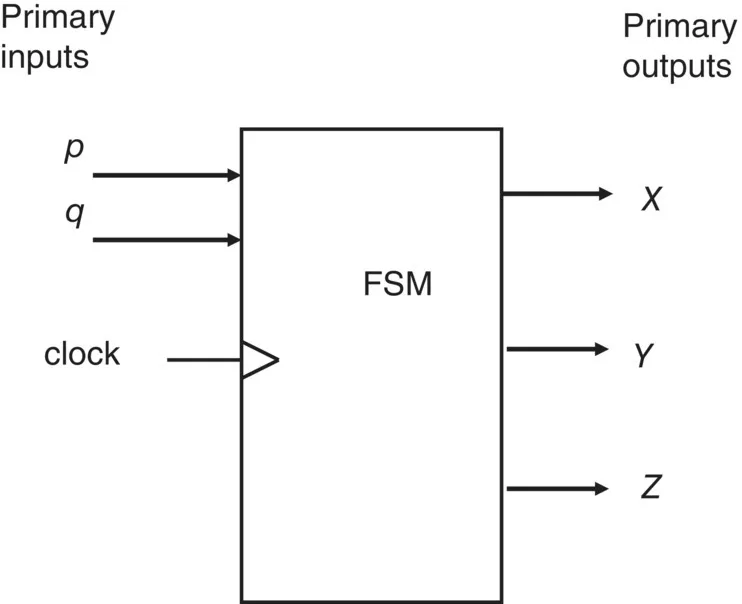
Schematic illustration of a block diagram of an FSM-based application.
Figure 1.1 Block diagram of an FSM‐based application.
In Figure 1.1, we see an FSM with three outside world inputs (p, q, and the clock) and three outside world outputs (X, Y, and Z). Note some FSMs have a clock input; those that don’t belong to a type of FSM called ā€˜asynchronous FSM’. However, this chapter deals with the more usual synchronous FSM, which do have a clock input. Only Chapter 4 and Chapter 6 will look at asynchronous FSM.
Synchronous FSM can move between states only if a clock pulse occurs.
Task:Draw a block diagram for an FSM with five inputs (x, y, z, t, and a clock) and with two outputs (P and Q)...

Table of contents

  1. Cover
  2. Table of Contents
  3. Title Page
  4. Copyright Page
  5. Preface
  6. Acknowledgements
  7. About the Companion Website
  8. Guide to Supplementary Resources
  9. 1 Introduction to Finite State Machines
  10. 2 Using FSMs to Control External Devices
  11. 3 Introduction to FSM Synthesis
  12. 4 Asynchronous FSM Methods
  13. 5 Clocked One Hot Method of FSM Design
  14. 6 Further Event‐Driven FSM Design
  15. 7 Petri Net FSM Design
  16. Appendix A1: Boolean Algebra
  17. Appendix A2: Use of Verilog HDL and Logisim to FSM
  18. Appendix A3: Counters, Shift Registers, Input, and Output with an FSM
  19. Appendix A4: Finite State Machines Using Verilog Behavioural Mode
  20. Appendix A5: Programming a Finite State Machine
  21. Appendix A6: The Rotational Detector Using Logisim Simulator with Sub‐Circuits
  22. Bibliography
  23. Index
  24. End User License Agreement