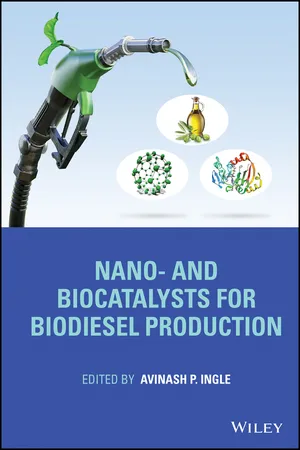
Nano- and Biocatalysts for Biodiesel Production
eBook - ePub

Nano- and Biocatalysts for Biodiesel Production

  1. English
  2. ePUB (mobile friendly)
  3. Available on iOS & Android
eBook - ePub

Nano- and Biocatalysts for Biodiesel Production

About this book

Reviews recent advances in catalytic biodiesel synthesis, highlighting various nanocatalysts and nano(bio)catalysts developed for effective biodiesel production

Nano- and Biocatalysts for Biodiesel Production delivers an essential reference for academic and industrial researchers in biomass valorization and biofuel industries. The book covers both nanocatalysts and biocatalysts, bridging the gap between homogenous and heterogenous catalysis.

Readers will learn about the techno-economical and environmental aspects of biodiesel production using different feedstocks and catalysts. They will also discover how nano(bio)catalysts can be used as effective alternatives to conventional catalysts in biodiesel production due to their unique properties, including reusability, high activation energy and rate of reaction, easy recovery, and recyclability.

Readers will benefit from the inclusion of:

  • Introductions to CaO nanocatalysts, zeolite nanocatalysts, titanium dioxide-based nanocatalysts and zinc-based in biodiesel production
  • An exploration of carbon-based heterogeneous nanocatalysts for the production of biodiesel
  • Practical discussions of bio-based nano catalysts for biodiesel production and the application of nanoporous materials as heterogeneous catalysts for biodiesel production
  • An analysis of the techno-economical considerations of biodiesel production using different feedstocks

Nano- and Biocatalysts for Biodiesel Production focuses on recent advances in the field and offers a complete and informative guide for academic researchers and industrial scientists working in the fields of biofuels and bioenergy, catalysis, biotechnology, bioengineering, nanotechnology, and materials science.

Trusted by 375,005 students

Access to over 1.5 million titles for a fair monthly price.

Study more efficiently using our study tools.

Information

Publisher
Wiley
Year
2021
Print ISBN
9781119730002
eBook ISBN
9781119730033

1
Biodiesel: Different Feedstocks, Conventional Methods, and Factors Affecting its Production

Hossein Esmaeili1 and Sajad Tamjidi2
1Department of Chemical Engineering, Bushehr Branch, Islamic Azad University, Bushehr, Iran
2Department of Chemical Engineering, Shiraz Branch, Islamic Azad University, Shiraz, Iran

1.1 Introduction

Fossil fuels are a non‐renewable source of energy whose reserves are limited, and they take millions of years to develop (Banković–Ilić et al. 2014). The widespread use of petroleum derivatives in recent decades has led to energy crisis, global climate change, environmental pollution, and many medical problems, such as cardiovascular diseases and cancers (Dhiraj and Mangesh 2012). Collectively, all these concerns, along with others like global warming and greenhouse gas emissions, have spurred the search for alternative fuels (e.g., biohydrogen, biodiesel, bioethanol, biomethanol, biogas, natural gas, and bioelectricity) that have relatively less adverse impacts on and greater compatibility with the environment (Demirbas 2004; Nascimento et al. 2011; Fahd et al. 2014). According to a report presented by the International Energy Agency (IEA), by 2035, world energy consumption will increase by 33% (International Energy Agency 2013), and it is anticipated that 40% of the growth will come from renewable sources. Among the renewable energies, biodiesel has recently experienced significant developments thanks to its outstanding advantages, including higher cetane number (CN), nontoxicity, and higher flashpoint compared with fossil fuels (Liu et al. 2010; Hasheminejad et al. 2011). Biodiesel is a biofuel with properties closely mimicking those of diesel, but without unfavorable contents such as nitrogen, sulfur, and polycyclic aromatics. This renewable biofuel is a mono‐alkyl esters of long‐chain fatty acids that is produced from vegetable oil, waste edible oil (WEO), waste cooking oil (WCO), waste non‐edible oil, animal fats, and microorganisms such as algae, fungi, and bacteria (Kralova and Sjoblom 2010; Nabi and Hoque 2008).
There are four primary methods of biodiesel production: blending, microemulsion, thermal cracking (pyrolysis), and transesterification. Among these, the transesterification reaction is the most commonly used for the conversion of oils into biodiesel, because the fuel produced by this method has been found to be highly compatible with conventional diesel engines. Direct use of the vegetable oil‐derived biodiesel damages such engines due to the high viscosity of the oil (Ramli et al. 2017). The most common short‐chain alcohols used for this purpose include methanol and ethanol; thanks to its lower price, methanol is the economic alcohol...

Table of contents

  1. Cover
  2. Table of Contents
  3. Title Page
  4. Copyright
  5. Preface
  6. List of Contributors
  7. 1 Biodiesel: Different Feedstocks, Conventional Methods, and Factors Affecting its Production
  8. 2 Nano(Bio)Catalysts: An Effective Tool to Utilize Waste Cooking Oil for the Biodiesel Production
  9. 3 A Review on the Use of Bio/Nanostructured Heterogeneous Catalysts in Biodiesel Production
  10. 4 Calcium‐Based Nanocatalysts in Biodiesel Production
  11. 5 Titanium Dioxide‐Based Nanocatalysts in Biodiesel Production
  12. 6 Zinc‐Based Nanocatalysts in Biodiesel Production
  13. 7 Carbon‐Based Nanocatalysts in Biodiesel Production
  14. 8 Functionalized Magnetic Nanocatalysts in Biodiesel Production
  15. 9 Bio‐Based Catalysts in Biodiesel Production
  16. 10 Heterogeneous Nanocatalytic Conversion of Waste to Biodiesel
  17. 11 Application of Rare Earth Cation‐Exchanged Nanozeolite as a Support for the Immobilization of Fungal Lipase and their Use in Biodiesel Production
  18. 12 Lipase‐Immobilized Magnetic Nanoparticles: Promising Nanobiocatalysts for Biodiesel Production
  19. 13 Technoeconomic Analysis of Biodiesel Production Using Different Feedstocks
  20. Index
  21. End User License Agreement

Frequently asked questions

Yes, you can cancel anytime from the Subscription tab in your account settings on the Perlego website. Your subscription will stay active until the end of your current billing period. Learn how to cancel your subscription
No, books cannot be downloaded as external files, such as PDFs, for use outside of Perlego. However, you can download books within the Perlego app for offline reading on mobile or tablet. Learn how to download books offline
We are an online textbook subscription service, where you can get access to an entire online library for less than the price of a single book per month. With over 1.5 million books across 990+ topics, we’ve got you covered! Learn about our mission
Look out for the read-aloud symbol on your next book to see if you can listen to it. The read-aloud tool reads text aloud for you, highlighting the text as it is being read. You can pause it, speed it up and slow it down. Learn more about Read Aloud
Yes! You can use the Perlego app on both iOS and Android devices to read anytime, anywhere — even offline. Perfect for commutes or when you’re on the go.
Please note we cannot support devices running on iOS 13 and Android 7 or earlier. Learn more about using the app
Yes, you can access Nano- and Biocatalysts for Biodiesel Production by Avinash P. Ingle in PDF and/or ePUB format, as well as other popular books in Tecnologia e ingegneria & Scienza dei materiali. We have over 1.5 million books available in our catalogue for you to explore.