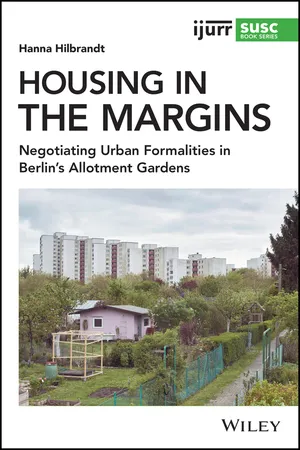
Housing in the Margins offers a theoretically informed and empirically detailed exploration of unruly housing practices and their governance at the periphery of Berlin.
An original empirical contribution to understanding housing precarity in the context of the German housing crisis
A novel approach to theorizing the nexus of informality and the state in ways that bridge analytical divides between debates about Northern and Southern states
An innovative account of urban development in Berlin that contributes to the limited discussions of urban informality in Euro-American cities
A theoretical understanding of the ways in which negotiations and transgressions are embedded in the making of urban order
A historically informed narrative of the development of allotment gardens in Berlin with a particular focus on housing practices at these sites
Chapter 1 Introduction Housing in the Entanglements of Formality, Informality, and the State
Taking the train from Schönefeld airport, a visitor to Berlin rides through a vast area of urban allotments.1 Still on the periphery, the train follows the East–West divide that long defined the city, if not much of the world. Straight ahead, at a distance, a passenger can spot the tip of the Berlin TV Tower – the symbol of former East Berlin that marks today’s city center. Green garden plots, seemingly endless along both sides of the tracks, are cluttered with small and colorful allotment huts [Lauben].2 I have been asked if these sites are the “slums” of Berlin – or if people live in these huts. Certainly, from a distance, their spatial and social order is difficult to grasp.
This book delves into the everyday governance of housing at these sites. More particularly, it explores the gardeners’ scattered, unruly, and precarious dwelling practices as well as the multifaceted and frequently contradictory efforts to regulate them. It examines these negotiations with an interest in learning about the mechanisms through which room for maneuver is gained and constrained in the everyday (re)production of urban order and the exclusions these processes entail.
One way of approaching this task is by framing the practices under examination through the notion of informality. Since the 1970s, researchers have used this concept to describe the unauthorized construction and inhabitation of urban space, particularly in Africa, Asia, and Latin America (ILO, 1972; Hart, 1973; Hann and Hart, 2011). These themes remain, as Tonkiss writes, “a major plot-line in the story of contemporary urbanization” (2012: 55), although today, critical scholarship employs the notion of informality to consider the ambiguities of state regulation, rather than the phenomena that lie beyond the oversight of state institutions (Roy, 2009a; McFarlane, 2012). In this critical understanding, the concept provides a starting point for describing the scene above through the incoherencies of state and urban governance in regulating housing at these sites.
Another way of approaching the theme of this book is by exploring the enactment of rules in everyday practices of regulatory enforcement. Dwelling in Berlin’s allotment gardens breaches the rules of the law, but it is also marked by other forms of intense regulation. Rather than being characterized through spontaneity, the construction of allotment huts is embedded in long-standing traditions of city life. Sheds transgress building codes but are organized strictly on clearly fenced plots. Although buildings are erected without permits, they are systematically serviced with water and electricity. Their residents exceed use rights, but they comply elsewhere with registration commitments. A closer look at the housing situation in the gardens provides insights into the ways in which transgressions are accommodated in the “formal” production of urban order and thereby also points out the institutional ambiguities on which allotment dwelling frequently depends.
Housing in the Margins relates these two approaches and argues that this matters because it accounts for housing and urban governance in a Western liberal democracy in ways that challenge some of the epistemological assumptions that have long been engrained in research on cities. With informal housing playing hardly more than a marginal role in scholarship on European, Canadian, or US cities, an exploration of how allotment dwelling is negotiated in Berlin troubles the North–South divisions that underlie much production of knowledge on urban informality and raises questions about the particularity of local experiences and the universality of concepts, including that of informality. I pursue this project with empirical and theoretical objectives: studying empirically how Berliners negotiate ways of staying put in allotment gardens and how boundaries around their dwelling practices are drawn, I aim at understanding the production and governance of housing precarity in a relatively rich European city. In theorizing these processes of governance, I seek to unveil the possibilities of conceptualizing informal housing in the context of bureaucracies that are commonly understood to regulate thoroughly, coherently, and according to fixed rules.
In the Margins: Allotment Dwelling in Berlin
An abundance of research has documented the history of allotment gardens, but it has rarely associated these sites with informal housing. Most of Berlin’s allotment compounds (see Figure 1.1) go back to a period of industrialization and rapid expansion of the city at the turn of the twentieth century. They are frequently referred to as colonies – a term that I adopt and contextualize in Chapter 3. As that chapter also details in depth, Berlin has witnessed more than a century of allotment governance in which dwelling on one’s plot was variably forbidden and politically sustained. The dwelling practices that persisted throughout two wars, rival political systems, and the increasingly profit-driven use of urban land have left their vestiges in the contemporary city: today’s landscape of allotment colonies, 876 compounds with 71,071 garden plots on 2,915 hectares of urban space (SenUVK, 2019: 24), is served by an infrastructure of mini-scale allotment huts, electricity networks, water hook-ups, and telephone lines (Urban, 2013; Hilbrandt, 2015).
FIGURE 1.1 View of allotment colony in Berlin-Neukölln. Source: Michael Berger.
By and large, allotment gardens can be characterized as spaces of the lower middle class, though over-proportionally white. Most gardeners are of an older generation that has fostered social networks between allotment holders who have gardened, plot by plot, over decades (SenSW, 2019: 32). Despite repeated exceptions with far-reaching consequences for the acceptability of dwelling, permanent residence on these sites is generally prohibited – today most centrally through the Federal Allotment Law, the Bundeskleingartengesetz (BKleinG). Yet, allotment holders rely on a variety of regulations as they take up residence within allotment huts. To avoid any misunderstandings, it should be stated that allotment dwelling is not a mass phenomenon. In addition to 1,131 gardeners who hold dwelling permits (documentation of the Berlin Senate, provided in an interview, 18.09.2013), an unknown number of Berliners with other legal statuses permanently reside in colonies, particularly in those that have functioning infrastructures throughout the year, including electricity connections and water pumps. Schwarzwohnen [literally: “black” (here signifying clandestine and unlawful) dwelling] remains the exception,3 although my research has taught me to expect at least one or two permanent dwellers in each colony and higher numbers in some of the colonies at the periphery of the city. Conversely, Sommerwohnen [summer dwelling] is a rather frequent practice. It implies moving “out” into the colonies in early spring and returning “back” into the city in late autumn, and possibly subletting one’s flat during the stay on the plot, or inhabiting a hut throughout longer vacations, or routinely spending the night.
In the diversity of these practices, the case of allotment dwelling widens understandings of housing precarity in a European city. In contradistinction to studies of homelessness (Mitchell, 1995; Marquardt, 2013), camps (Clough Marinaro, 2017; Pasquetti and Picker, 2017; Picker, 2019), emergency shelter, or some of the work on informal settlements in Asia, Latin America, and Africa, allotment dwelling does not limit the study of housing precarity to an exploration of severe urban poverty. Berlin’s allotments – even if some may be inhabited – are commonly seen as orderly and tradition-bound. It is to a lesser extent that allotment gardens also provide refuge for the income-poor – people scraping by on unemployment benefits, or migrant laborers, or pensioners with limited means, for example. Yet the case of allotment dwelling also speaks to growing social divides in which those at the bottom of the income ladder are additionally disempowered through the tensions in European housing markets and their spatial and social effects.
Over the years in which I researched and wrote this book, investment-led policy, housing privatization, and the financialization of real estate have crucially changed Berlin’s housing conditions. In the aftermath of the 2007/2008 financial crisis, processes of displacement and the associated deepening of social divides have increasingly appeared to be the order of the day (Aalbers and Holm, 2008; Bernt, 2012; Soederberg, 2017). As a result, Berlin has experienced a resurgence of interest in the “new” housing question (Schönig et al., 2017; PROKLA, 2018). A plethora of urban scholarship (e.g. Holm, 2011; Uffer, 2014) has drawn into sharp relief that Berlin’s housing crisis has been politically caused through neoliberal approaches to housing provisioning and the resultant reductions of social housing and rent increases in all market segments; that it is structurally determined through the global financial crisis that moved Berlin’s housing stock into the spotlight of capital flows; and that the crisis has been aggravated through the population growth of the city (Investitionsbank Berlin, 2017).
As I argue in Chapter 4, literatures explaining the resulting processes of gentrification and displacement focus predominantly on the political interventions that allow for or hinder gentrification, or on areas that experience gentrification and displacement (Holm, 2010; Schipper, 2018). This includes qualitative attention to incoming middle- to high-income pioneers and gentrifiers or quantitative explorations of population mobility incidences and rent increases to identify affected areas (e.g. Döring and Ulbricht, 2016). Yet, the debate remains limited in providing an understanding of the affected populations, their housing trajectories, and new forms and locations of residency – in part due to the difficulties of locating displaced residents (although see Helbrecht, 2016). The scarcity of literature on displaced populations is indicative of the lacuna of qualitative studies on housing precarity – including on the many faces of housing practices in irregular conditions. To date, informal housing is hardly recognized as existing in Berlin or in other European, Canadian, or US cities and rarely researched in relation to processes of governance (but see Chapter 4 for a discussion of existing research). Thus, to develop a more complete understanding of housing exclusion, to grasp the practiced relations formal and informal housing have to one another, and to challenge the “intellectual segregation” between these extensive but still largely disparate debates, my discussion of allotment dwelling joins up three strands of work: a global literature on informal housing, the contemporary German housing debate, and more specific and partly historical accounts of urban allotments.
To be sure, my aim is not to establish a direct causal relation between the tightening of housing markets and informal housing practices in Berlin’s allotments. Rather, the book approaches questions of the housing crisis “sideways,” as Jackson (2015: 3) puts it, through examining one of the “back ends” of the housing crisis – temporary or permanent residency in sites not deemed appropriate for dwelling. This includes discussion of people’s lived realities, strategies of staying put, and interim solutions; for instance, when people lessen their rent burden by moving into their allotments over the summer and subletting their apartments during that time. In particular, Chapter 4 offers a rich empirical account of how and why gardeners take up residence within allotment huts. On the one hand, it illustrates the entanglement of formal and informal housing in the dwelling biographies of the allotment’s residents. On the other hand, it explores how residents experience their housing conditions in widely varying ways.
This perspective promises two conceptual contributions to understandings of housing precarity. First, allotment dwelling constitutes an object of inquiry through which questions of governance can be explored through processes of negotiation in which informality tends to be tolerated and sustained. Although I also discuss instances of evictions, allotment dwelling allows examining the normalcy of governance arrangements in which rule-breaking is mostly accommodated by all concerned. Instead of top-down regulation by a heavy-handed state, the case of allotment dwelling permits us to understand how such compromises are collectively secured. Second, and conversely, I maintain that a focus on understanding small-scale negotiation also fosters an understanding of registers of exclusion and boundary work that often remain uncovered in structural accounts of informality and the state. This includes discussion of how ethnic discrimination, self-regulation, and other boundary mechanisms undergird the compromises I previously discussed.
Negotiating Formalities: Postcolonial Urbanism, Informality, and the State
Beyond empirical questions about housing precarity, this book wrestles with the theoretical implications of allotment dwelling and its regulation for an understanding of informality in cities that are commonly understood to regulate thoroughly, coherently, and according to fixed rules. For decades, scholars have argued that informality was a “pr...
Table of contents
Cover
Series Page
Title Page
Copyright
Table of Contents
List of Illustrations
Series Editors’ Preface
Acknowledgements
1. Introduction: Housing in the Entanglements of Formality, Informality, and the State
2. Negotiating Formalities: Informality and the Everyday State
3. Footnotes on the History of Housing: Allotment Dwelling in Berlin, 1871–2019
4. Housing in the Margins: Halfway Between Exclusion and Homeownership
5. The Colony and the Turf: Planning and the Politics of Land Use Change
6. Constellations of Consent: Navigating the Politics of Regulatory Enforcement
7. Working the Legal Threshold: Regulation, Translation, and Boundary Work
8. Conclusion: The “Gallic Village”
Glossary of German Terms
References
Index
End User License Agreement
Trusted by 375,005 students
Access to over 1.5 million titles for a fair monthly price.
Study more efficiently using our study tools.
Frequently asked questions
Yes, you can cancel anytime from the Subscription tab in your account settings on the Perlego website. Your subscription will stay active until the end of your current billing period. Learn how to cancel your subscription
No, books cannot be downloaded as external files, such as PDFs, for use outside of Perlego. However, you can download books within the Perlego app for offline reading on mobile or tablet. Learn how to download books offline
Perlego offers two plans: Essential and Complete
Essential is ideal for learners and professionals who enjoy exploring a wide range of subjects. Access the Essential Library with 800,000+ trusted titles and best-sellers across business, personal growth, and the humanities. Includes unlimited reading time and Standard Read Aloud voice.
Complete: Perfect for advanced learners and researchers needing full, unrestricted access. Unlock 1.5M+ books across hundreds of subjects, including academic and specialized titles. The Complete Plan also includes advanced features like Premium Read Aloud and Research Assistant.
Both plans are available with monthly, semester, or annual billing cycles.
We are an online textbook subscription service, where you can get access to an entire online library for less than the price of a single book per month. With over 1.5 million books across 990+ topics, we’ve got you covered! Learn about our mission
Look out for the read-aloud symbol on your next book to see if you can listen to it. The read-aloud tool reads text aloud for you, highlighting the text as it is being read. You can pause it, speed it up and slow it down. Learn more about Read Aloud
Yes! You can use the Perlego app on both iOS and Android devices to read anytime, anywhere — even offline. Perfect for commutes or when you’re on the go. Please note we cannot support devices running on iOS 13 and Android 7 or earlier. Learn more about using the app
Yes, you can access Housing in the Margins by Hanna Hilbrandt in PDF and/or ePUB format, as well as other popular books in Social Sciences & Urban Sociology. We have over 1.5 million books available in our catalogue for you to explore.