This volume on feminist, postcolonial and queer biblical interpretation gathers perspectives from a global body of researchers; in offering innovative interpretations of key texts from the Hebrew Bible, both established and emerging biblical scholars consider the question of how commonplace interpretative practices may be considered to be transgressive in nature. Utilizing innovative strategies, they read against the grain of the text and in support of the marginalized, the subordinated or subaltern others both in the text and in our world today.
Important questions regarding power and privilege are constantly raised: whose voices are being heard, and whose interests are being served? Knowing all too well the harm that stereotypical constructions of the Other can do in terms of feeding racism, sexism, homophobia and imperialism in their respective interpretative communities, the essays in this volume interrogate constructions of ethnicity, gender, sexual orientation, and class, both in the text as well as in their respective contexts. By means of these thought-provoking interpretations, the contributors show their commitment not merely the sake of scholarship but to a scholarly ethos, which in some shape or form contributes to the cultivation of more just, equitable societies.
eBook - ePub
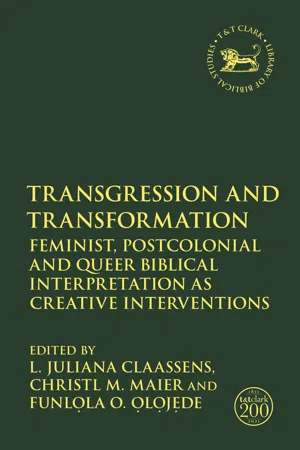
Transgression and Transformation
Feminist, Postcolonial and Queer Biblical Interpretation as Creative Interventions
- 208 pages
- English
- ePUB (mobile friendly)
- Available on iOS & Android
eBook - ePub
Transgression and Transformation
Feminist, Postcolonial and Queer Biblical Interpretation as Creative Interventions
About this book
Information
Part I
TRANSGRESSIVE MEASURES
Chapter 1
NUMBERED WITH THE TRANSGRESSORS: THE STORY OF THE DAUGHTERS OF ZELOPHEHAD AS RETOLD BY NOAH
Funlọla O. Ọlọjẹde
Stellenbosch University
1. A Voice Note from Noah
My name is Noah and I am the second of the five daughters of Zelophehad. Before I was born, my parents prayed earnestly for a son, but I turned out to be a girl anyway, so they gave me a boy’s name.1 So much has been said and written about my sisters and me, but we have never once spoken about ourselves. I thought it was time to tell you a little about my family even though I really don’t owe you an explanation. You may choose to judge our action as right or wrong, but would you at least try to understand our situation before you do so?
I, Noah, was born in that great and terrible wilderness, where there were fiery serpents, and scorpions, and drought, and where there was no water.2 So were my sisters Mahlah, Hoglah, Milcah and Tirzah. Our parents were gypsies in the desert of Sinai and part of the Israelite exodus from Egypt. But mother was a fragile person, and after the birth of five babies her body could no longer withstand the rigor of desert life. Her soul also was much discouraged along the way because she could not bear a son in a culture which privileged sons above daughters. She died shortly after Tirzah was born. Our family was never the same again.
You have no idea what life in that wilderness was like. We wandered day and night in a land of deserts and of pits, a land of drought, and of the shadow of death, a land that no one passed through, and where no one dwelt.3 I did not know any other life. Each day was the same. The weather was the same—either extremely hot or extremely cold. The food was the same, the landscape was the same, the pain was unbearably the same. We would go around in circles, ending up on the same spot we began.4 The men would go to war sometimes, but for us girls, life had little meaning beyond the prospect of marriage and motherhood. Life was tough, but you had to keep going. The life we lived then, you cannot imagine; and the live you live now, we could not imagine. Imagine being quarantined for seven days every month simply because your female body was undergoing its natural cycle. Everyone knew what was happening in your body. There was no “sanitary pad drive,” no bathroom, no privacy.
Instead, there were so many rules, so many sacrifices and rituals, so many taboos. Many people could not keep up with the myriad rules and regulations, most of which could result in death when violated. Father was one of the lawbreakers and, in time, he died for his sins.5 My sisters and I were heartbroken. In the camp, we heard every day about the new world, the land that flowed with milk and honey. We were told that there was a promissory note by the LORD that he would take our people into that land—a land of wheat, and barley, and vines, and fig trees, and pomegranates; a land of olive oil, and honey, a land wherein we would eat bread without scarceness and shall not lack any thing.6 But we knew that with the death of our father Zelophehad, we would have no part in that hill country beyond the Jordan, except as drifters and squatters. The elders would not allocate any portion of the land to our father because he had no sons.7 So life no longer had any meaning for us. Our hope was lost.
As Israelites in the aftermath of the exodus, we understood the meaning of homelessness, of landlessness, and of destitution. As orphan girls, my sisters and I understood grief, loneliness, and vulnerability. We were tired of roaming the desert but there was no other place to call home. We had no one else but ourselves, so we became very close. Soon, we learned to talk together, laugh together, cry together, and even tried to dream together; to dream of another land, and of a new day.
Then, we began to go to the Tent of the Meeting just to listen and catch a glimpse of the court proceedings as people brought different cases before the elders and before Moses. It was our own way of staying out of trouble. In the course of time, we perceived that if there would be any change in our lives, it would be through the law. The law was our only hope. But the law was against us. It discounted the girl child. How then could we transgress the boundaries of the law and live to tell the story? Moses was getting older and older and if we were to change our story, we would have to act fast before he died. Transforming policies and legislations appeared to be one of the few weapons that the powerless possessed. And so, for many months, we deliberated and prayed as we continued in the wilderness of Sinai. We then agreed to bring a class action suit before Moses. Our strength would be in our unity.
2. Our Day in Court
Let me talk a little about our day in court. The previous night, we could hardly sleep. We prayed, we plotted, we rehearsed our speech. Mahlah was to speak on our behalf—not only because she was the oldest but because she was bold, articulate, feisty and a truly great leader. She had been our second mother and our pillar of strength after the death of our parents. When our case was called, we were all so scared. My heart trembled, so did my hands. Tirzah clung to me, and I feigned a courage that I did not feel. We knew that Moses was a no-nonsense judge who followed the law to the letter. So we were quite uncertain of what would unfold. Would we get a fair hearing? Would he treat us as rebels and command the earth to swallow us as he did Korah, Dathan Abiram and On?8 Would one of the congregation members attack us and stone us to death? Unquestionably, ours was an act of transgression. No woman had ever challenged Moses or the law. Miriam who was joined by Aaron to oppose their brother Moses was smitten with leprosy for seven days.9
Nonetheless, we approached Moses. We were in awe of him—this figure whose face would shine so much with the Shekinah glory of the LORD that he had to cover it with a veil.10 I felt like running away, yet I wanted to etch that moment in my memory forever. We took the stand.11 There was no lawyer or advocate. So Mahlah presented and argued our case. Our father died without having any son, but he died for his own sins; he was not a rebel. Our request was to inherit the portion of land that would have been allocated to him in the Promised Land. The irony was that we were demanding for the rights to a land our father never owned. We were relying only on the promise that the LORD made to our people even before we were born. It was an act of great faith on our part. Surprisingly, Moses was not rough with us. He had no daughters himself and he was willing to hear us out. But after hearing our demand, he was confused. He did not know what to do. The law made no provision for our case, so he decided to turn to the LORD for an answer.12
When we attended those court sessions in the past, we saw that, in some cases, Moses was unsure of what to do, for example, in the case of the men who missed the Passover because of the uncleanness of a dead person, or the case of the man who was caught gathering sticks on the Sabbath, or the case of the son of the Israelite woman who blasphemed the name of the LORD. In all these instances, the law was inadequate or unclear and Moses had to turn to the oracle for guidance.13 We became a little apprehensive, then, not knowing what the response from the oracle would be. The outcome could be grim.
In the end, we received a verdict and we all began to weep. The LORD had favored our cause. We were right. Moses was ordered to amend the law. He was to give us an inheritance among our father’s brothers by transferring the inheritance of our father to us.14 The victory that day was unprecedented—it was a victory for daughters, for mothers, and for all men who had no sons.15 All the women came out singing and dancing outside the Tent of Meeting. It was a new day.
3. Aftermath of the Case
But our victory appeared short-lived. Sometime later, certain elders of our clan raised an objection to the ruling and went back to court.16 They argued before Moses and Eleazar that if a daughter who inherited land from her father married into another tribe, the portion of land belonging to her father’s tribe would be subverted. Their plea was that inherited land should remain within the clan so as not to alienate the land. A daughter who inherited her father’s landed property should therefore not marry outside the clan unless she was ready to forfeit that inheritance.17
You see, before the initial ruling, no man looked in our direction because we were five orphan girls wandering through the wilderness of life without any inheritance or dowry. All of a sudden, my sisters and I were inundated with marriage proposals after the ruling. As you all probably know, some men also are gold diggers. Men from different Israelite tribes sought our hands in marriage because now they saw the economic potential in us. This was what prompted the elders to challenge the ruling in court. Moses therefore ruled in their favor. But we were not bothered by this outcome; some of our cousins were among our suitors, so we married them.18 Our male offspring could then bear the name of our late father and inherit his portion. But more importantly, they would have a better life than we did. It was a compromise we made in the circumstances and we decided not to pursue the case. We had already made our point.
On our side, we reasoned that since Moses granted the appeal of the elders, it meant that the law was not cast in stone. The book of Numbers, which contains our story, ended with the suggestion that there was no last word on the matter. In the future, there could be additional amendments to the inheritance law if the need arose because a paradigm has been set that showed that the law could be challenged and revised. And today, we are content to see that various nations have used our case as a reference point in their search for justice and equity.
Many generations have passed since the case of the Zelophehad’s Daughters versus the State, but when my sisters and I hear what people continue to say about us, we are amazed and amused at the same time. Some say we are sons and not daughters,19 while others compiled a list of all the tabloid gossip about us.20 Some readers of our story accuse us of acting in the interest of men; that we were agents of patriarchy because we wanted to memorialize the name of our father. But we did not even know what patriarchy meant and we certainly did nothing for patriarchy but for love and for survival. And what is wrong with keeping our father’s memory alive anyway? Father was our hero. After our mother died, he could have remarried but he chose to take care of us. He nursed us when we were sick. He carried us when we fell down and when we were too tired to walk. He comforted us when we grieved and longed for our mother. Our father...
Table of contents
- Cover
- Title Page
- Contents
- Notes on Contributors
- List of Abbreviations
- INTRODUCTION: FROM TRANSGRESSION TO TRANSFORMATION
- PART I TRANSGRESSIVE MEASURES
- PART II TRANSGRESSIVE METHODOLOGIES
- Index of References
- Index of Authors
- Copyright
Trusted by 375,005 students
Access to over 1.5 million titles for a fair monthly price.
Study more efficiently using our study tools.
Frequently asked questions
Yes, you can cancel anytime from the Subscription tab in your account settings on the Perlego website. Your subscription will stay active until the end of your current billing period. Learn how to cancel your subscription
No, books cannot be downloaded as external files, such as PDFs, for use outside of Perlego. However, you can download books within the Perlego app for offline reading on mobile or tablet. Learn how to download books offline
Perlego offers two plans: Essential and Complete
- Essential is ideal for learners and professionals who enjoy exploring a wide range of subjects. Access the Essential Library with 800,000+ trusted titles and best-sellers across business, personal growth, and the humanities. Includes unlimited reading time and Standard Read Aloud voice.
- Complete: Perfect for advanced learners and researchers needing full, unrestricted access. Unlock 1.5M+ books across hundreds of subjects, including academic and specialized titles. The Complete Plan also includes advanced features like Premium Read Aloud and Research Assistant.
We are an online textbook subscription service, where you can get access to an entire online library for less than the price of a single book per month. With over 1.5 million books across 990+ topics, we’ve got you covered! Learn about our mission
Look out for the read-aloud symbol on your next book to see if you can listen to it. The read-aloud tool reads text aloud for you, highlighting the text as it is being read. You can pause it, speed it up and slow it down. Learn more about Read Aloud
Yes! You can use the Perlego app on both iOS and Android devices to read anytime, anywhere — even offline. Perfect for commutes or when you’re on the go.
Please note we cannot support devices running on iOS 13 and Android 7 or earlier. Learn more about using the app
Please note we cannot support devices running on iOS 13 and Android 7 or earlier. Learn more about using the app
Yes, you can access Transgression and Transformation by L. Juliana Claassens, Christl M. Maier, Funlola O. Olojede, L. Juliana Claassens,Christl M. Maier,Funlola O. Olojede in PDF and/or ePUB format, as well as other popular books in Theology & Religion & Biblical Studies. We have over 1.5 million books available in our catalogue for you to explore.