Drawing upon the long tradition of recalcitrant thought in Western humanist scholarship, this book rethinks education and educational research at a time of intense social transformation. By revisiting a range of post-foundational ideas and developing their own methodological experiment, Stephen Carney and Ulla Ambrosius Madsen reimagine the possibilities for the comparative study of education. Exploring the experiences of young people in Denmark, South Korea and Zambia, this book illustrates how these very different contexts are increasingly connected by common narratives of purpose, as well as overheated promises of success.
Focusing on the writings of Jean Baudrillard, the authors examine them in the context of works by other theorists of modernity, to explore processes of simulation and disappearance that are shaping life worldwide. In the process, the authors paint a rich portrait of education and schooling as a site of joy, hope, pain and ambivalence. Encompassing both theoretical and methodological innovation, Education in Radical Uncertainty provides inspiration for scholars and students attempting to approach the fields of comparative education, education policy and youth studies anew.
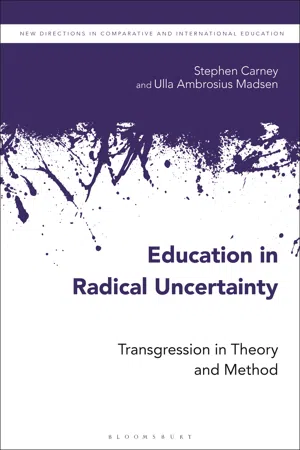
eBook - ePub
Education in Radical Uncertainty
Transgression in Theory and Method
- 304 pages
- English
- ePUB (mobile friendly)
- Available on iOS & Android
eBook - ePub
Education in Radical Uncertainty
Transgression in Theory and Method
About this book
Information
1
A Thousand and One Disturbing Little Stories1
1
Democracy strikes back: Helene saw the red sweater in an exclusive second-hand store in down town Copenhagen. It was expensive, a little worn but imploring her to fall in love: ‘I am retro, cool and irresistible. Be mine and we shall be noticed’. She bought the sweater, knowing she couldn’t afford it and aware that she would probably never wear it. But it felt good to capture its affection. Getting home, she immediately went to her bedroom, put it on, did her makeup and hair and photographed the trophy. Minutes later, this unbeatable team would be on social media. ‘Look at me! Look at us!’ It was a painful evening. Three ‘likes’ from her class of 30 ‘friends’ and a Facebook family of nearly 600. Sobbing, she explained: ‘I know it doesn’t matter that people ignore me. I don’t care that they are not real friends. But it hurts. I didn’t even want that stupid, stupid sweater. Why is it so hard to say no?’
*
Nothing happens unless first a dream: Sung’s journey to school is quite short. A walk to the train, then fifteen minutes packed tight before the bus that brings her to the front gates of one of Seoul’s most sought-after addresses. That’s just the beginning. The scary Mr Pak waits at the sentry’s box. He uses his eyes to measure the length of my skirt. Then, if these cannot decide for him, out comes the measuring stick. The flat side reads out the centimetres while we hold our breath; the sharp side is for striking the head while we stand stiffly to meet the sting. That’s our first exam of the day. At least he never cuts our hair. The boys are not so lucky. Today, I went straight to the assembly hall. A new school year, and the headmaster, teachers and parents are there to celebrate one more step on the way to realizing our dream. ‘Recall your duty, study with diligence, bring honour to your family.’ I think these are the words from the podium. Pisa, examination, number one, rankings. These are the things that our teachers dream of once the door to the classroom closes. That was a long time ago. Now I’m on the Eiffel Tower! In Paris! City of love and dreams. I made it! Up here everything is simple, quiet, solitary. Life is a long way from me. Korea, a cloud on the horizon. Now, at last, I’m an individual. Free. It’s 1.00 am and my sister wakes me. I must have fallen asleep at my desk, again.
*
Truth comes in small drops: Trees are knowledge. Old, tall, strong. Our trees carry memory. They talk if you listen and never judge. They are home to truth. Joseph often sits under the big tree behind the place where he lives. It’s cool and seems a long way from the noise and uncertainty of home, the street and school. Here, he can think, putting aside the thoughts that pile up each day and which refuse to sleep at night. Like messy papers, too many to set aside for later. The shadows are safe, but not when the monkeys come. He has thought a lot about monkeys since Mr Kabuta showed a picture of three wise ones during English class. One wouldn’t see, another wouldn’t hear and the third one held his tongue. Mr Kabuta said that it meant we should not judge each other. Our monkeys have not had this lesson. They know more than we think. You know, our president gave a big speech about how life in Zambia was getting better and that jobs and happiness would soon return. A monkey walked down the branch under the big tree in the palace gardens where the boss was speaking and did his toilet. Our human leader said, ‘Hey monkey, you have urinated on my jacket’ but the monkey just walked away like it was his right – or maybe duty – to soil us when we start making things up. Maybe he went away to steal something while everyone was busy laughing.
*
When all’s been said and done: Educational studies, education policy, comparative education and educational research are established fields carrying the ballast of ‘science’ but, also, varying degrees of its opposite. Some of these areas have sheltered and nurtured radical thought, others have struggled with, even actively resisted, forms of opening up, provocation, transgression and estrangement. In acknowledging the debt we have to recalcitrant thought in education, we ask ourselves: Where do we start when theory and method have already mapped our world to its vanishing point? What is left to say? What is allowed to be said? How can that be written? Do spaces remain between the authoritative academic text and the most radical of performative alternatives? What would be the point? What repetitions are at play when we claim to think anew? What is overlooked? Suppressed? Denied?
*
How can ‘research’ with a comparative ambition approach a world of entanglements that seems to have pushed far ahead of our capacity to map, understand and tame it?
*
Beware the scholar: The academic text claims to be original, indeed, must be original to be taken seriously. It must also acknowledge the history, contexts and ideas of others who have laid the well-worn paths we claim to be brave enough to travel. Ironic that we pretend originality by following routes signposted by the proper line of argument, the thorough literature review, the rigorously argued case and the defensible analysis:
Academia is as preoccupied with its fetish for originality as it is suspicious of its appearance. Academics need to be assimilated. So this pursuit of originality – by which each writer attempts a position against the heavy bibliography he or she must employ – leads to a profound and tightly felt academic bondage. Which gives another slant on the joke: I’ve seen the best research ideas of my generation destroyed by a brief literature search.2
*
An anti-manifesto: If we avoid the impulse to do ‘science’ that serves the reality principle on which it is based, what new ways of seeing become possible? If we reject the imperative to capture ‘culture’, how can we reimagine place, context and lived experience? If we defer judgements of good and bad, right and wrong, with what commitments can we meet vastly uneven educational worlds? Is our task to reveal, re-inscribe, guide, open, close, fo ol, subvert, mystify or enchant? What are the limits of experimentation in education research? Who says? Why?
*
A path less travelled: The short vignettes that open this chapter were crafted from a study of youth and schooling in three countries: Denmark, South Korea and Zambia. The study, funded by a major research agency, took place over a period of five years. It involved all the usual elements of policy literature and analysis, extended field work in and across places as well as our participation in a number of extended ‘cultural’ visits by Danish schools to their contemporaries in Africa and Asia. The connection to current research themes and the grounded, gritty, ethnographic flavour of the project promised relevance to a number of educational areas, not least comparative education and global education policy studies. Notwithstanding a familiar veneer, our project attempted to unfold additional perspectives on globalization, education and youth in order to push scholarly assumptions and limits in the search for new thought. Hopefully, our early vignettes will have aroused your suspicions that something different is afoot here. Our starting point was to question the coherence of contemporary meaning systems in education. We wanted to explore the ways in which they were now overloading and collapsing under the weight of unruly global flows for which they were never calibrated. We felt that while processes of seduction and simulation were challenging, even displacing, the ‘real’ in social life, education research (and especially work with a comparative ambition) continued to delay the inevitable break down of the system; finding meaning where ever it could be grasped, converting that into fuel for a system of reason, purpose and action that appeared to be dying. In the pages that follow, we let the objects of our study express themselves with complexity, contradiction and banality. Often, they are given a helping hand as we blur the sacred boundaries between truth and fiction, using the latter to shed a different light on that which we habitually take for granted. These pages contain the impassioned, profane, reasonable, magical, distressing and perfunctory. There is science (always ready to fill a crack!), politics (but whose?) and an aesthetic form of expression that belongs to no one and everyone, nothing and everything. By refusing to close down or reduce phenomena to neat, familiar or acceptable closures, we attempt to accelerate the tensions between messy worlds in semiotic crisis and those idealized ones that continue to hypnotize educational planners and their bedfellows in the academy. Let’s call it a fatal approach to research work.
A fatal research strategy aims at undermining the system of meaning, pushing it to breaking point. Wreakers or redeemers? Along the way, it gives up the pretence that theory can tame the world or that data is somehow (still) out there to be captured and made reason-able. Scratching, cynically, at the absurd in education, its venture is to write a disappearing world, perhaps until it finds new ways to express itself.
2
The best of times, the worst of times: The broad idea alluded to here was conceived as an experiment in method at a time when interest in the ‘global’ was at its high-water mark. That trope was by no means easy to unravel, not least because of its collision (collusion?) with the similarly narrative category of modernity.3 When viewed as the spatialization of modernity,4 globalization became a comfortable and compelling way to talk about the world of places, people and forces in one breath. Globalization was a harbinger of deeper inter-cultural integration and economic prosperity as well as a force for political renewal. Others were less certain, sensing a new if not dangerous phase of societal unravelling. A world of winner-take-all cosmopolitans but also one of wasted lives played out on shadowy peripheries.
The notion of modernity set free (or at least unravelling) from the confines of place, history and culture has important implications for the project of schooling. Does ‘globality’ entail a deep and permanent form of connectivity within the world? Is that connection a promise or contract of political, material and personal betterment? What forms of exclusion emerge or are built into the project of global schooling? How do people read and enact messages of hope and abjection?
In posing such questions, we were interested to understand more about the ‘chimerical, aesthetic, even fantastic’ worlds of those imagining ‘metropolitan life’ from the side-lines, as well as the ‘deeply disjunctive relationships’5 emerging from global flows. That interest resonated with our own experiences of engaging with young people, their teachers and families in the so-called Global South, as well as in ‘high-performance’ education systems in Europe and East Asia. In many cases, it seemed that notions such as ‘citizen’ or ‘schooled subject’ just didn’t capture the aspirations...
Table of contents
- Cover
- Half-Title
- Series
- Title
- Contents
- List of Illustrations
- Acknowledgements
- Series Editors’ Foreword
- Introduction : By Way of Explanation
- 1 A Thousand and One Disturbing Little Stories
- 2 Education in/and the Global
- 3 Into the Darkness
- 4 Writing as Method
- In Extremis
- 5 A World in/of Fragments
- 6 Comparative Education and Radical Uncertainty
- Notes
- References
- Index
- Copyright
Trusted by 375,005 students
Access to over 1.5 million titles for a fair monthly price.
Study more efficiently using our study tools.
Frequently asked questions
Yes, you can cancel anytime from the Subscription tab in your account settings on the Perlego website. Your subscription will stay active until the end of your current billing period. Learn how to cancel your subscription
No, books cannot be downloaded as external files, such as PDFs, for use outside of Perlego. However, you can download books within the Perlego app for offline reading on mobile or tablet. Learn how to download books offline
Perlego offers two plans: Essential and Complete
- Essential is ideal for learners and professionals who enjoy exploring a wide range of subjects. Access the Essential Library with 800,000+ trusted titles and best-sellers across business, personal growth, and the humanities. Includes unlimited reading time and Standard Read Aloud voice.
- Complete: Perfect for advanced learners and researchers needing full, unrestricted access. Unlock 1.5M+ books across hundreds of subjects, including academic and specialized titles. The Complete Plan also includes advanced features like Premium Read Aloud and Research Assistant.
We are an online textbook subscription service, where you can get access to an entire online library for less than the price of a single book per month. With over 1.5 million books across 990+ topics, we’ve got you covered! Learn about our mission
Look out for the read-aloud symbol on your next book to see if you can listen to it. The read-aloud tool reads text aloud for you, highlighting the text as it is being read. You can pause it, speed it up and slow it down. Learn more about Read Aloud
Yes! You can use the Perlego app on both iOS and Android devices to read anytime, anywhere — even offline. Perfect for commutes or when you’re on the go.
Please note we cannot support devices running on iOS 13 and Android 7 or earlier. Learn more about using the app
Please note we cannot support devices running on iOS 13 and Android 7 or earlier. Learn more about using the app
Yes, you can access Education in Radical Uncertainty by Stephen Carney,Ulla Ambrosius Madsen in PDF and/or ePUB format, as well as other popular books in Education & Education General. We have over 1.5 million books available in our catalogue for you to explore.