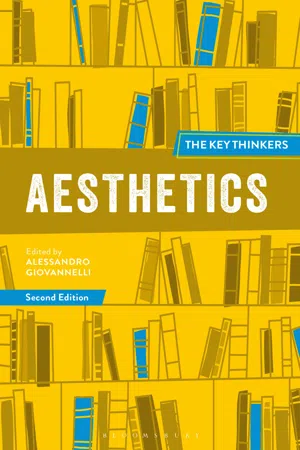
Aesthetics: The Key Thinkers offers a comprehensive historical overview of the field of aesthetics. Thirty specially commissioned essays introduce and explore the contributions of philosophers who have shaped the subject, from its origins in the work of the ancient Greeks to contemporary developments in the 21st century. Now thoroughly revised and updated throughout, this second edition includes new chapters on Ludwig Wittgenstein, Susanne Langer, Bernard Bolzano, as well as more coverage of post-1950 aesthetics with Frank Sibley, Stanley Cavell, Peter Kivy, Noël Carroll, Peter Lamarque, and Jerrold Levinson.
The book reconstructs the history of aesthetics, clearly illustrating the most important attempts to address such crucial issues as the nature of aesthetic judgment, the status of art, and the place of the arts within society. Ideal for undergraduate students, it lays the necessary foundations for a complete and thorough understanding of this fascinating subject.
- 376 pages
- English
- ePUB (mobile friendly)
- Available on iOS & Android
eBook - ePub
Aesthetics: The Key Thinkers
About this book
Information
1
Plato
(c. 427–347 BCE)
Robert Stecker
With respect to the arts, Plato is most famous for purportedly banning one particular art form—poetry—from the Republic, his ideal state. Another very common attribution is that he defines art as representation. Often enough, overviews of the history of aesthetics leave matters there.
So we should start by clearing the decks. Plato never did these two things for which he is most famous. First, there is no total ban on poetry. He did give several important criticisms of poetry, which people still grapple with today, did exclude poetry from many of the functions it had in the Athens of his day, and that the representational arts still have for us today. He advocated the censorship of much poetry but at the same time gave poetry a crucial role in the early education of the leaders of the state. Second, Plato never defines art as representation nor in any other terms. Mimēsis, a Greek word that is sometimes appropriately translated “representation,” but at other times should be translated as “imitation” or “image-making,” plays a crucial organizing role in his thinking about the several art forms, but the issue of defining what we now call the fine arts was not one Plato took up. He never asks, “what is art?” in the way he does ask, “what is justice?” or “what is piety?” His interest with respect to the arts lay elsewhere.
Plato’s main interest in the arts concerns the closely related issues of their effect on people, their value, and, in the light of these, the role they should play in society. In Plato’s Athens, poetry was thought to be a repository of both knowledge and wisdom. Plato questions not only whether this reputation is deserved but also whether poetry in particular, and art in general, might in fact create a barrier to the acquisition of these goods. Second, Plato recognizes that poetry and other arts are both expressive of states of mind and have a powerful emotional effect on their audience. But he wonders whether this is a good or bad thing. Finally, a theme that runs well beyond Plato’s thinking about the arts is whether we should count all pleasures as goods. Included in this thinking are the pleasures of sights and sounds—what we might today call aesthetic pleasure. Plato recognizes that “lovers of sights and sounds” truly enjoy those things but he questions whether this pleasure is always something of positive value (Republic, Book V, 476b). Plato’s thinking on these matters—what one might call his critique of artistic value—will occupy the bulk of this chapter, but we should first become clear about the concept of art he brings to the table.
1 Plato and the Concept of Art
Plato wrote about individual art forms such as poetry, music, and painting, but there is some controversy as to whether he had a concept under which he could think of these forms as art forms. Part of this controversy derives from the now widely held view that the concept of fine art, which groups together poetry, music, painting, sculpture, and architecture, only arose in the eighteenth century and hence before that there was just no concept that closely enough corresponds to our concept of art or the fine arts. The Greek word that is the best candidate for translation as “art” is technē, which covers all sorts of activities and their products that can be practiced or produced skillfully by learning a set of rules or procedures. Hence, such human activities as navigation and saddle making are both instances of technē. On the other hand, in the dialogue Ion, Plato has the character Socrates question whether poetry is really produced by skill or knowledge, or instead by inspiration. If the only concepts available to Plato when thinking about the arts were derived from the meanings of technē, he would be in a poor position to think about art in the relevant sense.
But there is no reason to think Plato in particular or the ancient Greeks in general had such limited conceptual resources. In Book III of the Republic, Plato links together poetry and music with painting, sculpture, architecture, embroidery, weaving, and furniture making—arts and crafts that produce items all capable of grace, rhythm, and harmony, or of course their opposites (401a). It is true that there is no sharp line here between art and craft; yet it is at least as important that the principle organizing the items mentioned in this part of the Republic is not that of item produced by skill or according to rules but rather item capable of expressing or exemplifying states of the psyche.
Even before Plato, there is a tradition of grouping together a collection of “both musicopoetic and visual arts which . . . had come to be considered mimetic” (Halliwell 2002, 43). It is this concept, which Plato adapts for his own purposes, that approximates to our own concept of the arts. In its breadth, it is probably closer to our twenty-first-century concept of art than is the eighteenth-century concept of fine art. It is plausible that conceptions of art or the arts vary over time with respect to the range of things they cover and the crucial properties the conceptions ascribe to those things. This does not prevent us from seeing these varying conceptions as conceptions of art that carve off roughly equivalent practices and forms—poetry, painting music, and so on—from others.
2 Art and Education
Plato discusses poetry and other arts in many dialogues, but the richest source of his aesthetics is the Republic, which contains two extended discussions of the arts. The first is found in Books II and III, and the second and most famous of all of Plato’s writings on this topic is in the final chapter, Book X.
The relevant stretches of Books II and III are concerned with the early education of the guardians, the ruling class of the state. (The guardians will eventually occupy two different tiers—the actual rulers of that state and the soldiers who protect it—but at this stage they all receive the same education.) The discussion begins with the role of poetic stories in this education and eventually goes on to discuss music and the other arts and crafts mentioned above. The import of this discussion goes well beyond the role of art in the education of children, but it is a good place to begin.
Regarding poetic stories, the question is never wh ether they have a role in education, but which stories ought to play this role and which should be excluded. So issues of censorship are definitely in the foreground, but equally important is the power of stories to shape character and the way we perceive and emotionally react to the world. Some stories do this in a harmful way, but others are beneficial.
Stories can be harmful in several different ways. First, they can express falsehoods about important matters such as the nature of the gods, the behavior of heroes, and the kinds of lives that can achieve happiness or well-being. That stories can do this is not merely a theoretical possibility. The preeminent literature of ancient Greece—the Iliad and the Odyssey of Homer, the stories of gods and heroes in the poetry of Hesiod, or the tragedies of Aeschylus—is rife with passages, which need to be eliminated if their works are to be read at all. Second, stories can be harmful in the attitudes and dispositions that they instill. For example, in the works just mentioned, death—both of those one loves and one’s own—is portrayed as a great misfortune, and grief is often expressed with wailings, lamentations, and even more excessive behavior, at least as Plato would see it. This is precisely the wrong attitude toward death, according to Plato, if one is to live courageously and put the fact that we die in proper perspective. There is more than one way in which poetry can instill such attitudes. It does so by representing role models such as heroes who possess just such attitudes and who exhibit such behavior. But even more insidious is the kind of dramatic representation where the characters in a story express such attitudes for themselves, and where, in reciting a poem or performing in a play that tells the story, one will naturally be prompted to take on those roles and identify with the characters. In taking on such roles one adopts the attitudes, and this leads to actually acquiring them. This brings us to the last way that stories harm: in allowing us to adopt the character and personality of all types of humanity in acting out dramatic representations, it hinders the formation of the right character and disposition for guardians.
Plato’s remedy for avoiding such harm is not to eliminate poetic stories from early education, but to limit stories to those that are beneficial: those that express truths rather than falsehoods about the gods, the heroes, and the type of life that leads to happiness; those that express appropriate attitudes toward life and death, or at least that put misguided attitudes in the mouths of characters who are not role models—that is, men and women of “low character.” What can and cannot be dramatically represented is even more strictly limited. Here only the representation of people of high character is permitted, lest one identify with vicious characters or, just as bad, become facile at adopting the attitude of almost anyone. The more one does this, the more one tends to become a person of bad character or of no particular character at all. (A person of bad character acquires dispositions to feel emotions, desire things, and act in ways that are harmful to oneself and others. A person of no character does not have firm dispositions one way or the other but is ruled by external circumstances such as the expectations of others or the role one happens to occupy.)
The same goes for music, which in ancient Greece accompanies the recitation of poetry, and even for painting, weaving, embroidery, architecture, and so on. Some of these items may not have an obvious representational content as poetry (and painting) do, but for Plato they all have an expressive character. In virtue of this, they fall under the concept of mimēsis, at least as Plato sometimes uses the term. There were a variety of modes of music in ancient Greece, and each mode has a characteristic expressive content. Music expressive of lamentation and grief is as undesirable as poetry and tragic drama that is expressive of those emotions, especially since they would accompany each other. Equally bad are compositions that have a great variety of expressive content, just as the dramatic representation of a great variety of characters is bad. The appropriate kind of music possesses a rhythm and grace of form expressive of the good moral character represented in appropriate poetry. The artifacts that make up the visual environment created by painting, architecture, sculpture, and other arts and crafts are capable of having similar expressive qualities. At their best, they are expressive of a grace and harmony that, as we discover in Book IV, is characteristic of the soul of a just person.
We can learn a good deal about the nature of the arts as Plato conceives them from this discussion of their role in early education. First, although he characterizes the poetic stories he mentions as pseudeis logoi, which might be translated either as false discourses or as fictional stories, he believes that they are capable of expressing both truths and falsehoods about important matters, just as we think that fictional literature can tell us something important, or instead mislead us, about the actual world. Second, these stories can express attitudes—some harmful, some beneficial—toward significant aspects of life, and children can easily be influenced to adopt those attitudes. (When we turn to Book X, we will see that adults can be so influenced as well.) Third, the very form of a work can be expressive of a character or a state of mind—some admirable, some contemptible—and this can affect the character and states of mind of those who encounter the works, for good or ill. This permits art forms like music and architecture, and even crafts like embroidery and weaving, to have an expressive character. Even when such works lack what we would regard as representational content, their expressiveness counts as a kind of mimēsis.
Most of us would agree that the three characteristics just outlined are important, if not universal, features of artworks. They imply that artworks can be both beneficial and harmful, which seems to be precisely the message of Books II and III. (What I leave out for now is our likely disagreement with Plato about which works are beneficial, which harmful.) Given this implication, it is surprising that Book X gives a much harsher assessment of the value of poetry and painting. We should then try to understand such a critique and why it is so harsh.
3 Art and Knowledge
Book X criticizes poetry and, more generally, representational art on two fronts: as a source of illusion and false belief and as a powerful force capable of corrupting the psyche with harmful emotions and attitudes. These criticisms should not surprise the reader of Books II and III, since something similar was already said there. The difference is that in those earlier parts of the Republic, these charges are directed at some works of art and poetry, and some parts of a given work, while allowing for other works and passages that not only escape the criticism but are positively beneficial. Not so in Book X. Most poetry, with the exception of that which praises the gods and good men, is banished. Representational art more generally is not banished, but, again unlike what occurs in the earlier books, only its failings are under discussion.
Let us focus first on art’s failure as a source of knowledge. Plato’s conclusion is that art is incapable of being such a source. In fact, he seems to go further and argue that art is incapable of even expressing truths or of representing reality. This radical conclusion again is in tension with his earlier discussion in Books II and III. Plato famously reaches this conclusion about poetry by way of an argument based on an analogy with painting.
The reasoning regarding painting begins with another analogy: that of the images produced by a mirror. Socrates asks Glaucon, his interlocutor, to imagine a craftsman who can make anything and suggests that the simplest way to do this is to imagine someone who takes a mirror and turns it around in all directions. “With it you can quickly make the sun, the things in the heavens, the earth, yourself, the other animals, manufactured items, plants, and everything else mentioned just now.” “I could make them appear, but I couldn’t make the things themselves as they truly are” is the correct reply given by Glaucon (596e). Paintings, like mirror images, give the visual appearance of things. Plato develops this idea further with a discourse on the “three beds.” The bed with which we are most familiar is the material artifact made by a craftsman. But there is also, according to Plato, the form of the bed—that in which all material beds participate and in virtue of which they are beds. According to the metaphysics Plato develops in the middle books of the Republic (Books V, VI, and ...
Table of contents
- Cover
- Half-Title
- Series
- Title
- Contents
- Introduction
- 1 Plato: (c. 427–347 BCE)
- 2 Aristotle: (384–322 BCE)
- 3 Medieval Aesthetics
- 4 Shaftesbury: (1671–1713)
- 5 Francis Hutcheson: (1694–1746)
- 6 Jean-Baptiste Du Bos (1670–1742) and Charles Batteux (1713–1780)
- 7 David Hume: (1711–1776)
- 8 Immanuel Kant: (1724–1804)
- 9 G. W. F. Hegel: (1770–1831)
- 10 Bernard Bolzano: (1781–1848)
- 11 Arthur Schopenhauer (1788–1860) and Friedrich Nietzsche (1844–1900)
- 12 Benedetto Croce (1866–1952) and Robin G. Collingwood (1889–1943)
- 13 Roger Fry (1866–1934) and Clive Bell (1881–1964)
- 14 John Dewey: (1859–1952)
- 15 Ludwig Wittgenstein: (1889–1951)
- 16 Martin Heidegger: (1889–1976)
- 17 Walter Benjamin (1892–1940) and Theodor W. Adorno (1903–1969)
- 18 Susanne K. Langer: (1895–1985)
- 19 Monroe Beardsley: (1915–1985)
- 20 Nelson Goodman: (1906–1998)
- 21 Frank Sibley: (1923–1996)
- 22 Richard A. Wollheim: (1923–2003)
- 23 Arthur C. Danto: (1924–2013)
- 24 Stanley Cavell: (1926–2018)
- 25 Peter Kivy: (1934–2017)
- 26 Kendall L. Walton: (b. 1939)
- 27 Noël Carroll: (b. 1947)
- 28 Peter Lamarque: (b. 1948)
- 29 Jerrold Levinson: (b. 1948)
- 30 Some Contemporary Developments
- Notes on Contributors
- Index
- Copyright
Trusted by 375,005 students
Access to over 1.5 million titles for a fair monthly price.
Study more efficiently using our study tools.
Frequently asked questions
Yes, you can cancel anytime from the Subscription tab in your account settings on the Perlego website. Your subscription will stay active until the end of your current billing period. Learn how to cancel your subscription
No, books cannot be downloaded as external files, such as PDFs, for use outside of Perlego. However, you can download books within the Perlego app for offline reading on mobile or tablet. Learn how to download books offline
Perlego offers two plans: Essential and Complete
- Essential is ideal for learners and professionals who enjoy exploring a wide range of subjects. Access the Essential Library with 800,000+ trusted titles and best-sellers across business, personal growth, and the humanities. Includes unlimited reading time and Standard Read Aloud voice.
- Complete: Perfect for advanced learners and researchers needing full, unrestricted access. Unlock 1.5M+ books across hundreds of subjects, including academic and specialized titles. The Complete Plan also includes advanced features like Premium Read Aloud and Research Assistant.
We are an online textbook subscription service, where you can get access to an entire online library for less than the price of a single book per month. With over 1.5 million books across 990+ topics, we’ve got you covered! Learn about our mission
Look out for the read-aloud symbol on your next book to see if you can listen to it. The read-aloud tool reads text aloud for you, highlighting the text as it is being read. You can pause it, speed it up and slow it down. Learn more about Read Aloud
Yes! You can use the Perlego app on both iOS and Android devices to read anytime, anywhere — even offline. Perfect for commutes or when you’re on the go.
Please note we cannot support devices running on iOS 13 and Android 7 or earlier. Learn more about using the app
Please note we cannot support devices running on iOS 13 and Android 7 or earlier. Learn more about using the app
Yes, you can access Aesthetics: The Key Thinkers by Alessandro Giovannelli in PDF and/or ePUB format, as well as other popular books in Filosofia & Estetica in filosofia. We have over 1.5 million books available in our catalogue for you to explore.