Reading Texts on Sovereignty charts the development of the concept from the classical period to the present day. Defined in antiquity as an absolute or supreme type of power, sovereignty's history has been marked ever since by numerous moments of crisis and contestation through which its meaning has been redefined and reconfigured. Using extracts of key texts selected and analysed by leading contributors from the USA, the UK, New Zealand, Japan, Cyprus, Finland, France, Austria, Israel, and Italy, this volume examines these moments and how different societies have grappled with sovereignty through the ages.
The book explores a diverse range of geographical and cultural contexts within which the issue of sovereignty became critical, including ancient China and medieval Islam. In addition, the book includes chapters that respond to the vital interplay between the development of the theory of sovereignty and such momentous historical events and developments as the birth of the democratic polis in the classical world, the legal and political developments that attended the rise of the Roman and Islamic empires, the bitter struggles over sovereign rights between the 'temporal' and 'spiritual' authorities of medieval and early modern Europe, the English Civil War, the French and American Revolutions, and the October Revolution.
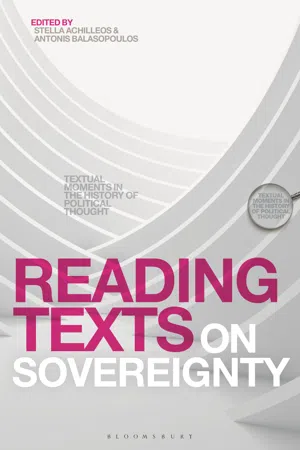
eBook - ePub
Reading Texts on Sovereignty
Textual Moments in the History of Political Thought
- 208 pages
- English
- ePUB (mobile friendly)
- Available on iOS & Android
eBook - ePub
Reading Texts on Sovereignty
Textual Moments in the History of Political Thought
About this book
Information
1
The Book of Lord Shang on the Origins of the State
Yuri Pines
In antiquity, the people resided together and dwelled herdlike in turmoil; hence, they were in need of superiors. So All-under-Heaven are happy having superiors and consider this orderly rule. Now, if you have a sovereign but no laws, it is as harmful as having no sovereign; if you have laws but are unable to overcome [those] who wreak havoc, it is as if you have no laws. Although All-under-Heaven have no peace without a ruler, they delight in flouting his laws: hence, the entire generation is in a state of confusion.1
How did the state come into existence? Is it essential to human society, or is it a product of certain social circumstances? Why do the people relinquish their freedoms for the sake of external coercive apparatus? How do the foundations of the state in the past reflect—if at all—on its desirable mode of functioning in the present? The rise of the modern state in the West triggered heated debates about these questions. For many thinkers of European modernity—from Thomas Hobbes to Jean-Jacques Rousseau, to Friedrich Engels—the question of the origins of the organized political community mattered a lot and had a direct bearing on their views of the contemporaneous state and its possible trajectory.
Unbeknownst to modern European theorists, similar debates about the origins of the state and of the ruler’s power were launched twenty centuries earlier, on the opposite side of Eurasia. Chinese thinkers of the Warring States period (453–221 BCE) lived under conditions that bear a certain degree of resemblance to those of early modern Europe. Their age witnessed rapid and radical transition from the loose aristocratic polities of the preceding Bronze Age (ca. 1500–400 BCE) to highly centralized and profoundly bureaucratized territorial states, each of which tried, to paraphrase Eric Hobsbawm, to reach “down to the humblest inhabitant of the least of its villages.”2 And much like in early modern Europe, the rise of the new state aroused a plethora of positive and negative emotions and generated heated debates, which included, among other things, putting forward conflicting perspectives about the state’s origins.3
Among the debaters of that extraordinarily vibrant age, dubbed the age of the “Hundred Schools of Thought,” the towering figure of Shang Yang (a.k.a. Gongsun Yang or Lord Shang, d. 338 BCE) is particularly important. Shang Yang was renowned not so much as a thinker but as an extraordinarily successful—and hugely controversial—political reformer. He reshaped the political, social, and to a certain extent also economic and military structure of the state of Qin, turning it into the most assertive, arguably most oppressive, and undoubtedly politically and militarily most successful state of the Warring States period. The Book of Lord Shang, attributed to him (but penned in part by his later followers) summarizes the major arguments in favor of his reforms. It defends the radical overhaul of existent institutions, dismisses the moralizing discourse of Shang Yang’s opponents as politically irrelevant, or, worse, subversive, and provides justification for the maintenance of a powerful state apparatus that imposes total control over subjects’ lives.4 This is the immediate context of chapter 7, “Opening the Blocked” (“Kai sai”), from which the above extract is cited. This chapter is an ideological centerpiece of the Book of Lord Shang. It provides one of the most sophisticated justifications of the absolute power of the state in the entire corpus of China’s political texts.
The first section of the chapter deals with the genesis of the state. It starts with the following depiction:
When Heaven and Earth were formed, the people were born. At that time, the people knew their mothers but not their fathers; their way was one of attachment to relatives and of selfishness. Attachment to relatives results in particularity; selfishness results in malignity. The people multiplied, and as they were engaged in particularity and malignity, there was turmoil. At that time, the people began seeking victories and forcefully seizing [each other’s property]. (7.1)
From the first phrases we can see the distinctiveness of Shang Yang’s approach. During the Warring States period there were two major attitudes to the “state of nature” that preceded the formation of the state. The majority view represented most vividly by Mozi (ca. 460–390 BCE) depicted primeval society as plagued by intrinsic turmoil. Like Hobbes, Mozi considered pre-political society as a bestial situation of war of all against all, the only remedy to which was the establishment of the state. In contrast, a minority view, most vividly evident in some chapters of the Zhuangzi (probably penned slightly later than the Book of Lord Shang), argued that the “state of nature” was an era of harmony and peace. According to this view, the creators of organized society were villains who destroyed the primeval idyll.5 The “Opening the Blocked” chapter combines both approaches. Turmoil is not intrinsic to a stateless society. Whereas the matriarchal (or promiscuous) situation in which “the people knew their mothers but not their fathers” is not enviable, it is not deplorable either; after all, the “attachment to relatives” characteristic of that age was considered by many thinkers—most notably the followers of Confucius (Kongzi, 551–479 BCE)—as a normative state of affairs. However, primeval society could not sustain itself for long because of population pressure. When “the people multiplied,” the intrinsic selfishness of human beings began endangering the social order. As the weaknesses of stateless society became evident, it had to be reformed:
Seeking victories results in struggles; forceful seizure results in quarrels. When there are quarrels but no proper [norms], no one attains his natural life span. Therefore, the worthies established impartiality and propriety and instituted selflessness; the people began rejoicing in benevolence. At that time, attachment to relatives declined, and elevation of the worthy was established. In general, the benevolent are devoted to the love of benefit, whereas the worthy view overcoming one another as the [proper] Way.6 The people multiplied yet lacked regulations; for a long time they viewed overcoming one another as the [proper] Way, and hence there again was turmoil. (7.1)
The kin-based order, which fostered selfishness, proved inadequate in coping with population pressure and the resultant struggles; hence, unidentified “worthies” intervened, replacing that order with the incipient stratified society based on the “elevation of the worthy.” It was at this stage that morality was first taught to the populace, apparently calming the struggles and putting an end to the forceful mutual seizure of property of the earlier age. We witness, then, profound social, ideological, and political change. However, morality and social stratification alone could not resolve the fundamental problem of human selfishness, which brought about renewed competition for material wealth and social prestige. Hence, the new cycle of population increase resulted in a new deterioration of the social order, which required a more radical overhaul of society:
Therefore, the sages took responsibility. They created distinctions among lands, property, men, and women. When distinctions were fixed but regulations were still lacking, this was unacceptable; hence, they established prohibitions. When prohibitions were established but none supervised [their implementation], this was unacceptable; hence, they established officials. When officials were instituted but not unified, this was unacceptable; hence, they established the ruler. When the ruler was established, the elevation of the worthy declined, and the esteem of nobility was established. (7.1)
As the morality-based society proved to be inadequate in coping with its internal contradictions, a new form of sociopolitical system had to come into existence. This new system—the state—was generated by unidentified “sages” (i.e. the people on a higher intellectual level than mere “worthies”). Yet the sages did not create the state as a single act of genius intervention. Rather, its formation was a result of a lengthy process of increasing political complexity and social change. Overall, society evolved from an egalitarian, promiscuous, kin-based order to an incipient stratified order and then to a mature political organization based on property distinctions, prohibitions, and officials. This process was crowned with the establishment of a ruler, and it is only then that we can speak of a fully formed state. This is an extraordinarily sophisticated and dynamic model.
The above narrative differs from most other stories of state formation insofar as the ruler’s role is concerned. In Mozi, for instance, the formation of the state was a top-down process. First the universal ruler—Son of Heaven—was established; then he created territorial distinctions in the realm and appointed local officials. In Zhuangzi, as well, the procedure was top-down; in this case, however, the state was the product of the power-hungry sages who were also its earliest rulers. In the “Opening the Blocked” chapter, in contrast, the ruler is the last to appear. He crowns the state formation rather than initiates it.
And yet, the ruler’s role is crucial. “Unifying” the officials is the sine qua non for creating a properly functioning state. And it is not just unifying the officials. It is unifying the realm, first in a single state and then, as the text hints elsewhere (7.3), in All-under-Heaven. The unification of the entire known world was the common cherished goal of political thinkers of the Warring States period, the only way to ensure lasting universal peace.7 The author of the “Opening the Blocked” chapter shared this goal, but he reminds us that unity—first in a single state and then in the entire subcelestial realm—requires the unifier. By the very fact of his singularity, the ruler ensures the proper functioning of the political system. He is not the system’s creator but its pivot. This is the rationale for concentrating all imaginab...
Table of contents
- Cover
- Half-Title Page
- Series Page
- Title Page
- Contents
- List of Contributors
- Series Editors’ Foreword
- Acknowledgments
- Introduction
- 1 The Book of Lord Shang on the Origins of the State
- 2 Aristotle on Sovereignty
- 3 Divided Sovereignty: Polybius and the Compound Constitution
- 4 Reading Sovereignty in Augustus’ Res gestae
- 5 Al-Fārābī: The Sovereignty of the Philosopher-King
- 6 Marsilius of Padua on Sovereignty
- 7 The King “Should Be” Sovereign: Christine de Pizan and the Problem of Sovereignty in Fifteenth-Century France
- 8 Jean Bodin’s République
- 9 Hugo Grotius: Absolutism, Contractualism, Resistance
- 10 Shakespeare on Sovereignty, Indivisibility, and Popular Consent
- 11 Sovereignty and the Separation of Powers on the Eve of the English Civil War: Henry Parker’s Observations and Charles’ Answer to the XIX Propositions
- 12 Thomas Hobbes, Sovereign Representation, and the English Revolution
- 13 John Locke and the Language of Sovereignty
- 14 Rousseau’s Sovereignty as the General Will
- 15 Sovereignty in the American Founding
- 16 Thomas Paine: Reinventing Popular Sovereignty in an Age of Revolutions
- 17 Sovereignty and Political Obligation: T. H. Green’s Critique of John Austin
- 18 Divided Sovereignties: Lenin and Dual Power
- 19 Carl Schmitt and the Sovereignty of Decision
- 20 Arendt on Sovereignty
- 21 Foucault and Agamben on Sovereignty: Taking Life, Letting Live, or Making Survive
- 22 Derrida on the “Slow and Differentiated” Deconstruction of Sovereignty
- Further Reading
- Index
- Copyright
Trusted by 375,005 students
Access to over 1.5 million titles for a fair monthly price.
Study more efficiently using our study tools.
Frequently asked questions
Yes, you can cancel anytime from the Subscription tab in your account settings on the Perlego website. Your subscription will stay active until the end of your current billing period. Learn how to cancel your subscription
No, books cannot be downloaded as external files, such as PDFs, for use outside of Perlego. However, you can download books within the Perlego app for offline reading on mobile or tablet. Learn how to download books offline
Perlego offers two plans: Essential and Complete
- Essential is ideal for learners and professionals who enjoy exploring a wide range of subjects. Access the Essential Library with 800,000+ trusted titles and best-sellers across business, personal growth, and the humanities. Includes unlimited reading time and Standard Read Aloud voice.
- Complete: Perfect for advanced learners and researchers needing full, unrestricted access. Unlock 1.5M+ books across hundreds of subjects, including academic and specialized titles. The Complete Plan also includes advanced features like Premium Read Aloud and Research Assistant.
We are an online textbook subscription service, where you can get access to an entire online library for less than the price of a single book per month. With over 1.5 million books across 990+ topics, we’ve got you covered! Learn about our mission
Look out for the read-aloud symbol on your next book to see if you can listen to it. The read-aloud tool reads text aloud for you, highlighting the text as it is being read. You can pause it, speed it up and slow it down. Learn more about Read Aloud
Yes! You can use the Perlego app on both iOS and Android devices to read anytime, anywhere — even offline. Perfect for commutes or when you’re on the go.
Please note we cannot support devices running on iOS 13 and Android 7 or earlier. Learn more about using the app
Please note we cannot support devices running on iOS 13 and Android 7 or earlier. Learn more about using the app
Yes, you can access Reading Texts on Sovereignty by Stella Achilleos, Antonis Balasopoulos, Stella Achilleos,Antonis Balasopoulos in PDF and/or ePUB format, as well as other popular books in History & World History. We have over 1.5 million books available in our catalogue for you to explore.