African migrants have become increasingly demonised in public debate and political rhetoric. There is much speculation about the incentives and trajectories of Africans on the move, and often these speculations are implicitly or overtly geared towards discouraging and policing their movements. What is rarely understood or scrutinised however, are the intricate ways in which African migrants are marginalised and excluded from public discourse; not only in Europe but in migrant-receiving contexts across the globe.
Invisibility in African Displacements offers a series of case studies that explore these dynamics. What tends to be either ignored or demonised in public debates on African migration are the deliberate strategies of avoidance or assimilation that migrants make use of to gain access to the destinations or opportunities they seek, or to remain below the radar of restrictive governance regimes.
This books offers fine-grained analysis of the ways in which African migrants negotiate structural and strategic invisibilities, adding innovative approaches to our understanding of both migrant vulnerabilities and resilience.
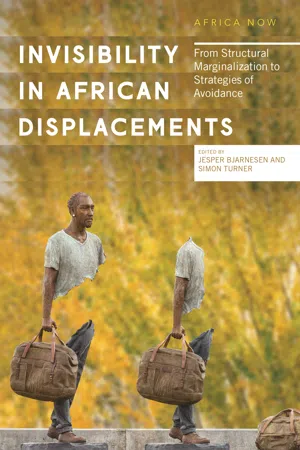
eBook - ePub
Invisibility in African Displacements
From Structural Marginalization to Strategies of Avoidance
- 288 pages
- English
- ePUB (mobile friendly)
- Available on iOS & Android
eBook - ePub
Invisibility in African Displacements
From Structural Marginalization to Strategies of Avoidance
About this book
Information
Section 1
Humanitarian in/visibilities
1 | Renegotiating humanitarian governance: challenging invisibility in the Chad–Sudan borderlands
Andrea Behrends
Introduction
In February 2003, the border region between Chad and Sudan became caught up in what was to remain a protracted situation of rebellion, counter-rebellion, refuge, humanitarian aid and international military intervention. As the ‘Darfur Crisis’ it initially received the world’s attention in late 2003 and was eventually framed as the ‘first genocide of the twenty-first century’, as Colin Powell, then US secretary of state had called it in September 2004. Although tensions had been rising before 2003, violence accelerated to an extreme after a prominently placed and surprisingly successful rebel attack, in which a group of armed men captured a military air base of the Sudanese army in Sudan’s westernmost province in the town of Gulu (de Waal 2004; Flint and de Waal 2005, 2008). While, as Prunier (2005) shows, much of the media attention focused on the violence and the need to prevent a second Rwanda, little attention was given to the populations that had been living in the border region for decades and for whom this war resembled others they had experienced before. As machakil (arab.: problems) or harb (arab.: war), people had developed knowledge about how to deal with such situations. Moving into refugee camps was one of those options. Remaining close to their homes and land another. Both (and other) options were related to factors such as access to land, the quality of land, but also access to national governmental institutions on both sides of the border, or access to humanitarian aid.
This chapter argues that in order to come closer to an understanding of the everyday dealing with violence, flight, aid and survival, it is necessary to look at a larger ensemble of actors and factors that characterize displacement and emplacement (Glick Schiller and Çağlar 2015; Bjarnesen and Vigh 2016) as well as at the knowledge, materials and technologies that accompany such processes. If aid agencies and international media, for instance, highlight only certain specific actors concerned by a so-called crisis, this bears the risk of making visible only parts of a much more complex situation. If the United Nations High Commissioner for Refugees (UNHCR) categorizes certain people as refugees, born out of a need to be able to deal with a complicated situation, a specific group with specific, well-defined characteristics is constructed as real, with real consequences on their everyday lifeworlds. Less visible, but with similar consequences, the registering of people who arrive at the gates of refugee camps as refugees in need of and entitled to aid also creates another category: those who do not address the aid agencies. Instead, they are perceived to belong to the much more vaguely defined category of host populations (those who have lived in areas where refugee camps are installed before the arrival of refugees) but also the categories of rebels (those who presumably cause the trouble and roam about rendering situations less secure) or better-off populations (who are presumed to be in control of their own survival by being in command of the means needed to cater for basic needs and security). High visibility thus creates shadows; spaces, where people and their needs become less visible – for instance to international media or, in particular, to aid infrastructures set up during displacement situations.
Such aid infrastructures are large-scale technologies that comprise historically developed procedures, regulations and categorizations (Glasman 2017, 2019). This technology is braced to address the presumed disorder that results from violence, war and displacement, by making populations ‘legible’, as James Scott (1998) called it, by counting people and putting labels on them – while others become invisible. Invisibility has been a prominent theme during the European industrialization and its consequences, which engaged a number of philosophers to think about the effects of what they observed to be an increasing technicization. In contrast to other philosophers of his time, the German philosopher Hans Blumenberg (1981) had a rather positive perspective on technicization and modernity. He maintained that in order for technologies to work as they should, a conscious invisibilization of their setup – a ‘waiver of sense’ (Sinnverzicht). Understanding technicization as the human enlargement of the room of creative possibilities, he proposed that it was indeed a positive development – and not, as Edmund Husserl had maintained before him, a ‘loss of sense’ (Sinnverlust) – that humans decided to invisibilize certain aspects of the process of technical innovation, so as to be able to apply them without constantly having to return to renegotiating their setup (Bolz 2012: 44). Translated to the technologies and infrastructures of humanitarian aid, this invisibilization of their technologies – that is, the underlying set-up and rules of each operation –might indeed be a gainful effect in order to calculate and justify aid measures and to be able to act quickly. Gainful, at least, for the aid agencies. When aid organizations focus on the people who are defined as recipients of aid, this may result in an exclusion or neglect of those whom the underlying set-up and rules have made legible as non-recipients. In this chapter I argue that the gainfulness of rendering some populations invisible is a one-sided affair. It is a measure of power, which results from creating legibility by ‘seeing like a state’ (Scott 1998). The villagers I had first met during the war were conscious of their being rendered invisible, and they lived with it, as they had chosen not to move to the camps. This decision might have been based at least in part on their previous experiences with aid measures in the 1980s, when the origins of people’s flight was misunderstood as being drought rather than war, leading to region-wide and disastrous famine (de Waal 1989). When I returned to the border region in 2007 to pay a visit to the people, both within and outside the refugee camps, whom I knew from my long-term research before the war (2000–2001), a spontaneous possibility opened to actively counter invisibilization by making me an intermediate between border villagers and the aid agencies. Arguing from a lifeworldly perspective of individual and collective ‘existential’ experiences (Jackson 2013, 2017), I maintain that the formalized rendering of people as legible (by applying categorizations) is actually by default relationally and temporally contingent. Elaborating on this example in the following, I aim to show that while aid agencies, in the end, will have had the power to decide whether people who are not categorized as refugees have access to aid measures or not, they could not prevent that the villagers’ move led to a higher visibility – in their active challenging of the invisibility enforced upon them.
Being – differentially – displaced in the borderlands
The war in Darfur approached slowly; there had been many signs of warning. While the world’s attention picked up on the events only in late 2003, Flint and de Waal (2008) describe how, already in 1995, harassing, sudden brutal attacks on villages, theft and violent assaults on people going to or returning from markets, as well as governmental patronizing and political side-lining had not only enraged, but also left many people desperate. While a number of factors came together in aggravating the conflict at the local level, including the historical situation of war and flight in the larger region (Burr and Collins 1999), its basic tenor was a continuation of the region’s political and economic marginalization that had been initiated in British colonial times and perpetuated through various phases of national leadership until today (Harir 1994; Johnson 2003; Mamdani 2009; Prunier 2005). Flight first started in small numbers. In 2000 when I started in my research, about 10,000 people had moved away from Sudan to settle in villages along the Chadian border, assisted by a one-person office of the UN Refugee Agency in Abéché, the largest city in Eastern Chad, and a locally staffed Catholic NGO called SECADEV (Sécours Catholique et Développement) with an office in the border town Adré. I had gone to this area for a study on ‘conflict and integration’1 and had lived for months in the small villages that hosted people from Sudanese Darfur who defined themselves ...
Table of contents
- Cover
- Series Page
- About the Editors
- Title Page
- Copyright Page
- Table of Contents
- List of figures
- Acknowledgements
- List of contributors
- Introduction: the production of invisibility in African displacements
- Section 1: Humanitarian in/visibilities
- 1 Renegotiating humanitarian governance: challenging invisibility in the Chad–Sudan borderlands
- 2 Encamped within a camp: transgender refugees and Kakuma Refugee Camp (Kenya)
- 3 An unsettling peace: displacement and strategies of invisibility in post-war Burundi
- 4 Sufficiently visible/invisibly self-sufficient: recognition in displacement agriculture in north-western Tanzania
- Section 2: State in/visibilities
- 5 War refugees in Northern Cameroon: visibility and invisibility in adapting to the informal economy and the ‘tolerant’ state
- 6 Entangled hypervisibility: Senegalese migrants’ everyday struggles for a place in the city
- 7 Paths to Paris: hodological space and invisibility among Malian migrants without papers in the French capital
- 8 Invisibility as a livelihood strategy: Zimbabwean migrant domestic workers in Botswana
- 9 The Nigerien migrants in Kaddafi’s Libya: between visibility and invisibility
- 10 Violence, displacement and the in/visibility of bodies, papers and images in Burundi
- Section 3: Social in/visibilities
- 11 (Dis)Connectivity and the invisibility of mobile Fulani in West Africa
- 12 Fugitive emplacements: mobility as discontent for wahaya concubine women with slave status in the transnational borderlands of Niger–Nigeria, 1960–2016
- 13 The paradoxes of migrant in/visibility: understanding displacement intersectionalities in Bobo-Dioulasso, Burkina Faso
- Afterword: The times of invisibility
- Index
Trusted by 375,005 students
Access to over 1.5 million titles for a fair monthly price.
Study more efficiently using our study tools.
Frequently asked questions
Yes, you can cancel anytime from the Subscription tab in your account settings on the Perlego website. Your subscription will stay active until the end of your current billing period. Learn how to cancel your subscription
No, books cannot be downloaded as external files, such as PDFs, for use outside of Perlego. However, you can download books within the Perlego app for offline reading on mobile or tablet. Learn how to download books offline
Perlego offers two plans: Essential and Complete
- Essential is ideal for learners and professionals who enjoy exploring a wide range of subjects. Access the Essential Library with 800,000+ trusted titles and best-sellers across business, personal growth, and the humanities. Includes unlimited reading time and Standard Read Aloud voice.
- Complete: Perfect for advanced learners and researchers needing full, unrestricted access. Unlock 1.5M+ books across hundreds of subjects, including academic and specialized titles. The Complete Plan also includes advanced features like Premium Read Aloud and Research Assistant.
We are an online textbook subscription service, where you can get access to an entire online library for less than the price of a single book per month. With over 1.5 million books across 990+ topics, we’ve got you covered! Learn about our mission
Look out for the read-aloud symbol on your next book to see if you can listen to it. The read-aloud tool reads text aloud for you, highlighting the text as it is being read. You can pause it, speed it up and slow it down. Learn more about Read Aloud
Yes! You can use the Perlego app on both iOS and Android devices to read anytime, anywhere — even offline. Perfect for commutes or when you’re on the go.
Please note we cannot support devices running on iOS 13 and Android 7 or earlier. Learn more about using the app
Please note we cannot support devices running on iOS 13 and Android 7 or earlier. Learn more about using the app
Yes, you can access Invisibility in African Displacements by Jesper Bjarnesen, Simon Turner, Jesper Bjarnesen,Simon Turner in PDF and/or ePUB format, as well as other popular books in Social Sciences & Immigration Law. We have over 1.5 million books available in our catalogue for you to explore.