Since 9/11 and the global War on Terror, practitioners of Islam in Europe and beyond have been scrutinised and surveyed under suspicion of disloyalty and as potential disrupters of national social cohesion. Seemingly benign, altruistic practices, such as charity, are viewed as potential threats to national security and have increasingly become subject to counter-terrorism policies. This work seeks to critically assess the assumptions behind the lesser-known financial War on Terror, through exploration of the effects of current policies on Muslim charitable practices in the UK. The consequences of current policies are multi-faceted – from the stigmatization and suspicion of Muslim charities and communities, individual loss of status and financial standing, to a decrease of living standards and/or loss of lives.
Engaging with the everyday socio-political activities of Muslim individuals, this book gives voice to the motivations, apprehensions and challenges faced by Muslim charitable practitioners. A must read for anyone wanting to challenge policy assumptions behind increased surveillance of charities and individual donors, whilst outlining the repercussions of current policies on Muslim individuals and charities.
eBook - ePub
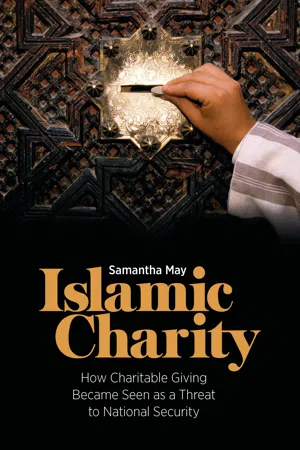
Islamic Charity
How Charitable Giving Became Seen as a Threat to National Security
- 208 pages
- English
- ePUB (mobile friendly)
- Available on iOS & Android
eBook - ePub
About this book
Information
1
The importance of the ‘everyday’
Theories and methods
It’s quite amazing . . . it’s like an instinct – people give money without expecting anything in return (Muslim charity worker in interview).
According to the UK government, current de-radicalization measures aim to ensure there are ‘no ungoverned spaces’ in which ‘extremism’ and ‘radicalization’ can stand unchallenged (Home Office, 2018). Security measures have therefore penetrated the mundane aspects of our everyday lives barely noticed by some but conspicuously experienced by others (often based on religious grouping or/and racializations). Particularly important is Kundnani’s observation that ‘when government widened the perceived threat of terrorism from individuals actively inciting, financing, or preparing terrorist attacks to those having an ideology, they brought constitutionally protected activities of large numbers of people under surveillance’ (2014: 12–13). Legitimate and legal everyday activities are now targeted for suspicion and monitored for deviance from ‘fundamental British values’ following from the UK counter-terror policies contained in CONTEST II (Contest, 2018). Qurashi has argued that ‘embedded surveillance is an increasingly mundane feature of late modern life as it is embedded into the routines of everyday life, across private and public spaces’ (2018). As the world was drawn to the spectacle of ‘shock and awe’, Guantanamo Bay, the hunt for Osama bin Laden and more, the small incremental moves into securing the everyday have largely gone unnoticed.
The securitization of the mundane is apparent across the social arena of the UK not least in the Prevent Duty (2015) that guarantees that all public spaces and institutions such as hospitals, schools and universities are scrutinized and surveyed to ensure they stay within the parameters of ‘fundamental British values’ (Contest, 2018). Not only do surveillance measures penetrate deeply into our daily activities, but they are also championed to monitor and cover a range of both public and private actors incorporating the likes of teachers, doctors and banking employees alongside police, journalists, bloggers and security agencies. Kundnani argues that ‘when informants are recruited from communities, surveillance becomes intertwined with the fabric of human relationships and the threads of trust upon which they are built’ (2014: 13). Kundnani further warns that ‘the power and danger of these forms of surveillance derive from their entanglement in everyday human interactions at the community level rather than from external monitoring capabilities of hidden technologies’ (2014: 13).
While the global War on Terror (WoT) generally has garnished much media and academic attention, what has achieved less public scrutiny is the securitization of everyday economic practices which ensure the state monitors and collect data on our everyday economic activities. The rationale being that by monitoring everyone, first, there are no ‘ungoverned spaces’ and, second, the data collected is thought to establish ‘normal’ from ‘deviant’ practices. ‘The minutiae of everyday life including ATM transactions, wire transfers and charitable donations are to be securitised, sorted and regulated in this logic’ (De Goede, 2012b: 29–30). One problem of such a logic is that our everyday economic practices are so diverse that ‘normal’ behaviour cannot be established let alone deviancy. Each and every one of us in our lifetimes will deviate from our everyday ‘normal’ financial activities on rare and special (yet completely ‘normal’ and legitimate) occasions such as marriages, deaths, buying a house or attending our children’s graduations. Essentially, what this means is that counter-terror measures are now in place to monitor our everyday lives and activities in an effort to establish ‘deviant’ from ‘normal’ behaviour but with scant evidence that it can succeed in its stated goal. As De Goede has argued, ‘legitimate, everyday money flows are no longer considered beyond suspicion but are inscribed with the ability to indicate terrorist intent if approached with the right data mining tools’ (2012b: 58). Important to De Goede’s assertion is that ‘legitimate’ financial activities are no longer ‘beyond suspicion’. This is further supported by a Financial Action Task Force (FATF) report on terrorism financing, which stated that ‘in many situations, the raising, moving and using of funds for terrorism can be . . . almost indistinguishable from the financial activity associated with everyday life’ (FATF, 2008). There are indeed no ‘ungoverned spaces’ and every one of us is being monitored and mapped according to scales of ‘normalcy’ or ‘deviancy’ which in reality cannot be empirically established.
Background assumptions and key concepts
This work largely assumes that the secular and the religious, rather than being oppositional dichotomies, are mutually incorporating terms that make little sense without the other (May et al., 2014). It understands the boundaries of the religious and the mundane to be porous so that ‘the mundane becomes sacred and vice-versa’ (Barylo, 2018: 13). Barylo posits that as religious and non-religious practices are so intertwined, separate analysis of these phenomena is difficult. Barylo argues that ‘trying to differentiate religion from non-religious actions in the social sciences’ would be like ‘trying to know if Schrödinger’s cat is dead or alive’ (2018: 14). Similarly, Barnett and Stein have argued that ‘trying to make sense of the relationship between the religious and the secular in the humanitarian world is no easier than doing so in the wider world . . . because the two concepts define one another, constitute one another, bleeds into one another through porous boundaries’ (20 12: 28–9). Osella has posited that charitable practices are constituted through both Islamic traditions ‘and encounters with non-Muslim Others, whether religious, ethnic, secular or political’ (2019). According to this position, Muslim charitable practices emerge from the ‘routinized practices of the everyday’, which allows for the ‘emergence of (novel) subjectivities which remain always incomplete and in the process of becoming’ (Osella, 2019). Hence, Islamic charitable practices alter and transform during encounters with other traditions and the environment in which it is embedded.
Religion has re-entered the public domain as an alternative or reformed option to challenge existing dominant economic and political paradigms: ‘this can be seen particularly in the role of faith-based organizations, who are increasingly filling the gaps left by the neoliberalization of the state, and campaigning for broader change’ (Wilson and Steger, 2013: 485). Thus, it is imperative to place the rise and resilience of Islamic charitable giving and the role of Islamic NGOs into the wider global perspective of the general upsurge of the third sector, whether that be faith-based or secular. The policy and media gaze upon Islamic charities and NGOs is, in all probability, far more correlated to the general perception of Islam in Western Europe than any specific peculiarity in Islamic NGOs.
Contemporary Western governance tends to view religion as a coin of two sides: one side dangerous and the other peaceful (Hurd, 2012: 947). Dangerous religion is transformed into an object of securitization and a target of state control and/or violence (Hurd, 2012: 947). Peaceful religion, on the other hand, is deemed to need recognition, reorganization and ‘rescued to serve as global problem solvers’ (Hurd, 2012: 949). Consequently, some religious views are banished, while others are brought into the system but strongly monitored and controlled by a variety of governmental and societal constraints.
Media portrayals and ‘common-sense’ popular belief tend to equate religion (of any sect) with dogma, rigidity and group isolationism. Samuel Huntington’s controversial, but highly influential, ‘Clash of Civilizations’ (1993) has intensified the perception that religious differences necessarily lead to conflict and are thus a threat to liberal societies. Such understandings of religion tend to be based on privileging elite textual theology rather than looking to the various ways religious beliefs are interpreted and acted upon by any community of believers. By contrast, privileging practices rather than textual commentary grants the opportunity of exploring how religious actions become contextualized in various environments (specifically in a Muslim-minority British context) and how practices alter and develop over time rather than simply rigidly following dogmatic acts from previous generations. This work therefore takes on board Gunning and Jackson’s observation that religion is best ‘contextualised as a living community of believers, rather than a set of text-based beliefs’ (2011: 383). This is not to suggest that texts and the substance of doctrines are not important but ‘not without methodological considerations looking at how the doctrines are played out and the performance of agency’ (Sheikh, 2012: 377). Osella (2019) has forcefully argued:
At the current historical juncture in which transformations of Islamic religious practice continue to be represented and misread . . . as determined primarily by theological debates or textual traditions, it is increasingly important, and indeed urgent to trace the articulation of Islamic discursive traditions within the broader social, cultural, political and economic environments in which they are debated.
Importantly, privileging religious practice over textual rigidness ‘can point towards the possibility of change and provide scholars a better understanding of why adherents within the same belief community can advocate different courses of action’ (Sheikh, 2012: 278).
Faith-based charities of all sects and denominations pose challenges to contemporary secular Britain. On the one hand, faith-based charities and NGOs have gained importance and visibility in the era of neoliberal economics which favours decreasing the role of the welfare state in preference for privatization and competition. This is the side of faith-based charities that has been viewed positively and ‘in general has been represented as a flowering of global citizenship in healthy counter balance to the power of the nation-state’ (Benthall, 2007: 5).
On the other hand, faith-based charities problematize the secular understanding of the British state as religion escapes from its confinement in the private sphere into civil/social society. Essentially, there is an ‘underlying assumption in security studies that implicitly associates security with secularisation’ (Mavelli, 2011: 179). Any perceived challenge to liberal secularism (real or imagined) is deemed a security issue in and of itself. One such challenge to secularism is the generally accepted understanding that ‘most religions perform social as well as psychological functions and meet collective as well as individual needs’ (Casanova, 1994: 46). The social and collective function of Islamic charitable giving necessitates that Islam cannot be neatly secured in the private domain as duties and obligations of the faith transcend from the individual to wider society. At least in the case of charity, Islam extends and negotiates between the boundaries of the public and private sphere and local British communities and global Muslim solidarities (ummah).
Consequently, governments and policy makers have begun to include and target religious actors and institutions in policy initiatives in an attempt to tame and domesticize religious groups and organizations, resulting in sweeping alterations in religious procedures.
The move to restore religion has laid the groundwork for an array of legal and administrative initiatives to intervene in religious affairs around the world – creating new religious and political realities. They designate acceptable spaces for religion and acceptable forms of religion that are regulated legally and politically, domestically, and transnationally. (Hurd, 2012: 946)
In the era of widespread Islamophobia and intense scrutiny of anything Muslim or Islamic, the Muslim charitable sector is one domain which the UK government wants to ensure is not a n ‘ungoverned space’ for fears of charitable funds being misused or redistributed for terrorist purposes. The ability to move with ease from the private to civic space grants Muslim charities the opportunity to expel persistent myths associated with Islam and Muslims. It also provides a platform for alternative interpretations of Islam to counter violent narratives from Islamist ideologies. Moving outside of the purely private, yet not fully within the realms of ‘high politics’, Muslim charitable practice in the UK offers potentials to benefit British society generally beyond isolated Muslim communities.
Many religions, including Islam, are not contained within the arbitrary borders of nation states and thus have important transnational dimensions that criss-cross geographical and political borders. Aspects of identity such as religion, culture and language have inherent transnational dimensions ‘that affects the way nations gain influence in foreign countries. Organisational, cultural, or emotional ties among religious groups create trans-border bonds with political impact on foreign and domestic policies’ (Jodicke, 2018: 1). It is the acknowledgement of potential cross-border loyalties that initiates the suspicion and fear in some policy makers’ minds. However, there is potential to embrace the transnational links that are created and sustained by Muslim charitable giving. Drawing from Nye, religion can be conceptualized as ‘soft power’ (2004). Nye conceptualized soft power as
the ability to get what you want through attraction rather than coercion or payments. It arises from the attractiveness of a country’s culture, political ideals, and policies. When our policies are seen as legitimate in the eyes of others, our soft power is enhanced. (2004: 12)
In terms of diplomatic soft power, charities and faith-based NGOs can be successful in a range of ways but not least in promoting democracy and human rights (Sheikh, 2012: 379). Charitable donations and the ease in which they can be distributed can create positive perceptions of both a state and its people that in turn can assist in the efficiency of soft power being deemed ‘legitimate’. Conversely, if actions are deemed illegitimate (such as the withdrawal, restriction or curtailment of aid and charity) a nation’s soft power may be drastically reduced internationally. The positive aspects of Muslim charitable giving are currently in danger of being thwarted by negative press, societal suspicion and the harmful consequences for end-users and recipients. The detrimental consequences of current counter-terror initiatives that have penetrated the charitable sector therefore risks more than just the lives of those actively involved in charity, but also the effectiveness and success of British diplomatic initiatives, especially in countries with sizeable Muslim populations.
Securitization
As one argument of this work is that there is an increased securitization of the mundane activities of everyday life that affects all British community (albeit some more than others), it is necessary to outline what is meant by ‘securitization’. The concept of securitization has grown from the 1980s and is associated with the likes of Ole Wǽver and Barry Buzan of the Copenhagen School who drew insights from social theory and linguistics to challenge the assumed ‘realities’ of dominant views of security (Stritzel, 2007: 357). ‘Securitization’ is understood to hold a relationship between saying and doing. The argument is that security is primarily about naming: ‘the utterance itself is the act. By saying it, something is done’ (Sheikh, 2012: 383). The point being that an object/subject becomes securitized because they are said to be a threat. The real degree of danger is largely irrelevant once an audience believes the threat exists. Once the ‘threat’ has been accepted by an audience, successful securitization has occurred regard...
Table of contents
- Cover
- Half-Title
- Title
- Contents
- Preface
- Acknowledgements
- Abbreviations
- Introduction
- 1 The importance of the ‘everyday’: Theories and methods
- 2 The (il)logic of financial counter-terrorism strategies: From the United States to the global
- 3 ‘You cannot split Islam from charitable work’: Zakat and sadaqah
- 4 ‘They keep asking for evidence. We have none . . . Absolutely none’
- 5 ‘No one starves in Britain’
- 6 ‘Actively awaiting the return’
- 7 ‘Diamonds are made from that pressure’
- Conclusion: Counter-terror or counterproductive?
- References
- Index
- Copyright
Trusted by 375,005 students
Access to over 1.5 million titles for a fair monthly price.
Study more efficiently using our study tools.
Frequently asked questions
Yes, you can cancel anytime from the Subscription tab in your account settings on the Perlego website. Your subscription will stay active until the end of your current billing period. Learn how to cancel your subscription
No, books cannot be downloaded as external files, such as PDFs, for use outside of Perlego. However, you can download books within the Perlego app for offline reading on mobile or tablet. Learn how to download books offline
We are an online textbook subscription service, where you can get access to an entire online library for less than the price of a single book per month. With over 1.5 million books across 990+ topics, we’ve got you covered! Learn about our mission
Look out for the read-aloud symbol on your next book to see if you can listen to it. The read-aloud tool reads text aloud for you, highlighting the text as it is being read. You can pause it, speed it up and slow it down. Learn more about Read Aloud
Yes! You can use the Perlego app on both iOS and Android devices to read anytime, anywhere — even offline. Perfect for commutes or when you’re on the go.
Please note we cannot support devices running on iOS 13 and Android 7 or earlier. Learn more about using the app
Please note we cannot support devices running on iOS 13 and Android 7 or earlier. Learn more about using the app
Yes, you can access Islamic Charity by Samantha May in PDF and/or ePUB format, as well as other popular books in Politics & International Relations & International Relations. We have over 1.5 million books available in our catalogue for you to explore.