eBook - ePub
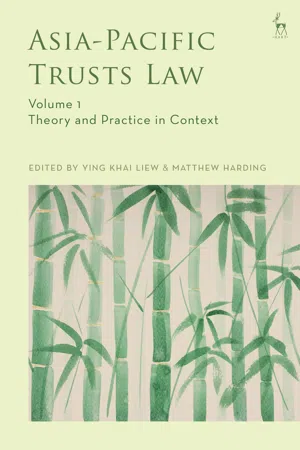
Asia-Pacific Trusts Law, Volume 1
Theory and Practice in Context
- 424 pages
- English
- ePUB (mobile friendly)
- Available on iOS & Android
eBook - ePub
About this book
At a time when Asia represents the fastest growing economic region, there is no better moment to consider what trusts law can contribute to societal stability and economic prosperity. This book does this by offering the first work that systematically explores trusts law across the region. Many Asian-Pacific jurisdictions have integrated and developed trusts law in their legal systems; either through colonial heritage or statutory activism. But the diversity of legal traditions and local contexts has resulted in trusts laws having a significantly varied impact across the region. In the modern globalised world there is growing need to adopt an outward looking approach in dealing with matters of common interest. This book answers this need by bringing together leading legal scholars and practitioners in the region to explore the theory and practice of trusts law, contextualised to specific jurisdictions in the Asia-Pacific. Exploring 17 jurisdictions in Asia, it bring both an academic and practitioner perspective to trusts law in the region.
Information
1
Introduction
YING KHAI LIEW* AND MATTHEW HARDING**
I.Background
It is as important as ever that legal discourse crosses jurisdictional boundaries. Of course, such crossings have occurred since ancient times, whether through imperial expansion, trade routes, religious or social movements, or simply the curiosity of jurists. They are so familiar in history that they often go unnoticed and unremarked upon. However, from our standpoint in the early twenty-first century, as geo-political trends in some respects push against cross-jurisdictional engagement, it is worth pointing out the many benefits that can flow when lawyers and academics understand, discuss and try to learn from each other’s legal systems. A collaborative approach, properly informed by historical and cultural differences, stands to generate insights that may seed legal and policy solutions to social, economic and even political challenges in multiple jurisdictions.
Cross-jurisdictional engagement has enriched the law of trusts as much as it has any other body of law. Again, such engagement has been present from the very beginning, reminding us of the importance of historical context in evaluating the widely accepted notion that the trust is a distinctive achievement of the peculiarly English legal practice known as equity.1 More recently, cross-jurisdictional perspectives on trusts law have been evident in initiatives such as the Hague Convention on Trusts of 1985, the Principles of European Trusts Law of 1999, and the Draft Common Frame of Reference (Principles, Definitions and Model Rules of European Private Law) of 2009. Scholarly efforts, too, have produced landmark contributions to academic literature bringing diverse jurisdictional perspectives to bear on central questions and puzzles for trusts law.2
While cross-jurisdictional dialogue on trusts law is thus well under way, there remain gaps. One significant gap relates to the theory and practice of trusts law in the Asia-Pacific region. Given the social, economic and political significance of this region, this might be thought surprising. On the other hand, the scale and rich diversity of the Asia-Pacific suggests that one reason why lawyers and academics from across the region do not talk to each other about trusts law is simply that they lack opportunities to do so. For those from jurisdictions with a common law heritage – Australia, Hong Kong, New Zealand and Singapore come immediately to mind – there are frequent and well-known conferences and other gatherings at which developments in trusts law in those jurisdictions can be reported, understood, discussed and critiqued. Similar opportunities exist for lawyers and scholars from the East Asian jurisdictions of Japan, South Korea, Taiwan and the People’s Republic of China (‘China’), whose trusts laws share a common genealogy. Beyond these established groupings and networks, little dialogue appears to take place – certainly none carried out in an inclusive and collaborative manner across the region. This represents a missed opportunity for trusts-advanced jurisdictions to contribute their experiences to those jurisdictions where trusts law is either less developed or absent. Equally, it represents a missed opportunity to gain insights from jurisdictions not typically looked to for trusts law expertise.
With this gap in mind, we organised the inaugural meeting of the ‘Asia-Pacific Trusts Law’ project in December 2019 at the Melbourne Law School, University of Melbourne. The symposium brought together lawyers and academics from the 17 jurisdictions of the Asia-Pacific region with the highest nominal GDP according to the International Monetary Fund.3 The jurisdictions are (from highest GDP to lowest): China, Japan, India, South Korea, Australia, Indonesia, Taiwan, Thailand, Hong Kong, Malaysia, Singapore, the Philippines, Bangladesh, Pakistan, Vietnam, New Zealand and Sri Lanka. The presenters were asked to focus on trusts law questions and issues in their respective jurisdictions. To these 17 presentations were added one presentation about ‘offshore’ jurisdictions in the South Pacific (the Cook Islands, Niue, Western Samoa), and another on private international law issues as they relate to trusts law in the region. This book builds on those presentations to provide the first in a series of edited collections discussing trusts law in the Asia-Pacific region.
II.The Book
The book is presented in five parts. The 17 jurisdiction-specific chapters are spread across parts I to IV, each of which groups jurisdictions together based on perceived commonalities. We explain these taxonomical choices in more detail below; for now, it will suffice to say that they are indeed choices and reasonable minds might disagree about the taxonomy of this book. We do not shy away from such disagreement. Rather, we welcome it, for debate and discussion about the appropriate classification of the trusts laws of various Asian-Pacific jurisdictions might well generate new insights about those bodies of law. Part V of the book presents the chapters on the offshore jurisdictions of the South Pacific and on private international law.
A.Part I
Part I contains chapters exploring aspects of trusts law and practice in five Asian-Pacific jurisdictions that are former colonies of the British Empire: Australia, New Zealand, Hong Kong, Malaysia and Singapore. These former British colonies sit plausibly together for the purposes of analysis for several reasons. First, despite having achieved political and legal independence from Britain, these are jurisdictions in which the common law (including equity) of England remains highly persuasive in local courts, including in relation to trusts. Second, the validity of trusts in these jurisdictions is not contingent on any statutory scheme. This is not to say that trusts statutes are absent in these jurisdictions; statutes governing the operation of trusts within specific contexts and regulating trustees’ duties are in fact quite commonplace. It is, rather, to point out that the recognition of trusts is a matter of common law and does not depend on the operation of any statute or ordinance. This is true even in New Zealand, where the landmark Trusts Act of 2019 purports extensively to ‘restate and reform’ the law of express trusts. As clarified by section 5(8) of that Act, the Act ‘is not an exhaustive code of the law relating to express trusts’, and ‘is intended to be complemented by the rules of the common law and equity relating to trusts (except where otherwise indicated)’.
A third perceived commonality in Australia, New Zealand, Hong Kong, Malaysia and Singapore is that in each of these jurisdictions the concept of the trust closely mirrors the orthodox conception in English law. Of course, in English law there is an ongoing debate about whether the trust is primarily concerned with relations of ‘obligation’,4 or with ‘property’,5 or indeed with both.6 However, historically the orthodoxy in English law has been that, at least to some extent, the trust entails a conception of dual ownership, or, putting it another way, a notion that legal title and beneficial interests in relation to property might be split. This reflects the historical origins of the trust in the practices of the English Court of Chancery, which operated to mitigate the rigours of common law. While common law would recognise the trustee alone as being the absolute owner of trust property by virtue of his or her legal title, equity was willing to recognise and enforce the substance of an agreement where the trustee took the property for and on behalf of another. A fourth and final commonality is that, in these jurisdictions, trusts arising by operation of law (resulting and constructive trusts) are recognised and enforced along with trusts that are directly the product of settlor intention (express trusts).
In her chapter on Australia, Jessica Hudson addresses the question of whether objects of a trust power or mere power have a right to the due administration of a trust. The orthodoxy is that the right to due administration is available only to beneficiaries as ‘equitable owners’ of the property. However, for various reasons the tendency of the modern settlor is to structure the intended beneficiaries under a trust as objects within a trust structure, and this gives rise to the need to re-examine the issue. While English law has struggled to provide a decisive answer, Hudson argues that in Australian law the answer is clearly in the affirmative. More fundamentally, she argues that this is the product of two related features of Australian law: that it accepts as valid discretionary powers which suspend an entitlement to the benefit of trust property, and that such an entitlement is not essential to the validity of express trusts. In turn, she argues that Australian law subscribes to a different interpretation of the beneficiary principle than that which is traditionally found in English law. This chapter provides an important reminder that differences do exist between English and other common law jurisdictions even in relation to basic and fundamental trusts law issues, and therefore that a careful, contextualised analysis is necessary for a proper understanding of trusts law in the Asia-Pacific.
New Zealand has one of the highest rates of trusts usage in the world, the majority of which are set up for private wealth management purposes. In this context settlors often attempt to retain as much control as possible over the trust, and thus it is common for litigation to challenge the validity of trusts. In Jessica Palmer’s chapter, she discusses different strategies New Zealand courts have adopted to circumvent these perceived misuses of trusts, thereby subordinating beneficiaries’ interests to other third parties such as creditors. While the courts often justify those strategies by reference to the need to take into account practical reality, Palmer explains how those strategies in fact put trusts principles under significant threat. This is of course not to say that orthodox trusts principles ought never to be departed from in order to meet the changing needs of a jurisdiction. But doing so at the expense of certainty and coherency brings the law into disrepute. Palmer’s chapter reminds us that, while trusts law can and ought to be kept alive as an organic body of law in the Asia-Pacific, caution must be exercised in order not to stretch the trust to breaking point if it is to retain its usefulness.
Hong Kong has experienced extensive and dramatic changes in its political and socio-economic landscape, and in their chapter Lusina Ho and Rebecca Lee trace how trusts law has developed and adapted through those changes. From the way in which trusts law grappled with Chinese customary landholding during the colonial period, to its mobilisation to serve the purposes of first-generation local entrepreneurs, to its modern role in transforming Hong Kong into an international financial centre, trusts law’s flexibility proves to be one of its greatest assets. Yet, Ho and Lee rightly caution against going too far; for trusts law to do its unique work, they argue against diluting the trust concept and in favour of preserving well-defined parameters for the trust. Thus, while the chapter masterfully traces the theory and practice of trusts law in Hong Kong, there is a deeper message, echoed also by other chapters in this book: trusts law is only practically useful where its development is theoretically coherent.
Ying Khai Liew’s chapter on Malaysia explores the ongoing influence of English law on the trusts law of Malaysia in a particular setting: that of statutory limitations to constructive trusts claims. The chapter brings to the surface a number of interesting interactions of wider significance for the trusts law of Malaysia. One is the interaction of English common law precedents and Malaysian common law precedents that build on and refer to, but differ in key respects from, their English counterparts. Another is the interaction of the English statutory heritage with local statutes; for example, the Statute of Frauds applies in some parts of Malaysia but not in others, and the same is true of limitations statutes inspired by English models. How should exogenous common law precedents and statutes be interpreted and understood in light of local legal developments since independence? And vice versa? A further interaction is that between statute and common law. Liew shows that Malaysian limitations statutes assume for their effective operation doctrinal clarity in the common law. What is to be done where such clarity is lacking? In the case of constructive trust claims, it is more important than ever that these questions receive satisfactory answers; after all, constructive trusts are an important component in the legal armoury for redressing the sort of large-scale fraud and corruption in Malaysia that has made international headlines in recent years.
Kelvin Low’s chapter examines the reception and development of the English law of implied trusts over family assets in Singapore. Low appeals to the political and social history of Singapore, and in particular to the Confucian and Victorian influences informing the thinking of Lee Kuan Yew and the People’s Action Party more generally. According to Low, these influences, putting the ‘traditional’ nuclear family at the very centre of the state-building project so distinctive of modern Singapore, have had a profound influence on how Singaporean judges have worked with implied trusts to achieve justice in family assets disputes. The chapter is a reminder of the importance of understanding political settings and culture when addressing the theory and practice of trusts in context in the Asia-Pacific. At the same time, it alerts us to the possibility that trusts law, as a state-enforced mechanism for the allocation and reallocation of property, might function as an instrument of social reform as well as a means for the achievement of settlor intentions and remedial objectives.
B.Part II
The chapters in part II of the book deal with aspects of trusts law and practice in India, Pakistan, Bangladesh, Sri Lanka and the Philippines. These are all jurisdictions in which trusts arise from the operation of legislation, rather than the common law. Thus, statutory interpretation has a central role to play in the application and development of trusts laws in these jurisdictions, although arguably less so for the Philippines given the brevity of the provisions of its Civil Code bearing on trusts.
India, Pakistan, Bangladesh and Sri Lanka are all former British colonies. However, unlike the former British colonies dealt with in part I, in these four jurisdictions trusts owe their existence and validity to the operation of a codified statute. The forerunner was the Indian Trusts Act of 1882, enacted at a time when Pakistan and Bangladesh were both part of British India. The Trusts Ordinance of Sri Lanka (Ceylon), enacted in 1917, was modelled on the Indian Trusts Act. And when Pakistan and Bangladesh achieved independence, they each passed an Adaptation Act,7 which adopted wholesale the Trusts Act of 1882. It might appear surprising that trusts statutes were thought necessary at all, given that these jurisdictions were directly influenced by English common law. On closer inspection, however, in these jurisdictions the influence of English common law was more attenuated than in the jurisdictions dealt with in part I, due mainly to the strong influence of posited and customary law already existing when the British first arrived.
The clearest case of such prior local influences is Sri Lanka: upon assuming rule in 1799, the British adopted the policy that prevailing laws would not be departed from unless ‘either absolutely necessary and unavoidable, or evidently beneficial and desirable’.8 Prevailing laws included Roman-Dutch law, introduced to the island by the Dutch who had ruled Sri Lanka since the mid-seventeenth century. The result was a piecemeal introduction of English law into Sri Lanka, with Roman-Dutch law retained as the ‘common law’ of the island, as remains the case today. Unsurprisingly, the s...
Table of contents
- Cover
- Title Page
- Preface
- Contents
- 1. Introduction
- PART I
- PART II
- PART III
- PART IV
- PART V
- Index
- Copyright Page
Trusted by 375,005 students
Access to over 1.5 million titles for a fair monthly price.
Study more efficiently using our study tools.
Frequently asked questions
Yes, you can cancel anytime from the Subscription tab in your account settings on the Perlego website. Your subscription will stay active until the end of your current billing period. Learn how to cancel your subscription
No, books cannot be downloaded as external files, such as PDFs, for use outside of Perlego. However, you can download books within the Perlego app for offline reading on mobile or tablet. Learn how to download books offline
Perlego offers two plans: Essential and Complete
- Essential is ideal for learners and professionals who enjoy exploring a wide range of subjects. Access the Essential Library with 800,000+ trusted titles and best-sellers across business, personal growth, and the humanities. Includes unlimited reading time and Standard Read Aloud voice.
- Complete: Perfect for advanced learners and researchers needing full, unrestricted access. Unlock 1.5M+ books across hundreds of subjects, including academic and specialized titles. The Complete Plan also includes advanced features like Premium Read Aloud and Research Assistant.
We are an online textbook subscription service, where you can get access to an entire online library for less than the price of a single book per month. With over 1.5 million books across 990+ topics, we’ve got you covered! Learn about our mission
Look out for the read-aloud symbol on your next book to see if you can listen to it. The read-aloud tool reads text aloud for you, highlighting the text as it is being read. You can pause it, speed it up and slow it down. Learn more about Read Aloud
Yes! You can use the Perlego app on both iOS and Android devices to read anytime, anywhere — even offline. Perfect for commutes or when you’re on the go.
Please note we cannot support devices running on iOS 13 and Android 7 or earlier. Learn more about using the app
Please note we cannot support devices running on iOS 13 and Android 7 or earlier. Learn more about using the app
Yes, you can access Asia-Pacific Trusts Law, Volume 1 by Ying Khai Liew,Matthew Harding in PDF and/or ePUB format, as well as other popular books in Diritto & Teoria e pratica del diritto. We have over 1.5 million books available in our catalogue for you to explore.