This book undertakes a systematic analysis of the 2019 Hague Judgments Convention, the 2005 Hague Choice of Court Convention 2005, and the 2017 Commonwealth Model Law on recognition and Enforcement of Foreign Judgments from a pragmatic perspective.
The book builds on the concept of pragmatism in private international law within the context of recognition and enforcement of judgments. It demonstrates the practical application of legal pragmatism by setting up a toolbox (pragmatic goals and methods) that will assist courts and policymakers in developing an effective and efficient judgments' enforcement scheme at national, bilateral and multilateral levels.
Practitioners, national courts, policymakers, academics, students and litigants will benefit from the book's comparative approach using case law from the United Kingdom and other leading Commonwealth States, the United States, and the Court of Justice of the European Union. The book also provides interesting findings from the empirical research on the refusal of recognition and enforcement in the UK and the Commonwealth statutory registration schemes respectively.
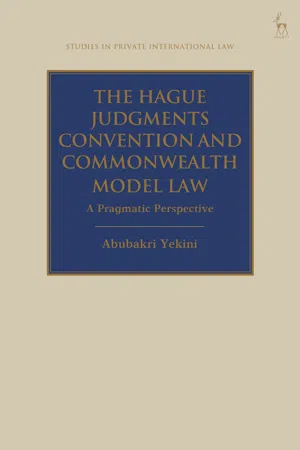
eBook - ePub
The Hague Judgments Convention and Commonwealth Model Law
A Pragmatic Perspective
- 308 pages
- English
- ePUB (mobile friendly)
- Available on iOS & Android
eBook - ePub
About this book
Information
1
General Introduction
I.Background of Study
Before the first wave of globalisation, civil litigation was essentially territorially defined. For instance, English courts would normally not exercise jurisdiction over a non-resident defendant because of the inconvenience of attending proceedings from a long distance.1 Also, they would not be disposed to granting orders that could not be enforced by arresting the defendant or seizing his assets within the jurisdiction of the court except where there was an assurance that the non-resident defendant would comply with the judgment or the judgment would be enforced abroad.2
Ever since the period of the Industrial Revolution, the world has witnessed a growing transformation of businesses and social engagements. The advancements in telecommunication technologies and efficient means of mass transportation have practically eroded State borders and distances between different parts of the world.3 One of the effects of these developments was an increase in economic flows, migration and capital transfer from Europe to other parts of the world, leading to the development of other economies in Asia, Africa and South America.4 Statistics show that all regions continue to experience economic growth as a result of global economic integration and a reduction in trade costs.5 The impact has been even more pronounced in the last two decades which saw an unprecedented increase in the number of Small and Medium Enterprises (SMEs) across the globe, a thriving gig economy and new business solutions that are added to the markets daily through numerous digital platforms.
The impact of globalisation is not limited to the commercial sphere. Rather, it permeates all areas of human endeavour including civil/personal relations.6 The modern family is becoming increasingly international due to the interconnectedness of today’s societies, the booming international marriage brokering business, and the availability of several social networking platforms.7 Apart from personal relationships, there is also an increasing internationalisation of tortious conduct such as online defamation via social media platforms, cross-border intellectual property theft, environmental degradation by foreign multinational corporations amongst others.8
The increase in cross-border trade, service and other interpersonal relationships have inevitably led to a corresponding increase in cross-border commercial and non-commercial conflicts. Unlike in the era before the Industrial Revolution, territorialism no longer exclusively defines civil litigation. The field of modern international civil procedure is complex and diverse owing to the absence of internationally harmonised civil procedure rules governing jurisdiction and judgments. Cross-border litigants are thus required to be very strategic in their choice of venue for litigation because that choice has implications for both the substantive outcome of the litigation and whether the successful party will be able to reap the benefits of his judgment.
As Professors Nadia de Araujo and Marcelo De Nardi rightly note, litigants may not always need to enforce foreign judgments. This situation may arise where the debtor complies with the judgment or where the creditor obtained a judgment in the jurisdiction where the debtor has enough assets to satisfy the judgment or where the case has no foreign element.9 However, this is not always the case. In the modern era, it is much easier for a smart defendant to judgment-proof himself by cascading his assets to States that do not have personal jurisdiction over him or subject-matter jurisdiction over the impending dispute. To cite a few examples, in Marex Financial Ltd v Sevilleja,10 a director asset-stripped his company by transferring a substantial part of the company’s funds abroad to his personal account, leaving the company with minimal assets for enforcement proceedings. In a similar vein, ICICI Bank UK Plc v Diminico NV11 illustrates how a company with a turnover of US$300m left only €2,600 in Belgium where it was sued. Fortunately, the judgment creditor was able to pursue some of the judgment debtor’s assets in England.
For cross-border disputes, the probability is high that a judgment creditor may need to apply to the court of another State to enforce his judgment, since such disputes always have foreign elements. Thus, a cross-border litigant, especially a judgment creditor, needs to consider the legal regimes of both the State where he intends to sue (S1) and other State(s) (S2) where he might need to enforce the outcome of the proceedings of S1.
While transactions are increasingly international, the legal regimes governing these transactions are largely national. The divergent national laws and policies create an unhealthy business environment for cross-border litigants because of the prevalent uncertainties concerning procedural laws and eventually the enforceability of foreign judgments. Besides, the role of the courts, the functions of law, the standards of justice, and States’ interests differ. This has a great impact on the global circulation of foreign judgments. The civil law legal systems12 generally recognise foreign judgments and allow them to be enforced after undergoing a special examination called ‘an exequatur’. An exequatur proceeding enables a court addressed to examine the foreign judgment to ensure, among other things, that the foreign court had jurisdiction over the matter, the judgment debtor was given a fair trial, the enforcement is not objectionable to the forum’s public policy, and also to consider whether its own judgments (the judgments of the court addressed) enjoy favourable treatment in the State of origin. The civil law tradition was exported from Europe to countries in the Middle East via Egypt,13 the majority of the Latin American States14 and Francophone countries in Africa.15 It should be noted, however, that the details of foreign judgments laws and practices developed differently amongst the States.
Unlike the heterogeneous practices in the civil law jurisdictions, the judgments recognition rules of common law as developed in England were applied, uniformly to a large extent, in the Commonwealth. No recognition was accorded to foreign judgments simpliciter, as foreign courts were not part of the English courts of record.16 However, common law courts often recognise the rights created by a foreign judgment through the doctrine of legal obligation. In other jurisdictions such as Canada, comity plays a key role in their judgments enforcement practice. Under civil and common law systems, certain hurdles usually present themselves when judgment creditors attempt to enforce foreign judgments.17
The divergent national responses have not provided the required legal certainty and predictability for cross-border litigants. These challenges were noted as far back as the late nineteenth century by Mancini and Asser who were very concerned with the state of confusion arising from the divergent rules of various States, especially, their European neighbours. From their days at the Institut de Droit International (IDI), they had conceived the idea of forming a special body of lawyers to promote the progressive development and unification of private international law rules.18 In 1869, Asser, in his writing in Revue de Droit International et de Législation Compare advocated for an international solution to the problems of recognition and enforcement of foreign judgments.19 This, among other reasons, ignited his passion for the establishment of the Hague Conference on Private International Law (Hague Conference) for the progressive development of private international law in 1893.
In the last six decades, many States have realised the need for deeper legal and judicial cooperation as the most suitable way to resolve the numerous practical problems surrounding foreign judgments recognition and enforcement. It is considered that litigants need a simple and effective global legal framework through which they can make an informed decision concerning their commercial and non-commercial activities. Before the recent achievements from the Hague Conference, Several States concluded bilateral and regional judgments enforcement frameworks. In Latin America, examples of such regional legal frameworks on foreign judgments include the Inter-American Convention on General Rules of Private International Law,20 the Inter-American Convention on Extraterritorial Validity of Judgments and Arbitral Awards21 and the Inter-American Convention on Jurisdiction in the International Sphere for the Extraterritorial Validity of Foreign Judgments.22 The EU also has several Regulations concerning foreign judgments and they have direct application in all Member States. Notable among them are Regulation (EU) No 1215/2012 of the European Parliament and of the Council of 12 December 2012 on jurisdiction and the recognition and enforcement of judgments in civil and commercial matters (Brussels Ia), Council Regulation (EC) No 2201/2003 of 27 November 2003 concerning jurisdiction and the recognition and enforcement of judgments in matrimonial matters and the matters of parental responsibility (Brussels IIa); Enforcement Order Regulation, European Account Preservation Order Regulation, European Small Claims Procedure Regulation, and European Payment Order Regulation.23 Apart from the regional frameworks, there are several bilateral frameworks and court-to-court agreements across the globe.
At the global level, the Hague Conference has been working assiduously to deliver global conventions on jurisdiction and judgments. The first judgments convention was concluded in 1971 but that convention did not enjoy wide ratification amongst Member States of the Conference. Further work on judgments has produced a Convention of 30 June 2005 on Choice of Court Agreements (HCCA) and a broader brand-new Convention of 2 July 2019 on the Recognition and Enforcement of Foreign Judgments in Civil or Commercial Matters. Other relevant specialised conventions that affect foreign judgments’ enforcement include the Convention of 23 November 2007 on the International Recovery of Child Support and Other Forms of Family Maintenance; the Convention of 19 October 1996 on Jurisdiction, Applicable Law, Recognition, Enforcement and Co-operation in Respect of Parental Responsibility and Measures for the Protection; and the Convention of 29 May 1993 on Protection of Children and Cooperation in Respect of Intercountry Adoption.24
II.Research Problem
The issues that are now associated with the recognition and enforcement of foreign judgments emerged from territorialism in eighteenth-century Europe as newly formed States began to guard their respective territories and sovereignty jealously against foreign sovereign acts. Judges were considered as sovereigns’ agents and judicial decisions in...
Table of contents
- Cover
- Dedication
- Title Page
- Series Editor’s Preface
- Preface
- Acknowledgements
- Contents
- List of Abbreviations
- List of Charts and Tables
- Table of Cases
- Table of Statutes/Conventions
- 1. General Introduction
- PART I: THEORETICAL FRAMEWORKS FOR JUDGMENTS RECOGNITION AND ENFORCEMENT
- PART II: COMMONWEALTH MODEL LAW ON THE RECOGNITION AND ENFORCEMENT OF FOREIGN JUDGMENTS
- PART III: HAGUE CONVENTIONS
- Bibliography
- Index
- Copyright Page
Trusted by 375,005 students
Access to over 1.5 million titles for a fair monthly price.
Study more efficiently using our study tools.
Frequently asked questions
Yes, you can cancel anytime from the Subscription tab in your account settings on the Perlego website. Your subscription will stay active until the end of your current billing period. Learn how to cancel your subscription
No, books cannot be downloaded as external files, such as PDFs, for use outside of Perlego. However, you can download books within the Perlego app for offline reading on mobile or tablet. Learn how to download books offline
Perlego offers two plans: Essential and Complete
- Essential is ideal for learners and professionals who enjoy exploring a wide range of subjects. Access the Essential Library with 800,000+ trusted titles and best-sellers across business, personal growth, and the humanities. Includes unlimited reading time and Standard Read Aloud voice.
- Complete: Perfect for advanced learners and researchers needing full, unrestricted access. Unlock 1.5M+ books across hundreds of subjects, including academic and specialized titles. The Complete Plan also includes advanced features like Premium Read Aloud and Research Assistant.
We are an online textbook subscription service, where you can get access to an entire online library for less than the price of a single book per month. With over 1.5 million books across 990+ topics, we’ve got you covered! Learn about our mission
Look out for the read-aloud symbol on your next book to see if you can listen to it. The read-aloud tool reads text aloud for you, highlighting the text as it is being read. You can pause it, speed it up and slow it down. Learn more about Read Aloud
Yes! You can use the Perlego app on both iOS and Android devices to read anytime, anywhere — even offline. Perfect for commutes or when you’re on the go.
Please note we cannot support devices running on iOS 13 and Android 7 or earlier. Learn more about using the app
Please note we cannot support devices running on iOS 13 and Android 7 or earlier. Learn more about using the app
Yes, you can access The Hague Judgments Convention and Commonwealth Model Law by Abubakri Yekini in PDF and/or ePUB format, as well as other popular books in Law & Conflict of Laws. We have over 1.5 million books available in our catalogue for you to explore.