Armed non-state actors (ANSAs) often have economic aims that international law needs to respond to. This book looks at the aim of Islamic State to create an effective government, with an economically independent regime, which focused on key oilfields in Syria and Iraq. Having addressed Islamic State's quest for energy resources in Iraq and Syria, the book explores the lawfulness of the war with Islamic State from a variety of legal aspects. It has been attempted to make inroads into the most controversial aspects of contradictions in the application of jus ad bellum and jus in bello, particularly when discussing the use of extraterritorial armed force against ANSAs, and the obligation to protect civilian objects, including the natural environment.
The question is whether the targeting of energy resources should be regarded as a violation of the laws of armed conflict, even though the war with Islamic State being classified as a non-international armed conflict. Ambitious in scope, the study argues that legal theory and state practice are still problematic as to how and under what conditions states can justify resorting to military force in foreign territory, and to what extent they can target natural resources as being part of state property. Furthermore, it goes on to examine the differences between international and non-international armed conflicts, to establish whether there is any difference in the targeting of energy resources as part of the war-sustaining capabilities of either party.
Through an examination of the Islamic State case, the book offers a comprehensive study to close the gaps in jus in bello by contextualising the questions of civilian protection, victimisation and state responsibility by evaluating the US's war-sustaining theory as a justification for the destruction of a territorial state's natural resources that are occupied by ANSAs.
eBook - ePub
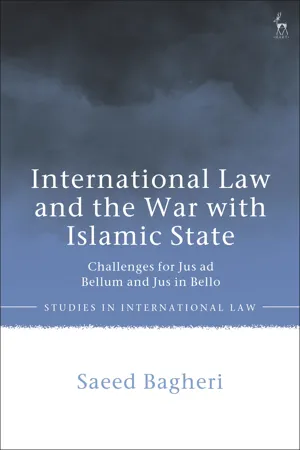
International Law and the War with Islamic State
Challenges for Jus ad Bellum and Jus in Bello
- 208 pages
- English
- ePUB (mobile friendly)
- Available on iOS & Android
eBook - ePub
International Law and the War with Islamic State
Challenges for Jus ad Bellum and Jus in Bello
About this book
Information
1
The Rise of Islamic State and Its Military Strength
‘The rise of [Islamic State] shows the urgent need to understand what has happened within Arab societies and the international relations of the Middle East’.1
I.INTRODUCTION
Although the overriding purpose of this book is to consider the lawfulness of the use of force against ANSAs and the destruction of energy resources controlled by them, the first substantive part of the book begins by considering how energy sources have become the focal point for states, ANSAs, and external powers, which have been at constant risk of violence and armed conflicts. Providing a contemporary perspective, this part shows that taking control over and using energy resources has often been one of the leading causes of armed conflicts in oil-rich countries and has invariably threatened regional and international peace and security.
This chapter begins by examining the emergence and strength of Islamic State in Iraq and Syria to see how its quest for energy resources in these countries triggered violence following the national and military intervention in Iraq and Syria. It then proceeds by describing Islamic State’s legal status, its actions inside Iraq and Syria, and its cross-border military actions. The ways in which Islamic State constituted an increasing threat to international peace and security will be explored. Chapter 1 then proceeds by analysing what the correlation between energy resources and armed conflict can tell us about the insecurity and the threat of violence as the costs of failed resource management, and the role of energy resources in intensifying Islamic State’s advance and its military operations in Iraq and Syria. It demonstrates that failed resource management and ANSAs’ quest for energy resources in energy-rich countries have often been the sources of violence and insecurity at the national and international level. A failure to address these issues at the beginning of the book would cast doubt on the validity of this study’s main arguments, whose primary purpose draws on the relationship between the quest for energy resources and the extraterritorial use of armed force against Islamic State in Iraq and Syria.
II.ISLAMIC STATE AT A GLANCE: GENERAL OBSERVATIONS
A.The Rise and Strength of Islamic State
The emergence of Islamic State in the fragile and generally conflict-affected Middle East has caused significant changes in the political behaviour and position of the Middle Eastern states as well as the regional and international powers. Islamic State, which arose shortly after US forces left Iraq, is one of the most powerful Islamic jihadist groups that has ever existed. Islamic State consolidated its power by occupying major parts of Iraqi and Syrian territory over a very short period and declaring an Islamic Caliphate, and its acts of violence and terrorism focused the international community’s attention on the Middle East. The emergence of Islamic State took the international community by surprise, particularly after the group declared a worldwide caliphate. Its success has undoubtedly been undergirded by the radical Islamic beliefs of its members, but more importantly by the failure of the Iraqi central government to ensure peace, stability, economic growth and the reasonable distribution of resources, particularly after the US invasion which provided the grounds for economic inequality and violent competition between a number of parties over Iraq’s energy resources.2
Part of the story of the rise of Islamic State is tied to the US invasion of Iraq in 2003. Although there are various opinions about the main factors that allowed the rise of Islamic State in Iraq and Syria,3 it seems that the main factors are the group’s radical ideology and its aspirations for an eventual caliphate. Having looked at Islamic State’s declarations and statements, it would seem that the group apparently uses Islamic rules to legitimise its violent jihadist campaign across the world.4 However, other arguments – as originally expounded by the Prophet Muhammad – mention that Islam should promote peaceful relations between nations.5
Islamic State has been more successful in strengthening and expanding its power in Iraq and Syria than was ever expected, and a sequence of external factors and conditions has undoubtedly facilitated this process. Within this particular context, the invasion of Iraq by the US-led coalition, the failure of the Iraqi central government to provide basic infrastructure for its citizens as a result of weak economic conditions, and the lack of an organised authority or political power to prevent minor conflicts from becoming major ones, has led to political and social troubles, instability and violence.6 The defeat of the Iraqi army and the establishment of a new government led to violence and an asymmetrical war between the insurgents, the US military and the Iraqi central government.7 Although the US government was seeking to establish a stable regime in Iraq, the invasion had many adverse consequences. Eventually, instability and insecurity, a humanitarian crisis, the dissolution of the Iraqi army, the inefficiency of the US army in taking control of Iraq in its entirety, the sectarian policies of the Iraqi central government under the leadership of Nuri al-Maliki for the benefit of Iraq’s Shi’ite majority and its attempts to weaken the Sunnis,8 and increasing protests and rebellions within Iraqi society led to a resurgence of Islamic jihadist groups in the country. The marginalisation and exclusion of Sunni leaders from political decision-making in the new government has been the major determinant in the increased uprisings and protests within Iraqi society. Since late 2012, the Sunni protests in Sunni-dominated regions – mainly in Kirkuk, Nineveh, Ramadi, Mosul and Fallujah – against the Shi’ite-dominated central government has led to the deaths of dozens of protestors. As a result of the triggered tensions, the Iraqi central government withdrew its security forces from Ramadi and Fallujah. This presented a golden opportunity for Islamic State, which proceeded to capture Fallujah in 2014.9 Ultimately, the long-standing disagreements and ethnoreligious conflicts10 between the Sunni and Shi’ite groups and the divided Kurdish-Arab ethnic groups have led to insecurity and a loss of confidence in the Iraqi central government.
Failed states have always been a threat to international security. However, because of their weak and fragile dynamics, they are becoming more dangerous, as terrorist groups frequently use them as bases of operation.11 For this very reason, the failure of the Iraqi central government to perform basic functions such as guaranteeing security, good governance, and a thriving economy has created a power vacuum and has caused instability both in Iraqi society and throughout the Middle East. Due to the inability of weak and failed states to exert central control over their territories,12 and their inability to take effective anti-terrorism measures, terrorist groups have attempted to take advantage of the power vacuum to further their objectives. Most crucially, terrorist groups often take advantage of regional players. For instance, al-Qaeda expanded its power and influence in the Middle East with the support of Sunni Muslim groups.13 All in all, weak and failed states provide a more convenient environment in which foreign terrorists can assemble. For instance, as a result of the weakness of the Iraqi and Syrian governments and their inability to fight against terrorism, thousands of foreign fighters from Egypt, Qatar, Saudi Arabia, France, Morocco and Algeria left their countries of origin to join Islamic State.14
Following the US-led invasion in 2003, the Iraqi central government lost control over national security, thereby making it possible for terrorist groups to establish themselves. Consequently, the entire world witnessed the presence of thousands of foreign terrorists fighting alongside Islamic State. According to a 2015 report by the Soufan Group (TSG), a US-based security consultancy firm, more than 30,000 foreign fighters from at least 86 countries have travelled to Iraq and Syria to join Islamic State and other violent extremist groups.15
Similarly, pro-democracy protests against President Bashar al-Assad in Syria, which initially began peacefully in March 2011, led to the killings of several protestors and plunged the country into chaos. This allowed Islamic State to take advantage of the situation and to expand its influence, while Syrian society remained repressive on the eve of the 2011 uprisings. At the onset of the chaos in Syria, Islamic State sent material support and delegates to various anti-government rebel groups.16 The uprisings and the subsequent civil war developed as a result of President Assad’s disruptive statements in which he characterised the opposition as Sunni Islamic extremists in the mould of al-Qaeda, plotting against the Syrian regime. Assad’s regime claimed from the outset that the uprising in Syria was the work of criminals, sectarians and terrorists supported by foreigners.17 This seems to suggest that Sunni sectarianism and ethnic division have been the most crucial factors in the deterioration of the security situation in Iraq and Syria. The Iraqi and Syrian governments’ policies and the implementation of strategies in this respect undermined their legitimacy and provided a ground for the resurgence of al-Qaeda and Islamic State in the two countries.18 The sectarian and ethnic division in Iraq and Syria, which has betrayed people’s trust in central government, brought Sunni groups more in line with Islamic State.19
B.The Legal Status of Islamic State
Islamic State’s leaders call the group a ‘state’; however, it should be ascertained whether the conditions required for the formation and creation of a sovereign state in international law exist for Islamic State.
There are different views as to what makes a state. Various scholars have defined the concept of a state in different ways. Some analyse the concept from an ‘institutional’ perspective, while others look at the state from a ‘functional’ perspective. Michael Mann, a British sociologist, has defined the state from an institutional perspective, as a concept which includes four main elements: (a) a differentiated set of institutions and personnel, embodying (b) centrality in the sense that political relations radiate outwards from a centre to cover (c) a territorially demarcated area, over which it exercises (d) a monopoly of authoritative rule-making, backed up by a monopoly over physical violence.20 However, from a functional perspective, Max Weber argued that ‘a compulsory political association with continuous organisation (politischer Anstaltsbetrieb) will be called a “state” if and insofar as its administrative staff successfully upholds a claim to the monopoly of the legitimate use of physical force in the enforcement of its order’.21
Despite the institutional and functional definitions of ‘state’ mentioned above, the most crucial issue is the current absence of an official definition of ‘state’ under international law. Despite all the difficulties, however, the essential requirements of statehood under international law that have been commonly accepted by the international community are set out in the Montevideo Convention on the Rights and Duties of States (1933).22 As stated in Article 1 of the Convention, ‘the state’, as a person of international law, should possess ‘a permanent population’, ‘a defined territory’, ‘government’, and the ‘capacity to enter into relations with other states’. In addition to the conditions mentioned by the Montevideo Convention, there is also a widely accepted view, raised customarily by the international community of states and particularly by some legal scholars, that ‘independence’ and ‘legitimacy’ are also required conditions for the creation of a state.23
At first glance, it could probably be claimed that the jihadist group known as Islamic State has a permanent population, since many of the Sunni tribes in western Iraq, Syria, Libya and Afghanistan pledged allegiance to Abu Bakr al-Baghdadi, the leader of the group, at the creation of the movement. The group entered...
Table of contents
- Cover
- Title Page
- Foreword
- Acknowledgements
- Contents
- Abbreviations and Acronyms
- Table of Cases
- Table of International Treaties and Conventions
- Introduction
- 1. The Rise of Islamic State and Its Military Strength
- 2. The War with Islamic State as a Matter of Jus ad Bellum
- 3. The Legality of the Attacks on Energy Resources Occupied by Islamic State as a Matter of Jus in Bello
- Conclusion
- Bibliography
- Index
- Copyright Page
Trusted by 375,005 students
Access to over 1.5 million titles for a fair monthly price.
Study more efficiently using our study tools.
Frequently asked questions
Yes, you can cancel anytime from the Subscription tab in your account settings on the Perlego website. Your subscription will stay active until the end of your current billing period. Learn how to cancel your subscription
No, books cannot be downloaded as external files, such as PDFs, for use outside of Perlego. However, you can download books within the Perlego app for offline reading on mobile or tablet. Learn how to download books offline
Perlego offers two plans: Essential and Complete
- Essential is ideal for learners and professionals who enjoy exploring a wide range of subjects. Access the Essential Library with 800,000+ trusted titles and best-sellers across business, personal growth, and the humanities. Includes unlimited reading time and Standard Read Aloud voice.
- Complete: Perfect for advanced learners and researchers needing full, unrestricted access. Unlock 1.5M+ books across hundreds of subjects, including academic and specialized titles. The Complete Plan also includes advanced features like Premium Read Aloud and Research Assistant.
We are an online textbook subscription service, where you can get access to an entire online library for less than the price of a single book per month. With over 1.5 million books across 990+ topics, we’ve got you covered! Learn about our mission
Look out for the read-aloud symbol on your next book to see if you can listen to it. The read-aloud tool reads text aloud for you, highlighting the text as it is being read. You can pause it, speed it up and slow it down. Learn more about Read Aloud
Yes! You can use the Perlego app on both iOS and Android devices to read anytime, anywhere — even offline. Perfect for commutes or when you’re on the go.
Please note we cannot support devices running on iOS 13 and Android 7 or earlier. Learn more about using the app
Please note we cannot support devices running on iOS 13 and Android 7 or earlier. Learn more about using the app
Yes, you can access International Law and the War with Islamic State by Saeed Bagheri in PDF and/or ePUB format, as well as other popular books in Law & International Law. We have over 1.5 million books available in our catalogue for you to explore.