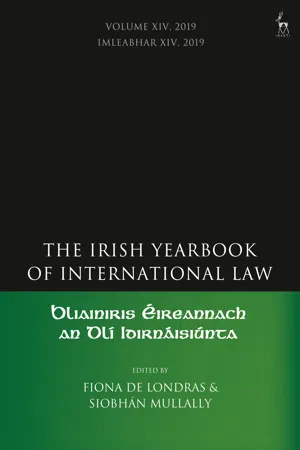
The Irish Yearbook of International Law supports research into Ireland's practice in international affairs and foreign policy, filling a gap in existing legal scholarship and assisting in the dissemination of Irish policy and practice on matters of international law. On an annual basis, the Yearbook presents peer-reviewed academic articles and book reviews on general issues of international law. Designated correspondents provide reports on international law developments in Ireland, Irish practice in international bodies, and the law of the European Union as relevant to developments in Ireland. In addition, the Yearbook reproduces key documents that reflect Irish practice on contemporary issues of international law.
This volume of the Yearbook includes a discussion of human rights based responses to human trafficking; the intersection between business and human rights in Ireland and statements on women, peace and security.
eBook - ePub
The Irish Yearbook of International Law, Volume 14, 2019
- 192 pages
- English
- ePUB (mobile friendly)
- Available on iOS & Android
eBook - ePub
The Irish Yearbook of International Law, Volume 14, 2019
About this book
Information
Correspondent Reports
Human Rights in Ireland 2019
2019 SAW IRELAND continuing to react to the ongoing developments in the United Kingdom’s exit from the European Union. At home, Ireland further advanced its commitments to human rights by ratifying the Istanbul Convention on combatting violence against women and domestic violence. It also received Concluding Observations from the United Nations Committee on the Elimination of Racial Discrimination which focused on the experiences of migrants, persons of ethnic minorities, and Travellers, in the jurisdiction. The Committee also criticised the Direct Provision system of asylum-seeker reception, and urged the Government to phase it out in favour of a more human rights-compliant system.
LEGISLATIVE DEVELOPMENTS
Ratification of the Istanbul Convention
The Government of Ireland ratified the Council of Europe Convention on preventing and combatting violence against women and domestic violence (the Istanbul Convention) on the 8th March 2019 (International Women’s Day). Ireland had signed the Convention in November 2015. Ratification followed the passage of the Criminal Law (Extraterritorial Jurisdiction) Act 2019 following the earlier promulgation of the Domestic Violence Act 2018, the Criminal Justice (Sexual Offences) Act 2017 and the Victims of Crime Act 2017.
Article 1 of the Istanbul Convention describes its purpose as to:
a)protect women against all forms of violence, and prevent, prosecute and eliminate violence against women and domestic violence;
b)contribute to the elimination of all forms of discrimination against women and promote substantive equality between women and men, including by empowering women;
c)design a comprehensive framework, policies and measures for the protection of and assistance to all victims of violence against women and domestic violence;
d)promote international co-operation with a view to eliminating violence against women and domestic violence;
e)provide support and assistance to organisations and law enforcement agencies to effectively co-operate in order to adopt an integrated approach to eliminating violence against women and domestic violence.
Compliance with the Istanbul Convention is overseen by GREVIO (the Council of Europe Group of Experts on Action against Violence against Women and Domestic Violence).
Ireland reserved the right not to apply the provisions of the Convention that relate to compensation for victims of domestic violence (Article 30(2)) and jurisdiction for the prosecution of offences (Article 44(3)).
HUMAN RIGHTS IN THE SUPERIOR COURTS
Nano Nagle School v Marie Daly
In July 2019, the Supreme Court handed down its decision in the case of Nano Nagle School v Marie Daly.1 This case concerned employment law: specifically, reasonable accommodations for disabled employees. The case was an appeal from a decision of the Labour Court concerning the Employment Equality Act 1998–2011. The appellant, Ms Daly, was a Special Needs Assistant (SNA) at the respondent school, which catered for children with autism and mild to profound disabilities. She became paralysed from the waist down following a car accident in 2010 and, due to her disability disqualifying her from the ‘significant’ physical elements of her job, was refused permission to return to work the following year.2
The appellant took a claim to the Equality Tribunal under the Employment Equality Act 1998–2011, sections 6, 8 and 16, alleging unlawful discrimination by her employer, and that ‘the employer had failed to comply with its statutory duty under s.16(3) and (4) of the legislation, to provide ‘reasonable accommodation’ or ‘appropriate measures’, to accommodate her disability, which would have allowed her to return to work’.3 The Equality Officer held that the school had not performed any unlawful discrimination as the applicant was no longer fully competent to undertake the duties involved in the position, and that she was not entitled to any remedy.4 The appellant appealed to the Labour Court, which overturned the Equality Officer’s decision and held that the school had not complied with section 16(3) of the Act.5 The school appealed to the High Court on points of law, and the High Court upheld the Labour Court’s decision; the school then further appealed to the Court of Appeal, which overturned the High Court’s decision. Leave was then sought by the appellant to appeal to the Supreme Court, which was granted.6 In granting the leave, the Supreme Court identified as a point of law the difference between the ‘tasks’ and ‘duties’ involved in a post.7
The Employment Equality Act 1998–2011 ‘promotes equality between employed persons and … outlaws discrimination in connection with work related activities on nine distinct grounds, including disability’. The Act provides for ‘reasonable accommodation’ for disabled employees through ‘appropriate measures’. However, there is a question over the nature of the essential duties, versus non-essential tasks, involved in any particular position. The appellant felt that the Court of Appeal interpreted section 16 of the Act ‘so as to render it necessary for a disabled person, on reasonable accommodation, to be able to perform all of what were seen as the core duties of a position of employment’. This, in their estimation, would defeat the Act’s purpose. The respondent disagreed.8
Section 16 of the Act is the most relevant to the questions in play in this case. It provides that an employer does not have to retain an employee in a position if they are not ‘fully competent and available to undertake, and fully capable of undertaking, the duties attached to that position’ (s 16(1)); however, an employer should make reasonable accommodations for the employee if doing so does not impose a disproportionate burden on them (s 16(3)).9 The respondent school submitted that the Court of Appeal was correct in interpreting these sections sequentially: s 16(3) as subject to s 16(1). Therefore,
if it is shown that an employer has formed a bona fide belief that an employee with disabilities was not fully capable of performing the duties for which he or she was employed, there is a complete defence to a claim of discrimination.10
The Court of Appeal also held that there is a difference between core, essential duties of a position, and non-essential tasks. The redistribution of tasks was held to be a reasonable accommodation which an employer should make.11
The Supreme Court surveyed some international law on the issue,12 including European Union Council Directive 2000/78/EC (the ‘Framework Directive’),13 the United Nations Convention on the Rights of Persons with Disabilities, and the jurisprudence of the Court of Justice of the European Union in HK Danmark (Jette Ring) v Dansk almennyttigt Boligselskab.14 It then went on to review the facts of the case in hand. The applicant undertook various non-teaching duties in the school as an SNA.15 Following her car accident, she completed a successful rehabilitation and was cleared by a senior occupational therapist in the National Rehabilitation Centre to return to her work. She was also cleared by the school’s own occupational physician to return to work, subject to an assessment of which activities it would be safe for her to perform.16
Two assessments were performed, the latter of which was considered in depth by the Court.17 The assessment reports were returned to the school, at which point the school’s occupational physician, Dr Madden, concluded that Ms Daly was not medically fit for the role of an SNA d...
Table of contents
- Cover
- Title Page
- Table of Contents
- Editorial
- Articles
- Correspondent Reports
- Documents
- Copyright Page
Trusted by 375,005 students
Access to over 1.5 million titles for a fair monthly price.
Study more efficiently using our study tools.
Frequently asked questions
Yes, you can cancel anytime from the Subscription tab in your account settings on the Perlego website. Your subscription will stay active until the end of your current billing period. Learn how to cancel your subscription
No, books cannot be downloaded as external files, such as PDFs, for use outside of Perlego. However, you can download books within the Perlego app for offline reading on mobile or tablet. Learn how to download books offline
We are an online textbook subscription service, where you can get access to an entire online library for less than the price of a single book per month. With over 1.5 million books across 990+ topics, we’ve got you covered! Learn about our mission
Look out for the read-aloud symbol on your next book to see if you can listen to it. The read-aloud tool reads text aloud for you, highlighting the text as it is being read. You can pause it, speed it up and slow it down. Learn more about Read Aloud
Yes! You can use the Perlego app on both iOS and Android devices to read anytime, anywhere — even offline. Perfect for commutes or when you’re on the go.
Please note we cannot support devices running on iOS 13 and Android 7 or earlier. Learn more about using the app
Please note we cannot support devices running on iOS 13 and Android 7 or earlier. Learn more about using the app
Yes, you can access The Irish Yearbook of International Law, Volume 14, 2019 by Fiona de Londras, Siobhán Mullally, Fiona de Londras,Siobhán Mullally in PDF and/or ePUB format, as well as other popular books in Law & International Law. We have over 1.5 million books available in our catalogue for you to explore.