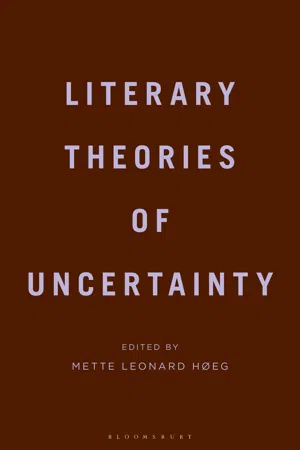
As the first study to examine the concept of uncertainty of meaning as it relates to modern and contemporary literature and literary theory, Literary Theories of Uncertainty demonstrates how this notion functions as a literary feature, narrative device and theoretical concept in 20th and 21st-century texts. Calling upon theories of interpretation and challenging the distinction between literature and theory, this exploration is broken down into three sections: Poststructuralist legacies of uncertainty; life-writing and uncertainty; and contemporary literary uncertainties.
The volume takes into account related terms such as undecidability, indeterminacy, ambiguity, unreadability, and obscurity, and the topics examined include: undecidability and the motif of suspension in deconstruction; Derrida and Bataille; poetry as a mode of critical discourse and point of convergence between logico-mathematical ideas of undecidability and literary forms of uncertainty; uncertainty in relation to speech and the impact of Robert Antelme on Mascolo and Blanchot; Proust and temporal uncertainty; uncertainty in relation to death, trauma and autobiography; moral uncertainty in the Scandinavian welfare state and Nordic Noir; the aesthetically disruptive and anti-authorian effect of uncertainty in in the works of German-Turkish writer Emine Sevgi Ozdamar; uncertainty in the form of 'the double' and in relation to meta-fiction; and many more.
Literary Theories of Uncertainty collates original and diverse discussions by some of the most prominent, inquiring minds in literary, cultural and critical theory today to map out the contours of the field of 'theory of uncertainty'.
- 224 pages
- English
- ePUB (mobile friendly)
- Available on iOS & Android
eBook - ePub
Literary Theories of Uncertainty
About this book
Information
1
Introduction
Towards a conception of ‘literary theory of uncertainty’
Mette Leonard Høeg
Uncertainty of meaning is a fundamental dimension and quality of literature and constitutive of what renders some literary works accessible, appealing and engaging across time and in different contexts. Uncertainty is a precondition for literature, indeed for any stabilization of meaning. A greater or lesser degree of authorial and readerly awareness of this precondition and fundamental trait is possible, and, thus, uncertainty can also form part of a narrative strategy and function as a literary device, used either to disrupt the seeming naturalness of a narrative or as a mimetic method to authentically render the uncertainty of reality and human perception. And uncertainty can be integrated into a critical reading strategy or interpretational attitude by which the fundamental uncertainty of narrative is acknowledged and the uncertainties and inherent tensions of a literary narrative are kept open and unresolved.
The notion of uncertainty of meaning has always existed and been relevant, if not in the form of explicitly recognized and theorized concepts, then implicitly present as the defining opposition of certain and decided meaning. In this sense, all theory of literature, interpretation and meaning is also theory of uncertainty. However, in the nineteenth century through the twentieth, the ideas of, and thinking about, uncertainty begin to consolidate into a more distinct branch in literary theory. This growing preoccupation in literature and literary theory with uncertainty of meaning and interpretation is linked to a general shift in how the world and human existence is perceived and to developments in the fields of physics, philosophy and psychology. As a new scientific view of the physical world emerges in the beginning of the twentieth century, notions of uncertainty become increasingly prevalent in all spheres of society, and scientific truth about the world and the human perception of it as well as the artistic representations and explorations of these undergo a noticeable change.
Uncertainty comes to function as a structuring principle and primary conveyor of meaning in literature in the late nineteenth and early twentieth century. The uncertainty of knowledge, epistemology and phenomenology are key issues in the impressionist and Modernist works of this period. Forms of uncertainty are used as subversive devices and strategies to challenge established literary conventions and to explore and develop novel philosophical and existential ideas, and the notion of uncertainty of meaning is established as a criterion of authenticity and truth in the literary representation of reality and human experience. This foregrounding of uncertainty in Modernist literature has had a radical and lasting effect on narrative, and uncertainty continues to hold a vital position through the postmodern period and into contemporary narrative where it still functions as a criterion for credibility in both fictional and nonfictional narrative.
Literary theory also becomes increasingly preoccupied with notions of uncertainty of meaning, representation and interpretation in the late nineteenth century. A variety of subforms and related terms such as ‘undecidability’, ‘indeterminacy’, ‘ambiguity’, ‘indistinction’, ‘obscurity’, ‘vagueness’, ‘opacity’ and ‘indiscernibility’ appear at the heart of some of the most central discussions about the meaning and nature of literature. The literary theories of uncertainty in the nineteenth and twentieth centuries vary in their focus, emphases, terminology and explanations, and indeed they are often developed in explicit opposition to the conceptions of uncertainty that precede them. They are, however, aligned in their view of uncertainty of meaning as an inherent textual feature and a fundamental literary property. They share the perspective that the most interesting meanings in a literary text are linked to its uncertainty; indeed, that uncertainty is constitutive of the very meaning of literature. They recognize that uncertainty is that from which meaning springs and on which reader engagement hinges.1
There seems to be in literary theory and culture an implicit understanding of the significance and centrality of the notion of uncertainty, in literature fundamentally and in Modernist literature in particular. But there is curiously little conscious awareness or deliberate investigation of the notion of literary and interpretive uncertainty and few detailed and focused meta-studies on the theory of uncertainty. The present volume attempts to make up for this. It represents an exploration of uncertainty both as a fundamental dimension of all literary theory and a continuation of the strand of ‘theory of uncertainty’ that runs through late nineteenth- and twentieth-century literary theory. The volume draws attention to and expands this implicitly recognized, yet underexplored area of literary theory, as it looks at uncertainty of meaning and interpretation from a variety of perspectives, with a focus on the modern and postmodern period. It reinstates, investigates and further develops a number of concepts of uncertainty, unleashing some of the analytical force and potential of notions of uncertainty for the study of literature. And it emphasizes the link between literary appeal and uncertainty of meaning, thereby shedding light on the fundamental appeal and effect of interpretive challenge and recalcitrance.
‘Uncertainty’, ‘undecidability’, ‘indeterminacy’, ‘obscurity’ and so on are contested terms, words with ‘bad vibes’ as Geoffrey Hartman has pointed out,2 often associated with meaning-relativism, nihilism and the prejudices against deconstruction. This volume springs from the view that a conceptualization of uncertainty need not, however, be vague, that the notion of uncertainty is not as elusive as is often presumed, and that it is both possible and desirable to explore a literary theory of uncertainty. The volume counteracts the existing conc eptual vagueness with theorizations of uncertainty as a fundamental dimension of literature and offers analyses of the types and modes, uses and strategies and functions and effects of uncertainty in twentieth-century and contemporary literature. In nine diverse chapters by some of the most prominent, inquiring minds of the disciplines of literary, cultural and critical theory today, the volume thus draws the contours of the field of a literary theory of uncertainty.
Inevitably, several uncertainties are at play in the volume itself. The chapters are all to some degree determined by the very uncertainty that precedes language and discourse and which is also their object of study. There is a clear self-awareness in the volume of its inherent uncertainty as an attempt at textual fixation of meaning, and several chapters engage demonstratively with this feature. The volume arises from the zone of indistinction between theory and literature on which it also sheds light. As one contributor notes in the form of a rhetorical question, it is impossible to clearly separate theories of uncertainty in literature from theories of uncertainty that are literary. These are connected, and the volume deals in both, demonstrating exactly the literary nature of theory and the theoretical quality of literature.
The present chapter functions as an introduction, both to the volume itself and to theory of uncertainty as a literary-theoretical strand more generally. Its aim is to establish the theoretical-historical background for the volume by introducing some of the most significant points in the history of theory of uncertainty and relating these to the broader scientific and cultural context and to relevant theories and trends in other fields than the literary. My focus is mainly on the first half of the twentieth century, which is characterized by a particularly strong inventive and productive theoretical energy, and which appears as a period of culmination for literary theory of uncertainty.
Nineteenth-century notions of uncertainty
The authorial, critical and readerly awareness of the fundamental uncertainty of meaning in literature and its meaning-productive function and potential grows notably in the last half of the nineteenth century, but notions of productive forms of uncertainty are also present in literary theory and narrative before the more explicit theories take form in the early twentieth century. In 1817, Keats uses the term ‘negative capability’ to designate the special ability of great writers such as Shakespeare to accept uncertainties, doubt and mystery. In a letter to his brothers, Keats reflects on the insight he has had during a discussion with Charles Dilke that a prerequisite for literary greatness is an ability to accept uncertainty of meanings: ‘several things dovetailed in my mind, & at once it struck me, what quality went to form a Man of Achievement especially in Literature & which Shakespeare possessed so enormously – I mean Negative Capability, that is when a man is capable of being in uncertainties, Mysteries, doubts, without any irritable reaching after fact & reason.’3 Uncertainty also clearly appears as an important aspect in early Modernist literature such as the works of Gustave Flaubert, Thomas Hardy, Henry James and Joseph Conrad. In The Uses of Obscurity: The Fiction of Early Modernism, Allon White shows how obscurity in the last decade of the nineteenth century began to function as a significant and positive aspect of English fiction. And Jonathan Culler, in his study Flaubert: The Uses of Uncertainty, sheds light on the undecidable point of view in Madame Bovary (1856), demonstrating how the novel obstructs the identification of a single narrator and how the narrative strategy of irony creates an uncertainty of meaning and undermines conventional reading strategies.
The authorial and readerly awareness of the undecidability between the domains of fiction and nonfiction, which is one of the most immediately obvious forms of uncertainty, is also fundamental and dates back much further than the twentieth century.4 In the first edition of Robinson Crusoe (1719), Daniel Defoe credited the protagonist of the work as its author, which led many to read the novel in the referential mode as a true travelogue. This undecidability between autobiography and fiction in life-writing has been a particularly contentious form of uncertainty. Generic blurring of the boundaries between the autobiography and the novel is generally perceived as dating back to Rousseau’s Confessions (1782–9) and even Saint Augustine’s Confessions (397–400), but the question of whether something has been made up or is true (in the sense of being in accordance with the real, external life of the author) has arguably been relevant to readers for as long as the form of the autobiography has existed.5
Literary experiments with the uncertainty between the autobiographical and the fictional mode begin to increase with literary impressionism around the turn of the century. In the late nineteenth century, literature begins to reject the reading strategies of Romanticism, in particular the attempt to identify literary works with their author, and uncertainty is applied as a means to avoid identification in life-writing. Max Saunders’s comprehensive study of the fusing of life-writing and fiction by modern and Modernist writers, Self Impression, which looks at the movement from literary impressionism in the late nineteenth century to Modernism in the early twentieth, thus shows how the conventional modes of autobiography, biography, fiction and criticism begin to blend and to disrupt each other, in works by writers such as Conrad, Ford, Proust, Joyce, Woolf, Stein, Mann, Sartre and Nabokov.6
Another highly conspicuous form of literary uncertainty is related to the representation of speech and thought. In third-person narration, there are always two voices and, thus, potentially two perspectives at play, namely that of the nar rator and that of the represented character, which may or may not be aligned. The narrative mode of free indirect discourse is particularly emblematic of this uncertainty.7 This form of narration by which the speech or thought of a character is rendered in the idiom of the character but with the grammatical discourse of a third-person narrator, which was later to become a standard style in fiction and an integral part of the narration in Modernist works by Woolf, Joyce, Mann, Kafka and many others, also becomes more prevalent in the nineteenth century and forms part of what has been termed the ‘inward turn’ of narrative. It was first used extensively by Jane Austen in Emma (1815) and in France by Flaubert in Madame Bovary (1856), where it famously formed part of the central argument in Flaubert’s defence in the trial against him for obscenity; and it comes to play a central role towards the end of the century as an effective technique for rendering impressions. The inherent uncertainty of Free Indirect Discourse was also used strategically to trick the reader, for instance in the works of Henry James where the perspective of the narrator is made to coincide closely with that of the character in order to confuse the reader. Indeed, the narrative undecidability of The Turn of the Screw (1898) has fuelled a variety of differing and even contradictory interpretations.
The work of Joseph Conrad is another prominent example of early but evident uncertainty, as is demonstrated, for instance, by the obscurity and fragmentation of The Heart of Darkness (1902) and its assertion of the uncertain nature of subjective understanding. James and Conrad are representative of the broader preoccupation with the notion of the impression in which uncertainty plays a central part (and the two are often discuss...
Table of contents
- Cover
- Half-Title
- Dedication
- Title
- Contents
- List of figures
- List of contributors
- 1 Introduction: Towards a conception of ‘literary theory of uncertainty’
- Part I Post-structuralist legacies of uncertainty
- Part II Life-writing and uncertainty
- Part III Contemporary literary uncertainties
- Index
- Copyright
Trusted by 375,005 students
Access to over 1.5 million titles for a fair monthly price.
Study more efficiently using our study tools.
Frequently asked questions
Yes, you can cancel anytime from the Subscription tab in your account settings on the Perlego website. Your subscription will stay active until the end of your current billing period. Learn how to cancel your subscription
No, books cannot be downloaded as external files, such as PDFs, for use outside of Perlego. However, you can download books within the Perlego app for offline reading on mobile or tablet. Learn how to download books offline
Perlego offers two plans: Essential and Complete
- Essential is ideal for learners and professionals who enjoy exploring a wide range of subjects. Access the Essential Library with 800,000+ trusted titles and best-sellers across business, personal growth, and the humanities. Includes unlimited reading time and Standard Read Aloud voice.
- Complete: Perfect for advanced learners and researchers needing full, unrestricted access. Unlock 1.5M+ books across hundreds of subjects, including academic and specialized titles. The Complete Plan also includes advanced features like Premium Read Aloud and Research Assistant.
We are an online textbook subscription service, where you can get access to an entire online library for less than the price of a single book per month. With over 1.5 million books across 990+ topics, we’ve got you covered! Learn about our mission
Look out for the read-aloud symbol on your next book to see if you can listen to it. The read-aloud tool reads text aloud for you, highlighting the text as it is being read. You can pause it, speed it up and slow it down. Learn more about Read Aloud
Yes! You can use the Perlego app on both iOS and Android devices to read anytime, anywhere — even offline. Perfect for commutes or when you’re on the go.
Please note we cannot support devices running on iOS 13 and Android 7 or earlier. Learn more about using the app
Please note we cannot support devices running on iOS 13 and Android 7 or earlier. Learn more about using the app
Yes, you can access Literary Theories of Uncertainty by Mette Leonard Hoeg in PDF and/or ePUB format, as well as other popular books in Letteratura & Critica letteraria europea. We have over 1.5 million books available in our catalogue for you to explore.