Taking in works from writers as diverse as William Shakespeare, William Wordsworth, Charlotte Brontë, John Keats, James Joyce and D.H. Lawrence, this book spans approximately 300 years and unpacks how bodily liquidity, porosity and petrification recur as a pattern and underlie the chequered history of the body and genders in literature.
Lennartz examines the precarious relationship between porosity and its opposite – closure, containment and stoniness – and explores literary history as a meandering narrative in which 'female' porosity and 'manly' stoniness clash, showing how different societies and epochs respond to and engage with bodily porosity.
This book considers the ways that this relationship is constantly renegotiated and where effusive and 'feminine' genres, such as 'sloppy' letters and streams of consciousness, are pitted against stony and astringent forms of masculinity, like epitaphs, sonnets and the Bildungsroman.
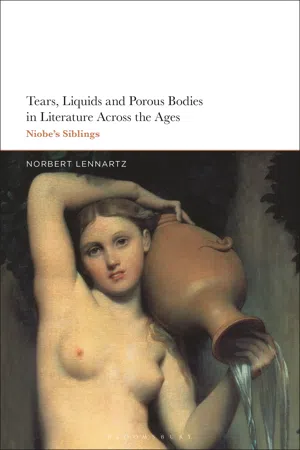
eBook - ePub
Tears, Liquids and Porous Bodies in Literature Across the Ages
Niobe’s Siblings
- 280 pages
- English
- ePUB (mobile friendly)
- Available on iOS & Android
eBook - ePub
About this book
Information
1
Porous bodies before (and after) the discovery of pores
Ambivalent manly tears on the stage
In Act IV, Scene 3 of Shakespeare’s dark tragedy Macbeth (c. 1606), Macduff, the powerful and soldierly Thane of Fife, suddenly finds himself flung into an unexpected Niobean situation: courageously demanding the truth from his bush-beating friends – ‘Be not niggard of your speech. How goes’t?’ (Mac 4.3.181) – he learns the horrifying fact that Macbeth has not only slaughtered his family, but also extirpated his entire household in a fit of barbarian revenge: ‘Wife, children, servants, all that could be found’ (Mac 4.3.213). That the vent for Macduff’s grief is a strikingly different one from that of Niobe or even men of the Romantic age is immediately made clear. Instead of drowning his sorrow in a gushing flood of tears, Macduff is reminded of his duties of masculinity and expected to ‘[d]ispute it like a man’ (Mac 4.3.223). Although concepts of masculinity were anything but fixed and tended to show degrees of diversification, there was universal agreement that it was mandatory for men to aspire to the ideal of the cortegiano, to a type of man who, according to Baldassare Castiglione’s widely read manual and its 1561 translation by Sir Thomas Hoby, The Courtyer, should refrain from appearing ‘soft and womanish’1 and fashion himself as a stoic who is at pains to seal his body from any onset of dissolution and what David B. Goldstein calls ‘a problematic liquidity’.2 The narration of the Porter’s losing battle against the urge to urinate, which Macduff had banteringly provoked in Act II, Scene 3, is only a burlesque reflection of early modern man’s dread of bodily openness and, in contrast to the courtier and soldier, shows the clown (like children or women) at the mercy of his intractable abdominal regions.3
Passages like these and admonishings in conduct books like The Courtyer stress that manliness was only loosely defined and that Italianate courtiers were constantly in danger of losing ‘the hardness and stability of male perfection and melt[ing] into unstable but protean imperfection’.4 Averse to relapsing into medieval habits of carnivalesque openness (which were related to certain classes and confined to certain ‘popular-festive’ seasons of revelry),5 Renaissance man saw himself indebted to a new ideal of restraint and obliged to channel the rush of overpowering feelings into ducts of rational enunciation:
Give sorrow words. The grief that does not speak
Whispers the o’erfraught heart and bids it break. (Mac 4.3.210–11)
Malcolm’s, the future king’s, advice to translate sorrow into words and later into stony redemptive revenge – ‘Be this the whetstone of your sword’ (Mac 4.3.231) – is clearly based on early modern man’s fear of effeminization, on the dissatisfaction that people evinced at the idea of ‘one elastic sex’6 that oscillated between dry and solid manliness and a phlegmatic and tearful melancholy, which, in the context of Galenic pathology, was seen as a token of perilous degeneration into coldish, watery and oozy femininity. While yellow bile, black bile and even blood were hidden fluids and could only be made partially visible by conscious (and male) acts of blood-letting, tears, sweat and other phlegmatic exudations (sometimes seen as ‘lubricant[s] and coolant[s]’,7 sometimes as ‘excrementitious humours’8) were not only embarrassing evidence of a lack of masculine control, but also testimony to a deceptiveness and dishonesty that, due to common misogynist parlance, was attributed to scheming women. The ‘gradual emergence of men of feeling in sixteenth- and seventeenth-century literary texts’, as Jennifer C. Vaught argues,9 is thus a daringly compelling hypothesis which, however, most of the texts included here do not support.
Even a self-proclaimed villain such as Richard III finds himself in tune with early modern customs and practices, when, in the presence of Anne, he boasts of the fact that the account of his father’s death did not elicit a single tear from his eyes: ‘in that sad time / My manly eyes did scorn an humbler tear’ (R3 1.2.166f.). The negative connotation of tears as ‘childish drops’ (R3 1.2.157) shows that Richard fully subscribes to the ideal of masculine dryness, and thus it comes as a surprise when Richard finally avows that his eyes have been made ‘blind with weeping’ (R3 1.2.169). This psychological inconsistency within a few lines not only reveals that Richard is an inconstant and psychologically liminal character, it also underlines the fact that Richard must be classed among a group of fitful and uninhibited weepers in Shakespeare’s plays who, by the hyperbolism of their gender-incompatible ‘emotional expressiveness’,10 are suddenly unmasked as dissemblers, actors and Machiavellian schemers. One of these dissemblers is one-handed Titus in Shakespeare’s early and derivative tragedy Titus Andronicus (c. 1594) who rantingly casts himself as a drunkard vomiting tears;11 another is Gertrude in Hamlet, who is less hyperbolic, but more calculating and reported to have shed excessive and false Niobean tears over her dead husband’s corpse and in the presence of her next (incestuous) husband.12
While Barthes eulogizes tears as the ‘truest of messages’, as the purest and most sincere of signs in a semiotics of bodily language,13 Shakespeare and his contemporaries seem to argue for the opposite, for the prevalence of tears as instruments of treachery and falsehood. Not only does Hamlet make a strong case for tears as excremental humoral fluids that easily lend themselves to (female) manipulation, their inherent staginess and histrionic quality also proved to be the appropriate and fashionable subject matter for several cynically misogynist plays on women’s, and in particular widows’, duplicity.14 While, as a widower, Macduff knows how to suppress these tokens of treachery and uses them to fuel his fiery-mettled revenge, widows in lurid Jacobean tragedies are shown as being on a par with Gertrude, exhibiting ‘short liu’d Widowes’ teares’ only to conceal the fact that, rejoicing in their new sexual freedom, they were ‘laughing vnder a Maske’.15 As if to live up to the ominous liminality to which widows were relegated, one of them, Gratiana in Chapman’s The Revenger’s Tragedy, fashions herself as a cunning launderer of tears (and other juices) and thus as the glaring opposite of a man stoically coming to terms with his grief:
I’ll rinse it [= her guilt] in seven waters of mine eyes.
Make my tears salt enough to taste of grace;
To weep is to our sex naturally given,
But to weep truly, that’s a gift from heaven.16
With their alchemist-like power to brew, adulterate and distil their tears ‘in seven waters’ of their eyes, women seem to have mastered their bodily fluids more than men were ready to admit. The image of the female sex as being hopelessly at the mercy of their riotous fluids, as creatures desperately unable to police their bodily orifices was a myth that men preferred to cherish in order to cement the idea of women’s liminality and to confirm their inferiority in the one-sex-based Chain of Being.17 That this simplified binary structure was jeopardized not only by manipulative widows’ alchemist adeptness at distilling their bodily fluids, but also by male adolescents’ proneness to tears is paradigmatically shown in Hamlet and Romeo and Juliet.
Young, immature and characterized by a disturbingly fluid masculinity, Laertes and Romeo trespass upon dangerous territory when they yield to their effeminizing tears in a flamboyancy which is rebelliously innovative, theatrical and dangerously hybrid. Both have lost (or are on the point of losing) a beloved companion; but although their responses to these challenges of fate are dissimilar, both characters are stuck in an impasse where bookish concepts of culture and masculinity have ceased to function. Having consented to become involved in a black plot against Hamlet, Laertes is suddenly thrown off his balance when he learns (from deviously aquatic Gertrude) about his sister’s suicidal madness and her dehumanizing death in the swampy ooziness of nature:
Her clothes spread wide
And mermaid-like awhile they bore her up,
Which time she chanted snatches of old lauds
As one incapable of her own distress,
Or like a creature native and endued
Unto that element. But long it could not be
Till that her garments, heavy with their drink,
Pulled the poor wretch from her melodious lay
To muddy death. (Ham 4.7.173–81)
More than other female characters in Shakespeare’s plays, tongue-tied Ophelia is a liminal creature par excellence (evidenced by her marginal position at court and in the play), so that in her death she seems to return to a sphere where the neat categories of the Chain of Being are blurred and invalid. In his study on the Gender of Death (1999), Karl S. Guthke refers to and concentrates too exclusively on the terrifying representations of early modern death as a skeleton, as a male fiddler in the garish dances of death or as an apocalyptic horseman.18 As Ophelia’s self-inflicted death, however, shows, death could, at that time, also be imagined in more feminine terms, as a slow thalassian transition and metamorphosis from corporeality to a mermaid-like and watery liminality. Like mermaids, sirens or other chimerical creatures, Ophelia is ‘native and endued’ to water and thus absorbed by a ‘body of fluid’ that, according to Kaara L. Peterson, together with the various flowers denotes menstrual fluid and the furor uterinus that is raging within her.19 The phrase ‘heavy with their drink’ seems to corroborate this and underlines the fact that (female) death is only an osmotic process, a kind of drinking and being drowned by a festering ‘stew-like stagnation of liquids’,20 and thus in line with the medieval conviction that women belonged to the element of water and were consequently cold, moist and a strange mixture of disgustingly phlegmatic juices: tears, milk, ‘flowers’ (= menses) and slimy vaginal lubricants.
Ophelia’s watery death instantaneously causes Laertes to put a censorial ban on his fluid grief: ‘Too much of water hast thou, poor Ophelia, / And therefore I forbid my tears’ (Ham 4.7.183–84). This imbalance makes him tragically akin to Hamlet who constantly oscillates between Herculean hardness and the lure to let his ‘too solid flesh … / Thaw, and resolve itself into a dew’ (Ham 1.2.129–30).21 Unable to restrain his tears and forced, at this moment of intense distress, to let porous female nature hold sway over him (‘nature her custom holds’), he fallaciously believes that with these irrepressible tears the last vestiges of a lurking femininity in him will be exorcized: ‘When these are gone / The woman will be out’ (Ham 4.7.186–87).22 In contrast to Macduff, who immediately transforms his grief into the rhetoric of a stony revenge, young Laertes, like Hamlet or the Duke of Exeter in Henry 5,23 finds himself momentarily overwhelmed by a female, maternal and watery ‘folly’ which shamefully deprives him of a male ‘speech of fire’ (Ham 4.7.188–89). At a loss to reconcile these onsets of softness with a world of armatorial competition,24 Laertes overcompensates for his temporary loss of masculinity with hyperbolic and declamatory language that is not only alarmingly replete with images of petrification, but also underlines the tension that, like a leitmotif, runs between solidity and fluidity throughout the entire play:25
Now pile your dust upon the quick and dead
Till of this flat a mountain you have made
T’o’ ertop old Pelion or the skyish hea...
Table of contents
- Cover
- Halftitle Page
- Title Page
- Contents
- List of figures
- Acknowledgements
- List of abbreviations
- Introduction
- 1 Porous bodies before (and after) the discovery of pores
- 2 Niobean bodies in the era of Romanticism
- 3 Far from the madding Romantic crowd: The anti-porous turn in the Victorian age
- 4 (Re-)Liquefaction at the dawn of the twentieth century
- 5 Niobean reverberations in post-war literature
- Bibliography
- Index
- Imprint
Trusted by 375,005 students
Access to over 1.5 million titles for a fair monthly price.
Study more efficiently using our study tools.
Frequently asked questions
Yes, you can cancel anytime from the Subscription tab in your account settings on the Perlego website. Your subscription will stay active until the end of your current billing period. Learn how to cancel your subscription
No, books cannot be downloaded as external files, such as PDFs, for use outside of Perlego. However, you can download books within the Perlego app for offline reading on mobile or tablet. Learn how to download books offline
Perlego offers two plans: Essential and Complete
- Essential is ideal for learners and professionals who enjoy exploring a wide range of subjects. Access the Essential Library with 800,000+ trusted titles and best-sellers across business, personal growth, and the humanities. Includes unlimited reading time and Standard Read Aloud voice.
- Complete: Perfect for advanced learners and researchers needing full, unrestricted access. Unlock 1.5M+ books across hundreds of subjects, including academic and specialized titles. The Complete Plan also includes advanced features like Premium Read Aloud and Research Assistant.
We are an online textbook subscription service, where you can get access to an entire online library for less than the price of a single book per month. With over 1.5 million books across 990+ topics, we’ve got you covered! Learn about our mission
Look out for the read-aloud symbol on your next book to see if you can listen to it. The read-aloud tool reads text aloud for you, highlighting the text as it is being read. You can pause it, speed it up and slow it down. Learn more about Read Aloud
Yes! You can use the Perlego app on both iOS and Android devices to read anytime, anywhere — even offline. Perfect for commutes or when you’re on the go.
Please note we cannot support devices running on iOS 13 and Android 7 or earlier. Learn more about using the app
Please note we cannot support devices running on iOS 13 and Android 7 or earlier. Learn more about using the app
Yes, you can access Tears, Liquids and Porous Bodies in Literature Across the Ages by Norbert Lennartz in PDF and/or ePUB format, as well as other popular books in Literature & Medieval & Early Modern Literary Criticism. We have over 1.5 million books available in our catalogue for you to explore.