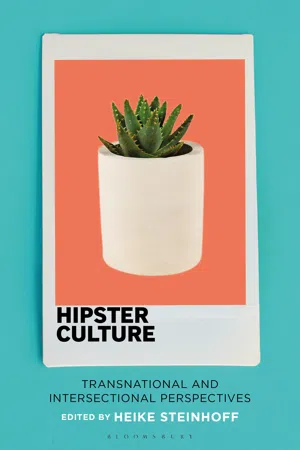
Twenty-first century popular culture has given birth to a peculiar cultural figure: the hipster. Stereotypically associated with nerd glasses, beards and buns, boho clothing, and ironic T-shirts, hipsters represent a (post-)postmodern (post-)subculture whose style, aesthetics, and practices have increasingly become mainstream. Hipster Culture is the first comprehensive collection of original studies that address the hipster and hipster culture from a range of cultural studies perspectives.
Analyzing the cultural, economic, aesthetic, and political meanings and implications of a wide range of phenomena prominently associated with hipster culture, the contributors bring their expertise and own research perspectives to bear, thus shaping the volume's transnational and intersectional approach. Chapters address global and local manifestations of hipster culture, processes of urban gentrification and cultural appropriation, alternative foodways and eclectic fashion styles, the significance of nostalgia, retro technologies and social media, and the aesthetics and cultural politics of literature, film, art, and music marked by self-reflexivity, irony, and a simultaneous longing for an earnest authenticity. Hipster Culture explores the diversification of hipster culture, sheds light on popular constructions of the hipster as cultural Other, and critically investigates hipster culture's entanglements with and challenges to dominant cultural discourses of gender, ethnicity, race, sexuality, age, religion, and nationality.
- 432 pages
- English
- ePUB (mobile friendly)
- Available on iOS & Android
eBook - ePub
About this book
Information
1
Hipster Culture: A Definition
Heike Steinhoff
Enter the Hipster
Twenty-first-century popular culture has given birth to a peculiar cultural figure: the hipster. Stereotypically associated with nerd glasses, beards and buns, boho clothing, and ironic T-shirts, hipsters represent a (post-)postmodern (sub)culture whose style, aesthetics, and practices have increasingly become mainstream. In the edited volume What Was the Hipster? A Sociological Investigation (2010), Mark Greif describes the American hipster as young, white, urban, college-educated, and middle-class. According to his definition, hipsters are “rebel consumers” who define, acquire, and possess ever new insider knowledge of goods and styles to continually distinguish themselves from the mainstream (“Positions”). Vintage style and retro design, urban gardening and organic food, DIY entrepreneurship and cafés or vegan restaurants marked by a nostalgic industrial chic are only some of the cultural trends that have been linked to hipster culture. At the same time, they have become key components of a dominant popular culture of hip, giving support to Greif’s claim that the hipster “aligns himself both with rebel subculture and with the dominant class, and opens up a poisonous conduit between the two” (“Positions” 9). Their eclectic cultural appropriations and their frequent association with gentrification processes implicate hipsters in some of the most contentious phenomena of contemporary Western urban culture, and they have been held responsible for the commodification and appropriation of past and marginalized cultures. The hipsters’ seemingly constant search for “authenticity” and difference from the mainstream has frequently turned them into figures of public ridicule at the same time as they have been increasingly charged with selling out. Yet, whereas some have declared the death of the hipster, hipster culture seems to be very much alive in global urban centers and in the popular cultural imagination.
In striking contrast to the hipster’s omnipresence in popular culture, the academic discussion of the (sub)culture has, however, been sparse and limited. With few exceptions, the scholarly publications about the hipster have mostly followed Greif, Ross, and Tortorici’s 2010 volume in taking a primarily sociological approach to the hipster. Hipster culture as a whole, however, has largely been ignored by academic studies and remained a topic of feuilletons and blog entries.1 This book seeks to fill this research gap by providing a collection of original articles that approach hipster culture from a variety of cultural perspectives, including urban studies, food studies, gender studies, queer studies, ethnic studies, art history, literary studies and media studies. A decade after What Was the Hipster implied that the hipster, born at the turn to the twenty-first century, had already become a figure of the past, this volume sheds light on the ways in which the hipster and hipster culture have indeed persisted, transformed, and diversified over the last twenty years of their existence. Rather than reflecting on the hipster as a primarily sociological figure, Hipster Culture foremost conceives of “hipster” as a powerful cultural discourse that takes shape in representations in movies, novels, TV shows, music, literature, and social media and as a lifestyle and aesthetic that informs and shapes many contemporary cultural practices, economic products, and popular places, such as barber shops, restaurants, urban gardens, arts and crafts products, or fashion.
While all of us well versed in global urban cultures and online media most likely share some idea of what hipsters and hipster culture look like, the hipster, despite frequent stereotypification, has indeed been linked to a diversity of styles, practices and cultural issues.2 More a sliding signifier than a signifier with a clear referent, “hipster” ultimately remains a nebulous cultural figuration that needs to be examined in the specific cultural, historical, economic, and political context of its (re)production. In the following, I will illuminate some of the features of contemporary hipster culture and hipster identities, suggesting that the hipster presents a liminal figure. At the beginning of the third decade of the twenty-first century, hipster culture sits at the borders between subculture and post-subculture, postmodernism and post-postmodernism, irony and sincerity, and political as well as environmental engagement and apoliticism. Moreover, hipster culture oscillates between the promotion of cultural, racial, ethnic, sexual, and gender diversity on the one hand and cultural exploitation and the reassertion of white middle-class privileges on the other hand. Whereas the mainstreaming of hipster culture bespeaks of an appreciation of the hipster as a figure of inspiration and imitation, the dominant mode of hipster criticism constitutes the hipster as object of ridicule and cultural blame. The hipster as cultural figure is produced by discourses about the hipster as well as by practices of hipster self-fashioning. In some cases, as I will argue, hipster criticism and hipster self-fashioning do not even collide but are actually the same.
Hipster: A (Trans)National History
The contemporary hipster—thus runs the dominant narrative—has emerged in urban centers of the United States in the late 1990s, most prominently in Williamsburg, Brooklyn, New York. Hipster culture emerged out of 1990s indie youth culture (cf. Greif, “Positions” 5), predominantly white middle-class youths interested in alternative music and art. Greif specifically dates the emergence of the contemporary American hipster in 1999 with the Iraq War and World Trade Organization protests and thus in the context of anti-war and anti-globalization movements (“Positions” 6). Historically, the roots of the hipster have been traced to the culture of 1940s African-American jazz and the 1950s white counterculture closely associated with the Beat Generation. In his 1948 article “Portrait of the Hipster,” Anatole Broyard defines the hipster as a Black subcultural figure. Displaced and marginalized in American society, the hipster expresses himself through the language of jazz, a language of “a priorism” (Broyard 722), that is, of superior and exclusive knowledge. The contemporary hipster shares this emphasis on apriorism as a main source of (sub)cultural capital and main mode of cultural distinction (cf. Bourdieu’s theory of cultural capital and Sarah Thornton’s theory of subcultural capital; cf. Greif “Positions” 8). It is expressed, for instance, in the ironic prints on their T-shirts, in their foodways, or their consumption—and in case of hipster filmmakers, their production—of idiosyncratic movies. However, the hipster’s apriorism is perpetually haunted by its commodification and integration into mainstream culture, now as much as in the mid-twentieth century. Whereas Broyard mourns the hipster’s demise through the wider cultural recognition of jazz and its appropriation into white American culture,3 contemporary critical discourses about the “death of the hipster” carry a reproachful or outright hateful tone, often suggesting that the twenty-first-century hipster never carried any “true” sub-cultural potential at all.
The recognition of jazz and Black hipster culture by a white avant-garde, in fact, presents the next step in dominant hipster history. In opposition to Broyard’s hipster, the contemporary hipster, after all, is imagined as white and middle-class, often less marginalized than self-consciously choosing positions and signifiers of marginalization. It is in this respect that contemporary hipster culture is indebted to Norman Mailer’s adoption of this label in his 1957 article, “The White Negro: Superficial Reflections on the Hipster.” Implicitly drawing on the Black hipster culture identified by Broyard in his essay, Mailer (re)defines hipsters as a contemporary white American counterculture that formed in American cities where “the bohemian and the juvenile delinquent came face-to-face with the Negro.” According to Mailer this cultural encounter gave birth to the hipster, a social outcast and rebel, whose being hip is opposed to the conformist, that is, “square,” tendencies of American mainstream culture. In response to the horrors of World War II and the conformity of 1950s American society, Mailer’s “white Negro” is an existentialist and non-conformist, characterized by a childlike clinging to the present, a longing for sexual freedom, and a desire to remove all social constraints. Contemporary hipster culture retains some of these features, most prominently the desire for authentic experience, the tendency to appropriate marginalized (life)styles, and the desire to defy (specific) social conventions.
The different and similar ways in which Broyard and Mailer defined the hipster as a rebellious cultural identity are symptomatic for a history of hip as a “story of black and white America” (Leland 6). As John Leland writes in Hip: The History, “At its best, it [hip] imagines the racial fluidity of pop culture as the real America … At its worst, hip glosses over real division and inequity” (6). While Mailer’s essay explicitly opposes segregationist and discriminatory racial politics, his claiming of Black culture as the source of the white hipster’s non-conformity romanticizes the marginalization of African Americans and reproduces racial stereotypes of Black people as “primitive” or “over-sexualized.”4 As this volume shows, this ambiguity continues to shape twenty-first-century hipster culture and identity both in terms of its racial politics and beyond. The hipster’s ambivalent cultural politics take shape in the ways in which the hipster’s attempts to be “hip,” “cool,” and distinct from mainstream culture is coupled with the appreciation, appropriation, and exploitation of the marginalized, be it in terms of race, ethnicity, class, or sexuality.
Most obviously, at the turn of the twenty-first century, the source of the hipsters’ stylistic appropriation shifted from race to class. In allusion to Mailer’s “white Negro,” Greif has referred to these hipsters as “white hipsters” (“What Was the Hipster?”). White hipsters did not so much copy Black cultural styles, but white hipsters “fetishized the violence, instinctiveness, and rebelliousness of lower-middle-class suburban and country whites” (“Positions” 10). This appropriation of signifiers of what is derogatorily called “white trash” was evident in the white hipsters’ adoption of “truckerhats; undershirts called ‘wifebeaters’, worn as outwear; the aesthetic of basement rec-room pornography, flash-lit Polaroids, fake wood paneling; Pabst Blue Ribbon; ‘porno’ or ‘pedophile’ mustaches; aviator glasses, Americana T-shirts for church socials, et cetera” (“Positions” 10). According to Greif’s periodization, in 2003 the “white hipster” was replaced by the “green hipster” or the “Hipster Primitive,” characterized by references to “animals, wilderness, plus the occasional Native American” (“What Was the Hipster?”). This is the hipster associated with urban gardening, lumberjack beards, and female hipsters in rubber Wellingtons, as well as a (renewed) appropriation of the styles of the “ethnic Other.” Mocking popular cultural (stereo)typifications of hipster identities such as Robert Lanham’s The Hipster Handbook (2003), Joe Mande’s Look at This F*cking Hipster (2010), based on a popular website by the same name that collected photos of people identified as hipster by the one posting the picture, or the comedy television series Portlandia (2011–18) offer numerous additional, most often parodic, categorizations of hipster identities. Toward the end of the first and beginning of the second decade of the twenty-first century, voices in the American media increasingly proclaimed the death of the hipster, and numerous other terms, such as “normcore” or “yuccie” have come up to describe what the hipster has been replaced by or turned into. The articles in this volume suggest that the hipster has not vanished from the cultural...
Table of contents
- Cover
- Half-title Page
- Title Page
- Contents
- List of Illustrations
- Acknowledgments
- 1 Hipster Culture: A Definition
- Hipster Places, Identities, and Transformations
- Hipster Fashion, Porn, and Body Politics
- Hipster Literature and Self-Fashioning
- Hipster Media, Aesthetics, and Identity Politics
- Hipster Foodways and Cultural Politics
- Hipsters as Intersectional Identities
- List of Contributors
- Index
- Copyright Page
Trusted by 375,005 students
Access to over 1.5 million titles for a fair monthly price.
Study more efficiently using our study tools.
Frequently asked questions
Yes, you can cancel anytime from the Subscription tab in your account settings on the Perlego website. Your subscription will stay active until the end of your current billing period. Learn how to cancel your subscription
No, books cannot be downloaded as external files, such as PDFs, for use outside of Perlego. However, you can download books within the Perlego app for offline reading on mobile or tablet. Learn how to download books offline
Perlego offers two plans: Essential and Complete
- Essential is ideal for learners and professionals who enjoy exploring a wide range of subjects. Access the Essential Library with 800,000+ trusted titles and best-sellers across business, personal growth, and the humanities. Includes unlimited reading time and Standard Read Aloud voice.
- Complete: Perfect for advanced learners and researchers needing full, unrestricted access. Unlock 1.5M+ books across hundreds of subjects, including academic and specialized titles. The Complete Plan also includes advanced features like Premium Read Aloud and Research Assistant.
We are an online textbook subscription service, where you can get access to an entire online library for less than the price of a single book per month. With over 1.5 million books across 990+ topics, we’ve got you covered! Learn about our mission
Look out for the read-aloud symbol on your next book to see if you can listen to it. The read-aloud tool reads text aloud for you, highlighting the text as it is being read. You can pause it, speed it up and slow it down. Learn more about Read Aloud
Yes! You can use the Perlego app on both iOS and Android devices to read anytime, anywhere — even offline. Perfect for commutes or when you’re on the go.
Please note we cannot support devices running on iOS 13 and Android 7 or earlier. Learn more about using the app
Please note we cannot support devices running on iOS 13 and Android 7 or earlier. Learn more about using the app
Yes, you can access Hipster Culture by Heike Steinhoff in PDF and/or ePUB format, as well as other popular books in Social Sciences & Social History. We have over 1.5 million books available in our catalogue for you to explore.