During the military dictatorship (1964–1985) in Brazil, the State’s official censorship of culture and the arts censored nearly 500 books (Reimao, 2019b, p. 28), 500 films, 450 theatrical works, dozens of radio programs, 100 magazines, more than 500 songs, and a dozen episodes or clips of soap-operas (Ventura, 1988, p. 285).
The aim of this chapter is to make a systematic survey of a specific kind of censored books: non-fiction by foreign authors that were published in Brazil, and then were all censored over the course of the military dictatorship. We will also undertake an analytical study of the censorship policies.
REASONS FOR CENSORSHIP: BOOK CENSORSHIP AND CENSORIAL REGULATIONS
Between the military coup of 1964 and Institutional Act Number 5, AI-5 in 1968, publishers and bookstores were targets of right-wing vandalism, numerous book seizures and confiscation, and physical attacks on publishers and booksellers.
With the intention of intimidating publishers and booksellers, “Seizures were simple and often improvised, undertaken by operatives who were poorly trained” (Stephanou, 2001, p. 215). The homes of several academics and writers, especially in Rio de Janeiro, were invaded in search of books to be confiscated (Hallewell, 2005, p. 576).
On April 9, 1964, Institutional Act Number 1, AI1 was introduced, which revoked the mandates of 63 federal deputies, two senators, and dozens of local councilors. It also suspended the political rights of approximately 400 people, including Ênio Silveira – the editor of Civilização Brasileira. On October 12, 1968, the Civilização Brasileira bookstore was partially destroyed by a bomb planted by army officers and sergeants; in 1968, right-wing terrorists carried out attacks against Editora Tempo Brasileiro and the Livraria Forense, both in Rio de Janeiro (Gaspari, 2002, pp. 301–328).
Publishers and bookstores had been targets of right-wing vandalism since the military coup of 1964; however, the creation of a unified censorship system for books was only consolidated after 1968.
This lack of censorship regulations in relation to books made it possible to publish national left-wing classics, such as Celso Furtado’s Um Projeto para o Brasil [A Project for Brazil], international erotic fiction like the Hindu physiological and sexual treatise on morality, the Kama Sutra, Sade’s Filosofia na Alcova [Philosophy in the Bedroom], and Henry Spencer Ashbee’s Minha Vida, Meus Amores [My Secret Life] – an account of a collector of erotic art (Reimao, 2019b, p. 22).
The 1967 constitution officialized the centralization of censorship as a federal government activity in Brasilia. Prior to 1967, various different authorities from a range of governing bodies and levels of public administration, both state and federal, had been able to undertake censorship activities.
When Institutional Act Number 5 was decreed on December 13, 1968, censorship was finally centralized within the federal government. Under the guise of “authentic democratic order” and “to combat subversion and ideologies counter to the traditions of our people,” the AI-5 made it possible to terminate mandates, suspend individual guarantees, and create the conditions for the expansion of censorship on information disclosure, free speech, and cultural and artistic productions.
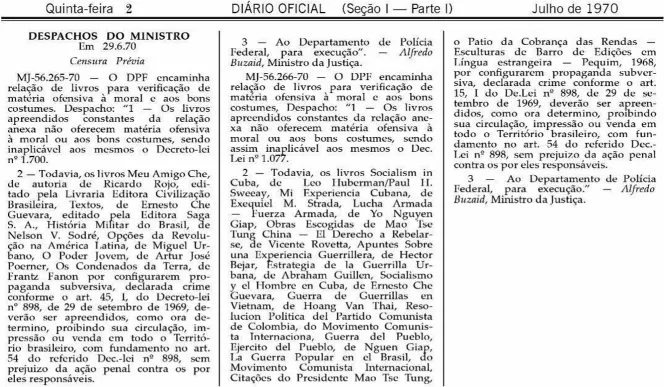
The main arguments used for censoring books during the military dictatorship were the accusation of spreading subversive propaganda and of threatening good morals and customs. During the Brazilian military dictatorship, the most important legal tools used for acts of censorship were decrees 898 of September 29, 1969, and 1077/70 of January 26, 1970.
Decree 898, the National Security Law, was in force from September 29, 1969 to December 1978. Chapter 2 of decree 898 was entitled “crimes and punishments,” and Article 45 states that it is a crime to make “subversive propaganda,” encompassing any means of social communication, including newspapers, magazines, periodicals, books, newsletters, brochures, radio, television, cinema, theater, and other spectacles, as vehicles of adverse psychological, revolutionary, or subversive war propaganda.
Decree 1077/70 of January 26, 1970 stated that it was essential to regulate and censor the media to maintain and protect morals and good manners, with emphasis on book publishing.
The 1960s in Brazil was a time of vibrant artistic and cultural manifestations, particularly in film and theatre. It was also a period when many ideas and attitudes – with roots in print, theory, and fiction – blossomed on stage and screen, and developed and evolved. As noted by journalist Zuenir Ventura (1988): “The generation of ’68 may have been the last literary generation of Brazil – at least in the sense that their academic learning and aesthetic perception had been formed through reading. I was brought up reading more than seeing” (p. 51).
From a quantitative point of view, book production in 1960s Brazil was relatively low. 36,322,827 books were printed in Brazil in 1960. With the Brazilian population having reached 65,743,000 inhabitants, this meant the average number of books per capita per year was 0.55 (cf. Reimao, 2019a, pp. 16–37).
In 1972, according to data from the Instituto Brasileiro de Geografia e Estatística, the Brazilian (IBGE) national statistics department, the barrier of one book per inhabitant per year was finally breached. The population that year had reached 98 million, and there were 136 million books printed. In 1972, there were 1.3 books per inhabitant printed. With some distortions, this ratio continued to grow throughout the 1990s, reaching 1.8 in 1979. The rise in literacy rates from 29% to 39% between 1970 and 1980 (among those over five years of age), and the growth in the number of university students (especially in private institutions) from 100,000 to almost one million over the same period, help to understand the expansion of book production and trade in Brazil in 1970 (cf. Reimao, 2019a, p. 29).
Hallewell (2005) discussed the quantitative growth of book production and marketing in Brazil in the 1970s, and stated that despite the “truly phenomenal growth of the book trade,” it became “both financially and personally risky to publish anything that might exceed the – unclear – limits of official tolerance” (p. 574).
Therefore, while there was on the one hand a relative increase between 1974 and 1985 in left-wing publications, there was also a concomitant, comparatively greater, and “truly phenomenal” expansion in publishing in general in Brazil – which underwent impressive growth and industrialization.
Thus, we can say that under the Brazilian military dictatorship, book production underwent a process of conservative modernization; a phenomenon similar to that observed by Rodrigo Patto Sá Motta in Brazilian universities in his book As Universidades e o Regime Militar. In the words of Sá Motta (2014):
the modernizing aim focussed on economic and administrative growth, and the acceleration of industrialisation (…). The authoritarian-conservative project was founded on maintaining these excluded subaltern sectors, particularly as political actors, as well as in fighting against the ideology and agents of the left – or anything avant-garde at all in the fields of politics and culture (…). (p. 15)