The use of digital tracking technologies is a widespread phenomenon. Millions of people around the world now track, document, and analyse their physical activities, vital functions, and daily habits through wearable devices, apps, and platforms. The aim is to assess and improve health, productivity, and wellbeing. The current Covid-19 pandemic has accelerated the uptake of tracking technologies.
At the heart of this trend lies the quantification of the body, deemed as a key element in medical practice and personal self-care. While often couched in positive promotional terms that highlight its value to users' mental, emotional, and physical health, it is also raising a host of issues and concerns that are at once ontological, ethical, political, social, legal, economic, and aesthetic.
The Quantification of Bodies in Health aims to deepen understanding of this growing phenomenon and of the role of self-tracking practices in everyday life. It brings together established and emerging authors working at the intersection of philosophy, sociology, history, psychology, and digital culture, while bridging between philosophical and empirical approaches.
A timely topic of extreme relevance and significance, The Quantification of Bodies in Health constitutes a useful and unique companion for anyone interested in the study of body quantification and self-tracking practices.
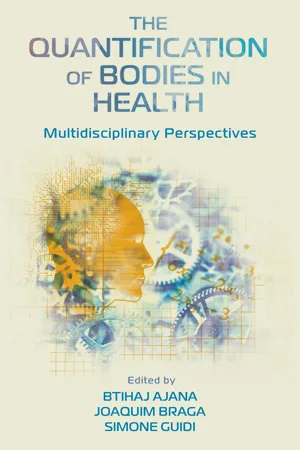
eBook - ePub
The Quantification of Bodies in Health
Multidisciplinary Perspectives
- 284 pages
- English
- ePUB (mobile friendly)
- Available on iOS & Android
eBook - ePub
The Quantification of Bodies in Health
Multidisciplinary Perspectives
About this book
Information
Part I
Body Quantification and Subjectivity: Philosophical Perspectives
Chapter 1
Body, Media and Quantification
Abstract
‘What is the meaning of the process of body quantification?’ – This is the central question of this chapter. With it, the author intends to question and analyse the way the body relates to new technologies and new technical procedures, and how these depend on the body itself to constitute themselves as mediating cultural forms. To make this enquiry feasible, the author shall critically examine the status of ‘object’ to which the body has been relegated by the myths of quantification, notably those concerning the universal symbolic character of numbers and measurement techniques. If the body is considered as a mere ‘quantified object’, then it is unlikely to be distinguished from other objects subjected to the same process. Consequently, it will easily tend to support the imaginary of technological determinism that prevails in our societies. Health trackers for personal use are, today, a good example of how the body is a fundamental element of such imaginary, since the feeling of control that they nurture in their users is also connected with the possibility of sharing information about the body itself. Given all these factors, the author intends to argue that, instead of being a simple quantified object, the body is, for new quantification technologies (namely those related to self-care), a ‘medium of the media’, insofar as it reinforces the effects of technological mediation processes, and potentialises the increased digital convergence of media. Recognising this means, finally, that the imaginary of quantification and associated techno-myths are also stimulated and reproduced by an extra-discursive somatic level inherent in the empirical use we make of technological devices.
Keywords: Convergence; embodiment; information; mediation; self-care; technology
Introduction
The several somatic dimensions involved in mediation and quantification processes – which are the main subjects of this chapter – constitute a theoretical horizon still full of misconceptions and, in many cases, incapable of providing a true epistemic status within the scope of a media theory of such processes. Moreover, in the prevailing discourse on the relationship between medium and body – chiefly anchored in McLuhan’s prosthesis-theory – there is a strong anthropomorphic approach that prevents us from glimpsing and exploring possible articulations and links entirely. Allied to this approach are also descriptive frameworks that, in the form of ekphrasis, tend to favour more the reification of the individual experiences and the psychic projections of human beings, and less the awareness of the multiple connections that bond the human body to mediation processes. As I want to demonstrate, the lack of a conceptual framework capable of highlighting all these connections not only prevents any critical updating of the concepts used by media theory, but also calls into question analyses of new mediation devices. In addition to that, conceptual misunderstandings tend to obscure the somatic inscriptions that each new medium fosters, as well as their structural effects on the configuration of the medium itself. Considering all these possibilities, I adopt, as a main maxim, the following seminal formulation: in each new mediation artefact there are self-reflexive technological features that, both in the empirical sphere and in the imaginary sphere, restore the place of the body in its own material constitution. Therefore, the purpose of this chapter is twofold: to analyse both the inscriptions of the body in technological media and the representations of the body prompted by them.
Quantification processes can have multiple objects, organic and inorganic, natural and artificial; but when analysed theoretically, objects tend to lose both the value of their material nature and the value of their symbolic profile. The general tendency is to analyse, above all, the techniques and technological devices that make them possible, as well the main differences that gradually occur among them. We are still, at this theoretical stage, linked to the old paradigm of mathesis universalis, reformulated by René Descartes, in his Règles pour la Direction de l’Esprit, to support ‘a general science that explains everything that it is possible to inquire into concerning order and measure, without applying them to a particular subject-matter’ (Descartes, 2003, p. 27).
Consequently, the body as a ‘quantified object’ is no longer distinguished from all other quantifiable objects. Features that symmetrically describe the body as one more object among many others, and, in the context of a broad technological determinism, as a phenomenon that is unilaterally transformed, distorted, and even dematerialised by measuring techniques and instruments, easily come to light. Theorists of new quantification technologies, such as Deborah Lupton, claim that although
other aspects of one’s everyday life (e.g., work outputs or social encounters) are often recorded as part of producing the quantified self, bodily functions represent a major target of self-tracking activities. (Lupton, 2013, p. 395)
Here it is convenient to ask, first, why bodily functions are relevant for the development of the quantification technologies themselves and to question whether the body, at the heart of the quantification processes, should or could be reduced to a simple object status?
Body and Media Theory
For many centuries, the idea of a human body was built through a strong connection with various cultural media. In Western thought, the body was understood according to two main approaches: firstly, as a representation subject and, secondly, as an articulation metaphor.
In the first case, as a representation subject, the human figure was primarily used to ascertain its expressive potentialities and, simultaneously, through them, those of art itself. Plastic artistic forms, such as sculpture and painting, created and offered us a kind of ‘body frame’ that covers the pictorial depictions based on human figures. Aesthetic concepts linked to art, such as those of proportion and volume, greatly express the referential value of the body for the configuration and appreciation of all other pictorial elements that can also be symbolised by a picture or a statue. In short, the forms of representation of the body tend to support all other forms of representation of objects in general. In the second approach, as an articulation metaphor, the anatomy of human body came to support the discourse of articulation of ‘parts’ within the ‘whole’, extending this logic not only to artistic objects and technological artefacts, but also to several forms of social organisation, political and religious, for instance. In this case, the threshold between body and culture is rather tenuous, because as is evident from the ancient idea of organism – according to which an organ has an instrumental value and a specific function quite like a handmade tool – the notion of body already presupposes a convergence with certain forms of mediation. Common to these two anchors that shape the idea of ‘body’ is the conception of an expressive contiguity between body and cultural artefacts. Following the ancient conception that the body could render visible certain psychic states and that there is an undeniable transparency between psychic states and their expression, in cultural media there is an intimate analogous link between their own operability and somatic structures, functions and dispositions. The greatest example of this organic unity are the famous words that Socrates, in Phaedrus, uses to define the art of discourse in general: ‘every discourse ought to be a living creature, having a body of its own and a head and feet’ (Plato, 1892, pp. 472–473), in which the parts remain fully articulated with a whole.
The imaginary of pre-digital media is thus anchored in a somatic analogue link, based on the idea of a pre-given and pre-defined body, in which the body itself serves to reinforce the nature-culture binomial. With the emergence of new media – particularly digital media – the suggestive power of the body, although not entirely eliminated, tends to undergo a significant set of changes. The organic metaphor of the parts and the whole is now fully transformed by the active and indispensable involvement of the bodies of users of new media in the several operations provided by them. The body is no longer just a matter of representation; it also reflects the way in which digital media operates technologically. Thus, if we want to qualify the new metaphor that prevails in the huge theoretical spectrum developed by the studies of new media and new technologies, it may be called the metaphor of disappearance.
It is part of the symbolic nature of all metaphors to contain a kind of expressive ecstasy, which allows them to further suggest rather than to properly signify. Although metaphor in general is not, in a narrow sense, a concept, it supports the sense-making processes of concepts, both in their formulation and representation, and, above all, in their unification within a given theory or given theoretical paradigm. This happens to what I call the metaphor of disappearance. In new media theories, such metaphor derives essentially from five assumptions that connect with each other: first, media are extensions of the human body and, therefore, tend to gradually replace the body itself – what starts to be considered an ‘extension’ becomes, for instance, in Marshall McLuhan’s famous prosthetic lexicon, an ‘amputation’ (McLuhan, 2001, p. 49); second, in impersonal communication at a distance, mediated by digital devices, the invisibility of the interlocutors’ body results in a disembodied experience; third, in body depictions operated by digital means, due to the possibility of manipulating pictorial configurations, the old idea of an empirical referent of the body fades and, in its place, the idea of the fragment and of the illusion prevails; fourth, in so-called ‘immersion technologies’, the viewer-user experiences a kind of somatic dissolution, as there is no clear demarcation line between their body, their artificial representations and those of other multimodal elements that allow the immersion process itself; fifth, and finally, the supposed body disappearance suggests and is suggested by the disappearance of the medium itself, as described, for instance, by Jay David Bolter and Richard Grusin in their book Remediation: Understanding New Media (1999).
Through these five assumptions it is possible to see how the metaphor of disappearance intends to replace its precedent – the metaphor of appearance – which enlivened the theoretical discourse on pre-digital media and analogical inscription surfaces, such as those of the photographic medium. There is no doubt that, as can be inferred from Roland Barthes’ descriptions of photography, the metaphor of appearance has, in its semantic genealogy, an ancestral religious pregnancy, linked to the myth of vera icona (Barthes, 1980, pp. 126–133). Through the picture a body appears; in this case the face of Christ, who is the true and faithful visible sign of his existence.
Despite their many and different entailments, the two kinds of metaphors share the same aesthetic paradigm – the paradigm of visibility. Making the invisible visible has always been the operative formula associated with the symbolic power of all media. Even if it was deeply rooted within a mythological semantic heritage, it is a formula with a technological import. In the second case, given by the opposite movement of disappearance, the paradigm of visibility is preserved, but with the subtle difference of turning a technological cause into a veritable technological effect. The abovementioned five assumptions are, in fact, anchored in the effects triggered by technological mediation devices and, as such, denote a passive nature of their users. In its eminently religious formulation, as grasped in medieval thought, the invisible never becomes absolutely visible. It never manifests and exhausts itself in a particular and single sensible form – that is, it transcends its material inscription. This discourse, which supports, for instance, the descriptions of religious icons, mitigates the technological import of mediation and its respective core effects.
Consequently, the relevant question that can be inferred from these five assumptions concerns the material nature of media, namely digital media. To be formulated, the metaphor of appearance had to suppress the materiality of the medium. The old metaphysical precept of the subjection of ‘matter’ to ‘form’ – as it is formulated in ancient philosophical thought, both in the Platonic theory of ideas and in the Aristotelian theory of the four causes – has shaped, until our days, media studies and a significant part of aesthetics and philosophy of art. The passive role of matter in relation to the active role of form almost always served the expressivist version of the mind’s intentionality and its psychical unity.
Such negative conception of the medium’s materiality is not, however, overcome by the metaphor of disappearance. On the contrary, the negative approach is here preserved and even seems, in its several types, to sublimate its philosophical legacy. Lev Manovich, in his seminal work on new media, initially raises the following question about digital interfaces: ‘What are the relationships between the physical space where the viewer is located, her body, and the screen space?’ (Manovich, 2001, pp. 94–95). According to Manovich, unlike the pre-digital screen, where there is a clear contrast between observer and medium, in the digital universe this contrast no longer holds. The author gives the example of the so-called ‘virtual reality’ (VR) to vindicate the belief on the screen disappearance: ‘with VR, the screen disappears altogether’, namely, as he reiterates,
The virtual space, previously confined to a painting or a movie screen, now completely encompasses the real space. Frontality, rectangular surface, difference in scale is all gone. The screen has vanished. (Manovich, 2001, p. 97)
Yet, as he adds, such disappearance is initially caused by the sensory-motor operations of the viewer-user: ‘to look up in virtual space, one has to look up in physical space’. In this mediation context, ‘The spectator is no longer chained, immobilized, anesthetized by the app...
Table of contents
- Cover
- Title
- Introduction
- Part I. Body Quantification and Subjectivity: Philosophical Perspectives
- Part II. Body Quantification: Historical and Empirical Perspectives
- Part III. Body Quantification and Mental Health
- Part IV. Body Quantification and Smart Machines
- Index
Trusted by 375,005 students
Access to over 1.5 million titles for a fair monthly price.
Study more efficiently using our study tools.
Frequently asked questions
Yes, you can cancel anytime from the Subscription tab in your account settings on the Perlego website. Your subscription will stay active until the end of your current billing period. Learn how to cancel your subscription
No, books cannot be downloaded as external files, such as PDFs, for use outside of Perlego. However, you can download books within the Perlego app for offline reading on mobile or tablet. Learn how to download books offline
Perlego offers two plans: Essential and Complete
- Essential is ideal for learners and professionals who enjoy exploring a wide range of subjects. Access the Essential Library with 800,000+ trusted titles and best-sellers across business, personal growth, and the humanities. Includes unlimited reading time and Standard Read Aloud voice.
- Complete: Perfect for advanced learners and researchers needing full, unrestricted access. Unlock 1.5M+ books across hundreds of subjects, including academic and specialized titles. The Complete Plan also includes advanced features like Premium Read Aloud and Research Assistant.
We are an online textbook subscription service, where you can get access to an entire online library for less than the price of a single book per month. With over 1.5 million books across 990+ topics, we’ve got you covered! Learn about our mission
Look out for the read-aloud symbol on your next book to see if you can listen to it. The read-aloud tool reads text aloud for you, highlighting the text as it is being read. You can pause it, speed it up and slow it down. Learn more about Read Aloud
Yes! You can use the Perlego app on both iOS and Android devices to read anytime, anywhere — even offline. Perfect for commutes or when you’re on the go.
Please note we cannot support devices running on iOS 13 and Android 7 or earlier. Learn more about using the app
Please note we cannot support devices running on iOS 13 and Android 7 or earlier. Learn more about using the app
Yes, you can access The Quantification of Bodies in Health by Btihaj Ajana, Joaquim Braga, Simone Guidi, Btihaj Ajana,Joaquim Braga,Simone Guidi in PDF and/or ePUB format, as well as other popular books in Social Sciences & Global Development Studies. We have over 1.5 million books available in our catalogue for you to explore.