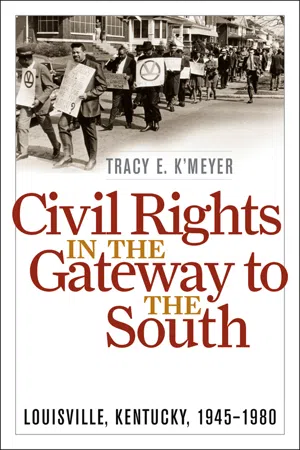
Situated on the banks of the Ohio River, Louisville, Kentucky, represents a cultural and geographical intersection of North and South. Throughout its history, Louisville has simultaneously displayed northern and southern characteristics in its race relations. In their struggles against racial injustice in the mid-twentieth century, activists in Louisville crossed racial, economic, and political dividing lines to form a wide array of alliances not seen in other cities of its size. In Civil Rights in the Gateway to the South: Louisville, Kentucky, 1945–1980, noted historian Tracy E. K'Meyer provides the first comprehensive look at the distinctive elements of Louisville's civil rights movement. K'Meyer frames her groundbreaking analysis by defining a border as a space where historical patterns and social concerns overlap. From this vantage point, she argues that broad coalitions of Louisvillians waged long-term, interconnected battles during the city's civil rights movement. K'Meyer shows that Louisville's border city dynamics influenced both its racial tensions and its citizens' approaches to change. Unlike African Americans in southern cities, Louisville's black citizens did not face entrenched restrictions against voting and other forms of civic engagement. Louisville schools were integrated relatively peacefully in 1956, long before their counterparts in the Deep South. However, the city bore the marks of Jim Crow segregation in public accommodations until the 1960s. Louisville joined other southern cities that were feeling the heat of racial tensions, primarily during open housing and busing conflicts (more commonly seen in the North) in the late 1960s and 1970s. In response to Louisville's unique blend of racial problems, activists employed northern models of voter mobilization and lobbying, as well as methods of civil disobedience usually seen in the South. They crossed traditional barriers between the movements for racial and economic justice to unite in common action. Borrowing tactics from their neighbors to the north and south, Louisville citizens merged their concerns and consolidated their efforts to increase justice and fairness in their border city. By examining this unique convergence of activist methods, Civil Rights in the Gateway to the South provides a better understanding of the circumstances that unified the movement across regional boundaries.
- 439 pages
- English
- PDF
- Available on iOS & Android
eBook - PDF
About this book
Information
Publisher
The University Press of KentuckyYear
2009Print ISBN
9780813130064
9780813125398
eBook ISBN
9780813173351
Table of contents
- Front cover
- Copyright
- Contents
- Abbreviations
- Acknowledgments
- Introduction
- 1. Postwar Campaigns for Citizens' Rights
- 2. Confronting School and Residential Segregation during the Cold War
- 3. Open Accommodations in the All American City
- 4. The Battle for Open Housing
- 5. Building Bridges, Fighting Poverty, and Empowering Citizens
- Photo insert
- 6. Militancy, Repression, and Resistance in the Black Power Era
- 7. Making Civil Rights Gains Real
- 8. The Busing Crisis
- Conclusion: Where Does the Story End?
- Notes
- Bibliography
- Index
Trusted by 375,005 students
Access to over 1.5 million titles for a fair monthly price.
Study more efficiently using our study tools.
Frequently asked questions
Yes, you can cancel anytime from the Subscription tab in your account settings on the Perlego website. Your subscription will stay active until the end of your current billing period. Learn how to cancel your subscription
No, books cannot be downloaded as external files, such as PDFs, for use outside of Perlego. However, you can download books within the Perlego app for offline reading on mobile or tablet. Learn how to download books offline
Perlego offers two plans: Essential and Complete
- Essential is ideal for learners and professionals who enjoy exploring a wide range of subjects. Access the Essential Library with 800,000+ trusted titles and best-sellers across business, personal growth, and the humanities. Includes unlimited reading time and Standard Read Aloud voice.
- Complete: Perfect for advanced learners and researchers needing full, unrestricted access. Unlock 1.5M+ books across hundreds of subjects, including academic and specialized titles. The Complete Plan also includes advanced features like Premium Read Aloud and Research Assistant.
We are an online textbook subscription service, where you can get access to an entire online library for less than the price of a single book per month. With over 1.5 million books across 990+ topics, we’ve got you covered! Learn about our mission
Look out for the read-aloud symbol on your next book to see if you can listen to it. The read-aloud tool reads text aloud for you, highlighting the text as it is being read. You can pause it, speed it up and slow it down. Learn more about Read Aloud
Yes! You can use the Perlego app on both iOS and Android devices to read anytime, anywhere — even offline. Perfect for commutes or when you’re on the go.
Please note we cannot support devices running on iOS 13 and Android 7 or earlier. Learn more about using the app
Please note we cannot support devices running on iOS 13 and Android 7 or earlier. Learn more about using the app
Yes, you can access Civil Rights in the Gateway to the South by Tracy E. K'Meyer in PDF and/or ePUB format, as well as other popular books in History & North American History. We have over 1.5 million books available in our catalogue for you to explore.