The terrorist attacks of September 11, 2001, shattered the prevalent optimism in the United States that had blossomed during the tranquil and prosperous 1990s, when democracy seemed triumphant and catastrophic wars were a relic of the past. President George W. Bush responded with a bold and controversial grand strategy for waging a preemptive Global War on Terror, which has ignited passionate debate about the purposes of American power and the nation's proper role in the world.
In Defense of the Bush Doctrine offers a vigorous argument for the principles of moral democratic realism that inspired the Bush administration's policy of regime change in Iraq. The Bush Doctrine rests on two main pillars—the inadequacy of deterrence and containment strategies when dealing with terrorists and rogue regimes, and the culture of tyranny in the Middle East, which spawns aggressive secular and religious despotisms.
Two key premises shape Kaufman's case for the Bush Doctrine's conformity with moral democratic realism. The first is the fundamental purpose of American foreign policy since its inception: to ensure the integrity and vitality of a free society "founded upon the dignity and worth of the individual." The second premise is that the cardinal virtue of prudence (the right reason about things to be done) must be the standard for determining the best practicable American grand strategy.
In Defense of the Bush Doctrine provides a broader historical context for the post–September 11 American foreign policy that will transform world politics well into the future. Kaufman connects the Bush Doctrine and current issues in American foreign policy, such as how the U.S. should deal with China, to the deeper tradition of American diplomacy. Drawing from positive lessons as well as cautionary tales from the past, Kaufman concludes that moral democratic realism offers the most compelling framework for American grand strategy, as it expands the democratic zone of peace and minimizes the number and gravity of threats the United States faces in the modern world.
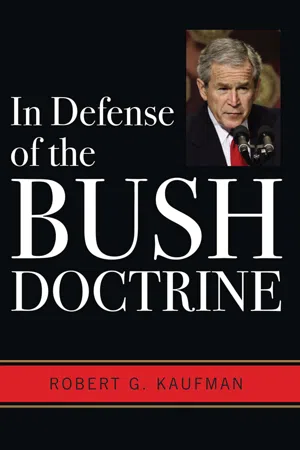
- 263 pages
- English
- PDF
- Available on iOS & Android
eBook - PDF
In Defense of the Bush Doctrine
About this book
Information
Publisher
The University Press of KentuckyYear
2007Print ISBN
9780813191850
9780813124346
eBook ISBN
9780813172200
Table of contents
- Front cover
- Copyright
- Contents
- Acknowledgments
- Introduction
- 1. The Imprudence of Isolationism
- 2. The Perils of Neorealism
- 3. The Unrealistic Realism of Classical Realists
- 4. The Perils of Liberal Multilateralism
- 5. Moral Democratic Realism
- 6. Moral Democratic Realism and the Endgame of the Cold War
- 7. The Bush Doctrine and Iraq
- Conclusion: Beyond the War on Terror
- Epilogue
- Appendix
- Notes
- Bibliography
- Index
Trusted by 375,005 students
Access to over 1.5 million titles for a fair monthly price.
Study more efficiently using our study tools.
Frequently asked questions
Yes, you can cancel anytime from the Subscription tab in your account settings on the Perlego website. Your subscription will stay active until the end of your current billing period. Learn how to cancel your subscription
No, books cannot be downloaded as external files, such as PDFs, for use outside of Perlego. However, you can download books within the Perlego app for offline reading on mobile or tablet. Learn how to download books offline
Perlego offers two plans: Essential and Complete
- Essential is ideal for learners and professionals who enjoy exploring a wide range of subjects. Access the Essential Library with 800,000+ trusted titles and best-sellers across business, personal growth, and the humanities. Includes unlimited reading time and Standard Read Aloud voice.
- Complete: Perfect for advanced learners and researchers needing full, unrestricted access. Unlock 1.5M+ books across hundreds of subjects, including academic and specialized titles. The Complete Plan also includes advanced features like Premium Read Aloud and Research Assistant.
We are an online textbook subscription service, where you can get access to an entire online library for less than the price of a single book per month. With over 1.5 million books across 990+ topics, we’ve got you covered! Learn about our mission
Look out for the read-aloud symbol on your next book to see if you can listen to it. The read-aloud tool reads text aloud for you, highlighting the text as it is being read. You can pause it, speed it up and slow it down. Learn more about Read Aloud
Yes! You can use the Perlego app on both iOS and Android devices to read anytime, anywhere — even offline. Perfect for commutes or when you’re on the go.
Please note we cannot support devices running on iOS 13 and Android 7 or earlier. Learn more about using the app
Please note we cannot support devices running on iOS 13 and Android 7 or earlier. Learn more about using the app
Yes, you can access In Defense of the Bush Doctrine by Robert G. Kaufman in PDF and/or ePUB format, as well as other popular books in Politics & International Relations & International Relations. We have over 1.5 million books available in our catalogue for you to explore.