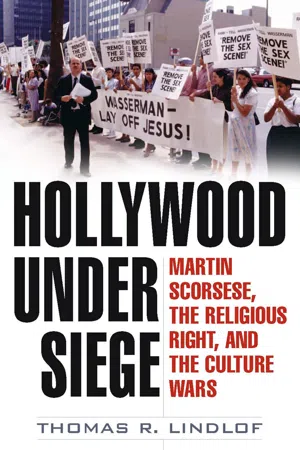
In 1988, director Martin Scorsese fulfilled his lifelong dream of making a film about Jesus Christ. Rather than celebrating the film as a statement of faith, churches and religious leaders immediately went on the attack, alleging blasphemy. At the height of the controversy, thousands of phone calls a day flooded the Universal switchboard, and before the year was out, more than three million mailings protesting the film fanned out across the country. For the first time in history, a studio took responsibility for protecting theaters and scrambled to recruit a "field crisis team" to guide The Last Temptation of Christ through its contentious American openings. Overseas, the film faced widespread censorship actions, with thirteen countries eventually banning the film. The response in Europe turned violent when opposition groups sacked theaters in France and Greece and caused injuries to dozens of moviegoers. Twenty years later, author Thomas R. Lindlof offers a comprehensive account of how this provocative film came to be made and how Universal Pictures and its parent company MCA became targets of the most intense, unremitting attacks ever mounted against a media company. The film faced early and determined opposition from elements of the religious Right when it was being developed at Paramount during the last year the studio was run by the celebrated troika of Barry Diller, Michael Eisner, and Jeffrey Katzenberg. By the mid-1980s, Scorsese's film was widely regarded as unmakeable—a political stick of dynamite that no one dared touch. Through the joint efforts of two of the era's most influential executives, CAA president Michael Ovitz and Universal Pictures chairman Thomas P. Pollock, this improbable project found its way into production. The making of The Last Temptation of Christ caught evangelical Christians at a moment when they were suffering a crisis of confidence in their leadership. The religious right seized on the film as a way to rehabilitate its image and to mobilize ordinary citizens to attack liberalism in art and culture. The ensuing controversy over the film's alleged blasphemy escalated into a full-scale war fought out very openly in the media. Universal/MCA faced unprecedented calls for boycotts of its business interests, anti-Semitic rhetoric and death threats were directed at MCA chairman Lew Wasserman and other MCA executives, and the industry faced the specter of violence at theaters. Hollywood Under Siege draws upon interviews with many of the key figures—Martin Scorsese, Paul Schrader, Michael Ovitz, Jeffrey Katzenberg, Jack Valenti, Thomas P. Pollock, and Willem Dafoe—to explore the trajectory of the film from its conception to the subsequent epic controversy and beyond. Lindlof offers a fascinating dissection of a critical episode in the embryonic culture wars, illuminating the explosive effects of the clash between the interests of the media industry and the forces of social conservatism.
eBook - PDF
Hollywood Under Siege
Martin Scorsese, the Religious Right, and the Culture Wars
- 407 pages
- English
- PDF
- Available on iOS & Android
eBook - PDF
About this book
Trusted by 375,005 students
Access to over 1.5 million titles for a fair monthly price.
Study more efficiently using our study tools.
Information
Subtopic
Film History & CriticismTable of contents
- Front cover
- Copyright
- Contents
- Acknowledgments
- Prologue
- 1. Dying Dangerously
- 2. Paramount
- 3. Universal
- 4. Morocco
- 5. Fevers Under the Veil
- 6. Summer of the Locust
- 7. Teeth Bared, Knuckles White
- 8. The Big Wind-Up
- 9. Trouble in Flyover Country
- 10. Scorched Earth Blues
- Epilogue
- Notes
- Selected Bibliography
- Author Interviews
- Index
Frequently asked questions
Yes, you can cancel anytime from the Subscription tab in your account settings on the Perlego website. Your subscription will stay active until the end of your current billing period. Learn how to cancel your subscription
No, books cannot be downloaded as external files, such as PDFs, for use outside of Perlego. However, you can download books within the Perlego app for offline reading on mobile or tablet. Learn how to download books offline
Perlego offers two plans: Essential and Complete
- Essential is ideal for learners and professionals who enjoy exploring a wide range of subjects. Access the Essential Library with 800,000+ trusted titles and best-sellers across business, personal growth, and the humanities. Includes unlimited reading time and Standard Read Aloud voice.
- Complete: Perfect for advanced learners and researchers needing full, unrestricted access. Unlock 1.5M+ books across hundreds of subjects, including academic and specialized titles. The Complete Plan also includes advanced features like Premium Read Aloud and Research Assistant.
We are an online textbook subscription service, where you can get access to an entire online library for less than the price of a single book per month. With over 1.5 million books across 990+ topics, we’ve got you covered! Learn about our mission
Look out for the read-aloud symbol on your next book to see if you can listen to it. The read-aloud tool reads text aloud for you, highlighting the text as it is being read. You can pause it, speed it up and slow it down. Learn more about Read Aloud
Yes! You can use the Perlego app on both iOS and Android devices to read anytime, anywhere — even offline. Perfect for commutes or when you’re on the go.
Please note we cannot support devices running on iOS 13 and Android 7 or earlier. Learn more about using the app
Please note we cannot support devices running on iOS 13 and Android 7 or earlier. Learn more about using the app
Yes, you can access Hollywood Under Siege by Thomas R Lindlof in PDF and/or ePUB format, as well as other popular books in Media & Performing Arts & Film History & Criticism. We have over 1.5 million books available in our catalogue for you to explore.