- 656 pages
- English
- ePUB (mobile friendly)
- Available on iOS & Android
eBook - ePub
The Invention of Terrorism in Europe, Russia, and the United States
About this book
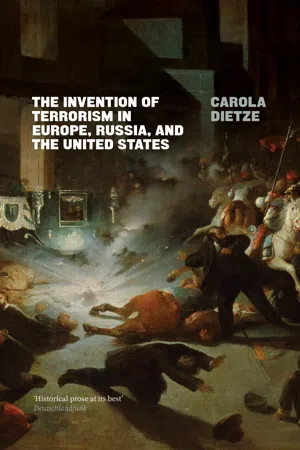
This book examines key cases of terrorist violence to show that the invention of terrorism was linked to the birth of modernity in Europe, Russia and the United States, rather than to Tsarist despotism in 19th century Russia or to Islam sects in Medieval Persia. Combining a highly readable historical narrative with analysis of larger issues in social and political history, the author argues that the dissemination of news about terrorist violence was at the core of a strategy that aimed for political impact on rulers as well as the general public. Dietze's lucid account also reveals how the spread of knowledge about terrorist acts was, from the outset, a transatlantic process. Two incidents form the book's centerpiece. The first is the failed attempt to assassinate French Emperor Napol?on III by Felice Orsini in 1858, in an act intended to achieve Italian unity and democracy. The second case study offers a new reading of John Brown's raid on the arsenal at Harpers Ferry in 1859, as a decisive moment in the abolitionist struggle and occurrences leading to the American Civil War. Three further examples from Germany, Russia, and the US are scrutinized to trace the development of the tactic by first imitators. With their acts of violence, the "invention" of terrorism was completed. Terrorism has existed as a tactic since then and has essentially only been adapted through the use of new technologies and methods.
Information
1
Theoretical and historical premises
Components of a theory of terrorism: concept, logic of action, causes and effects
What is terrorism? Only a precise concept of terrorism, its causes, and the ways in which it operates can help identify this specific kind of violence and differentiate it from other forms of violence in history. In terms of scientific disciplines, the questions of what terrorism is, how it arises, and how it functions fall under the purview of the social sciences, in particular sociology and political science. A careful review of the literature on terrorism, however, has made it clear that the social sciences have no single comprehensive approach that explains all the questions that are important in a historical analysis of terrorism’s origins. The aspects crucial to a historical inquiry into this topic are therefore discussed below.
The general purpose of the social sciences is to arrive at universally valid statements that hold true independently of time and space. This chapter’s synthesis of approaches from political science and social science is thus itself a theory on the origins and functioning of terrorist violence. It is a theory with a claim to systematic universal validity even though it is embedded in a historical investigation based on specific times, spaces and actors, and hence on the uniqueness of each of them. As it turns out, however, the theory that emerges from the following synthesis is equally applicable to the analysis of all five incidents at the heart of this book, their perpetrators and the societies in which they lived. It thereby proves valid for understanding the rise of terrorism, at least in the nineteenth century. The degree to which it can explain terrorism’s history since the mid-nineteenth century is discussed in the concluding chapter.
Concept
As repeatedly emphasized in the relevant literature, the notion of terrorism is problematic for various reasons. First, the word as used in today’s political discourse does not refer to an analytical concept designating a particular kind of violence. It is instead a battle cry to defame a political opponent.1 The argument is that political positions ultimately determine what terrorism is. Gerald Seymour sums it up in an aphorism: ‘One man’s terrorist is another man’s freedom fighter.’2 Second, Martha Crenshaw and Charles Tilly correctly warned against the term’s objectifying effect. Terror and terrorism appeared to be virtually independent actors when former US president George W. Bush declared war on terrorism and his secretary of defense Colin L. Powell stated, ‘Terrorism doesn’t only kill people. It also threatens democratic institutions, undermines economies, and destabilizes regions.’3 By contrast, Crenshaw and Tilly conceive of terrorism as a strategy used by different political actors with different goals and effects, depending on the situation.4 Third, research on terrorism stresses again and again how difficult it is to define the term. In the early 1980s the Dutch terrorism researcher Alex Schmid found more than a hundred different definitions by different scientific and political institutions, and their number has only grown since then.5 This multiplicity explains the frequent assumption that the term does not lend itself to scientific study.6
A closer look shows that these objections to the term ‘terrorism’ are of only limited value. The sheer abundance of definitions for terrorism is undeniable, but well-conceived scientific ones converge in the essential points.7 German sociologist Peter Waldmann, on whose terminology the study in this book rests, defines terrorism as ‘violence against a political order from below which is planned and prepared [planmäßig vorbereitet] and meant to be shocking. Such acts of violence are supposed to spread feelings of insecurity and intense fear, but they are also meant to generate sympathy and support.’8 The term ‘political order’ in German can include the social and economic order of a society, so that Waldmann’s definition also covers these aspects of societal order as objects of violence (for example, aimed at by right-wing or social-revolutionary terrorists, such as the anarchists). Waldmann underlines the political dimension expressed in the political intentions and objectives of the violence committed by the terrorists.9 Terrorism is thus a politically motivated strategy of resorting to spectacular violence with the goal of producing a powerful psychological effect in a society – fear on the one hand, sympathy on the other – in order to compel political change. This view limits the concept of terrorism to underground acts of violence against an inherently more powerful opponent (bottom-up), whereas acts of violence by the state against the population (top-down) are called ‘terror’. More recent research literature reflects broad international agreement on the elements identified in this definition.10 The repeatedly evoked problem of defining terrorism is thus not so much a terminological issue as it is a battle over political ascriptions.11
By contrast, the widely cited alternative distinction between terrorist and freedom fighter stems from a logical fallacy. As the Israeli terrorism researcher Boaz Ganor convincingly argues, terrorism and the fight for freedom describe two different aspects of political action. The former term refers to tactics; the latter, to the political objective. Individuals who practise insurgent violence can therefore be terrorists and freedom fighters, the one or the other, or neither.12
For these reasons, it is possible to use the word ‘terrorism’ as an analytical term without becoming mired in polemics or lapsing into anthropomorphization, as long as one strictly observes the criteria, for example, in the definition by Waldmann.13 This definition serves in the following chapters to assess the violent acts committed by Felice Orsini and John Brown and by their imitators Oskar Wilhelm Becker, John Wilkes Booth and Dmitry Vladimirovich Karakozov. This approach will show that, or to what degree, the different acts of violence constitute terrorism.
Waldmann’s definition, however, is complemented by additional criteria and observations relating to the causes of terrorist violence and to the conditions on which its success hinges. These criteria and observations come from several sources: first, Rainer Paris’s analyses based on action theory; second, research by James C. Davies and Samuel Huntington in political science and sociology on the social causes of political violence; third, the work by historical sociologists and researchers of movements and protests like Donatella della Porta, Dieter Rucht, Sidney G. Tarrow and Charles Tilly; fourth, the results of terrorism research by Martha Crenshaw, Bruce Hoffman and Peter Waldmann, as well as by Luigi Bonanate, Janny de Graaf, Ze′ev Iviansky, Louise Richardson, Alex P. Schmid, Gabriel Weimann, Paul Wilkinson and Conrad Winn; and fifth, Reinhart Koselleck’s study on the history of philosophy. This approach makes it possible not only to examine the deed itself but also to study its origin and effect for criteria and patterns typical of terrorist violence. It will then be possible to contextualize what exactly happened and further corroborate the definition-based finding that the acts of violence presented in the following pages were indeed terrorism.
Logic of action
How does terrorism work? Rainer Paris, a phenomenological sociologist who has analysed particular kinds of social action for their inherent ends and logics independent of their positive or negative moral value, has shown that terrorism serves the exercise of power and must be classified as a special case of provocation. He sees power ‘not as possession … of resources and means of power but rather as a dynamic reciprocal process that plays out between at least two actors within a social relationship in which one presses his will upon the other and is able to prevail even against resistance’.14 Building on this notion of the sociology of power, Paris defines provocation ‘as a deliberate, surprising norm violation intended to draw the other into an open conflict and prompt a reaction that morally discredits and exposes that party in the eyes of third parties’.15 Paris’s definition of provocation encompasses a number of elements that also appear in Waldmann’s definition and that are crucial constituents of terrorist strategy – intentionality, norm violation, surprise, conflict orientation and dependence on a reaction. Paris includes the additional aspect of exposure that discredits.
The structural elements of provocation that Paris identifies entail specific social conditions, action logics and consequences. According to him, provocations are especially frequent where a power imbalance exists. They usually occur from the bottom up and are thus ‘the preferred weapon of the weaker parties. The provocation positions the powerful as having power and simultaneously impugns their legitimacy.’ Of course, provocations can sometimes appear opportune to the powerful person, too, ‘if it is a matter of seeking occasion to impose sanctions or eliminate barriers to legitimacy that block you from activating your own power resources’.16 A provocation, he continues, is aimed and direct, yet also calculated and dosed. The purpose is to insult, wound, expose and show up the powerful person and to disavow their legitimacy. The agitator proceeds indirectly. The idea is to make the other feel attacked so that he attacks in turn, for the agitator wants to discredit the other – but, if at all possible, in a way that gets the person to discredit himself.17 Terrorism is an extreme manifestation of such action. Whether in history or in contemporary society, this social logic is decisive for identifying violence as terrorism.
By contrast, other factors extraneous to this logic of action, but nonetheless frequently mentioned as criteria in the literature, are irrelevant for defining an act of violence as terrorism. For example, it is immaterial whether an individual, a group, or a network is behind an attack and how many attacks are carried out.18
The analysis must also account for the fact that terrorists adapt their tactics to the circumstances in order to exploit the potential of the method optimally as conditions change. What starts as a strategy of provocation can expand to a kind of war when a conflict has reached a certain degree of polarization.19 That is why terrorism often accompanies other kinds of political violence, from vigilantism, civil wars and guerrilla war to Leninist-style revolutions, ethnic clashes and coups d’état. Identifying terrorist violence within such larger altercations becomes problematic at times, even with a clear analytical concept of terrorism.20
Authors vary in their answers to the question whether the political motives and objectives of the persons perpetrating terrorist acts are important for identifying terrorism. In the social-science research of the 1970s and 1980s, terrorism was generally seen as violence motivated by anarchist or socialist ideologies. Today, this kind of violence is often associated with Islamism. Objecting to such tendencies, Lawrence Freedman, for example, has pointed out that terrorism is politically and religiously open as a tactic: ‘The methods of terrorism are not the monopoly of any cause or political philosophy.’21 Nonetheless, researchers agree that ideologies shape the actual forms and manifestations of terrorist action. In that capacity, ideology serves as a kind of prism through which terrorists interpret their environment and the world. It prescribes their motives and political objectives as well as the weapons and targets that are deemed legitimate. Terrorists target the victim whose symbolic value is high in relation to their convictions and goals.22
Apart from the generalization that terrorism can serve as a tactic for different motives and objectives, three political directions of terrorism stand out empirically in the nineteenth and twentieth centuries. Waldmann characterizes them as social-revolutionary, ethno-nationalist, and radical right-wing terrorism. Since the late twentieth century, this scope has come to encompass religiously motivated terrorism as well. Waldmann underlines how important it is to distinguish clearly between these ‘basic ideas … that subscribe to and determine terrorist action’, while the possibility of ‘fluid transitions and overlaps’ between the three secular political motivations. Substantively, Waldmann defines the three types of revolutions as
the striving for a revolutionary change in social and political structures according to Marx’s ideas; the will of ethnic minorities or repressed peoples to gain state independence, or at least increased political autonomy; a third type encompasses law-and-order movements that purport to protect the existing social order while circumventing the state and violating the law – one could describe them as right-wing radical or vigilante terrorism.23
Right-wing extremist terrorism is a special case in that it often combines elements of top-down state terror with bottom-up terrorism against the political order. Right-wing radical groups fight to defend the status quo and, depending on the situation, direct their violence less against the state than against certain social groups. In that sense, the phenomena of both right-wing terrorism and state-sponsored terrorism illustrate that powerful actors, too, sometimes resort to indirect means if it appears opportune to them.24
One conclusion for the historical analysis of the logic behind violent terrorist action is that terrorism serves the exercise of power and that the element of provocation aimed at delegitimizing and exposing powerful opponents can be added to Waldmann’s definitional criteria as a key constituent of terrorist tactics. Another conclusion is that terrorism, although its goals can be indeterminate in principle, has been effective empirically (at least in the nineteenth and twentieth centuries) in three political manifestations: as social-revolutionary, ethno-nationalist and right-wing radical terrorism.
Causes
What can be gathered from the social-science literature regarding the causes of terrorism? The preceding description of the phenomenon suggests that terrorism is a tactic of political action that follows rational logics. It is misleading to keep dismissing terrorists simply as irrational fanatics whose behaviour is psychopathologically conditioned.25 There is no such thing as a psychologically abnormal ‘terrorist personality’.
If psychopathological approaches to explaining terrorism are excluded, the question about its causes becomes even more pressing. The use of terrorist violence is not a tactic of first choice. Lawrence Freedman stresses that terrorism, as an indirect course of action that depends on responses, is difficult to control and thus always at a disadvantage up against direct methods of military coercion. Accordingly, terrorist attacks would be mounted primarily where excessively unequal power relations would rule out modes of direct military control as a sensible option. Martha Crenshaw agrees, noting that terrorism is usually the result of a learning process and is not used until other means have proven ineffective.26 To understand how terrorism arose as a tactic and why political actors use terrorist viol...
Table of contents
- Cover Page
- Halftitle Page
- Title Page
- Copyright Page
- Dedication
- Contents
- Introduction
- 1. Theoretical and historical premises
- 2. Bombs for the nation: Felice Orsini’s assassination attempt on Napoleon III and the emergence of Italy
- 3. Transatlantic communication: reporting in the United States on Orsini’s attempted assassination of Napoleon III
- 4. Hostages for emancipation: John Brown’s raid on Harpers Ferry and the end of slavery in the United States
- 5. Transatlantic communication: European and Russian coverage of the raid on Harpers Ferry
- 6. Further development by imitators: the universalization of terrorist tactics
- Conclusion
- Acknowledgements from the German edition
- Acknowledgements for the English edition
- Notes
- Index
Trusted by 375,005 students
Access to over 1.5 million titles for a fair monthly price.
Study more efficiently using our study tools.
Frequently asked questions
Yes, you can cancel anytime from the Subscription tab in your account settings on the Perlego website. Your subscription will stay active until the end of your current billing period. Learn how to cancel your subscription
No, books cannot be downloaded as external files, such as PDFs, for use outside of Perlego. However, you can download books within the Perlego app for offline reading on mobile or tablet. Learn how to download books offline
Perlego offers two plans: Essential and Complete
- Essential is ideal for learners and professionals who enjoy exploring a wide range of subjects. Access the Essential Library with 800,000+ trusted titles and best-sellers across business, personal growth, and the humanities. Includes unlimited reading time and Standard Read Aloud voice.
- Complete: Perfect for advanced learners and researchers needing full, unrestricted access. Unlock 1.5M+ books across hundreds of subjects, including academic and specialized titles. The Complete Plan also includes advanced features like Premium Read Aloud and Research Assistant.
We are an online textbook subscription service, where you can get access to an entire online library for less than the price of a single book per month. With over 1.5 million books across 990+ topics, we’ve got you covered! Learn about our mission
Look out for the read-aloud symbol on your next book to see if you can listen to it. The read-aloud tool reads text aloud for you, highlighting the text as it is being read. You can pause it, speed it up and slow it down. Learn more about Read Aloud
Yes! You can use the Perlego app on both iOS and Android devices to read anytime, anywhere — even offline. Perfect for commutes or when you’re on the go.
Please note we cannot support devices running on iOS 13 and Android 7 or earlier. Learn more about using the app
Please note we cannot support devices running on iOS 13 and Android 7 or earlier. Learn more about using the app
Yes, you can access The Invention of Terrorism in Europe, Russia, and the United States by Carola Dietze in PDF and/or ePUB format, as well as other popular books in Politics & International Relations & World History. We have over 1.5 million books available in our catalogue for you to explore.