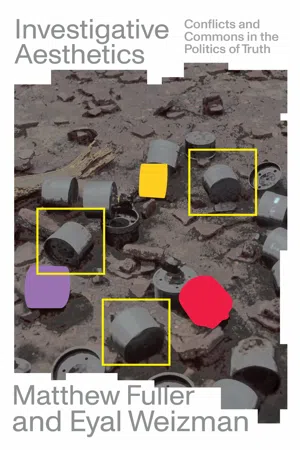
Today, artists are engaged in investigation. They probe corruption, state violence, environmental destruction and repressive technologies. At the same time, fields not usually associated with aesthetics make powerful use of it. Journalists and legal professionals pore over open source videos and satellite imagery to undertake visual investigations. This combination of diverse fields is what the authors call "investigative aesthetics": mobilising sensibilities often associated with art, architecture and other such practices to find new ways of speaking truth to power.
This book draws on theories of knowledge, ecology and technology, evaluates the methods of citizen counter-forensics, micro-history and art, and examines radical practices such as those of Wikileaks, Bellingcat, and Forensic Architecture. Investigative Aesthetics takes place in the studio and the laboratory, the courtroom and the gallery, online and in the streets, as it strives towards the construction of a new 'common sensing'.
The book is an inspiring introduction to a new field that brings together investigation and aesthetics to change how we understand and confront power today.
To Nour Abuzaid for your brilliance, perseverance, and unshaken belief in the liberation of Palestine.
eBook - ePub
Investigative Aesthetics
Conflicts and Commons in the Politics of Truth
- 272 pages
- English
- ePUB (mobile friendly)
- Available on iOS & Android
eBook - ePub
About this book
Information
Topic
ArteSubtopic
Arte e politicaPart 1 Aesthetics
1
Aesthetics beyond Perception
What is aesthetics? The notion of aesthetics that we invoke is distinct from its colloquial or specialist use. To aestheticise something is not to prettify or to decorate it, but to render it more attuned to sensing. As such it is also different from the way it is often used by practitioners of art and culture. Rather, we employ a variation on the classic meaning of the term.
The ancient Greeks used the word aisthesis to describe that which pertains to the senses.1 Aesthetics thus concerns the experience of the world. It involves sensing – the capacity to register or to be affected, and sense-making – the capacity for such sensing to become knowledge of some kind. The finding or invention of means to achieve such effects is to aestheticise.
Defining aesthetics in this way allows us to derive two other terms: hyper-aesthetics, which we consider to be the augmentation and elaboration of such experience, and hyperaesthesia, which we consider to be the state in which experience overloads or collapses, and, as a result, sensation stops making sense.
In this expanded meaning, as a way of sensing the world, aesthetics does not exclusively refer to a property or capacity of humans. It equally refers to other sensing organisms, such as animals and plants, which themselves apprehend their environment. Further, we argue that sensing is also found in material surfaces and substances, on which traces of impact or slower processes of change are registered, including in digital and computational sensors, which themselves detect, register and predict in multiple novel ways.
But aesthetics is not only about sensation or receiving information understood as a passive act; it is also about perception, the making sense of what is sensed. This entails modes of knowledge production, of figuring things out. Sensing is thus only a part of the more complex question of sense-making. The former is the result of the receptive action of a sensory organ, a material or a system. The latter involves experience and understanding of what is being sensed, a perception and conception, or a world view, if you like.
Making sense involves constructing means of sensing. This can take place through the design and development of technologies and techniques – literally making senses – or of reflections and enquiries into sensing, making sense as reasoning of different kinds. The sense-making aspect of material aesthetics is more complex and always involves relations between substances and organisms. We should also keep an open mind as to whether artificial forms of sense-making might arise.
The two meanings of aesthetics – sensing and sense-making – are not reducible to each other. In fact, they are sometimes not even conducive to each other. One can, for instance, be deceived by one’s senses, by an ideology or turn of thought, by a perception of accuracy in an instrument. Both sensing and sense-making, then, each necessarily involve a tension with the other. They may even sometimes seek to undo each other.
Each sensing event has a particular mix of contributing elements that distinguish it. In the unfolding of each sensing entity and process of sense-making, aesthetics is situated and perspectival. Each particular form of experience has inherently unique aspects that not only shape it but constitute it. This given, aesthetics can also be a collective practice which assembles the multiple varied and sometimes seemingly incompatible situated experiences – of different individuals and groups, of matter and code – into a poly-perspectival rendering of a situation, combining multiple views from within. Unlike other entry points into fields of knowledge, aesthetics, conceived in this way, does not appeal to a universal a priori knowledge. There is no privileged or external position from which to make aesthetic judgement. It is, rather, both collective and additive. The experience of different people, for instance, varies depending on their location, privilege and cultural history. Human experience is substantially different from that of non-humans – bats, pangolins, apes, plants, clouds, digital cameras, thermometers or rocks. Indeed, we are not just talking about the sensing capacities of immediately identifiable entities, but also those of more diffuse systems such as economies that can be seen as a complex and varied aesthetic field in which a huge number of sensing points – many more than simply price, such as interest rates, parameters of leverage, volatility of rates of profit and others as well as their complex relations to desire, knowledge and social processes, are present and active. So aesthetics is an approach that is fundamentally about assembling, and finding the means to recognise, a multiplicity of different forms of sensation.
Further, aesthetics does not solely pertain to or spring from an individual thing, such as a person, an object or a plant. In fact, we argue that aesthetics is always relational. Relationality always means that something is always also occurring beneath and beyond individuating entities and dynamics.2 Indeed, as the expanding academic field of the posthumanities emphasises, computational systems, new biomedical forms and the urgency of ecological understanding compel us to go beyond the frame of what is understood to be individual human perception.3
Aestheticisation, the process or act of becoming or making sensitive, is dialogic and collective, just like an emotion is relational and justice is assembled. There is a process to take part in it, but it is also necessary to recognise how the sensing self is an occurrence. The conscious subject is built up through the interaction of numerous entities, systems and experiences. Each of these may have quite distinct aesthetic capacities. The event of an aesthetic relation between processes manifests in dynamic transformation.
Aesthetics is, crucially, a question of the material relation within and between entities and the ecologies of which they are part. Given this, we must note that materials are aestheticised to each other without the need for human perception and intervention as a convenor. Communication is not simply about sending signals, but it is about transformative interconnection. Examples of such basic sensing might be the way the electron is in thick communication with the nucleus, or the way molecules key into or repel each other, or the moon dances with the tide. A crucial question for aesthetics is to develop capacities of sense-making adequate to such pluralities of sensation.
The obverse of aestheticisation is anaesthetisation, to make the senses numb. Crucially, aesthetics also pertains to the intellect. It implies the ability to perceive. This can include the ability to recognise pain (in more than its physical sense) and even to sense this in the political sphere. For example, a sense of injustice can be aestheticised or anaesthetised, in fact may be primarily so as a feeling before it becomes a thought. And this can create a link between what one may tacitly perceive, see or hear; what one may feel about what one sees and hears; and how that affects one’s sense of right and wrong. In this sense, to be politicised is to increase one’s ability to be aestheticised to the world.
Sometimes self-anaesthetisation can be necessary to slip out of a sphere of influence, to cauterise a wound. But complimentarily to the anaesthetic, one can also learn to tune into the sensorial dimension of phenomena. Such aestheticisation is not only perceptual, but also may involve creating existential or conceptual dispositions through experience, attention, even by studying. Creating dispositions and devices that dilate perception to illuminate affinities and insights, the work of magnifying and expanding aestheticisation is that of hyper-aesthetics.
Hyper-aesthetics is an expanded state of aesthetic alertness. At one level it can involve tuning in to the sensorial nature of matter and biological substance in a way that is akin to cosmic reverie: a state often referred to by poets and artists wherein the world is experienced in a way that dissolves the self into a feeling of a common unfolding of the world. It is also found in a different way in the development of new technologies of sensing, for instance in the expanded understanding of physics worked through at particle colliders, such as CERN. Here, collisions between accelerated particles are sensed for a fraction of a millisecond by massive arrays of measuring devices. Their sensings are probed in turn by calculations of the possible momentary states of matter produced by these collisions in order to discern what may or may not be present.
But hyper-aesthetic states are not simply to be affirmed: for those with access privileges allowing synoptic oversight via control screens and dashboards, a certain kind of hyper-aesthetic frisson can be garnered from what philosopher Bernard Stiegler calls the planetary-scale grammatisation of culture – the installing of a certain limited pattern of operations – taking place through social media.4 For those with lower-level access, systems that under different political and economic imperatives might be more fully novel experiential and analytic assemblages show different facets. On the one hand social media become infinitely scrollable production lines, and on the other they are sites where fleeting and partial patchworks of affinity can be constructed.
Crucially, hyper-aesthetics also emerges in devising forms of integration between different forms of sensation. First, hyper-aesthetics becomes particularly palpable through the incorporation of human sensing with a network of devices that monitor, count and measure. The unprecedented number and quality of mediating sensors has a politics. What are they tuned to sense and what are they designed to miss? What lies under their threshold of detectability? How are they assembled?
Biometric surveillance, of faces, of genes, of gaits, would be one branch of the ‘family tree’ of such technologies. Another could be found in the tools and regimes of testing in times of pandemic. Finding the tests that can be aestheticised to the virus is a privilege to those, or those states, with connections, wealth or power. The uneven distribution and accessibility of technological sensors ramifies and produces the sensorium of some. This puts into motion a differential regime of aesthetics that defines emerging geometries of domination. Hyper-aesthetics is saturated with new formations of power.
Second, hyper-aesthetics also emerges in the recognition of an ecology of sensing and sense-making. In such an expanded aesthetics, entities laterally relate to each other as matter to matter, plant to plant, code to code and among and between these, increasingly in novel configurations, such as plant to code, and plant to plant to code, in proliferating cascades of hyper-aesthetic processes that may not go through human consciousness. A simple example would be a greenhouse whose ventilation is automatically adjusted by consulting a moisture sensor: a decision to open or to close windows is made if humidity goes over a specified threshold. There is no inherent need for a human ‘in the loop’ once the initial programme is set. A more complex one, requiring multiple levels and kinds of sensing and sense-making, is the chains of sensing – from ground, air and orbit – of the mappings of respiration, growth and despoilation involved in the recognition of climate damage.
Such an account might be reducible to a functionalism were it not for the significant matter described well by the novelist Ronald Sukenick when he writes, ‘one cannot have control “over” that of which one is part, or even formulate it completely, one can only participate more deeply in it.’5 Hyper-aesthetics is partly to be found in this deepening of participation, and the recognition of the way in which a ‘one’ might emerge in such a condition.
An example of the deepening of knowledge that involves sensing and the making of senses through both reasoning and augmentation is the Transborder Immigrant Tool, a collaboration by the art groups Electronic Disturbance Theater 2.0 and b.a.n.g. lab.6 Begun in 2007, in the shape of an app within a wider campaign, this project brought together a number of capacities. First, as a GPS-based mapping tool it was designed to enable migrants to cross the US–Mexico border northwards and to find resources, such as water, placed in helpful locations by activist groups. Secondarily, the app also delivered poetry that was specifically written for the project. This had the aim of dissolving the border as an experience simply of danger, making it also one of reflection. The project brought together and reworked a military infrastructure, that of GPS, by combining it with a means of political and material empowerment as well as sensual reflection. The exceptionally pragmatic – a means of crossing a border – is combined with the poetry’s ‘luxury’ of thought and experience not trained at any necessary ends, but responding to what some scholars and activists call the ‘autonomy of migration’7 – the ever prevalent turbulence of self-instigated migrant mobilities as the prevalent condition of humanity. The project provides a public service and in doing so asks questions about the design of technologies. It questions whose practices and experiences are augmented and amplified and whose are rendered mute, designated to be lost. In this sense, the experience of migration is a hyper-aesthetic process, tuned to perception, and engaged in counter-surveillance and camouflage.
An important factor in hyper-aesthetics is the way in which different substances – from the most abstract to the most concrete – communicate and share, or competitively and collaboratively, or indeed indifferently, coexist, in sensation. This is the foundation for what we will propose to be an investigative commons, or even a common sense. Hyper-aesthetics is thus both an expanded mode of sensation and a condition in which facts may be assembled out of the coming together of multiple and different modes of sensing.
Sometimes, however, sensing bypasses sense-making, blows it open, and forces it to reorganise in ways that may be sometimes creative even if they are not always very pleasant. The state of hyperaesthesia occurs when the senses stop making sense, when information overload short-circuits the logic of reason or the capacity for reflection, sometimes leading to psychic disintegration. It is an aesthetic form of madness, not in the solely clinical sense, but perhaps more in the way that psychoanalyst Félix Guattari saw madness as a disjointed means of figuring out the world that breaks its bounds.8
Hyperaesthesia, furthermore, is an informational spasm or fit that is experienced in numerous different registers. It is something that can happen at the level of the nervous system of an individual organism. Hyperaesthesia is often the result of trauma, which could be experienced as a sensory shock which amplifies, distorts or blanks sensation, existing as a filter between sensing and sense-making. Because most of the incidents we discuss are saturated in different ways with ongoing conflicts, hyperaesthesia in individual or collective trauma is an integral component of aesthetic investigations.
This is the reason why hyperaesthesia can also be used as a form of torture, or ‘enhanced interrogation’, using intervals of intense sounds, lights or smell often alternating with long stretches of sensory deprivation. At another scale, it provides an ideal for a certain form of military strategy which aims to induce it in an opponent at a systemic level, to blind their ability to see and understand what is happening to them by making sure that too many signals arrive at the same time. Hyperaesthesia is among those strategies of overload and of brinksmanship at the edge of entropy that frame the present. This latter aspect of hyperaesthesia is especially found in the strategic rumblings of military-informational dominance and the disinformation campaigns that characterise the sheer density of contemporary politics, the projection of informational overload to force a sense as much as to render it insensible. In such conditions we can understand that, for certain actors and formations, cyber-warfare becomes the baseline paradigm for understanding communication in all spheres.
2
Aesthetics
The use of ‘aesthetics’ in this book is distinct from certain other historical uses of the word. In its modern framing, the word ‘aesthetics’ was established by the eighteenth-century philosopher Alexander Baumgarten. One of his aims was to initiate a basis for art history, and more broadly to establish a training mechanism for good taste.1 Baumgarten’s work later provided some of the source for philosopher Immanuel Kant’s formation of the proper activity of aesthetics as the work of disinterested contemplation. This, Kant partly saw as a way of refining the intellect on something that mattered less than those pressing affairs of everyday life and that perhaps had a different significance than mundane affairs. This understanding of aesthetics’ capacity to germinate other kinds of experience outside of social routines gave it a potentially subversive power.
One rich strand of aesthetic thinking that followed was developed in poetry by Romantic...
Table of contents
- Cover Page
- Halftitle Page
- Title Page
- Copyright Page
- Contents
- Introduction
- Part 1: Aesthetics
- Part 2: Investigations
- Part 3: Propositions
- Acknowledgements
- Notes
- Index
Trusted by 375,005 students
Access to over 1.5 million titles for a fair monthly price.
Study more efficiently using our study tools.
Frequently asked questions
Yes, you can cancel anytime from the Subscription tab in your account settings on the Perlego website. Your subscription will stay active until the end of your current billing period. Learn how to cancel your subscription
No, books cannot be downloaded as external files, such as PDFs, for use outside of Perlego. However, you can download books within the Perlego app for offline reading on mobile or tablet. Learn how to download books offline
Perlego offers two plans: Essential and Complete
- Essential is ideal for learners and professionals who enjoy exploring a wide range of subjects. Access the Essential Library with 800,000+ trusted titles and best-sellers across business, personal growth, and the humanities. Includes unlimited reading time and Standard Read Aloud voice.
- Complete: Perfect for advanced learners and researchers needing full, unrestricted access. Unlock 1.5M+ books across hundreds of subjects, including academic and specialized titles. The Complete Plan also includes advanced features like Premium Read Aloud and Research Assistant.
We are an online textbook subscription service, where you can get access to an entire online library for less than the price of a single book per month. With over 1.5 million books across 990+ topics, we’ve got you covered! Learn about our mission
Look out for the read-aloud symbol on your next book to see if you can listen to it. The read-aloud tool reads text aloud for you, highlighting the text as it is being read. You can pause it, speed it up and slow it down. Learn more about Read Aloud
Yes! You can use the Perlego app on both iOS and Android devices to read anytime, anywhere — even offline. Perfect for commutes or when you’re on the go.
Please note we cannot support devices running on iOS 13 and Android 7 or earlier. Learn more about using the app
Please note we cannot support devices running on iOS 13 and Android 7 or earlier. Learn more about using the app
Yes, you can access Investigative Aesthetics by Matthew Fuller,Eyal Weizman in PDF and/or ePUB format, as well as other popular books in Arte & Arte e politica. We have over 1.5 million books available in our catalogue for you to explore.