- English
- ePUB (mobile friendly)
- Available on iOS & Android
eBook - ePub
About this book
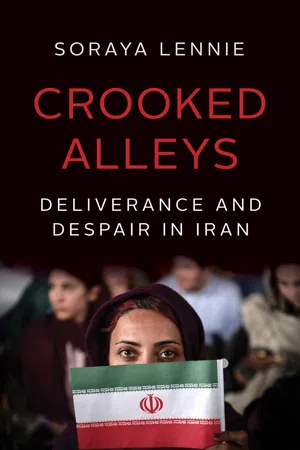
By 2013, Iranians were suffocating, as though the streets had become narrower, the buildings taller, the dirty air thicker. In electing Hassan Rouhani, they chose a new, reformist leader, burying the days when a Holocaust-denying president had pushed Iran to the edge of economic collapse and conflict. But the nation hasn't quite broken free.
Iranians are trying to move on, yet the Islamic Republic remains a prisoner of the past, plagued by US sanctions, a broken economy and the threat of war. After 2016, Donald Trump's presidency derailed the future of millions of people. How have Iranians met these challenges? What future do they imagine now? Has Iran missed its best chance for real change?
Crooked Alleys explores Iran during some of its darkest days, but also its most hopeful.
Information
1
DAR IN BONBAST (IN THIS DEAD-END)
It was late 2012. The man’s full moustache was peppered with streaks of white, and his eyes somehow smiled despite the agony and dreariness that accompanied his current predicament. Mahmoud Gomari had seen much in his life: an eight-year war with Iraq that threatened to drag Iran down into the depths of hell, bringing breadlines around the block and shortages of basic staples, such as sugar, flour, baby formula. Government-imposed rations had forced him to line up for hours, identity card in hand, hoping to get to the start of the line before everything ran out, knowing full well he had a family that depended on him not to come home empty-handed.
On many occasions, as the air raid sirens blasted through Tehran, Gomari would hurry through the small streets hoping luck was on his side, that his life would not be lost for the hot newspaper-wrapped sangak shoved under his arm.
The war was a pitiful misery, imposed on a population still wide-eyed with jubilation and horror in the wake of the impossible revolution in 1979. Saddam Hussein’s invasion of Iran in September 1980 ushered in rivers of bloodletting and the quick-sand of political struggle for the Islamic Republic’s infant system, where it seemed no one knew what was going on, or what would happen.
Gomari had struggled his whole life to make ends meet, taking on odd jobs—sometimes illegal ones—for a few rial; anything was better than nothing and surely one day it would all work out. But that day never came, and Mahmoud, now in his late sixties, could only look around him and wonder about all the paths not taken, and how long it would take him to die.
A soft whirr emanated from the big blue machine keeping him alive, a few beeps here and there, numbers on its four panels. Lots of tubes came and went, some filled with a deep maroon-coloured blood. Gomari was hooked up to dialysis. His kidneys were failing, and without it, he would certainly die. Because of his age, the chances of a transplant were slim, and Gomari had neither the money nor the position in society that could curry favour to push him up the list or allow him to travel abroad for help. The machine was his lifeline.
His eyes were deeply creased in the corners, and he was bald, save for the short Friar Tuck ring above his ears. He spoke softly and was quite matter-of-fact: ‘I’m almost sixty-nine years old. I’ve been coming here three times a week for the past year. If I do not, my body parts start to swell up. My kidneys don’t work.’1
As Gomari lay in a hospital bed, his rolled up grey sleeves exposed a tattooed arm—a seemingly sporadic mix of ink; a cross, a woman, eshgh, or love. All faded like his hopes of redemption, of a new life, of a second chance. And so, this was his lot: a thin, crepe sheet–covered bed, boredom, silence, the collective agony of his fellow patients stuck in a hospital ward, five beds to a side.
In a normal country, in a normal situation, this would be as bad as it gets. As though kidney failure was not terrible enough. As though the prospect of a slow death was not shattering. As though the pain was not torturous.
But in Tehran, war loomed. Outside these hospital walls, in a fitful autumn of haze, clouds and brief rays of sun, the Iranian nuclear crisis had reached its peak. Though Iran had gone back to the negotiating table, there was no progress and little hope of a breakthrough. The country’s president, Mahmoud Ahma-dinejad, in the death throes of a final term, continued to antagonise both at home and abroad, seemingly oblivious to the rising chance of war or a military strike on Iran. But the tense atmosphere did not escape everyone’s notice; in Tehran, foreign embassy officials had started going over protocols and test evacuations in case of war, while Iranians themselves started thinking about whether to stay or, if they had the means and possibility, to go.
The United States under Barack Obama, who was heading for re-election in November 2012, had already issued eleven orders sanctioning Iran for various sins, including its nuclear programme. Sanctions compounded an already troubling situation: the Iranian rial was in a death spiral, having lost 60 per cent of its value against the US dollar in just two weeks.
It was just about as bad as it could get. And this was well before anyone had even considered the possibility that, four years later, Hillary Clinton would lose the so-called unlosable election and Donald Trump would take a seat in the Oval Office, where he would wage his own, very special, ‘tremendous’ war on Iran’s economy.2
In the midst of the Obama-era chaos, crisis and uncertainty, Gomari had come in for yet another dialysis treatment—the third that week—feeling deeply anxious and under immense pressure. He was also alone, with no one except his fellow patients to keep him company. ‘Only God knows how long I’ll have to keep coming here,’ he quietly wondered, giving voice to the crippling nervousness of uncertainty. Knowing he probably would not get a donor. Not knowing if he would survive. Not knowing what would happen to his country. His primary concern, like that of the other patients in the room, was dialysis and survival, but the nuclear crisis too and the hovering threat of war had seeped into this place and poisoned any last well of optimism.
The nuclear standoff meant that these patients, as miserable as they were, as ordinary as they were, had been thrust into the middle of an international struggle of wills. And make no mistake: for many Iranians this struggle was—and continues to be—one of life and death.
For dialysis patients, survival was dependent on a $7 plastic filter. Although Iran had become increasingly self-reliant, including medically, the government estimated that imports accounted for 5 per cent of its medical supplies—including those cylinderlike filters, which were made in Germany. Known as an F70 dialyser, the filter is unexceptional-looking—about thirty centimetres long and encased in clear plastic. Inside, white hollow fibres run its length to filter the blood and dialysis fluids before they are returned to the patient.
Under normal circumstances—whatever they once were—buying these parts would not be an issue. In fact, they are available to patients on home dialysis the same way they are available to hospitals. But under sanctions, life in Iran was no longer normal.
And yet, it did continue. Under the worst multilateral sanctions regime in Iran’s modern history, patients like Mahmoud had no choice but to come in for their scheduled treatments. But the stock of medical equipment was depleting at the hospital, one of the many branches of the Charity Foundation for Special Diseases, as it tried to keep up. According to the foundation’s chairwoman, Fatemeh Hashemi Rafsanjani—daughter of former president Ayatollah Ali Akbar Hashemi Rafsanjani—they had been stockpiling as much as they could for almost a year, preparing for the worst. But, like other importers and buyers of foreign medicine, Hashemi had recently noticed a sharp increase in prices. Suddenly, the $7 filter became a $14 filter, then jumped to $21 apiece.
It has been widely assumed that nefarious price gouging and corruption—typical in Iran during times of economic crisis, and rampant during the presidency of Mahmoud Ahma-dinejad3—had a significant impact on the sudden price increases under sanctions. That may be true of other types of goods, but there was another factor contributing to the rising costs of medicine and equipment. At the same time that the Charity Foundation for Special Diseases was trying to stockpile medicine and equipment, European exporters specifically targeted the Iranian market, raising prices. The trend began in early 2010, just as the Obama administration, the EU and the UN started to ramp up sanctions. The same period shows no such increase in price to other similar export markets, namely Russia, Turkey and Pakistan.4
The price hike continued into 2011, when on December 31, in the dying hours of the Georgian year, the Obama administration issued sanctions to target the Central Bank of Iran. The legislation specifically stated, ‘The President may not impose sanctions under paragraph (1) with respect to any person for conducting or facilitating a transaction for the sale of agricultural commodities, food, medicine, or medical devices to Iran.’5
It was useless now to omit medical sanctions when traders with Iran were already hyperventilating in fear of US punishment. The European price hike had already created critical shortages inside Iran, disproportionately affecting people with rare or special diseases, as special medications made up a large proportion of imports. Customs data shows that by Norooz (Iranian New Year) on 21 March, the price of European medical exports to Iran in 2012 was €10,167.13 per 100 kilograms—a 40 per cent price increase compared to the same pre-sanctions period in March 2010.6
The stress of treating patients with rare diseases is high, but the added pressure of not knowing if you can continue to find the medicine and supplies, or if you can even afford to provide those services anymore, was palpable. The doctor overseeing the dialysis patients had had enough. Mentally, he had checked out. He had not shaved, his dark hair was matted, and his thin eyes were tired and dejected. ‘We do our best to supply the needed medications and materials despite the increasing prices,’ began Dr Ali Reza Fallah, who even spoke with a defeated air. ‘We have to do it at any cost. If the medication is not supplied, it can lead to death. There is no other way to solve this problem. Even if one part of this equipment doesn’t work, it’s useless.’
The doctor walked through the ward, casually checking charts and monitors, making a few notes. He explained that his patients had nowhere else to go. True, Gomari might not get a kidney. He was in his seventh decade of life, and his physicians had determined that he was not an ideal candidate. But there were others in beds near him that might. A teacher, a mother, a wife. But that is only if they could get to that point, if the machines kept them alive for long enough, if Iran could keep buying foreign filters, even though the price was astronomical and it took all kinds of deals to get it done.
Gomari was caught in a situation over which he had no control: international politics. The Obama administration, like some in the Trump administration that followed, made a point of distinguishing Iran’s leadership and institutions from its people—at least in speech. US Secretary of State Hillary Clinton stated, ‘Our goal is to pressure the Iranian government, particularly the Revolutionary Guard elements, without contributing to the suffering of the ordinary [Iranians], who deserve better than what they currently are receiving.’7 Some went even further, like Obama-era Treasury spokesman John Sullivan, who said Iran was to blame for its own problems: ‘If there is in fact a shortage of some medicines in Iran, it is due to choices made by the Iranian government, not the US government.’8
A few short years later, the Trump administration followed the same script, with Secretary of State Mike Pompeo insisting that sanctions were directed at the Iranian regime, ‘point blank’, and ‘not at the Iranian people’.9
It was a point of bitter frustration on the streets of Tehran—indeed, across the country; very clearly, sanctions were and are impacting average people, despite all the high-minded statements coming out of Washington. At the pop-up Mahak Charity bazaar for Norooz in the capital’s suburb of Shahrak-e Gharb, one young volunteer described the US sanctions stance as ‘someone holding your head underwater while telling you you’re not drowning’.10 At organisations like Foundation for Special Diseases, and Mahak, which supports children with cancer, the frustration was arguably heightened, as their patients have specialised needs because of their illnesses and rely on charity for treatment and assistance. For many, there is no other option but benevolence. Even that had become difficult. Because of EU sanctions that disconnected Iranian banks from the SWIFT bank service, charities could not buy foreign medicine through traditional avenues, and Iranians abroad could not transfer money home to help either.
But there is another side to this story: a government that empowered cartels, traded in nepotism and seemed to be more concerned with the promotion of excessive religious traditionalism than economic policy.11 Economists had been warning Ahmadinejad for years—in writing—that his policies were devastating, but the president saw this as a ‘challenge’ rather than advice, and refused to listen.12 And even as the price of oil reached record highs and Iran, before the oil embargo, was making more money from black gold than at any time in the republic’s history, there was little to show for it. The administration had already drained the Oil Stabilization Fund, set up in 2000 by former president Mohammad Khatami, which according to its rules was to hold 85.5 per cent of oil and gas earnings in excess of the amount earmarked for the national budget. Some of the money went to fund one of Ahmadinejad’s pet projects, the Imam Reza Love Fund, which he had set up to help newlyweds.13
By the time the Obama administration and its allies began imposing the worst of their sanctions regime, the country was already in deep economic trouble. Again, economists—including Saeed Laylaz—predicted that, if not handled correctly, the wave of sanctions would be a deathblow. But again, the president ignored them, focusing his efforts on resistance abroad and promoting his version of Iranian values at home. It was as though the president and his men thought sheer stubbornness could circumvent an international coalition that was cutting off all the country’s financial lifelines.
Laylaz, seated in the corner of his lounge, described the negative effect of sanctions as a result of ‘stupid policies by the government, rather than exclusively the fault of the West’.14 Coming from an Ahmadinejad critic, Laylaz’s views were not a surprise. He had been sentenced to nine years in jail in 2009 after repeatedly accusing the country’s leaders, in both Iranian and foreign media, of rigging the election in favour of incumbent President Ahmadinejad.15
The economist, identifiably sporting his trademark large black-rimmed glasses, dark moustache and permanent salt-and-pepper stubble, served as an economic advisor to reformist President Mohammad Khatami. He also holds close ties to imprisoned Green Movement leader Mir Hossein Mousavi, for whom he worked during the 2009 election, and whose original artwork hangs on Laylaz’s wall.
According to Laylaz, Ahmadinejad’s handling of the subsidies crisis was also to blame for the country’s situation. The administration, cheered on by the International Monetary Fund (IMF), had planned to phase out the Shah-era subsidies for basic staples like fuel, bread and rice, which drained an estimated US$100 billion an...
Table of contents
- Cover
- Title Page
- Copyright
- Dedication
- Contents
- List of Illustrations
- Preface
- 1. Dar In Bonbast (In This Dead-End)
- 2. The War Within
- 3. Romantic Revolutionaries
- 4. Hope Returns
- 5. Mr Fereydoun
- 6. Deliverance
- 7. Sabotage
- 8. Hardening Hearts
- 9. Ma Chegoone Ma Shodim? (What Has Become of Us?)
- Notes
- Acknowledgements
- Index
- Bm
Trusted by 375,005 students
Access to over 1.5 million titles for a fair monthly price.
Study more efficiently using our study tools.
Frequently asked questions
Yes, you can cancel anytime from the Subscription tab in your account settings on the Perlego website. Your subscription will stay active until the end of your current billing period. Learn how to cancel your subscription
No, books cannot be downloaded as external files, such as PDFs, for use outside of Perlego. However, you can download books within the Perlego app for offline reading on mobile or tablet. Learn how to download books offline
Perlego offers two plans: Essential and Complete
- Essential is ideal for learners and professionals who enjoy exploring a wide range of subjects. Access the Essential Library with 800,000+ trusted titles and best-sellers across business, personal growth, and the humanities. Includes unlimited reading time and Standard Read Aloud voice.
- Complete: Perfect for advanced learners and researchers needing full, unrestricted access. Unlock 1.5M+ books across hundreds of subjects, including academic and specialized titles. The Complete Plan also includes advanced features like Premium Read Aloud and Research Assistant.
We are an online textbook subscription service, where you can get access to an entire online library for less than the price of a single book per month. With over 1.5 million books across 990+ topics, we’ve got you covered! Learn about our mission
Look out for the read-aloud symbol on your next book to see if you can listen to it. The read-aloud tool reads text aloud for you, highlighting the text as it is being read. You can pause it, speed it up and slow it down. Learn more about Read Aloud
Yes! You can use the Perlego app on both iOS and Android devices to read anytime, anywhere — even offline. Perfect for commutes or when you’re on the go.
Please note we cannot support devices running on iOS 13 and Android 7 or earlier. Learn more about using the app
Please note we cannot support devices running on iOS 13 and Android 7 or earlier. Learn more about using the app
Yes, you can access Crooked Alleys by Soraya Lennie in PDF and/or ePUB format, as well as other popular books in Politics & International Relations & Politics. We have over 1.5 million books available in our catalogue for you to explore.