- English
- ePUB (mobile friendly)
- Available on iOS & Android
eBook - ePub
About this book
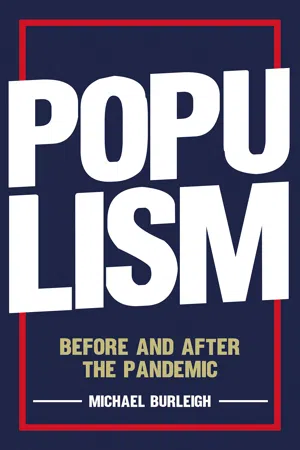
Drawing on his Engelsberg Lectures, Michael Burleigh explores the new global era of national populism. He first probes the nature of mass anger in the West: how might popular discontent be artificially incited and sustained by elite figures claiming to speak for the common people? He then compares empire's difficult aftermaths in Britain and Russia: how does History foster a sense of exceptionality, and how is it exploited by populists, as we've seen again with 2020's 'statue wars'? And finally, he turns to China, where the ruling Communist Party depends on a nationalised version of History for popular support.
Covid-19 has created problems for several populist leaders, whose image has suffered amidst the public's new-found respect for expertise and disappointment over their shouty handling of the pandemic. Yet despite Donald Trump's defeat, with extended economic depression looming, Burleigh fears that new post-populists may yet arise.
Information
1
WE THE PEOPLE
The last time I lectured at the LSE, in the early 1990s, my talk was probably about the Nazis, by then a niche preoccupation in a world mesmerised by the end of the Cold War in Europe. Imagine my surprise to find that nowadays the Führer’s face is ubiquitous; in fact there is even a history of his face. I haven’t read it. We all also know the television history channels which should be renamed Hitler channels, where the last global war is on a continuous loop.
Many of you will have read new books dedicated to the expiry of democracy, or the problems it is encountering in late middle age.
There is also a newfound and urgent interest in the imminence of tyranny. The historian Timothy Snyder had success with a civics primer designed to help identify signs of creeping tyranny in the era of President Trump.
The literary historian Stephen Greenblatt contributed Shakespeare on Power, which alludes to the then president on every page, without ever mentioning him. Critics joked that Greenblatt has a bad case of the ‘DTs’, seeing Trump rather than creepy crawlies on the ceiling. This last book had a lot of powerful admirers. The holidaying Chancellor Merkel was photographed reading Greenblatt, in preference to the avalanche of new social science books on populism. Good for her.
Liberal warnings about the recrudescence of fascism and tyranny have no monopoly on lessons from the past. Among European populists, to range no further, mythologised or weaponised history abounds. It often consists of post-modernist mash-ups, worthy of the disturbing content one can see on Russian television every night.
A recent video showed Spain’s far-right VOX party leader Santiago Abascal on a horse, re-enacting the medieval Reconquista, to the theme music of ‘Lord of the Rings’. His party had just doubled its number of seats in parliament at a time of renewed crisis with the Catalan nationalists. Bang goes the belief in Iberian exceptionalism. An Alternative für Deutschland election poster used Gérôme’s nineteenth-century Orientalist painting of a ‘Slave Market’ to ensure that ‘Europe does not become Eurabia’.
Then there is this sceptre’d isle, as Shakespeare put it. With the Brexit party using air raid sirens and searchlights to announce Mr Farage, I am often confused whether we are living in the ‘Darkest Hour’ of 1940; or, as some suggest, the early modern Civil War without swords and muskets. Or a re-run of the Protestant Reformation as we once more break with Brussels and (the Treaty of) Rome. This last bizarre conceit is especially popular among the conservative Roman Catholics who own and write for the Brexity Daily Telegraph which used to be a respectable newspaper.
Right now I want to escape the dreary gravity of Hitler, not least because the EU’s twenty-seven nations have their own distinctive histories which we should respect. History is supposed to broaden the mind, not restrict our collective imaginations to the Nazis. But first I must optimistically rehearse why our time is unlike the interwar era.
Our European present has not just emerged from a global war that killed eighteen million people and which destroyed four major empires by its episodic conclusion in 1918–22, though something resembling the Spanish flu pandemic is stalking us.
We have experienced nothing comparable to the political effects of the hyper-inflation and Depression which book-ended the Weimar Republic’s tragic history, and in the case of inflation destroyed the middle class, their money and liberal political parties.
Our streets are not overrun by uniformed paramilitaries assaulting and murdering their rivals often with the complicity of policemen and courts, though there has been an uptick in the incidence of assassinations of democratic politicians from Jo Cox to Walter Lübcke, both killed by neo-Nazis.
Most contemporary European societies are strikingly demilitarised, as the Stanford historian James Sheehan showed in a rather good book, even though European defence spending is three times that of Russia, some of it for export. Nowhere in Europe are the military out of civilian control, as was the case of the political generals of Weimar, or the imperialistic Japanese ones who from 1932–45 hijacked the government. The retired three-star German air force general who is an AfD mayoral candidate seems eccentric.
Hardly anyone other than the evil or insane regards violence as essential to the birth of a new Fascist type of being, let alone the idea that national salvation will (not might) result from exterminating entire races. As David Runciman says, wars of national survival discredited far right politics for a couple of generations; since we are unlikely to have one, there is not going to be such a drastic resolution to populism. The incompetence of braggart demagogues in major crises may however be their undoing. Fomenting social division, promoting polarisation, scorning professional expertise, cowing civil servants, and above all acting as advocates for the most ignorant and uneducated elements in our societies, does not work when—for example—a killer virus is working its way through every nation.
This is not to recommend complacency towards that era of religoid totalitarianism, to whose exploration I devoted two decades of my writing life.
It is crucial to be alert to worrying affinities. One cannot read Sebastian Hafner’s Defying Hitler without noting the implosion of the moderate political centre, which is happening nowadays particularly in the case of European Social Democracy. The re-emergence of movement politics, within or outside political parties, is also disturbing, most obviously in the case of PEGIDA, the German acronym for Patriotic Europeans Against the Islamisation of the Occident which from October 2014 onwards marched in East German cities.
There is depressing relevancy in what the Viennese satirist Karl Kraus, the English novelist George Orwell, or German philologist Victor Klemperer noted about the creeping brutalisation of thought and language and the temptation of the tribal tom-tom beat, as Orwell called it.
Nor should we forget the exiled German Catholic historian Eric Voegelin’s contempt for a conservative ‘elite rabble’ which was disastrously porous towards the Hitlerites. He meant Papen, Schleicher and all the other posh vons.
There is much culpable porosity around nowadays, as well as transgressive speech which helps lower the threshold to violence, most disturbingly visible inside the US Capitol on 6 January 2021. In various countries, there is also a Jacobin-style mobocracy, only some of it confined to online platforms. Britain is not alone either in having politicised hooligans. The German equivalent to Stephen Yaxley-Lennon, aka Tommy Robinson, founder of the English Defence League, is a convicted burglar and drug-dealer called Lutz Bachmann who founded PEGIDA.
But before moving to a more recent past I think needs attention, I want to rehearse some thoughts about populism for those who might not be as familiar with this subject as historians or political scientists.
By populism I mean the identification of the people as an organic and uniquely virtuous whole, ignored or malignly divided by corrupt and oligarchic elites.
Populism restores the illusion of efficacy to those who feel their views are ignored by identikit managerial politicians, while constitutional checks and balances actively frustrate the translation of the people’s will into policy through elected delegates. Mr Dominic Cummings’s 2016 slogan ‘take back control’ actually captures the sense of regaining agency rather well, though it is likely to prove entirely illusory.
This goes with a kind of moral indignancy, more usually characteristic of the Left, on the part of a majoritarian Right which has appropriated the grievance culture of minority identity politics.
Arlie Hochschild’s Strangers in Their Own Land is a fine account of how that has played out in the US, especially in her metaphor of people becoming impatient with waiting in line for rewards that never come, while others cut in ahead of them.
A similar sense of victimhood is pervasive across the European populist right. Rarely can we have heard so much from people who claim to be voiceless, yet who are protected from scorn by a kind of right-wing political correctness. Actually, they have plenty of articulate ventriloquists too, many writing for magazines and websites which are the toys of hedgefund millionaires. For example the Brexit-supporting political philosopher John Gray blames liberal ‘bien pensants’ for this state of affairs, writing ‘Populism is the creation of a liberal political class that blames its decline on the stupidity of voters’. The Brexit supporting academic Matthew Goodwin has never seen an extreme right party he could not find excuses for.
Many bewildered liberals may be silently assenting to something said by the great eighteenth-century French reactionary thinker Joseph de Maistre:
‘The principle of the sovereignty of the people is so dangerous that, even if it were true, it would be necessary to conceal it’.
I know many liberals who feel like that, some of whom advocate an epistocracy in which voters are differentially weighed according to criteria like education.
Unlike major ideologies, there is no founding text which encapsulates populism, as there are for liberalism, Marxism or reaction.
That is why the Dutch scholar Cas Mudde calls populism a thin ideology bolstered with extraneous elements from other political traditions. That can lead to incoherence.
British populist ideologues and leaders, for example, are divided between demands for more spending by a state construed as the Wagnerian ‘magic spear which heals all wounds’, as the nineteenth-century Prussian historian and politician Friedrich Dahlmann called it. But others are animated by the happy vision of ‘Singapore on Thames’ which excites some hedge-fund bosses.
In reality this would leave everyone outside the M-25 motorway in a colder Malaya without the rubber and tin, including most supporters of Brexit who on every projection are going to take the largest economic hit from the strategy they enthusiastically support as if it were a kind of religious faith.
One can further define populism as a supposedly ‘authentic’ rhetorical style, in which shameless lies are part of the charm; as a series of family resemblances akin to the Habsburg jaw in portraiture; or as a shadowy near-relation to democracy that in times of turmoil looms over the object.
Maybe these definitions are too bland, for in all cases, conspiracy theories are involved, namely the belief that ‘liberal’ global and national elites are actively conniving to thwart the righteous will of the people because they fundamentally despise them. Remember the old joke that Tony Blair so hated the English working class that he sought out a less inert Polish one to replace them. It ceased to be a joke some time ago.
Recall too prime minister Gordon Brown dismissing a ‘bigoted woman’ during the 2010 election on a microphone that was still live, or Hillary Clinton’s remark, six years later, about half of Trump’s supporters belonging in a ‘basket of deplorables’—by which she meant, further excavating her own grave, ‘They’re racist, sexist, homophobic, xenophobic—Islamophobic—you name it’.
What claims to be holistic is in fact highly divisive, and involves many of us being rendered ‘unreal’.
Populism involves a sleight of hand in which the People must be sub-divided into the authentically real ones, who intuit what is right, and the cosmopolitan unrooted who could be everywhere and nowhere, as prime minister Theresa May notoriously put it, echoing the British journalist David Goodhart.
‘Vox populi, vox Dei’ as Mr Mogg puts it with his usual condescending smirk. Actually the cliche of ‘ordinary people’ is highly constructed, though we accept vox pops all the time. It derives from the Second World War and films like 1945’s Brief Encounter in which Celia Johnson protests: ‘I am just an ordinary woman’. Ordinary people were celebrated as the common-sense alternative to academics, bureaucrats and experts.
Unlike inter-war fascists, most populists are not anti-democratic. They can’t get enough of voting. Italy’s Five Star Movement would have us all voting online 24/7, a truly nightmarish prospect and one which would lend itself to obsessives—to be charitable. Imagine all the online poker addicts switching late at night to put side bets on the outcome of referenda and trying to alter the results.
There is also what Mudde and others call ‘the democratisation of democracy’ which is harder to controvert. One effect of populism, whether in Latin America, Britain or Germany, has been to revitalise democracy, in the first case by empowering indigenous peoples excluded by Hispanic elites, in the second and third by coaxing lifelong non-voters to the ballots, often meaning voting AfD or Brexit Party. It is hard to deplore political apathy and then object when people vote in record numbers, though as many argue voting is only the half of it, for people vote in Russia and Turkey too.
These core beliefs of populism have been around a long time. As an historian I’d better include some more history.
Just recall the idealistic peasant-worshipping Narodnik students of Tsarist Russia, who like anthropologists discovered their own peasantry rather than a new tribe of hunter-gatherers in Siberia. Many were so appalled by their lack of resonance among these God- and Tsar-fearing folk that they took to terrorism instead.
Or there is the Wizard of Oz world of American Democrat demagogue William Jennings Bryan. Both the 1900 book and the 1939 film are an allegory of populism in which Oz is short for ounce of gold or silver and the failed demagogue Bryan himself is the lion without a roar. The wicked witches of the compass are Eastern bankers and railroad barons. There was a nasty anti-Chinese racism too.
Such a brief history would encompass such evanescent figures as Guglielmo Giannini and Pierre Poujade in post-war France and Italy. The latter launched the political career of an equally antisemitic 27-year-old soldier called Jean Marie Le Pen, who in 1956 was elected a Poujadist deputy, the youngest in the Assembly, before resuming a military career in Algeria as a professional torturer of Arabs and going on to lead the Front National.
Poujade and Giannini remained what seemed to be backwards-facing figures because the main ideological conflict was the Cold War struggle between the partisans of liberal democracy and Soviet Communism, rather than about newsagents, parfumiers or tobacconists being wiped out by department stores and supermarkets and extortionate taxes. The milk-drinking prime minister Pierre Mendès-France, who was Jewish, excited special hatreds in a nation of vin rouge and Pernod lovers.
The rise of populist parties has been more...
Table of contents
- Cover
- Title Page
- Copyright
- Contents
- 1. We the People
- 2. Russia and Britain
- 3. A Journey Through History, Populism and Nationalism
- 4. Populists and the Pandemic: Will This Be the End of Them?
Trusted by 375,005 students
Access to over 1.5 million titles for a fair monthly price.
Study more efficiently using our study tools.
Frequently asked questions
Yes, you can cancel anytime from the Subscription tab in your account settings on the Perlego website. Your subscription will stay active until the end of your current billing period. Learn how to cancel your subscription
No, books cannot be downloaded as external files, such as PDFs, for use outside of Perlego. However, you can download books within the Perlego app for offline reading on mobile or tablet. Learn how to download books offline
Perlego offers two plans: Essential and Complete
- Essential is ideal for learners and professionals who enjoy exploring a wide range of subjects. Access the Essential Library with 800,000+ trusted titles and best-sellers across business, personal growth, and the humanities. Includes unlimited reading time and Standard Read Aloud voice.
- Complete: Perfect for advanced learners and researchers needing full, unrestricted access. Unlock 1.5M+ books across hundreds of subjects, including academic and specialized titles. The Complete Plan also includes advanced features like Premium Read Aloud and Research Assistant.
We are an online textbook subscription service, where you can get access to an entire online library for less than the price of a single book per month. With over 1.5 million books across 990+ topics, we’ve got you covered! Learn about our mission
Look out for the read-aloud symbol on your next book to see if you can listen to it. The read-aloud tool reads text aloud for you, highlighting the text as it is being read. You can pause it, speed it up and slow it down. Learn more about Read Aloud
Yes! You can use the Perlego app on both iOS and Android devices to read anytime, anywhere — even offline. Perfect for commutes or when you’re on the go.
Please note we cannot support devices running on iOS 13 and Android 7 or earlier. Learn more about using the app
Please note we cannot support devices running on iOS 13 and Android 7 or earlier. Learn more about using the app
Yes, you can access Populism by Michael Burleigh in PDF and/or ePUB format, as well as other popular books in Politics & International Relations & Political Ideologies. We have over 1.5 million books available in our catalogue for you to explore.