Young children count and count and then they count some more! They count things they can see and touch (how many fingers on one hand, how many treats they can have at snack time) as well as things they can’t (how old they are, how many minutes until they go outside). While counting may seem straightforward to older children and adults, as young children count to find out how many, they are engaging in complex mathematical work and coordinating many different ideas, such as connecting the numbers they are saying to the objects they are pointing to, touching, or moving as they count.
One idea for early childhood educators to consider is the range and depth of mathematics in counting. There is so much for young children to learn, and having many and different kinds of opportunities to count is essential for young children to continue to develop their mathematical understandings and for teachers to continually take stock of what they are learning about children’s understandings. You will see throughout this chapter rich examples of different ways children count, how they are working on coordinating important counting principles, and what this might mean for the child and teacher.
Children use what they learn about counting to begin to add, subtract, multiply, and divide. This is often grounded in real-life experiences inside and outside of school and driven by the need to do things like get more of something, put things together, or pass them out. You will also see examples of how counting can naturally be extended into problem solving with purposeful follow-up questions: What if you found two more rocks outside and put them in your collection? What if three dinosaurs left the dinosaur party? What if you wanted to share your collection with a friend? With two friends? What children know about counting and the contexts or stories that can emerge from the collections they count can be leveraged to build understandings of operations, both how they work and the actions they relate to.
The goal in this chapter is to address the teaching and learning of counting and operations as they are worked on in practice, through intentional yet open Instructional Activities and beyond. It opens with a visit to Ms. Gaxiola’s preschool classroom and an Instructional Activity called Counting Collections, in which children work on ideas of counting and operations. This is followed by an exploration of informal spaces that support continued learning of counting and operations.
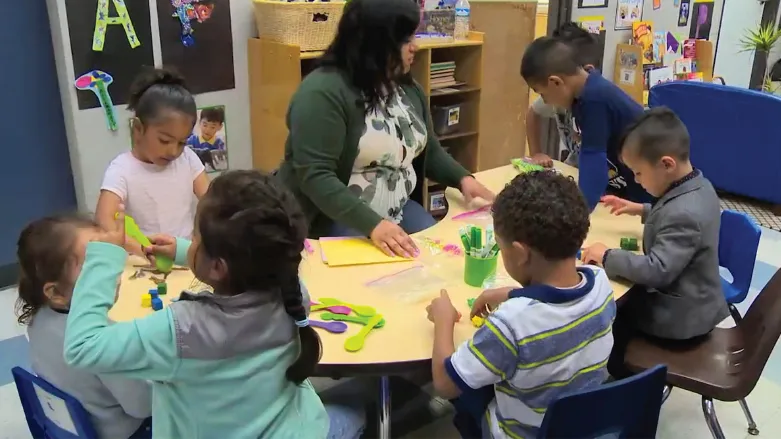
Ms. Gaxiola is sitting at one of the kidney-shaped tables, joined by seven of the 3- to 4-year-olds in her classroom: Mattias, Jayden, Aubree, Saavi, Angel, Soraya, and Penelope. Each child has a different collection of objects on the table in front of them—colorful wooden blocks, old keys, bottle caps, counting bears, puff balls, and plastic spoons. There are also some blank sheets of paper and markers strewn about the table.
Mattias is saying one number word for each plastic bear that he stands up. Jayden quickly counts his collection of 21 keys and moves on to make some X shapes with the keys in groups of four. Glancing over at the pile of nine puff balls she has just counted, Aubree reaches for a marker and piece of paper and draws a group of large circles on her paper. Saavi, who has just arrived at the table, is carefully pouring the spoons out of the plastic baggie into a pile in front of her, making sure her spoons don’t interfere with the long line of bears that Mattias has arranged. Angel and Soraya have a large collection of bottle caps in front of them and are working to count them together.
Instructional Activity: Counting Collections
The children are engaged in an activity called Counting Collections. Their job seems straightforward, but it’s challenging and mathematically important: to figure out how many objects they have in their collection and make a recording of their collection on a piece of paper. While the objective for each child is the same (to count and find out how many), something that stands out is how each child works on the task a bit differently. This is an important part of Counting Collections—that each child is engaged in the task in a way that makes sense to that child and that builds on their math understanding. This is what differentiation looks like in action! Let’s reenter Ms. Gaxiola’s classroom to see how the children’s participation plays out.
Counting Collections in Ms. Gaxiola’s Classroom (continued)
Noticing that Penelope has finished counting and arranging a collection of seven wooden blocks, Ms. Gaxiola asks, “Are you ready to show your collection on paper, Penelope?” She gives her a blank sheet of paper and a marker, and Penelope gets to work. Ms. Gaxiola observes Penelope for a moment before Jayden begins tugging at her shirt. She turns her attention to Jayden and his collection of 21 keys.1
Ms. Gaxiola: Yes, Jayden?
Jayden: I’m done counting.
Ms. Gaxiola: (Looks at his keys, which are arranged in groups of four that resemble X shapes.) I see that. How many keys do you have?2
Jayden: (Points to one key for each number word he says.) One, two, three, four, five, six, seven, eight, nine, ten, eleven, twelve, (Skips thirteen.) fourteen, (Skips fifteen.) sixteen, seventeen, eighteen, nineteen, twenty, twenty-one, twenty-two, twenty-three!
Ms. Gaxiola: So how many do you have?
Jayden: Twenty-three!
Ms. Gaxiola: Wow, you have a lot of keys. Can you count them for me one more time?
Jayden: (Counts again, using the same sequence and reaching the same final amount.)3
Ms. Gaxiola: Nice counting. It looks like you did something interesting with your keys. Can you tell me about what you did?
Jayden: I made an X with the keys. There’s an X, there’s an X, there, there, there. But this one is just one. (Points to the single key that is not arranged in a group of four like the others.)
Ms. Gaxiola: Ah, you made X’s! And how many keys are in each X?
Jayden: (Quickly responds just by looking at a group.) Four!4
Ms. Gaxiola: Yes, there are four in that group. Hey Jayden, what would happen if you shared some keys with me? What if you gave me one group of keys? How many would you have left?
Ms. Gaxiola leaves Jayden thinking about the question she has just posed, then turns her attention back to Penelope. Penelope has drawn seven circles on her paper and is in the midst of placing one block on top of each of the circles.
Ms. Gaxiola: How many cubes do you have?5
Penelope: (Uses her index finger to point to each block as she counts.) One . . . two . . . three . . . four . . . (As Penelope hesitates, Ms. Gaxiola joins in and points to the blocks with Penelope, counting the last three with her.) five . . . six . . . seven.
Ms. Gaxiola: How many do you have?
Penelope: Seven.
Ms. Gaxiola: You have seven cubes. You’re right. And if I take off your seven cubes, how many circles do you have? (Carefully slides the blocks off of the paper.)
Penelope: One, two, three, four, five, six. (Counts as she points to each circle with her index finger but skips a circle in the middle.)
Ms. Gaxiola: And this one? (Points to the skipped circle in the middle.)6
Penelope: One.
Ms. Gaxiola: Yeah, there’s one more there. Can you count them over again?
Penelope: (Starting with a different circle, counts again but skips another circle in the group and still ends up with six.)
Ms. Gaxiola: Shall we count them one more time?
Penelope: (Hesitates.)
Ms. Gaxiola: Maybe you can help me count? (Points to the first circle at the bottom of the page and waits for Penelope to place her finger on the same one.) One . . . (Pauses to let Penelope retake the lead.)
Penelope: One . . .
Penelope and Ms. Gaxiola: Two . . . three . . . four . . . (Point and count together. As they reach five, Penelope’s counting begins to lose its correspondence with the circles. Ms. Gaxiola slows and exaggerates her count, staying on the fifth circle an extra half second.) fiiiive . . . six . . . seven!7
Ms. Gaxiola: Seven! You have seven here (Gestures to blocks.) and seven here (Gestures to the paper.). Okay, Penelope, can we put them away and count them into the bag?8
Penelope: (Counts slowly as she reaches for each block and puts it into the storage bag.) One . . . two . . . three . . . four . . . five . . . six . . . seven!
Ms. Gaxiola: How many did you have?
Penelope: Seven!
Ms. Gaxiola: Seven! You had seven cubes. Thank you, Penelope. Which area do you want to go to next?
As Penelope heads toward the dramatic play area, Ms. Gaxiola watches over her shoulder as Aubree counts her collection of puff balls one last time.
Aubree: Ms. Gaxiola, it’s nine! Look, one, two, three, four, five, six, seven, eight, nine! See, it’s nine!
Ms. Gaxiola: I see you counted each one and got nine! Hey, I have a question. What if I gave you some more? If I gave you . ...