By highlighting the connections between domestic political struggles and overseas imperial structures, The Politics of Imperial Memory in France, 1850–1900 explains how and why French Republicans embraced colonial conquest as a central part of their political platform. Christina B. Carroll explores the meaning and value of empire in late-nineteenth-century France, arguing that ongoing disputes about the French state's political organization intersected with racialized beliefs about European superiority over colonial others in French imperial thought.
For much of this period, French writers and politicians did not always differentiate between continental and colonial empire. By employing a range of sources—from newspapers and pamphlets to textbooks and novels—Carroll demonstrates that the memory of older continental imperial models shaped French understandings of, and justifications for, their new colonial empire. She shows that the slow identification of the two types of empire emerged due to a politicized campaign led by colonial advocates who sought to defend overseas expansion against their opponents. This new model of colonial empire was shaped by a complicated set of influences, including political conflict, the legacy of both Napoleons, international competition, racial science, and French experiences in the colonies.
The Politics of Imperial Memory in France, 1850–1900 skillfully weaves together knowledge from its wide-ranging source base to articulate how the meaning and history of empire became deeply intertwined with the meaning and history of the French nation.
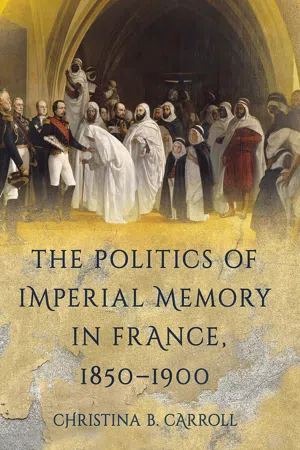
- 282 pages
- English
- ePUB (mobile friendly)
- Available on iOS & Android
eBook - ePub
The Politics of Imperial Memory in France, 1850–1900
About this book
Information
Publisher
Cornell University PressYear
2022Print ISBN
9781501763083
9781501763083
eBook ISBN
9781501763137
CHAPTER 1
The Second Empire’s Imperial Ideologies in Mexico and Algeria
On April 29, 1865, Emperor Napoleon III left Paris for a highly publicized trip to Algeria. He landed on May 3 in Algiers, where he gave a speech to a crowd composed largely of French colonists. He began by noting that he had traveled to Algeria to learn more about his subjects’ needs, as well as to assure them that they had the protection of the metropole behind them. He encouraged them to “have faith in the future; attach yourselves to the soil that you cultivate as a new fatherland.” The colonists, he implied, would come to “belong” to Algeria as they worked its soil, and, in collaboration with the metropole, they would bring new prosperity to the territory. He then introduced a different note, asking colonists to “treat the Arabs in your midst as compatriots. We are necessarily the masters, because we are the most civilized; we should be generous, because we are the strongest.” He finished by urging the colonists to “justify” France’s conquest of Algeria by cultivating an attitude toward the indigenous population based on “peace” and “charity.”yy1 The speech thus praised the colonists and implied that Algeria would eventually become their homeland. But at the same time, it highlighted the centrality of the indigenous population to the French imperial project and implied that French claims to Algeria rested on France’s guarantee of their happiness. The speech therefore sought to balance settler interests with indigenous rights, depicting the settlers as allies in the government’s attempt to secure the prosperity of conquered indigenous peoples.
Napoleon III’s attempt to define the respective roles of colonists and indigenous peoples in Algeria was part of a broader project to rethink the territory and its relationship with France. This project emerged partly out of ongoing conflicts between the French administration, the settler population, and indigenous Algerians over their social positions in the territory, their respective legal rights, and the nature of the institutions that should administer them.2 But it was also driven by Napoleon III’s desire to redefine the image of the Second Empire. Throughout the 1850s, Napoleon III had promoted the empire as a political program that could integrate revolutionary principles with the need for security and stability within France while spreading what he called “the politics of nationality” to its European neighbors.3 But in the face of growing popular frustration with France’s domestic and foreign policies at the end of the decade, he began to search for opportunities to recast the Second Empire, affirm its importance, and secure its popularity in a new way.4 One of the strategies he adopted was to associate his regime with the memory of ancient Rome and Napoleon I’s legacy of expansion. Napoleon III had always made use of both Roman symbolism and the Napoleonic myth, but in his early years he at least publicly rejected his uncle’s legacy of military conquest—even if he did not avoid war itself.5 It was only in the 1860s that he began to use the language of expansionary politics.6
The embrace of expansionism was not simply rhetorical. In the 1860s Napoleon III also began to look for ways to increase the size of the empire he ruled. In Mexico he sought to create a “Latin” empire under Archduke Ferdinand Maximilian of Austria that would serve as France’s ally in the Americas. In Southeast Asia he worked to establish French control over Cochinchina and increase French access to East Asian commerce. And, at the same time, he also began to eye the weakening Ottoman Empire on the other side of the Mediterranean and dream of expanding his imperial reach into North African territories that had once belonged to Rome. He hoped to recast the Second Empire as both a particular political program within France and as an expansive, multinational “Mediterranean empire”—much like ancient Rome.7 Napoleon III made a series of efforts to increase French influence in these Ottoman territories, although he never attempted to seize them.8 Instead, he sought to redefine France’s relationship with Algeria in order to use it as a model for this still unconquered Mediterranean empire by transforming the territory into a royaume arabe.
Both the Third Republic’s construction of an extensive overseas empire and the diverse attempts of politicians, administrators, and writers to justify that empire by developing an imperialist ideology have attracted extensive scholarly attention over the past twenty years. Recently scholars have also begun to look more closely at the Second Empire’s specific policies in Algeria and have highlighted some of the ways that debates over these policies influenced the Third Republic’s colonial practices.9 Gavin Murray-Miller’s work, for example, has shown how arguments over the Second Empire’s colonial strategies informed French conversations about national identity, unity, and difference into the Third Republic and beyond.10 But this scholarship has not explained how the Second Empire’s colonial practices intersected with contemporary French understandings of empire. In fact, despite growing attention to the multiple referents of terms such as “colony” in nineteenth-century European thought—and the important consequences of that semantic flexibility—few scholars have investigated the complex intellectual history of the meanings of “empire” during this period.11 Even the growing body of scholarship that has begun to reflect critically on “empires” and their relationship to “nations” has not examined how that relationship was understood within nineteenth-century French thought.12 Moreover, most existing scholarship has treated European overseas empires separately from the history of European continental empires. As a result, there has been little investigation of how ideas about overseas empires and continental empires interacted—especially in France.
During the last years of the Second Empire, the contradictions between domestic and overseas visions of empire would emerge in a series of arguments about the French invasion of Mexico and the ideal organization of Algeria. These arguments were primarily waged by a relatively narrow group of French politicians, colonial administrators, colonists, intellectuals, and pamphlet writers whose critiques of government policy expressed different understandings of empire and its purpose. But the arguments were also influenced by petitions and publications written by conservative Mexican émigrés living in Europe and to a lesser extent by a wider array of Mexican politicians. Elite indigenous Algerians—and Napoleon III’s perceived relationship with them—also played an indirect role in shaping these conversations.
The public sphere that these arguments over empire emerged in was enlarging during the 1860s. Throughout the early years of his reign, Napoleon III had taken extensive measures to censor newspapers and books and to limit their circulation, especially in Paris. But he loosened press laws in 1860 as a sign of his commitment to a new “liberal” empire, which meant that newspapers and other publications not only were more likely to publish a wider set of opinions, but they could also circulate more freely.13 Increasing literacy rates and the emergence, by the mid-1860s, of inexpensive daily newspapers such as Le petit journal, which were aimed at nonelite audiences, also widened the reading public.14 In Algeria, too, the number of newspapers and the scope of their circulation increased at the same moment.15 As a result, a wider array of readers would have been aware of these debates than might have been even a decade before.
That said, the scope of the audience for these debates over empire should not be overstated; it remained fractured, uneven, and exclusive. Newspapers and editors claimed to represent “public opinion,” but liberal elites continued to dominate the publishing industry.16 The ostensibly nonpolitical identity of the new mass dailies, which had the widest audience, made them less likely to cover arguments over empire.17 The press in Algeria in particular remained more tightly controlled than in France, and all of the newspapers and presses were run by settlers—they certainly did not reflect the perspectives of Algeria’s different indigenous communities.18 The French army and Maximilian’s regime also closely censored the press in occupied Mexico, and few Mexican publications circulated back to France.19 But if the audience for the publications that these arguments about empire appeared in remained predominantly elite, both the government and the political opposition nevertheless saw them as capable of shaping popular opinion and, in turn, electoral results.20 And perhaps partly because of the resulting sense that the arguments about empire that appeared in these publications had political consequences, these arguments would influence the wider conversation about colonial expansion during the early years of the Third Republic.
This chapter examines Napoleon III’s attempts to redefine the Second Empire in the last years of his reign, when the foundation for these later debates began to develop. I connect his attempts to found a new empire in Mexico with his redefinition of Algeria as a royaume arabe and consider what the conflicts over both territories reveal about the tensions that characterized the discourses of empire during the last years of his reign. This approach follows Frederick Cooper and Ann Laura Stoler’s suggestion that focusing on tensions can be “a way of exploring how imperial projects were made possible and vulnerable at the same time.”21 I also look at the ways in which various intellectual legacies—from Napoleonic imperialism and revolutionary nationalism to Saint-Simonian ideas about race—shaped the new understanding of empire that Napoleon III proposed. And, finally, I reflect on the legacy of Napoleon III’s imperial visions in the early Third Republic. The chapter thus provides insight into the different intellectual frameworks through which French writers, politicians, and theorists understood colonial expansion during this period. It also highlights the interconnections between continental and colonial understandings of empire and shows how they evolved over time.
Napoleon III’s Imperial Vision: Defining the French Empire
From the beginning of his rule, Napoleon III sought to provide a theoretical backbone to the Second Empire that would legitimize it politically. Even in the early years of his political career, he developed a theory of empire in dialogue with his uncle’s rule, whose legacy he both drew on and distanced himself from. During his presidential campaign in 1848, Louis Napoleon made explicit reference to his connection to Napoleon I as evidence of his fitness to lead the country—even as he promised that he would, unlike his uncle, uphold the values of the republican constitution and preserve the republican state.22 In a speech to the National Assembly in the early part of his presidency, he went even further, allying himself with what he identified as his uncle’s politics, maintaining, “The name Napoleon is itself a program. It says: in the interior, order, authority, religion, the well-being of the people: on the exterior, national dignity. This is the politics that I have enacted with the support of the assembly since my election.”23 Of course, this assessment of Napoleon I’s political program failed to mention the authoritarian nature of the former emperor’s rule and made only oblique reference to the extensive military campaigns that had characterized it. But the quote shows how, from the beginning, Louis Napoleon drew on aspects of Napoleon I’s imperial legacy to create his own vision of empire, centered on a commitment to order, the suppression of political radicalism, and the guarantee of economic and social security for all classes of society.
After the coup d’état in 1851, Napoleon III’s references to his uncle became more frequent and direct. In the new constitution, he based the government’s organization on Napoleon I’s administrative, military, judicial, financial, and religious institutions—even though he still claimed that he was not restoring the empire.24 But although he relied on his uncle’s prestige, he worked to redefine Napoleon I’s legacy. He was particularly interested in refuting the republican claim that “the empire means war.” In a speech in 1852, he assured his listeners that Napoleon I’s importance lay not in his external wars but in the “internal peace” he established. Only under the First Empire, Napoleon III maintained, had the French people set aside their ideological differences and worked together for their common interest.25
According to Napoleon III, the new empire would follow the Bonapartist legacy of creating domestic peace by outlawing fractious political parties, even as it extended suffrage. Without these parties, elections would no longer cause division; instead, the population would come together to vote on the emperor’s plebiscites. Like the first Napoleonic empire, the second Napoleonic empire would thus maintain the appearance of democratic principles and practices while depoliticizing the population and ending social strife.26 This depoliticization, Napoleon III claimed, would enable a return to stability and prosperity for rich and poor alike. He thus defined the “Napoleonic empire” as the combination of the “best” aspects of the Revolution—its belief in democratic principles, political expression, and human progress—with the guarantee of order and security.27
If Napoleon III drew on Napoleon I to define the Second Empire domestically, his attempt to articulate the empire’s position, identity, and purpose on the international stage was more complicated. In th...
Table of contents
- Cover
- Title
- Dedication
- Contents
- Acknowledgments
- Note on Translation and Transliteration
- Introduction: Empires, Republics, and French Political Culture in the Long Nineteenth Century
- 1. The Second Empire’s Imperial Ideologies in Mexico and Algeria
- 2. Redefining Republic and Empire in France after 1870–71
- 3. Creating a Republican Algeria
- 4. Expeditions and Expansion between Algeria and Senegal
- 5. New Colonial Vocabularies and Overseas Conquest in Vietnam
- 6. Defending a “Colonial Empire” in Republican France
- Conclusion: The Imperial Paradoxes of French Republicanism
- List of Abbreviations
- Notes
- Index
- Copyright
Trusted by 375,005 students
Access to over 1.5 million titles for a fair monthly price.
Study more efficiently using our study tools.
Frequently asked questions
Yes, you can cancel anytime from the Subscription tab in your account settings on the Perlego website. Your subscription will stay active until the end of your current billing period. Learn how to cancel your subscription
No, books cannot be downloaded as external files, such as PDFs, for use outside of Perlego. However, you can download books within the Perlego app for offline reading on mobile or tablet. Learn how to download books offline
Perlego offers two plans: Essential and Complete
- Essential is ideal for learners and professionals who enjoy exploring a wide range of subjects. Access the Essential Library with 800,000+ trusted titles and best-sellers across business, personal growth, and the humanities. Includes unlimited reading time and Standard Read Aloud voice.
- Complete: Perfect for advanced learners and researchers needing full, unrestricted access. Unlock 1.5M+ books across hundreds of subjects, including academic and specialized titles. The Complete Plan also includes advanced features like Premium Read Aloud and Research Assistant.
We are an online textbook subscription service, where you can get access to an entire online library for less than the price of a single book per month. With over 1.5 million books across 990+ topics, we’ve got you covered! Learn about our mission
Look out for the read-aloud symbol on your next book to see if you can listen to it. The read-aloud tool reads text aloud for you, highlighting the text as it is being read. You can pause it, speed it up and slow it down. Learn more about Read Aloud
Yes! You can use the Perlego app on both iOS and Android devices to read anytime, anywhere — even offline. Perfect for commutes or when you’re on the go.
Please note we cannot support devices running on iOS 13 and Android 7 or earlier. Learn more about using the app
Please note we cannot support devices running on iOS 13 and Android 7 or earlier. Learn more about using the app
Yes, you can access The Politics of Imperial Memory in France, 1850–1900 by Christina B. Carroll in PDF and/or ePUB format, as well as other popular books in History & French History. We have over 1.5 million books available in our catalogue for you to explore.