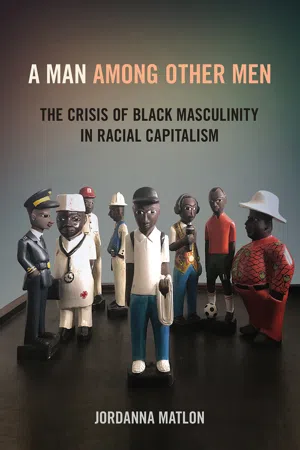
Award winner book of the ASA Distinguished Scholarly Book Award, the Lee Ann Fujii Book Award, Paul Sweezy Outstanding Book Award, ISA Global Development Studies Best Book, ASA Viviana Zelizer Best Book Award, co-winner of the ISA John Ruggie Annual Best Book Award, and co-winner of the Society for the Study of Social Problems Global Division Book Award.
A Man among Other Men examines competing constructions of modern manhood in the West African metropolis of Abidjan, Côte d'Ivoire. Engaging the histories, representational repertoires, and performative identities of men in Abidjan and across the Black Atlantic, Jordanna Matlon shows how French colonial legacies and media tropes of Blackness act as powerful axes, rooting masculine identity and value within labor, consumerism, and commodification.
Through a broad chronological and transatlantic scope that culminates in a deep ethnography of the livelihoods and lifestyles of men in Abidjan's informal economy, Matlon demonstrates how men's subjectivities are formed in dialectical tension by and through hegemonic ideologies of race and patriarchy. A Man among Other Men provides a theoretically innovative, historically grounded, and empirically rich account of Black masculinity that illuminates the sustained power of imaginaries even as capitalism affords a deficit of material opportunities. Revealed is a story of Black abjection set against the anticipation of male privilege, a story of the long crisis of Black masculinity in racial capitalism.
This book has received honorable mentions by the African Studies Association Best Book Prize, by the American Anthropological Association Society for the Anthropology of Work Best Book, and multiple honorable mentions by the American Sociological Association (Sociology of Development Section; Race, Gender, and Class Section; and Sociology of Sex and Gender Section).
Capital can only be capital when it is accumulating, and it can only accumulate by producing and moving through relations of severe inequality among human groups…. These antinomies of accumulation require loss, disposability, and the unequal differentiation of human value, and racism enshrines the inequalities that capitalism requires. Most obviously, it does this by displacing the uneven life chances that are inescapably part of capitalist social relations onto fictions of differing human capacities, historically race.
—Jodi Melamed, Racial Capitalism
The very obviousness of the visibility of race convinces me that it functions as a signifying system, as a text we can read.
—Stuart Hall, Race, The Floating Signifier
1
TROPES OF BLACK MASCULINITY
Racialization and racism are intrinsic to capitalist development and reproduction (Robinson 2000). Race colonizes social hierarchies and strategies of capital accumulation, enabling some bodies to command property while others are commodified. Race provides “the raw materials from which difference and surplus— a kind of life that can be wasted and spent without limit—are produced” (Mbembe 2017, 34). From capitalism’s originary moment reaching beyond Europe to encapsulate the land and labor of peoples it rendered subject, Blackness operated as the minor term, the acute and diminished other, of a binary worldview: white/black, civilized/savage, beautiful/ugly, good/evil. Henceforth paired, these oppositions normalized social and economic inequality within the dominant purview. Toward peoples of African descent, racialization has justified, and racism is thereby a consequence of, the exploitation of Black bodies in the transatlantic slave economy. “The features of the man, his hair, color and dentrifice, his ‘subhuman’ characteristics so widely pleaded, were only the later rationalizations to justify a simple economic fact: that the colonies needed labor and resorted to Negro labor” (Williams 1994, 20). With the experiences of Black humanity in stark juxtaposition to the liberal ideology of freedom in the emergent discourse of free wage labor, the slave posed from the outset as its primitive and necessary exterior.1 Appealing thus to ideology and imaginary, capitalism generates value out of—and devalues—Blackness in regimes where whiteness is both immediately and symbolically hegemonic.2 The social is in every instance embedded in the economic.
To trace the means by which capitalism situates Black labor, and how accordant imaginaries of Blackness structure the social order and legitimize domination, is to document the hegemonic order of racial capitalism. To further demonstrate the production of consent among Black populations requires critically interrogating value creation in racial capitalism, attentive to how inclusion on one axis may preclude resistance on another. Integral to these considerations is the fact that capitalism codes labor, and economic participation generally, as masculine.
The incorporation of Black men in capitalism occurred under severe structural disadvantage, generating an enduring crisis of Black masculinity. Part I assembles the theoretical components of Blackness, and particularly Black masculinity, in racial capitalism to examine the production of hegemony and consent. To begin, I situate the two frames that compose my argument: the construction of the French West African évolué, and the Black Atlantic media icon, both of which disseminated as idealized imaginaries for Abidjanais men.
Representation of Consent: The évolué
In French colonial discourse, race was at the center of cultural contestation, the site of hegemonic struggle. Civilization peddled a whitening effect, ascendance up an evolutionary ladder from commodity to collaborator, the pinnacle a “not quite/not white” (Bhabha 1994) évolué: translated, literally, as “evolved.”3 The term “reflected the permeation of social Darwinist discourse throughout European societies by the late nineteenth century” and the belief in the teleological journey from savage to civilized/citizen, an idea that “animated France’s overseas expansion… and provided an ideological framework through which to legitimize the fact of imperial rule. Consequently, those people the French colonizers decided had made the first steps out of their initial state toward becoming French were said to have ‘evolved’ in comparison to their countrymen” (Genova 2004, 21–22). Thereafter entitled to seek the rights of a citizen, evolution presumed an inherent “biological handicap” of Africanity that fused colonial “racial criteria and sociological criteria” (Urban 2009, 452).
Acting as material and ideological interlocutors of colonial regimes in Africa, the évolué was a means by which “racial capitalism deploy[ed]… terms of inclusion to value and devalue forms of humanity differentially to fit the needs of reigning state-capital orders” (Melamed 2015, 77). The évolué realized the mission civilisatrice by becoming a modern, capitalist subject: a man who would approximate the Frenchman in public and private life, providing for his wife and children with the wages he earned in the new, colonial economy. To exchange free labor in the white man’s image, a capitalist realm whose parameters were defined by and largely interchangeable with the colonial state—was to become an acting subject of history. At its base membership ensured consent.
When colonial territories achieved independence, civilization, evidenced by economic and political parity and the social benefits such parity was to accrue, became the charge of the new regimes. The mission civilisatrice assumed the discourse of “development.” In Côte d’Ivoire as elsewhere in the colonies of French West Africa, or AOF (Afrique Occidentale Française), a peaceful transition to independence was driven by and saw the évolué assume power, consolidating political and economic interests and maintaining a neocolonial relationship with France under the elite complicity of Françafrique.4 The public sector encompassed a somewhat wider but nonetheless minor stratum of wage earners. Neither fully bourgeoisie nor proletariat by the prototype of European industrial capitalism, this constituency of bureaucrats and unionized workers constituted a relatively privileged “nucleus of the colonized population… most pampered by the colonial regime” (Fanon 1963, 108). The measure of a successful state— and the implicit state-society social contract—would be whether modern workers’ livelihoods and lifestyles would proliferate widely, supplanting noncapitalist arrangements otherwise labeled nonmodern, traditional, or African. External to the wage economy, these latter arrangements, such as market trade, were relegated to what women did—and posited as something other than work. The state being the major employer of wage labor, these steady and dignifying jobs became crucial sources of patronage (Cooper 1996, Mbembe 2001). At the level of man and state, global belonging was largely a question of the character of one’s economic incorporation into the domestic and international realms (Ferguson 2006).
Relations between individuals and the state as well as between states were in these ways embedded in political arrangements that originated in the colonial project. In Côte d’Ivoire close ties to France and full coffers from a booming cocoa sector in its early years of independence enabled first President Houphouët-Boigny to maintain an expansive civil service and buttressed its position as the regional hegemon, le miracle ivoirien. With a large, regional migrant population working in low-status, informal occupations, wage labor was a proxy not only for manhood but also citizenship. In Côte d’Ivoire the idea of civilization translated into the language of development and state-sponsored employment. Racial capitalism, with its political economy of Françafrique and impetus to civilize Africans in the image of the French colonizer, was inextricably linked to gender and nation. Being évolué was a matter of man’s relationship to the intertwined state and economy.
Representation of Consent: The Media Icon
Another means of contesting Black subjugation has entailed not sociocultural whitening but rather resignifying bodily commodification as economic agency. From the outset, racial capitalism engaged a politics of representation to devalue Blackness in the world political economy, thereby aligning white supremacy and capitalist hegemony. A coalition of antiracist and anticapitalist struggles has frequently met this coupling while also lending to a common sense understanding of Blackness as oppositional to both forms of oppression. Yet asserting an equivalence between Black value and economic agency decouples antiracist and anti-capitalist agendas. Within the racial capitalist world order, these assertions appear to undermine racial domination even while its structural inequalities persist.
Black men’s breadwinning aspirations meet their disproportionate marginalization in the global economy. In urban Africa the informal economy has inadequately absorbed surplus laborers, leaving the great majority of men under-employed, while men across the Black Atlantic are more likely to be under- and unemployed or illicitly employed than the white majority.5 Nevertheless, icons of Black manhood appear prominently as skilled entrepreneurs and conspicuous consumers, their celebrity status articulating corporate culture (see, e.g., Carrington 2010, Shipley 2013). Figuring within a long tradition of glorified Black entertainers and athletes when Black people are otherwise excluded from mainstream social, political, and economic life, these icons operate as tropes of Blackness that provide authoritative, mass-mediated counternarratives to racialized dispossession. In doing so, they model a path to full citizenship that bypasses wage labor. And like the évolué, theirs are gendered tropes: economic participation simultaneously makes Blackness visible and facilitates patriarchal entitlement.
As celebrity icons, African Americans are key agents of global popular culture and direct the “standards, desires and passions” (Gilroy 2001, 100) of Black culture globally. Yet as a demographic, African Americans do not profit from the commodification of Black culture. The “paradoxical location” (Hanchard 1990, 32) of American Blackness is thus inextricable from histories of capitalist excess and negation. Disseminated across media circuits, it appears simultaneously hegemonic—as American, imperialist, and capitalist, and counterhegemonic—as African, colonized, and resistant if not revolutionary. The latter, in its “stylish opposition” (Ebron 2008, 319), obscures the former. This expression of Blackness neither identifies nor opposes white supremacy as a tool of capital accumulation. A double entendre, American Blackness provides a productive tension for the pursuit of capital accumulation on a global scale.
Colonial formulations and global media circulations represent idealized imaginaries of Blackness amid la crise. Abidjanais men drew on these imaginaries as they aspired to become évolués and celebrity icons. Together, they comprised the spectrum of Black masculinity vis-à-vis production, consumption, and com-modification. And, by creating an illusion of opportunities that were in fact out of reach for the vast majority of Black men, together they obscured the overarching structures of racial capitalist exploitation.
2
THE EVOLUTION OF THE WAGE LABOR IDEAL
History shows us that every civilization originates from the white race, that none could exist without the help of this race, and that a society is only great and brilliant in proportion to its sustained contact with this noble race.
—Arthur de Gobineau, Essai sur l’inégalité des races humaines
What reassures France is that she holds light and freedom; for a savage people, to be enslaved by France is to begin to be free, for a city of barbarians, to be burned by France is to begin to be enlightened!
—Charles Hugo, Un coté de la question d’Afrique
In 1441 Portuguese sailors offered ten Africans from the Guinean coast to their expedition’s benefactor, Prince Henry of Portugal.1 Within three years the Portuguese were systematically trafficking and enslaving African men, women, and children. Other European nations soon joined in the lucrative sale of human flesh, and with the growing importance of sugar production in the West Indies and Brazil and the dependence on African slave labor for its cultivation, the slave trade quickly became central to the emerging global capitalist economy. After Britain and Portugal, France commanded the third-largest transatlantic slave trade.2 By the 1620s the French had established colonial plantations in the West Indies to breed cattle and cultivate tobacco and sugar. Settlers introduced African slaves prior to the territory’s falling under formal French jurisdiction, and within a half century “it was clear that slavery would become the dominant form of labor and the basis for French wealth in the Caribbean,” with the “institutions, customs, and laws that developed around black slavery in the French West Indies confirm[ing] the inequality between the races” (Cohen, W. 2003, xxii).
Having already granted concessions to private companies in the Senegal and Gambia region during the previous decade, in 1638 France established a trade port on the Senegal River that became its first sub-Saharan African colony in 1659. French traders commenced slave trading there in the 1670s, and France brought it under government control in 1685, at which point the trade constituted France’s primary economic interest in Africa (Schneider 1982). The first French expedition to present-day Côte d’Ivoire, in search of slaves and gold, occurred in 1687 (Cohen, W. 2003, 158). There, the French coordinated its slave trade predominantly from the port of Assinie, abducting bodies for transatlantic transport as well as for continental labor in mines (Loucou 2012).3 The slave trade in the region peaked from 1720–1760; when it declined, so too did the French presence (Atger 1960, Loucou 2012). From the start of the slave trade to its end, the French enslaved approximately 400,000 Africans from what is now Côte d’Ivoire (Loucou 2012).
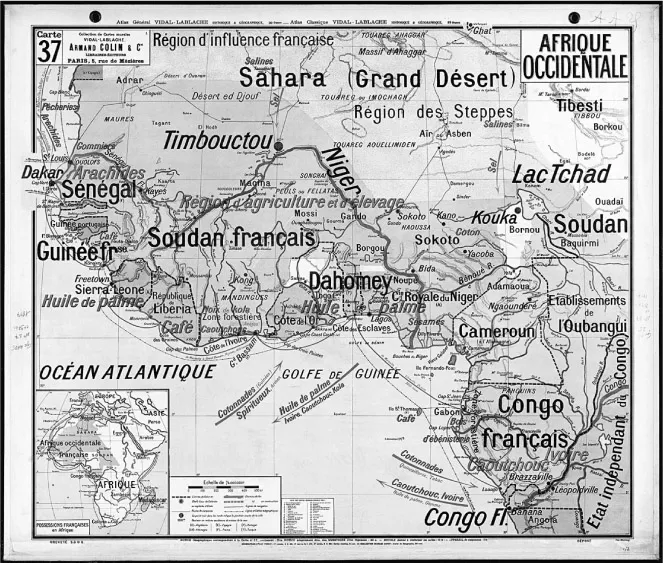
FIGURE 2.01. Map of Afrique Occidentale (West Africa) featuring natural resources (1897). Credit: Bibliothèque Nationale de France.
The transatlantic enslavement of African-descended people ended in three general phases: first, European nations sequentially abolished slavery in the metropole beginning in the early 1700s; next, they abolished the slave trade in the early 1800s; and finally, over a period of several decades in the mid-nineteenth century, they abolished slavery in their colonies. France abolished colonial slavery in 1848. Rather than Europe’s departure from Africa, however, manumission signaled a renewed orientation toward colonial rule, trade monopolies, and varying forms of forced labor. From the slave trade through colonization, the known territory of Africa was for Europeans a continent to be understood and carved up according to commercial interests.
French conquest of the territory, originally called Côte d’Or and renamed Côte d’Ivoire in 1893, was initiated through treaties with chiefs along the coastal region.4 In 1832 France returned to its post at Assinie and began fortification in 1842 under the guise of securing the region from slave traders (Daddieh 2016). Assinie was inaugurated as Fort Joinville in a treaty the next year with Attacla, its king. The initial terms were stock colonial arrangements: ceded African territory, French legal authority over disputes between French and natives, and a commitment to “free” trade—in other words, French control over the terms of trade and monopoly access to native products (Atger 1960, 446).5 In the earliest years commerce was mostly an individual affair. Arriving in Grand Bassam in 1862, the merchant Arthur Verdier became the first permanent French settler in 1871. At this point France had, by decree, extended its sovereignty over much of contemporary Ivoirian terri...
Table of contents
Cover
Title
Epigraph
Contents
Acknowledgments
Introduction: Greatness in Each Man
Part I THEORIZING BLACK MASCULINITY IN RACIAL CAPITALISM
Part II BETWEEN PLACE AND IMAGINARIES
Part III IMAGINARIES IN A CRISIS ABIDJAN
Conclusion: With Every Grace and Cuff Link
Postscript: Reflections on Intersections/Infrastructure
Notes
References
Index
Copyright
Trusted by 375,005 students
Access to over 1.5 million titles for a fair monthly price.
Study more efficiently using our study tools.
Frequently asked questions
Yes, you can cancel anytime from the Subscription tab in your account settings on the Perlego website. Your subscription will stay active until the end of your current billing period. Learn how to cancel your subscription
No, books cannot be downloaded as external files, such as PDFs, for use outside of Perlego. However, you can download books within the Perlego app for offline reading on mobile or tablet. Learn how to download books offline
Perlego offers two plans: Essential and Complete
Essential is ideal for learners and professionals who enjoy exploring a wide range of subjects. Access the Essential Library with 800,000+ trusted titles and best-sellers across business, personal growth, and the humanities. Includes unlimited reading time and Standard Read Aloud voice.
Complete: Perfect for advanced learners and researchers needing full, unrestricted access. Unlock 1.5M+ books across hundreds of subjects, including academic and specialized titles. The Complete Plan also includes advanced features like Premium Read Aloud and Research Assistant.
Both plans are available with monthly, semester, or annual billing cycles.
We are an online textbook subscription service, where you can get access to an entire online library for less than the price of a single book per month. With over 1.5 million books across 990+ topics, we’ve got you covered! Learn about our mission
Look out for the read-aloud symbol on your next book to see if you can listen to it. The read-aloud tool reads text aloud for you, highlighting the text as it is being read. You can pause it, speed it up and slow it down. Learn more about Read Aloud
Yes! You can use the Perlego app on both iOS and Android devices to read anytime, anywhere — even offline. Perfect for commutes or when you’re on the go. Please note we cannot support devices running on iOS 13 and Android 7 or earlier. Learn more about using the app
Yes, you can access A Man among Other Men by Jordanna C. Matlon,Jordanna Matlon in PDF and/or ePUB format, as well as other popular books in Scienze sociali & Studi di genere. We have over 1.5 million books available in our catalogue for you to explore.