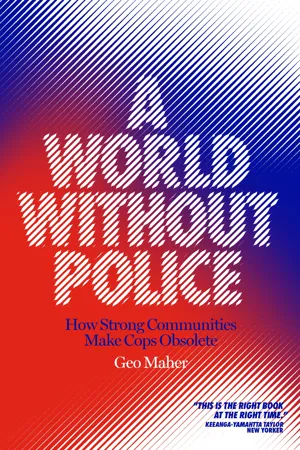
Tens of millions of people poured onto the streets for Black Lives Matter, bringing with them a wholly new idea of public safety, common security, and the delivery of justice, communicating that vision in the fiery vernacular of riot, rebellion, and protest. A World without Police transcribes these new ideas-written in slogans and chants, over occupied bridges and hastily assembled barricades-into a compelling, must-read manifesto for police abolition.
Compellingly argued and lyrically charged, A World without Police offers concrete strategies for confronting and breaking police power, as a first step toward building community alternatives that make the police obsolete. Surveying the post-protest landscape in Minneapolis, Philadelphia, Chicago, and Oakland, as well as the people who have experimented with policing alternatives at a mass scale in Latin America, Maher details the institutions we can count on to deliver security without the disorganizing interventions of cops: neighborhood response networks, community-based restorative justice practices, democratically organized self-defense projects, and well-resourced social services.
A World without Police argues that abolition is not a distant dream or an unreachable horizon but an attainable reality. In communities around the world, we are beginning to glimpse a real, lasting justice in which we keep us safe.
- 288 pages
- English
- ePUB (mobile friendly)
- Available on iOS & Android
eBook - ePub
About this book
Trusted by 375,005 students
Access to over 1.5 million titles for a fair monthly price.
Study more efficiently using our study tools.
Information
1
The Pig Majority
Ahmaud Arbery wasn’t killed by an officer of the law. But he was killed by police. How else to describe Gregory McMichael, his son Travis, and William “Roddie” Bryan, when they decided to pursue Arbery—with a .357 Magnum and a shotgun in tow—while he was jogging through Brunswick, Georgia, on February 23, 2020? When the pursuers attempted to corral him with their pickup truck before ultimately shooting him in the chest with a shotgun, there is no doubt that, at that moment, they were the police. This intuition would soon be confirmed. The McMichaels were not arrested for a full seventy-four days after they killed Arbery, and it took the recusal of two prosecutors—the second of which only did so after penning a letter insisting that there were no grounds to arrest the three assailants. Why the recusals? Because the elder McMichael had been a longtime police officer himself.
Some have decried Arbery’s killers as vigilantes or a lynch mob—both are certainly true. As one former federal prosecutor commented on the case: “the law does not allow a group of people to form an armed posse and chase down an unarmed person.” But to draw a hard line between the state and its self-deputized enforcers betrays a woeful ignorance of US history, throughout which the police have rarely if ever been distinguishable from the white mob. After all, the power to convoke a posse, one still enshrined in Georgia criminal law (section 17-4-24), is a power that belongs to the police. While vigilante violence has taken distinct forms throughout US history, self-deputized defenders of property and whiteness have almost always served as a brutal adjunct to the police, and the line between the two has been far from clear. Vigilantism first emerged on the southern border to terrorize Mexican and Indigenous people, in support of and supported by the official forces of colonial order. The complicity of police with lynch mobs—in up to half of all lynchings—is well-documented.1 And today, police membership in white supremacist organizations has been widely characterized as an “epidemic”; indeed, the name of one such organization, Posse Comitatus, says it all.2
In late August 2020, the smoldering embers of the George Floyd rebellion dramatically reignited after the videotaped shooting of Jacob Blake by police in Kenosha, Wisconsin. When protests broke out, armed white militias—bolstered by right-wing narratives about Antifa and Black Lives Matter (as well as a Republican National Convention that foregrounded racist vigilantes)—quickly arrived on the scene. Kyle Rittenhouse was among them. Rittenhouse’s mother had driven her teenaged son, an aspiring police officer, across state lines with his AR-15-style rifle to defend the private property of others. Police greeted and thanked the militias, offering water to Rittenhouse and others. He was later seen speaking to an interviewer on camera: “Our job is to protect this business,” although, as the New York Times quickly pointed out, “there is no indication that he was asked to guard the site.”3 This child-vigilante soon shot three protesters, two fatally.
In a video posted to Twitter, he can be heard speaking on the phone—“I just killed somebody”—before jogging, armed, toward the police, only occasionally raising his hands in the air. Despite protesters yelling to the police that Rittenhouse had shot someone, he was allowed to simply walk away from the scene of a double murder, crossing state lines before later being arrested. The Kenosha police chief blamed protesters themselves for the violence inflicted upon them: if they hadn’t been out past curfew, they wouldn’t have died. Kyle Rittenhouse, too, was out after curfew.
Seventeen-year-old Trayvon Martin wasn’t technically killed by the police either, although George Zimmerman had certainly deputized himself to police the gated community in Sanford, Florida, where he would murder Martin in 2012. Nor was Jordan Davis, also seventeen, killed in Jacksonville nine months later, after white vigilante Michael Dunn became incensed by the loud “thug music” Davis and his friends were listening to at a gas station. Nor was nineteen-year-old Renisha McBride, who knocked on Theodore Wafer’s door in Dearborn Heights, Michigan, for assistance a year later. Wafer fired a shotgun blast through his screen door and into McBride’s head. And in 2020 alone, white vigilantes took it upon themselves to attack BLM protests nationwide with vehicles, firearms, bear spray, and even a bow and arrow.
When police attacked Black teenagers at a pool party in McKinney, Texas, in 2015, most of the subsequent uproar focused on Eric Casebolt, the raging police officer who grabbed a fifteen-year-old girl by the hair and pointed his gun at others. Less discussed, however, was the behavior of other civilians involved: the teenagers later attested to the fact that white women had attacked them and made racist comments, and video of the incident clearly shows a large, self-deputized white man physically intervening to help police detain the teenagers. When 22-year-old John Crawford III was shot dead by police in an Ohio Walmart in 2014 for holding a BB gun in an open carry state, police claimed he had ignored verbal commands. Surveillance video shows they fired immediately. In fact, police had been called to the scene by a white bystander, who was later found to have “intentionally” lied about Crawford behaving in a threatening manner. Whether this was a lie or white fear, the result was just as deadly. Vigilantes don’t always need to pull the trigger; sometimes they just dial 911.
It was not the police but a grand jury of everyday citizens that declined to charge Crawford’s killers. The same goes for the majority-white grand jury that declined to charge Darren Wilson, who gunned down Mike Brown in Ferguson, and the officers who shot twelve-year-old Tamir Rice in Cleveland. While grand juries are often seen as a rubber-stamp institution that, in the words of one judge, would “indict a ham sandwich” if prosecutors so requested, this clearly doesn’t apply to cases involving Black people, where grand juries shield the system from scrutiny by letting police and white vigilantes walk free so prosecutors don’t have to. Even in cases where grand juries or prosecutors do indict, as with Freddie Gray’s death in police custody in Baltimore, judges often throw out the charges, or juries deadlock and acquit on flimsy claims of self-defense—rights not accorded to the victims of police violence.
This is what Ta-Nehisi Coates means when he writes, in Between the World and Me, that “to challenge the police is to challenge the American people, and the problem with the police is not that they are fascist pigs but that we are majoritarian pigs.”4 The pig majority includes the police, but it exceeds them as well. It comprises all those volunteer deputies eagerly doing their violent work alongside them. It is the judges, the courts, the juries, and the grand juries. It is the mayors and the district attorneys who demand “law and order” and denounce those who protest police brutality as “mindless rioters and looters.” It is the racist media apparatus that bends over backward to turn victims into aggressors and—above all when the former are Black and the latter white—killers into saints. It is the same pig media that selects innocent-looking photos for white aggressors while their victims are painted as violent, that breathlessly reports drugs in the victim’s bloodstream, previous encounters with the law, and scandalous social media posts. And it is the same media that, amid the wreckage of Hurricane Katrina in 2005, infamously coded white people as survivors and Black people as looters—legitimizing vigilante violence in defense of white property.
This expansive, amorphous pig majority comes into being long before violence occurs and continues to coalesce and expand after the body is cold. Its backbone is the self-deputized white majority that, with an effortlessness bordering on instinct, volunteers to police others, in part because it dreams police dreams and plays them out at home on wives and children, all while praying to a police god. This pig majority is fueled not only by overt racism and a white victimhood complex, but also by that perilous quantity that is white fear. It is part of the so-called implicit bias that leads police to shoot suspects of color—and Black suspects in particular—without hesitation. But white fear is deadly in other ways, too: when it calls 911 to report a suspicious person or a crime; when it describes a suspect; when it moves to a neighborhood and calls the cops on longtime residents and businesses for being too loud, too rowdy. It’s apps like Citizen and local Facebook groups; it’s cop-calling gentrifiers and the real estate developers behind neocolonial land grabs. And, as we will see, the pig majority that upholds white supremacy extends far beyond white Americans, conscripting many people of color—some voluntarily, some less so—to do its work as well.
The pig majority might include you, too. But it doesn’t have to.
—
Policing and whiteness—white power—are inseparable. As W.E.B. Du Bois argued in Black Reconstruction, this has been true from the beginning, when “slavery demanded a special police force and such a force was made possible and unusually effective by the presence of the poor whites.”5 As slave patrols morphed into police forces, moreover, little changed, and the “police system was arranged to deal with blacks alone, and tacitly assumed that every white man was ipso facto a member of that police.”6
After the abolition of slavery, when Black freedom threatened the plantation economy and terrified many whites, policing became more important, not less. “Black codes” across the South made Black labor mandatory under vagrancy laws, punishing those found in violation with forced labor. The objective was clear: to discipline a necessary workforce. Those who refused were imprisoned, and many were subjected to the regime of convict leasing—some of whom were returned in chains to the same plantations they had only just escaped. The broader result was a cheap labor force whose docility was ensured by the threat of re-enslavement, or worse. If policing disciplined former slaves, it provided concrete employment for many otherwise-destitute whites as overseers, slave breakers, and patrolmen. Whiteness, however, was not only about monetary wages, but also entailed what Du Bois called a “public and psychological wage” that “fed his vanity because it associated him with the masters.”7 Poor whites were bestowed with symbolic superiority and titles, but also material privileges: access to public functions and parks, public education, and leniency in the courts.
These petty privileges and “wages of whiteness” encouraged poor whites to identify as white rather than as poor, ensuring their loyalty to their class enemies and disarming any potential solidarity with poor Black people, slave or free. The police were thus the linchpin holding together a vast, cross-class alliance that, for Du Bois, marked the tragedy of post-emancipation America. Poor whites had betrayed their own class interests by entering into a devil’s bargain with their “race,” thereby setting American capitalism on a path of untrammeled greed and racial avarice from which it hasn’t strayed since. This racial bargain had upheld the slave system, and the same bargain would doom Reconstruction, a radical experiment in social and racial equality that had improved the lives of everyone, poor whites included, by breaking the political power of the planter class, abolishing debtors’ prisons, establishing public schools, and eliminating property qualifications for voting.
Having chosen their race over their class, these ipso facto police took on another name: the Ku Klux Klan. Through terroristic intimidation, the Klan-police disenfranchised Black Southerners and imposed “a double system of justice” that sought “to use the courts as a means of re-enslaving the blacks.” “Gradually,” Du Bois wrote, “the whole white South became an armed and commissioned camp to keep Negroes in slavery and to kill the black rebel.”8 The police stood against democracy from the very beginning, resisting with violent terror even its most limited representative form—one person, one vote. But this was in part because to grant basic suffrage to former slaves posed a threat to those limits and opened the door to more substantial demands. As Reconstruction governments showed, the vote was not an end in itself, but a means toward building that world of greater equality and more substantive participation that Du Bois called “abolition democracy.” The Klan-police rolled back this ambitious vision, containing it within bounds acceptable for racists and capitalists alike.
While slave patrols provided the vicious blueprint, the policing of slaves in the South dovetailed with the policing of other “dangerous” classes like the poor and immigrant rabble of the North. It was in the context of Northern cities that professional policing had emerged in the United States, heavily influenced by the English model of Robert Peel’s London Metropolitan Police. Even though their sources differed, there was no real contradiction between these two forms of policing—after all, in the development of American capitalism, slavery had been as important as industry, providing raw materials to the North and to London itself. In their genesis, police embodied the division of the poor, and in their practical function they uphold that division every day, patrolling the boundaries of property and that most peculiar form of property that is whiteness. American policing has always been about two things at once: controlling “dangerous” people and disciplining the workforce; assuaging the moral anxieties of white elites and the needs of capital accumulation; racist fear and economic profit.
Whether in the North or in the South, police have attacked workers and broken strikes, and they have policed the perceived vice and immorality that is primarily associated with people of color. After the abolition of slavery, policing helped keep the Black labor force on the plantations from which they had been momentarily freed, patrolling the boundaries of segregated neighborhoods for decades to come. And as deindustrialization set in in the 1970s and poor Black workers were pushed out of the labor market entirely, the police stepped in to enforce the violent feedback loop connecting ghettoes to prisons. This contemporary arrangement squeezes nearly free labor like blood from a stone, providing a never-ending stream of jobs for police and prison guards while protecting property—real estate values in particular—from the poorest. If Du Bois spoke more than a century ago of the role of the courts in re-enslaving Black people, the racist seeds of Jim Crow have borne fruit in the mass incarceration and the mass policing of today. How else to explain, more than a century after abolition, disparities in federal sentencing guidelines of one hundred to one between powder cocaine and crack?
It is no exaggeration to say that the South won the long Civil War, even if the fight rages on in the streets today. The racist policing pioneered under slavery and in the Jim Crow South have gone nationwide and metastasized—from Black codes to “broken windows,” from convict leasing to the criminalization of Blackness. The watchword of American history is not change but continuity, not abolition but substitution. New structures of containment have replaced the old, in a seemingly interminable cycle driven by the irrepressible yearning of Black freedom dreams. Meanwhile, poor whites, dying of opioid addiction and preventable disease, choose the increasingly meager wages of whiteness over a better world for all, voting for more police as the coffers of the rich burst their hinges.
—
If whiteness were a job, it would be the police. But if policing emerged as historically indistinguishable from whiteness, and if white Americans continue to play a disproportionately heavy role in today’s pig majority, what of the legions of Black and Brown police officers, commanders, and commissioners, district attorneys, mayors, and judges? What of the diversity among the ranks of border patrol, immigration and customs agents, and active duty foot soldiers of global imperialism abroad? And what of the complicity of the broader multiracial political class in what legal scholar James Forman Jr. has called “locking up our own?”
After a young client of his was handed a harsh sentence delivered via a speech about the virtues of Martin Luther King Jr. and the civil rights movement, it suddenly dawned on Forman that everyone in the Washington, DC, courtroom is Black:
not just the judge, but the court reporter, the bailiff, and the juvenile prosecutor. So was the police officer who had arrested Brandon, not to mention the police chief and the mayor … I had been to the detention facility that would be Brandon’s new home … and I knew that all the gua...
Table of contents
- Cover Page
- Title Page
- Copyright Page
- Contents
- Introduction
- 1. The Pig Majority
- 2. Who Do You Serve? Who Do You Protect?
- 3. The Mirage of Reform
- 4. Breaking Police Power
- 5. Building Communities without Police
- 6. Self-Defense and Abolition
- 7. Abolish ICE, Abolish the Border
- Conclusion: Democracy or the Police?
- Acknowledgments
- Notes
- Index
Frequently asked questions
Yes, you can cancel anytime from the Subscription tab in your account settings on the Perlego website. Your subscription will stay active until the end of your current billing period. Learn how to cancel your subscription
No, books cannot be downloaded as external files, such as PDFs, for use outside of Perlego. However, you can download books within the Perlego app for offline reading on mobile or tablet. Learn how to download books offline
Perlego offers two plans: Essential and Complete
- Essential is ideal for learners and professionals who enjoy exploring a wide range of subjects. Access the Essential Library with 800,000+ trusted titles and best-sellers across business, personal growth, and the humanities. Includes unlimited reading time and Standard Read Aloud voice.
- Complete: Perfect for advanced learners and researchers needing full, unrestricted access. Unlock 1.5M+ books across hundreds of subjects, including academic and specialized titles. The Complete Plan also includes advanced features like Premium Read Aloud and Research Assistant.
We are an online textbook subscription service, where you can get access to an entire online library for less than the price of a single book per month. With over 1.5 million books across 990+ topics, we’ve got you covered! Learn about our mission
Look out for the read-aloud symbol on your next book to see if you can listen to it. The read-aloud tool reads text aloud for you, highlighting the text as it is being read. You can pause it, speed it up and slow it down. Learn more about Read Aloud
Yes! You can use the Perlego app on both iOS and Android devices to read anytime, anywhere — even offline. Perfect for commutes or when you’re on the go.
Please note we cannot support devices running on iOS 13 and Android 7 or earlier. Learn more about using the app
Please note we cannot support devices running on iOS 13 and Android 7 or earlier. Learn more about using the app
Yes, you can access A World Without Police by Geo Maher in PDF and/or ePUB format, as well as other popular books in Politics & International Relations & Civil Rights in Politics. We have over 1.5 million books available in our catalogue for you to explore.