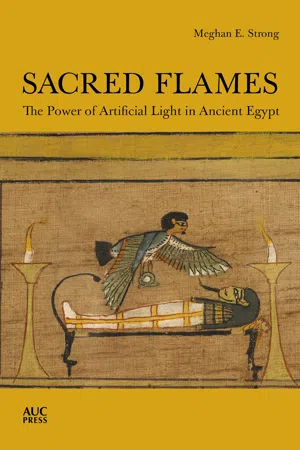
A fascinating examination of the role of lighting in ancient Egyptian culture
Artificial lighting is one of the earliest tools used by humans. By the time we began to paint cave walls, we were producing lamps consisting of an illuminant, a fat or oil, and a wick, such as a strip of fabric or a piece of reed or wood.
Drawing on archaeological, textual, and iconographic sources, Meghan Strong examines the symbolic part that artificial lighting played in religious, economic, and social spheres in ancient Egyptian culture. From the earliest identifiable examples of lighting devices to the infiltration of Hellenistic lamps in the seventh century BC, Sacred Flames explores the sensory experience of illumination in ancient Egypt, the shadows, sheen, color, and movement that resulted when lighting interacted with different spaces and surfaces. The soft, flickering light from lamps or hand-held lighting devices not only facilitated the navigation of darkened environments, such as allowing workers to see in underground chambers in the Valley of the Kings, or served as temple offerings, but also impacted upon the viewer's perception of a space and the objects within it.
Sacred Flames illustrates the active role that lighting played in Egyptian society, providing a richer understanding of the symbolic and social value of artificial light and the role of lighting in ritual space and performance in ancient Egyptian culture, while serving as a case study of the broader impact of artificial light in the ancient world.
- English
- ePUB (mobile friendly)
- Available on iOS & Android
eBook - ePub
About this book
Information
1
The Archaeology of Light
At Sais, when the assembly takes place for the sacrifices, there is one night on which the inhabitants all burn a multitude of lights in the open air round their houses. They use lamps in the shape of flat saucers filled with a mixture of oil and salt, on the top of which the wick floats.Herodotus, Histories II. 62
Herodotus recorded this observation in the fifth century bc during the festival of Neith, patron goddess of Sais. For the next 2,000 years, his remark would serve as the primary account for the methods of ancient Egyptian artificial lighting. In 1924, Norman de Garis Davies remarked on the appearance of “A Peculiar Form of New Kingdom Lamp” in Nineteenth Dynasty Theban tombs. He described these objects as “white cones decorated with red and yellow bands, set on short poles” that were either presented before a deceased individual in the hand of an offering bearer or placed into an altar.1 Although Davies uses the word “lamp” in his title, he refers to these objects as “tapers” or “candles” throughout his nine-page article, as that is what they most closely resemble in the modern vernacular. Davies’s piece serves primarily as a catalogue of Eighteenth and Nineteenth Dynasty tomb scenes in which this type of lighting device is depicted. He does provide some analysis, however, suggesting that these objects may have been used for illumination and/or fumigation.
Flinders Petrie briefly touches on the use of lamps based on his discovery of two limestone vessels during his excavations at Lahun. He does not attempt to discuss lamps in ancient Egypt more broadly, but suggests that salt water may have been used in the Twelfth Dynasty lamps and that this would explain Herodotus’s observation at Sais.2 Petrie also suggests that water must have been used in Egyptian lamps because that was the type of lamp used in the Middle Ages and in modern-day Egypt. However, he provides no support for these assertions, nor any evidence for continuity between the Twelfth Dynasty lamps and modern Egyptian types. Interestingly, despite his publication of the earliest corpus of Roman lamps from Egypt3 and his work on the origins and development of the ceramic oil lamp of the ancient Levant,4 Petrie never produced a typology of lamps for Pharaonic Egypt. In 1939, F.W. Robins would publish the only examination of archaeological evidence for artificial lighting from the entire Pharaonic period, an area of research of which, he rightly suggested, “little or nothing is known.”5 Robins quickly jumps to the conclusion that lamps must have been the primary source of illumination for the Egyptians, even though “lamps of the dynastic period seem to be wholly lacking from recorded finds.”6 To explain this lack of material evidence, he returns to Herodotus and focuses on the observation that Egyptians used a “floating wick” lamp. This type of lamp, Robins states, is “the hardest of all to identify” because “since the flame floated more or less in the centre of an open bowl there are not necessarily any visible signs of burning.”7
Herodotus, Davies, and Robins all have contributed valuable information to the examination of artificial lighting in ancient Egypt, but there is certainly opportunity to address questions that they have left unanswered. Herodotus wrote his observation about lamps in the fifth century bc, and it seems unwise to assume that the Egyptians used only one type of lighting technology throughout the 3,000 years prior to his description. Robins provides an intriguing explanation for the lack of material evidence of lamps but fails to explain how a “floating wick type” lamp would function. Additionally, drawing literally from the observations of Herodotus may be problematic. His comment on the “floating wick” likely relates to the visibility of the wick within the bowl, which would have been in contrast to wicks in contemporaneous Archaic Greek lamps that were concealed within a wick nozzle (figure 2).8
From a mechanical standpoint, it is impossible for a lamp wick to float on top of the oil or in the middle of a bowl of its own accord. A scrap of fabric may have been able to float on the surface of the oil if it was wrapped around or threaded through a piece of wood or cork, but no material evidence has been found to suggest that this was done in ancient Egypt. There is also no evidence for a vegetal material that could serve as a floating wick such as the calyx of Ballota acetabulosa, an evergreen plant native to Greece and Turkey, which was used in lamps in ancient Greece and is still used today.9 In addition to the use of a floating wick, Robins theorizes that ancient Egyptian lamps likely developed out of adapting household vessels for use as a lighting device. However, he provides no archaeological evidence to support this claim. This chapter will investigate this hypothesis by determining what types of vessels were utilized for lamps, and whether or not they were purpose-made as lighting devices. Wick emplacements or means of creating a “floating wick” will also be considered.

2. Greek oil lamp, fifth century bc (1986.1041). Cleveland Museum of Art
Davies’s article highlights the contributions that iconography can make to our understanding of lighting paraphernalia, but as his writing provides minimal analysis, these scenes certainly require reinvestigation. Davies’s article clearly illustrates, however, that oil lamps were not the only type of lighting device that ancient Egyptians used. This begs the question of whether there was a distinction in, or hierarchy of, lighting implements? Were different devices employed in specifically designated spaces? The ancient Egyptians themselves are not particularly explicit in describing their lighting utensils, and as a result the materials used to create these objects, their shape, color, size, and the context in which the lights were used are not always apparent. Nevertheless, I would suggest that there is sufficient archaeological evidence for lighting from the Predynastic through the Late Period (ca. 3000–650 bc) to build a basic typology of lighting equipment.
The focus of this chapter is to provide a typology based on the most consistent types of lighting equipment from the Pharaonic period, particularly those that correlate with textual or iconographic evidence. My starting point for the typology is Henry Fischer’s study in the Lexikon der Ägyptologie, which provides a broad overview of pieces that have been identified as lamps within published archaeological field reports.10 The types that I discuss here developed from comparing Fischer’s examples with museum collections and catalogues, tomb and temple iconography, lychnological publications, and published finds from across Egypt and Sudan. This chapter is not meant to serve as an exhaustive catalogue of all ancient Egyptian lighting devices, as these are poorly published and difficult to identify. Instead, it will present examples of the most consistent types of lighting equipment that I have identified, which can then be used to study and (re)examine relevant archaeological material, as well as provide a focus for the future collection of additional examples.
It is important to acknowledge that the majority of these devices derive from mortuary contexts, and while they are useful there are also minimal numbers. In an attempt to avoid abstract terminology, such as candle, torch, and so on, I have instead used descriptive names for the four types of lighting devices that I have identified: non-spouted open-vessel lamp, spouted open-vessel lamp, wick-on-stick device, and wick-in-stick device. Because there are so few extant examples, the typology includes vessels and relevant accessories (that is, lampstands) made from ceramic, stone, metal, and wood. As stated in the introduction, the majority of these pieces lack telltale markers of lighting devices, for instance, a wick spout or nozzle, burn marks, or wick remains. The identification of vessels as lamps without these features, designated as “probable” or “possible” in this chapter, is therefore tentative. There is also no way to account for the number of lamps that may have been ignored or discarded during excavation due to the lack of these features. Nor can I address the number of lamps that may exist in storage magazines or museum collections that have lost identifiable signs of use as a lamp due to cleaning or degradation.
The vessels presented in the typology also could have served multiple purposes.11 I acknowledge that the objects I discuss below were likely not used solely as means of illumination. Spouted vessels, for example, could be used for libations while non-spouted vessels could be used to hold foodstuffs. I am not suggesting that every spouted or non-spouted vessel functioned as a light source. I am, however, indicating that these types of vessels had the potential to serve as a lamp and sometimes there is evidence that one did. Because the evidence is minimal and displays no clear development over time, the material will not be presented chronologically. Instead, the pieces within each type will be presented by degree of plausibility that they served as lighting devices. Any chronological implications will be separately highlighted. Objects that can be securely identified as lighting paraphernalia include those containing remains of wick material and/or illuminant. Probable lighting devices are designated by the presence of burn marks, wick anchors, or iconographic evidence. Some types will also contain possible lighting objects that I have identified based on comparison with securely identified pieces or because of initial identification by an archaeologist. It is important to note that while every effort has been made to be as detailed as possible, some of the data are limited due to the lack of published material. Several of these objects have never been published, while many were cursorily mentioned in archaeological reports of the nineteenth and twentieth centuries and thus lack the detail expected in modern archaeological publications.12
Non-spouted Open-vessel Lamps
Examples of non-spouted open-vessel lamps exist in the archaeological record of Egypt as early as 4000 bc and continue in usage until the end of the Late Period. They are generally ceramic vessels made of Nile silt with the exception of the Middle Kingdom, during which time limestone lamps are more prominent in the archaeological record; however, examples are also found in rough limestone, copper, and calcite. They range in diameter from approximately 10 to 30 cm and in height from 4.9 to 33 cm, with conical, spherical, chalice, and hemispherical body shapes and round or flat bases (figure 3).
Definite examples of non-spouted open-vessel lamps
The earliest non-spouted lamp that I have firmly identified based on the presence of wick remains inside the vessel comes from the Sixth Dynasty mastaba of Kaemsenu at Saqqara. The spherical, non-spouted copper bowl (JE63675) measures approximately 10 cm in diameter and, based on the published drawing, appears to be round bottomed.13 There were, in fact, two lamps with wick remains found in Kaemsenu’s mastaba: a copper lamp found in a subsidiary burial chamber and a Nile silt ware example found in a serdab. The latter will be discussed in the next section of this chapter as it is a spouted-vessel lamp. This is, however, a good illustration of the use of both spouted and non-spouted bowls at the same time, and even in the same burial, as means of illumination. The non-spouted vessel was placed in front of the coffin along the east wall of the burial chamber on a shelf formed by the stones blocking the door (figure 4). An intact wick was found inside the bowl, although no indication is given in the publication as to whether the wick exhibited signs of burning or if any traces of illuminant were found in the vessel. Based on the drawing of the...
Table of contents
- Cover
- Half Title Page
- Title Page
- Copyright Page
- Contents
- List of Figures
- List of Abbreviations
- Acknowledgments
- Introduction
- 1 The Archaeology of Light
- 2 Artificial Lighting in Context
- 3 The Language of Light
- 4 Offering Light
- 5 The Power of Light
- 6 Accessing the Ancient Egyptian Lightscape
- Notes
- References
- Appendix One: Lighting Devices
- Appendix Two: Theban Tombs with Light-offering Scenes
- Index
Trusted by 375,005 students
Access to over 1.5 million titles for a fair monthly price.
Study more efficiently using our study tools.
Frequently asked questions
Yes, you can cancel anytime from the Subscription tab in your account settings on the Perlego website. Your subscription will stay active until the end of your current billing period. Learn how to cancel your subscription
No, books cannot be downloaded as external files, such as PDFs, for use outside of Perlego. However, you can download books within the Perlego app for offline reading on mobile or tablet. Learn how to download books offline
Perlego offers two plans: Essential and Complete
- Essential is ideal for learners and professionals who enjoy exploring a wide range of subjects. Access the Essential Library with 800,000+ trusted titles and best-sellers across business, personal growth, and the humanities. Includes unlimited reading time and Standard Read Aloud voice.
- Complete: Perfect for advanced learners and researchers needing full, unrestricted access. Unlock 1.5M+ books across hundreds of subjects, including academic and specialized titles. The Complete Plan also includes advanced features like Premium Read Aloud and Research Assistant.
We are an online textbook subscription service, where you can get access to an entire online library for less than the price of a single book per month. With over 1.5 million books across 990+ topics, we’ve got you covered! Learn about our mission
Look out for the read-aloud symbol on your next book to see if you can listen to it. The read-aloud tool reads text aloud for you, highlighting the text as it is being read. You can pause it, speed it up and slow it down. Learn more about Read Aloud
Yes! You can use the Perlego app on both iOS and Android devices to read anytime, anywhere — even offline. Perfect for commutes or when you’re on the go.
Please note we cannot support devices running on iOS 13 and Android 7 or earlier. Learn more about using the app
Please note we cannot support devices running on iOS 13 and Android 7 or earlier. Learn more about using the app
Yes, you can access Sacred Flames by Meghan E. Strong in PDF and/or ePUB format, as well as other popular books in History & History of Ancient Art. We have over 1.5 million books available in our catalogue for you to explore.