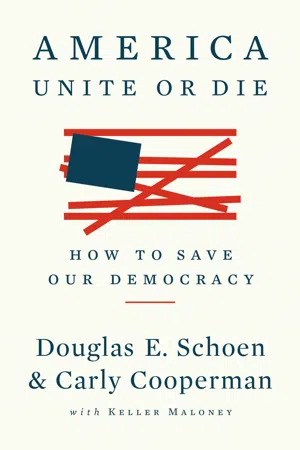
America: Unite or Die
eBook - ePub

America: Unite or Die

How to Save Our Democracy

  1. 496 pages
  2. English
  3. ePUB (mobile friendly)
  4. Available on iOS & Android
eBook - ePub

America: Unite or Die

How to Save Our Democracy

About this book

WHAT AMERICA MUST DO TO ACHIEVE UNITY AND SAVE OUR DEMOCRACY AMERICA: UNITE OR DIE is a real-time analysis of why American Democracy is crumbling and why both sides – Republicans and Democrats – are responsible for its collapse. This is the first objective, nonpartisan analysis of what has happened, and most importantly, explains what we can do to avoid impending doom for our system, and most of all, our nation.
ONE NATION, INDIVISIBLE? America is the only country in the history of the world founded on an idea—and that idea is liberty. It's an idea that resulted in the most flourishing citizenry in human history, but today that idea is under attack, not just from foreign adversaries but from within as the extreme right of the Republican Party and extreme left of the Democratic Party move further and further apart. These dangerous, corrosive positions pose a serious threat to the foundations of American democracy as we now face: · A political class that has lost touch with mainstream America. · Public loss of trust in the institutions of democracy. · The rise and mobilization of extremism on the right and left, both threatening violence. · The rise of social media, websites, and cable TV news that splinters audiences andcreates alternate realities. · Inequality of opportunity that creates a two-tiered society of haves and have-nots. · Anti-democratic regimes ruling China and Russia that threaten freedom around the world. In an era of growing distrust, demonization, and hatred, as we live America's tragic 'Tale of Two Cities, ' our most inspired turn is to embrace the idea engendered in a true symbol of American democracy: the mighty woman with a torch, 'the Statue of Liberty Enlightening the World' "Give me your tired, your poor/Your huddled masses yearning to breathe free". When citizens who work hard and play by the rules believe they have no shot at the American Dream — or conclude that the American values, identity, and the principles they grew up with are vanishing — a giant question mark hangs over the future of our democracy.If we hope to preserve our democracy, both sides must start by reaffirming their belief in the democratic principles of America so they can move from the fringes to the moderate middle-of-the-road positions that millions of Americans embrace. AMERICA: UNITE OR DIEis an inspired plan to turn the Divided States of America into the Reunited State of America. "America: Unite or Die is a must-read for anyone interested in politics and governing or in the current dysfunction of our political system. Douglas Schoen and Carly Cooperman are great scholars and practitioners of American politics. They are two of the country's finest pollsters and strategists who have seen it all—from advising presidents in the White House to analyzing the voters in the precincts across America. The polarization in this country today is explained clearly. Every citizen who cares about this extraordinary country of ours should read this book and be enlightened about what's going on around them." —Ed Rollins, former assistant to President Reagan for political and governmental affairs, and former co-chairman to the National Republican Congressional Committee
Frequently asked questions

Yes, you can cancel anytime from the Subscription tab in your account settings on the Perlego website. Your subscription will stay active until the end of your current billing period. Learn how to cancel your subscription.
No, books cannot be downloaded as external files, such as PDFs, for use outside of Perlego. However, you can download books within the Perlego app for offline reading on mobile or tablet. Learn more here.
Perlego offers two plans: Essential and Complete
  • Essential is ideal for learners and professionals who enjoy exploring a wide range of subjects. Access the Essential Library with 800,000+ trusted titles and best-sellers across business, personal growth, and the humanities. Includes unlimited reading time and Standard Read Aloud voice.
  • Complete: Perfect for advanced learners and researchers needing full, unrestricted access. Unlock 1.4M+ books across hundreds of subjects, including academic and specialized titles. The Complete Plan also includes advanced features like Premium Read Aloud and Research Assistant.
Both plans are available with monthly, semester, or annual billing cycles.
We are an online textbook subscription service, where you can get access to an entire online library for less than the price of a single book per month. With over 1 million books across 1000+ topics, we’ve got you covered! Learn more here.
Look out for the read-aloud symbol on your next book to see if you can listen to it. The read-aloud tool reads text aloud for you, highlighting the text as it is being read. You can pause it, speed it up and slow it down. Learn more here.
Yes! You can use the Perlego app on both iOS or Android devices to read anytime, anywhere — even offline. Perfect for commutes or when you’re on the go.
Please note we cannot support devices running on iOS 13 and Android 7 or earlier. Learn more about using the app.
Yes, you can access America: Unite or Die by Doug E. Schoen,Carly Cooperman,Keller Maloney in PDF and/or ePUB format, as well as other popular books in Politics & International Relations & Democracy. We have over one million books available in our catalogue for you to explore.

1 / LOSS OF TRUST IN AMERICA’S INSTITUTIONS

American democracy is facing an existential crisis of historic proportions. Millions of our citizens no longer have faith and trust in our core institutions and values, including our system of government, our educational system, big business and capitalism, the news media, law enforcement, our commitment to racial equality, our health care system, and our traditional religious institutions. Most Americans still trust the military, but that trust has dropped sharply since 2018.
The optimism that generations of Americans have embraced since colonial times, expecting better days ahead even when times are hard, has been replaced for millions of people by feelings of pessimism. The belief in the American Dream of upward mobility—that someone can go from rags to riches, climbing the economic ladder from the bottom rungs—is nowadays often dismissed as a fantasy. We can’t ignore this crisis if we want to keep our democracy from imploding.
The trust and optimism crisis has been worsening for decades. It is rooted in the failure of the institutions above and the people who lead them to respond to the needs of the American people in times of rapid change, and in almost nonstop partisan battles. Instead of focusing on solving problems, far too many politicians are focusing on the next election and on denying the opposing party credit for accomplishing anything significant. The old saying that “politics is the art of compromise” has become sadly outdated. Many politicians and their most committed supporters and donors now consider compromise and moderation signs of weakness and insufficient ideological fervor. Many consider fighting more important than legislating.
Too few lawmakers embrace the view of then-representative Deb Haaland (D-NM) who in her first term beginning in 2019 built a record of bipartisanship. “I couldn’t agree more that collaboration is important,” Haaland said during the Senate confirmation hearing on her nomination by President Biden to become interior secretary. “I was the highest-rated freshman in Congress on bipartisan collaboration…. I feel like the people of New Mexico sent me to Congress to get work done and that’s exactly what I’ve done.”1 Our democracy would be in much better shape if more lawmakers shared the attitude of Haaland, who was confirmed in March 2021 to become secretary of the interior and the first Native American to serve in a president’s cabinet.
Democracy only works when most citizens believe in it and trust their leaders to be true public servants. Democracy fails when leaders become a corrupt elite out to game the system for their own advantage. When citizens who work hard and play by the rules believe they have no shot at the American Dream—or conclude that the American values, identity, and the principles they grew up with are vanishing—a giant question mark hangs over the future of our democracy. The urban riots of the spring and summer of 2020 that broke out amidst largely peaceful protests calling for racial justice—along with the right-wing insurrection at the Capitol on January 6, 2021, to keep Donald Trump in the White House—might be only the beginning of the troubles that await us.
Don’t just take our word for it when we say American democracy is endangered. In a report published in early 2021, Freedom House (a nonprofit and nonpartisan organization) raised alarm about the weakening of democracy around the world—including in the United States. “The parlous state of U.S. democracy was conspicuous in the early days of 2021 as an insurrectionist mob, egged on by the words of outgoing president Donald Trump and his refusal to admit defeat in the November election, stormed the Capitol building and temporarily disrupted Congress’s final certification of the vote,” the report states. “This capped a year in which the administration attempted to undermine accountability for malfeasance, including by dismissing inspectors general responsible for rooting out financial and other misconduct in government; amplified false allegations of electoral fraud that fed mistrust among much of the U.S. population; and condoned disproportionate violence by police in response to massive protests calling for an end to systemic racial injustice.”2
The Freedom House report said the U.S. was one of 73 nations out of 195 the organization studied that became less free in 2020. Freedom House dropped America from its list of nations with the strongest democracies and instead ranked the U.S. with countries known for weak institutions and corruption. The report received little notice in the U.S. media, but we should all pay attention. If we don’t take action, our democracy could become even more endangered.
Unfortunately, instead of working together to strengthen our democracy and to help it recover from the trauma of the 2020 election and the insurrection at the Capitol, Democrats and Republicans in Congress are doing all they can to undermine each other—and hurting the American people in the process. Lawmakers are acting like two teams of rowers in the same boat working against each other—each rowing in the opposite direction. Because they can’t agree on which way to go, they prevent the boat from making any progress. This has left millions of Americans on both the left and right disappointed, disillusioned, disgusted, and distrustful of our nation’s government and many of society’s major institutions. As a result of these deep divisions, American democracy is in dire straits.
Making things even worse is the sad truth that divisions in Congress are mirrored by the divisions among the American people. As President Biden said in his inaugural address, we are engaged in an “uncivil war.”3 We are divided from each not just by political party affiliation, but by economic class, race, ethnicity, religion, sexual orientation, geography, educational level, and other factors. Too often, we see each other as members of a particular group rather than as fellow Americans. One of the few ideas finding broad support among the American people is that the elite are exploiting everyone else and—as the old saying goes—the rich get richer and the poor get poorer.
Even when a majority of the American people are in agreement on issues, bitter partisan divisions among citizens and lawmakers often stand in the way of effective government action. For example, following two mass shooting in March 2021—one claiming the lives of eight people (including six Asian American women) in the Atlanta area, and a second in Boulder, Colorado, in which ten people were murdered—a USA Today–Ipsos poll found that 65 percent of Americans believe gun control laws should be stricter, down from 78 percent in a Gallup poll in 1972. But the gap between Democrats and Republicans on this issue in the 2021 poll was enormous. While 90 percent of Democrats favor tougher gun laws, only 35 percent of Republicans do.4 Democratic support in 2021 was about the same as it was in a poll two years earlier, but Republican support for more gun control dropped substantially from 54 percent two years earlier.5
This widening of the gap on the gun issue between Democrats and Republicans illustrates how divisions between Americans are growing at a time when they need to be shrinking. Republican members of Congress—understanding full well that they could be attacked in primaries for supporting almost any new gun controls—are largely opposed to any new firearms legislation. As a result, there is virtually no chance that such legislation could receive the necessary 60 votes needed for passage in the Senate to overcome a GOP filibuster.
In order to take some small steps to reduce gun deaths, President Biden announced six executive actions he was taking in April 2021. One action will require all parts in kits that are used by consumers to assemble so-called “ghost guns” to have serial numbers, making it possible for the guns to be traced if they are used in crimes. The unassembled parts of the “ghost guns” would be classified as firearms for the first time, subjecting buyers to background checks. Another action will more strictly regulate a stabilizing brace that turns a pistol into a rifle with a short barrel. Such a brace was used in the mass shooting in Boulder. The president also said the Justice Department will publish model “red flag” legislation that state legislatures can consider passing to enable family members and police to petition a court to remove guns temporarily from people who may present a danger to themselves or others. However, stronger gun control measures that Biden would like to see—including a national red flag law, a ban on assault rifles, closing background check loopholes for gun purchases, and taking away protections gun manufacturers now have against lawsuits—would require congressional approval. Biden acknowledged that “much more needs to be done.” He said: “Gun violence in this country is an epidemic, and it’s an international embarrassment.”6
In an analysis on the CNN website shortly after seven mass shootings in seven days (including the ones in the Atlanta area and Boulder) took place, reporter Zachary Wolf wrote: “These sad truths about mass shootings in the U.S. are self-evident: In a country with easy access to guns, there will be mass shootings…. Lawmakers will talk about making it ever-so-slightly more difficult for people to buy guns. They will fail to do anything about it.”7 Wolf’s article quoted Representative Cynthia Lummis (R-WY) explaining Republican opposition, even in the wake of new mass shootings: “Every time that there’s an incident like this, the people who don’t want to protect the Second Amendment use it as an excuse to further erode Second Amendment rights,” Lummis said. “I no longer believe the goal of people who want to erode our rights, little by little, is to just affect or tweak our rights. I now believe that their ultimate goal is to abolish our rights.”
However, despite Republican claims, Democrats couldn’t repeal the Second Amendment of the Constitution—which the courts have ruled allows gun ownership—even if they wanted to. The amendment states, in its entirety: “A well-regulated Militia, being necessary to the security of a free State, the right of the people to keep and bear Arms, shall not be infringed.”8 To adopt a new amendment or repeal an amendment to the Constitution requires a two-thirds vote by both the U.S. House and Senate, followed by ratification by legislatures or conventions in three-fourths of the states (38 states). There is zero chance that repealing the Second Amendment could get this level of support.9
According to the Gun Violence Archive, 43,541 people were killed by guns in the United States in 2020—19,385 in homicides and accidents, and 24,156 by suicide. Another 39,429 people were wounded by guns in 2020.10 Surveys from the Pew Research Center, Harvard University, and Northeastern University have found that about 40 percent of Americans say they or someone in their household owns a gun. In addition, the Small Arms Survey, based in Switzerland, reports that while the U.S. has only about 4 percent of the world’s population, Americans possess about 40 percent of civilian-owned guns in the world. The survey estimates that Americans own 393 million guns—meaning the number of guns in the U.S. exceeds the population of 331 million.11 A Gallup poll found that in 2020, 42 percent of Americans said they had a gun in their home, down from 51 percent in 1982.12
The large number of guns in America makes it clear that gun violence will unfortunately claim some lives every year, no matter what Congress does. But common sense tells us that reasonable new restrictions on guns—such as requiring background checks for all gun purchases and a ban on assault weapons, on top of existing restrictions—will save lives without infringing on the rights of law-abiding Americans to own guns.
Democrats need to acknowledge that millions of Americans want to own guns and have a right to do so. Pew found in a 2017 survey that 67 percent of gun owners said a major reason for gun ownership is protection, while 38 percent cited hunting, 30 percent cited sport shooting, 13 percent cited gun collections, and 8 percent said they owned guns for their jobs.13 Republicans need to accept the fact that government will not repeal the Second Amendment, confiscate all guns, or take away all our liberties if laws are changed to do a more effective job keeping guns out of the hands of people at risk of committing murder and other crimes. After all, we have speed limits on our roads, require drivers and passengers to wear seat belts in vehicles, and outlaw drunk driving—but that hasn’t led to government confiscation of cars and trucks. The fact that the two sides continue to be unable to come together to agree on any new reasonable gun regulatory measures is a testament to the dysfunction of our political system.
Sadly, political combat today has escalated from a boxing match with rules and a clear ending to become a never-ending knife fight where anything goes. We see this most vividly in former president Trump’s incessant repetition of the Big Lie that he won the 2020 presidential election, even though state and federal courts tossed out this baseless claim when they dismissed more than sixty Trump campaign lawsuits. Yet a Suffolk University/USA Today poll of 1,000 people who voted for Trump found that “Three of four, 73 percent, say Biden wasn’t legitimately elected…. Six in 10, 62 percent, say congressional Republicans ‘should do their best to stand up to Biden on major policies, even if it means little gets passed.’ ”14 By April 2021, a Reuters-Ipsos poll showed that the number of Republicans who believe that “the 2020 election was stolen from Donald Trump” stood at 58 percent—still a majority.15
If this attitude prevails among GOP members of the House and Senate, we can expect Democrats to pay the next Republican president back when the shoe is on the other foot. This is a recipe for congressional gridlock to become a permanent affliction, except during the occasional times when the same political party controls the White House, the House of Representatives, and a 60-vote supermajority in the Senate to block filibusters (assuming the filibuster survives efforts by some Democrats to end it).
In Congress, Democrats have pulled out all the stops to attack Trump and Republicans. Many Democrats accused Trump of colluding with Russia to win the 2016 presidential election and were enthusiastic supporters of the nearly two-year probe of that claim by Special Counsel Robert Mueller, which ended with a report saying there was insufficient evidence to prove a criminal conspiracy. House Democrats later impeached Trump twice and Senate Democrats voted to convict him twice on other issues (the second time after his term had ended), but he was acquitted because most Republican senators supported him in his trials and refused to convict him.
Some Democratic members of Congress have hurled angry charges, including condoning racism and violence, at Republicans. For example, after House Minority Leader Kevin McCarthy (R-CA) refused to strip far-right extremist Rep. Marjorie Taylor Greene (R-GA) of her committee assignments, Democratic Rep. Alexandria Ocasio-Cortez of New York responded on MSNBC in late January 2021: “There are no consequences in the Republican caucus for violence. No consequences for racism. No consequences for misogyny. No consequences for insurrection. And no consequences means that they condone it. It means that that silence is acceptance.”16 House Democrats wound up removing Greene from her committee assignments in an unprecedented action. This only intensified the bitterness between Democratic and ...

Table of contents

  1. Cover
  2. Title Page
  3. Introduction
  4. Chapter 1: Loss of Trust in America’s Institutions
  5. Chapter 2: Schoen-Cooperman Research Survey: Public Perceptions of Government
  6. Chapter 3: The Divided States of America
  7. Chapter 4: A History of Populism
  8. Chapter 5: The Threat of Political Extremism
  9. Chapter 6: Russia, China, and the New Cold War
  10. Chapter 7: Centrist Reforms to Reunite Us
  11. Chapter 8: Conclusion
  12. About the Authors
  13. Notes
  14. Copyright