"An accessible introduction to the fundamental algorithms used to run the world." - Richard Vaughan, Purple Monkey Collective
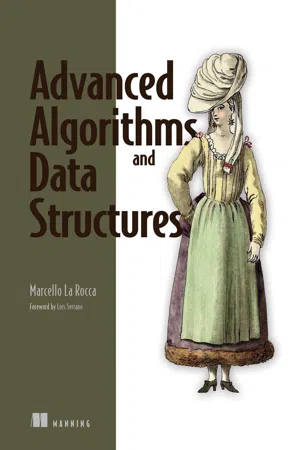
Advanced Algorithms and Data Structures introduces a collection of algorithms for complex programming challenges in data analysis, machine learning, and graph computing.
Summary
As a software engineer, you’ll encounter countless programming challenges that initially seem confusing, difficult, or even impossible. Don’t despair! Many of these “new” problems already have well-established solutions. Advanced Algorithms and Data Structures teaches you powerful approaches to a wide range of tricky coding challenges that you can adapt and apply to your own applications. Providing a balanced blend of classic, advanced, and new algorithms, this practical guide upgrades your programming toolbox with new perspectives and hands-on techniques.
About the technology
Can you improve the speed and efficiency of your applications without investing in new hardware? Well, yes, you can: Innovations in algorithms and data structures have led to huge advances in application performance. Pick up this book to discover a collection of advanced algorithms that will make you a more effective developer.
About the book
Advanced Algorithms and Data Structures introduces a collection of algorithms for complex programming challenges in data analysis, machine learning, and graph computing. You’ll discover cutting-edge approaches to a variety of tricky scenarios. You’ll even learn to design your own data structures for projects that require a custom solution.
What's inside
Build on basic data structures you already know
Profile your algorithms to speed up application
Store and query strings efficiently
Distribute clustering algorithms with MapReduce
Solve logistics problems using graphs and optimization algorithms
About the reader
For intermediate programmers.
About the author
Marcello La Rocca is a research scientist and a full-stack engineer. His focus is on optimization algorithms, genetic algorithms, machine learning, and quantum computing.
Table of Contents
1 Introducing data structures
PART 1 IMPROVING OVER BASIC DATA STRUCTURES
2 Improving priority queues: d-way heaps
3 Treaps: Using randomization to balance binary search trees
4 Bloom filters: Reducing the memory for tracking content
5 Disjoint sets: Sub-linear time processing
6 Trie, radix trie: Efficient string search
7 Use case: LRU cache
PART 2 MULTIDEMENSIONAL QUERIES
8 Nearest neighbors search
9 K-d trees: Multidimensional data indexing
10 Similarity Search Trees: Approximate nearest neighbors search for image retrieval
11 Applications of nearest neighbor search
12 Clustering
13 Parallel clustering: MapReduce and canopy clustering
PART 3 PLANAR GRAPHS AND MINIMUM CROSSING NUMBER
14 An introduction to graphs: Finding paths of minimum distance
15 Graph embeddings and planarity: Drawing graphs with minimal edge intersections
16 Gradient descent: Optimization problems (not just) on graphs
17 Simulated annealing: Optimization beyond local minima
18 Genetic algorithms: Biologically inspired, fast-converging optimization
- 768 pages
- English
- ePUB (mobile friendly)
- Available on iOS & Android
eBook - ePub
Advanced Algorithms and Data Structures
About this book
Information
Table of contents
- inside front cover
- Advanced Algorithms and Data Structures
- Copyright
- dedication
- contents
- front matter
- 1 Introducing data structures
- Part 1. Improving over basic data structures
- 2 Improving priority queues: d-way heaps
- 3 Treaps: Using randomization to balance binary search trees
- 4 Bloom filters: Reducing the memory for tracking content
- 5 Disjoint sets: Sub-linear time processing
- 6 Trie, radix trie: Efficient string search
- 7 Use case: LRU cache
- Part 2. Multidimensional queries
- 8 Nearest neighbors search
- 9 K-d trees: Multidimensional data indexing
- 10 Similarity Search Trees: Approximate nearest neighbors search for image retrieval
- 11 Applications of nearest neighbor search
- 12 Clustering
- 13 Parallel clustering: MapReduce and canopy clustering
- Part 3. Planar graphs and minimum crossing number
- 14 An introduction to graphs: Finding paths of minimum distance
- 15 Graph embeddings and planarity: Drawing graphs with minimal edge intersections
- 16 Gradient descent: Optimization problems (not just) on graphs
- 17 Simulated annealing: Optimization beyond local minima
- 18 Genetic algorithms: Biologically inspired, fast-converging optimization
- appendix A. A quick guide to pseudo-code
- appendix B. Big-O notation
- appendix C. Core data structures
- appendix D. Containers as priority queues
- appendix E. Recursion
- appendix F. Classification problems and randomnized algorithm metrics
- index
- inside back cover
Trusted by 375,005 students
Access to over 1.5 million titles for a fair monthly price.
Study more efficiently using our study tools.
Frequently asked questions
Yes, you can cancel anytime from the Subscription tab in your account settings on the Perlego website. Your subscription will stay active until the end of your current billing period. Learn how to cancel your subscription
No, books cannot be downloaded as external files, such as PDFs, for use outside of Perlego. However, you can download books within the Perlego app for offline reading on mobile or tablet. Learn how to download books offline
Perlego offers two plans: Essential and Complete
- Essential is ideal for learners and professionals who enjoy exploring a wide range of subjects. Access the Essential Library with 800,000+ trusted titles and best-sellers across business, personal growth, and the humanities. Includes unlimited reading time and Standard Read Aloud voice.
- Complete: Perfect for advanced learners and researchers needing full, unrestricted access. Unlock 1.5M+ books across hundreds of subjects, including academic and specialized titles. The Complete Plan also includes advanced features like Premium Read Aloud and Research Assistant.
We are an online textbook subscription service, where you can get access to an entire online library for less than the price of a single book per month. With over 1.5 million books across 990+ topics, we’ve got you covered! Learn about our mission
Look out for the read-aloud symbol on your next book to see if you can listen to it. The read-aloud tool reads text aloud for you, highlighting the text as it is being read. You can pause it, speed it up and slow it down. Learn more about Read Aloud
Yes! You can use the Perlego app on both iOS and Android devices to read anytime, anywhere — even offline. Perfect for commutes or when you’re on the go.
Please note we cannot support devices running on iOS 13 and Android 7 or earlier. Learn more about using the app
Please note we cannot support devices running on iOS 13 and Android 7 or earlier. Learn more about using the app
Yes, you can access Advanced Algorithms and Data Structures by Marcello La Rocca in PDF and/or ePUB format, as well as other popular books in Computer Science & Data Processing. We have over 1.5 million books available in our catalogue for you to explore.