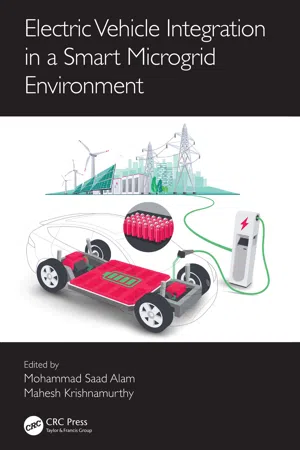
Electric Vehicle Integration in a Smart Microgrid Environment
eBook - ePub

Electric Vehicle Integration in a Smart Microgrid Environment

  1. 362 pages
  2. English
  3. ePUB (mobile friendly)
  4. Available on iOS & Android
eBook - ePub

Electric Vehicle Integration in a Smart Microgrid Environment

About this book

Electric Vehicle Integration in a Smart Microgrid Environment

The growing demand for energy in today's world, especially in the Middle East and Southeast Asia, has been met with massive exploitation of fossil fuels, resulting in an increase in environmental pollutants. In order to mitigate the issues arising from conventional internal combustion engine-powered vehicles, there has been a considerable acceleration in the adoption of electric vehicles (EVs). Research has shown that the impact of fossil fuel use in transportation and surging demand in power owing to the growing EV charging infrastructure can potentially be minimalized by smart microgrids.

As EVs find wider acceptance with major advancements in high efficiency drivetrain and vehicle design, it has become clear that there is a need for a system-level understanding of energy storage and management in a microgrid environment. Practical issues, such as fleet management, coordinated operation, repurposing of batteries, and environmental impact of recycling and disposal, need to be carefully studied in the context of an ageing grid infrastructure. This book explores such a perspective with contributions from leading experts on planning, analysis, optimization, and management of electrified transportation and the transportation infrastructure.

The primary purpose of this book is to capture state-of-the-art development in smart microgrid management with EV integration and their applications. It also aims to identify potential research directions and technologies that will facilitate insight generation in various domains, from smart homes to smart cities, and within industry, business, and consumer applications. We expect the book to serve as a reference for a larger audience, including power system architects, practitioners, developers, new researchers, and graduate-level students, especially for emerging clean energy and transportation electrification sectors in the Middle East and Southeast Asia.

Frequently asked questions

Yes, you can cancel anytime from the Subscription tab in your account settings on the Perlego website. Your subscription will stay active until the end of your current billing period. Learn how to cancel your subscription.
No, books cannot be downloaded as external files, such as PDFs, for use outside of Perlego. However, you can download books within the Perlego app for offline reading on mobile or tablet. Learn more here.
Perlego offers two plans: Essential and Complete
  • Essential is ideal for learners and professionals who enjoy exploring a wide range of subjects. Access the Essential Library with 800,000+ trusted titles and best-sellers across business, personal growth, and the humanities. Includes unlimited reading time and Standard Read Aloud voice.
  • Complete: Perfect for advanced learners and researchers needing full, unrestricted access. Unlock 1.4M+ books across hundreds of subjects, including academic and specialized titles. The Complete Plan also includes advanced features like Premium Read Aloud and Research Assistant.
Both plans are available with monthly, semester, or annual billing cycles.
We are an online textbook subscription service, where you can get access to an entire online library for less than the price of a single book per month. With over 1 million books across 1000+ topics, we’ve got you covered! Learn more here.
Look out for the read-aloud symbol on your next book to see if you can listen to it. The read-aloud tool reads text aloud for you, highlighting the text as it is being read. You can pause it, speed it up and slow it down. Learn more here.
Yes! You can use the Perlego app on both iOS or Android devices to read anytime, anywhere — even offline. Perfect for commutes or when you’re on the go.
Please note we cannot support devices running on iOS 13 and Android 7 or earlier. Learn more about using the app.
Yes, you can access Electric Vehicle Integration in a Smart Microgrid Environment by Mohammad Saad Alam, Mahesh Krishnamurthy, Mohammad Saad Alam,Mahesh Krishnamurthy in PDF and/or ePUB format, as well as other popular books in Technology & Engineering & Electrical Engineering & Telecommunications. We have over one million books available in our catalogue for you to explore.

1 Trends in Electric Vehicles, Distribution Systems, EV Charging Infrastructure, and Microgrids

April Bolduc
S Curve Strategies

Contents

1.1 Introduction: Transportation Electrification Trends
1.2 Distribution System Trends
1.3 Charging Technology Trends

1.1 Introduction: Transportation Electrification Trends

With the rapid growth of transportation electrification, efficient electric vehicle (EV) integration with the grid is becoming exponentially more important. Geographically, China is leading the EV and electric bus market, followed by Europe and then the United States. Automakers continue to accelerate their EV manufacturing efforts to comply with increasingly stringent regulations in these countries. While pandemics like COVID-19 can demonstrate initial delays in manufacturing, the overall impact of such world events is low. By 2022, more than 500 models of EVs will be available globally due to competitive pricing and consumer choice, making EVs attractive to new buyers in the market.1
Passenger EV sales has grown from 450,000 in 2015 to 2.1 million in 2019 as battery prices decrease, battery capacity improves for a longer driving range, the installation of charging infrastructure continues, and EV sales move into new markets. Globally, sales will increase to 8.5 million by 2025, 26 million by 2030, and 54 million by 2040 when over half of all passenger vehicles sold are electric.2
As for the electricity consumption required by this growing technology grows, the rise in EV sales increases the demand for more fast charging stations. If the U.S. reaches its forecasted growth of more than 20 million EVs by 2030, the vehicles could require annual energy consumption of 93 terawatt-hours (TWh).3 If these vehicles demonstrate larger battery capacities and rates of charge as current automakers are demonstrating, the collective electricity consumption could reach between 58 and 336 TWh annually.4 By 2040, passenger electric cars could consume 1,290 TWh, while commercial EVs consume 389 TWh and electric buses consume 216 TWh.5
1 BNEF https://about.bnef.com/electric-vehicle-outlook/.
2 BNEF https://about.bnef.com/electric-vehicle-outlook/.
3 EEI/IEI, November 2018, EV Sales Forecast and the Charging Infrastructure Required through 2030.
4 National Renewable Energy Laboratory, 2018, Electrification Futures Study: Scenarios of Electric Technology Adoption and Power Consumption for the United States.
5 BNEF https://about.bnef.com/electric-vehicle-outlook/.
To prepare the electric grid to support such a need, there is much being done across the globe. Key drivers for such support include policy requirements for regions to reduce pollution and meet air quality goals and recognition of EV electricity consumption as an opportunity by the electric power industry to sustain electric load growth reduced by energy efficiency. Additionally, the demonstrated ability of grid-integrated technologies such as smart microgrids and managed charging is needed to smooth the grid transition to accommodate this load – even for the most congested grids with intermittent power supply across the globe.
The grid must be able to integrate this technology while meeting both the capacity needs of transportation electrification and the need for increased renewable energy to reduce greenhouse gas emissions.

1.2 Distribution System Trends

Many utilities are taking a leading role in facilitating transportation electrification. Trends in increased infrastructure investment, collaboration across utilities, and grid modernization are apparent. Atlas EV Hub tracks the number of U.S. investor-owned utility transportation electrification programs being implemented. By April 2020, almost $3 billion in utility investments were approved or pending approval to support this growth.6 Increasingly, programs have moved from a focus on light-duty EVs to medium- and heavy-duty transportation electrification due to the benefits these vehicles can provide the grid, while at the same time, heavy-duty vehicle charging could require 1 megawatt per charge.
California utilities have made the majority of this investment and are now creating a collaborative 10-year plan across the state’s different utilities that looks to minimize transportation electrification grid impacts and accelerate EV adoption. The state’s climate, air quality, and economic development goals require broad electrification of both passenger and fleet vehicles and require support for the widespread adoption of transportation electrification.7 Over the past decade, numerous utility transportation electrification programs have been filed with their regulating body, the California Public Utilities Commission, in number and scale. During this time, the regulator assessed the utility programs that did not contain transportation infrastructure deployment planning strategies or projections on how to include incremental transportation electrification load into their distribution and transmission systems. Therefore, they proposed a ā€œtransportation electrification frameworkā€ requiring the utilities to develop an overarching 10-year plan that details investments in transportation electrification infrastructure.8
6 Atlas EV Hub, 2020. Utility Filings Dashboard. www.atlastevhub.com.
7 California Senate Bill 350, DeLeon, 2015.
8 https://docs.cpuc.ca.gov/PublishedDocs/Efile/G000/M326/K281/326281940.PDF.
The goal of this framework is to create a process that best harnesses lessons learned from past regulator proceedings, research, and transportation electrification efforts taking place in the state, as well as create a competitive market. Such a 10-year plan can provide guidance and standardize the key components of transportation electrification programs, such as charging vendor criteria, open access, cybersecurity, safety, and the length of time a utility should take to interconnect EV charging infrastructure. Most importantly, a plan like this can encourage utilities to collaborate across their distribution planning departments to assess the research from EV charging pilots from within their territories and across the globe to more fully understand the possible impacts of increasing the load from EVs and how to best use technology to integrate these efforts with the grid.
An example of such a collaboration is the West Coast Clean Transit Corridor Initiative in the U.S. made up of nine electric utilities and two agencies representing more than two dozen municipal utilities that worked together to develop a study to electrify 1,300 miles of interstate from the Mexican to the Canadian border for freight haulers and delivery trucks.9 The study proposes a phased approach that could lead to significant reductions of pollution from freight transportation along the Pacific Coast providing a roadmap for electric utilities to electrify transportation in a coordinated fashion. The first phase would involve installing 27 charging sites along Interstate-5 at 50-mile intervals for medium-duty EVs, such as delivery vans, by 2025. A second phase would expand 14 of the 27 charging sites to also accommodate charging for electric big rigs by 2030 when it is estimated that 8% of all trucks on the road in California could be electric. Of the 27 proposed sites, 16 are in California, 5 in Oregon, and 6 in Washington. The study also demonstrated that an additional 41 sites on highways connecting to Interstate-5 should be considered for electrification.
Near- and long-term distribution planning such as this can help determine the number of shovel-ready charging infrastructure locations vs. those that will trigger expensive distribution upgrades. For example, a transit agency converting its fleets to electric buses over time could trigger the need for a new substation upgrade.10 For a majority of grids, improving the modeling and transparency into a distribution system’s hosting capacity can provide visibility of gaps in grid infrastructure when aligned with possible charging site locations. This visibility supports charging infrastructure deployment in regions where the incremental load would not trigger distribution system upgrades, and where load management technology could defer otherwise necessary upgrades.
While these gaps are identified and modeled by grid modernization planning departments, parallel efforts can be performed to design charging infrastructure programs in distribution system locations where the grid currently has the capacity and where costly upgrades can be avoided. The advancement of smart charging technology and the implementation of these efforts in EV charging infrastructure is one of the best ways to reduce distribution impacts.
9 West Coast Clean Transit Corridor Initiative: Interstate 5 Corridor California, Oregon, Washington, June 2020, www.westcoastcleantransit.com.
10 https://ww2.arb.ca.gov/rulemaking/2018/innovative-clean-transit-2018.

1.3 Charging Technology Trends

The global EV charging infrastructure market is projected to reach $140 billion by 2030 and grow at an estimated annual rate of 31%.11 Germany, home to major automakers such as Volkswagen, BMW, and Mercedes, significantly propelled their demand for EV charging infrastructure by passing a policy to ban internal combustion engines by 2030. Such a rapid pace of adoption will be assisted by charging innovation and the ability to both manage charging loads and reduce on-peak charging by incentivizing drivers to shift their charging time when there is the most capacity on the grid. For drivers to participate in any such advancement technology, the ease of use for the driver or commercial fleet operator must not be hindered.
Standardization of charging technology accessibility and interoperability is a growing trend. The way the first EV charging technologies in China and the U.S. evolved are broadly similar, but fast charging in China has one standard, known as China GB/T, while the U.S. has three EV fast charging standards: CHAdeMO, SAE Combo, and Tesla.12 Considerations around charging options for EV owners include the ease in accessibility at the place and time it is needed and that it is competitively priced.
EVs are often compared to the phenomenon of rooftop solar installations and frequently cluster in a particular neighborhood as awareness grows about the benefits of the technology, leading to increased adoption. Utility EV time-of-use rates are made available only to those with an electric car. Until recently, they have been the only mechanism to encourage off-peak charging. Incentivizing drivers with lower rates to charge at times of the day when there is more capacity on the grid has proven eff...

Table of contents

  1. Cover
  2. Half Title
  3. Title Page
  4. Copyright Page
  5. Table of Contents
  6. Foreword
  7. Preface
  8. Editors
  9. Contributors
  10. Chapter 1 Trends in Electric Vehicles, Distribution Systems, EV Charging Infrastructure, and Microgrids
  11. Chapter 2 Fog Computing for Smart Grids: Challenges and Solutions
  12. Chapter 3 Opportunities and Challenges in Electric Vehicle Fleet Charging Management
  13. Chapter 4 Challenges to Build a EV Friendly Ecosystem: Brazilian Benchmark
  14. Chapter 5 Coordinated Operation of Electric Vehicle Charging and Renewable Power Generation Integrated in a Microgrid
  15. Chapter 6 Energy Storage Sizing for Plug-in Electric Vehicle Charging Stations
  16. Chapter 7 Innovative Methods for State of the Charge Estimation for EV Battery Management Systems
  17. Chapter 8 High-Voltage Battery Life Cycle Analysis with Repurposing in Energy Storage Systems (ESS) for Electric Vehicles
  18. Chapter 9 Charging Infrastructure for Electric Taxi Fleets
  19. Chapter 10 Machine Learning-Based Day-Ahead Market Energy Usage Bidding for Smart Microgrids
  20. Chapter 11 Smart Microgrid-Integrated EV Wireless Charging Station
  21. Chapter 12 Shielding Techniques of IPT System for Electric Vehicles’ Stationary Charging
  22. Chapter 13 Economic Placement of EV Charging Stations within Urban Areas
  23. Chapter 14 Environmental Impact of the Recycling and Disposal of EV Batteries
  24. Chapter 15 Design and Operation of a Low-Cost Microgrid-Integrated EV for Developing Countries: A Case Study
  25. Index