Exploring the practices developed by remote teams to maintain trust across cultures, this book offers both theoretical and practical resources to enable better working in challenging contexts of project work. This book emphasizes building trust between team members from a practice perspective, meaning patterns of collective, shared activities that are produced and reproduced within the virtual team with the purpose of developing team trust.
The author explores the trust practices that members of remote project teams use to describe their relationships and interactions. Team trust practices are powerful organizational tools for members of remote cross-cultural teams, influencing team decision-making and facilitating team effectiveness. This book offers extensive descriptions of team practices that build and maintain trust in virtual teams in two different cultures: Germany and Singapore. This is a unique contribution as it offers case studies from project teams that were observed and interviewed during their work and provides readers an in-depth, contextual analysis of the trust practices that virtual project teams develop, which previous research has overlooked.
This book will appeal to researchers and graduate students in MBA programs studying project management, human resource management, and strategic leadership. This book is also of direct interest to many practitioners, particularly management consultants and project managers of virtual, cross-cultural, and interdisciplinary project teams.
Building and maintaining trust is critical in remote teams from the beginning. This book explores the processes and practices that remote teams develop to build and maintain trust across cultures.
Because of the inherent uncertainty and complexity of remote teamwork and the fact that not every team task can be monitored or predicted, successfully accomplishing team tasks and project objectives requires trust. But trust is not effortless or uncomplicated, rather trust must be carefully built and maintained. Building teams on trust heightens well-being and productivity – employees are happy at work and perform well. Trust helps everyone suspend their uncertainty about information, relationships, and complexity, and enables them to relate positively in spite of uncertainty and risk.
Without risk and interdependence trust would not be necessary. Trust is the process of balancing between risk and interdependence in remote teams. But how do team members collectively achieve this balance? What meaning do they give to their interactions? And how are trust interactions maintained and reproduced? The purpose of this book is to answer these questions from a social practice perspective – in terms of patterns of activities that build and maintain trust.
Why remote teams? Risk, uncertainty, and interdependence characterize the complex environment of remote teams, and these aspects are preconditions of trust development and maintenance (Möllering 2006). Remote project teams develop new products, organizational processes, or information systems for internal or external customers, within specific time, quality, and cost constraints (Zolin et al. 2004; Loehr 2015). These characteristics make trust both more relevant and more complicated to achieve.
With this book we want to theoretically explore an alternative conceptualization of trust in remote teams from a practice perspective, and empirically illustrate (1) how trust practices are produced and reproduced in team interactions through the processes of signaling, interpreting, negotiating, and cooperating; and (2) what remote teams do to build and maintain trust (e.g., practices of creating rules of communication, sharing, and rotating power, and checking for common understanding) as well as the cultural preferences and variations mentioned with these practices.
Limited research exists on how virtual teams build and maintain trust in practice, and on the meanings and interpretations that team members and project managers ascribe to trust (Dumitru 2015; Dumitru and Schoop 2016). Much is known about how team members gather and signal trustworthy information but not how they interpret this information in interaction. Researchers usually conceptualize trust in teams as shared beliefs of trustworthiness or collective sets of expectations (Costa, Fulmer, and Anderson 2017), disregarding that trust in teams takes different forms and meanings according to context. Most of the knowledge we have about trust in remote teams comes from quantitative and experimental designs, creating a lack of qualitative field research that could contribute a comprehensive and context-specific view of trust in remote teams (Patton 2002).
With this book we address these research gaps not only by looking at what team members believe, but also by observing how they interact, and most importantly, how they interpret their interactions. What activities do team members engage in to build and maintain trust? And how do they produce and reproduce trust in team interactions? What are their cultural variations and preferences? Answering these questions provides a richer understanding of how remote teams experience trust, and how team interactions produce and reproduce them through different processes and in different cultural contexts.
1.2 Organization of the book
In this chapter we present the goals, the context, and the challenges of remote project teams. We highlight the main research objectives as well as the context of this research: virtual project teams. Why is it challenging for virtual teams to function? What are their distinctive features that make them unique? And how do virtual teams develop?
Chapter 2 reviews the theoretical models adopted to study and measure trust in teams, their assumptions as well as their main drawbacks. In this chapter we introduce an alternative approach of conceptualizing trust in teams as a social practice, including team interactions and organizational embeddedness. The social practice approach offers a complex view of trust by incorporating meaning and interaction through the processes of signaling, interpreting, negotiating, and cooperating. We present an in-depth analysis of how these processes emerge and are perpetuated in three team interactions – establishing rules of communication, developing a strategy to manage client expectations, and adapting the project reporting tool.
In Chapter 3 we present a theoretical overview of cultural dimensions theory, the most widely applied theory in intercultural management and organizational research, and we discuss the relationship between trust and culture. Then we analyze team case studies from Germany and Singapore and explore what virtual teams do to build and maintain trust (e.g., practices of creating rules of communication, sharing and rotating power, checking for common understanding) and the cultural preferences and variations mentioned in these practices. Our findings help us better understand trust practices in cultural contexts.
Chapter 4 offers a summary and a discussion on the theoretical and practical implications of adopting a practice perspective for studying trust in virtual teams. This research also demonstrates the cultural preferences and variations of trust practices and presents implications for designing team interventions and kick-off workshops.
1.3 Characteristics and challenges of remote teams
Remote teams – also known as virtual teams, distributed teams, or geographically dispersed teams – are a dynamic and complex context of organizing characterized by technologically mediated communication (Jarvenpaa, Knoll, and Leidner 1998; Crisp and Jarvenpaa 2013). Researchers define remote teams as “a group of geographically, organizationally and time dispersed workers brought together by information and telecommunication technologies to accomplish one or more organizational tasks” (Powell, Piccoli, and Ives 2004).
Many organizations choose this form of organizing because of the efficiency and the diversity of people from different cultures and professional backgrounds. Transcending time and space with the use of technology, remote teams work across the world and around the clock delivering fast and innovative products and services. The diversity by design of remote teams means collaboration is enabled between different departments, organizational positions, occupations, and cultures. Gibson and Cohen (2003) note that the competitive advantages of remote teams include cost and time efficiency, complexity, innovation, and organizational learning.
Cost efficiency is probably the most important advantage brought to organizations by remote teams. Mediated by technology, remote teams reduce the cost and time it takes to develop and implement products and strategies because team members do many of the tasks concomitantly across time and space without ever meeting in person. For example, for new product development projects establishing a remote team of skilled developers from different parts of the world reduces the cost and time spent on the development cycle.
Complexity refers to the ability of remote teams to solve complex business problems that transcend disciplines, functions, and cultures. By providing the technological structure of bringing together professionals such as scientists and engineers from different parts of the world and with a diverse set of skills, remote project teams allow organizations to develop complex products and services. More innovative and complex products and services result from the interaction of diverse skilled team members within a remote project team.
Innovation is a direct consequence of bringing together team members with diverse skill sets, experiences, and cultural backgrounds. Although this diversity can be difficult to manage for the organization, the increased capacity for creative output outweighs the potential risks. Remote teams embody the positive features of the informal organization because they provide the opportunity for creative expression. Usually characteristic of small companies and start-ups, remote teams become a great environment for aligning the needs of the organization for creativity and new product and strategy development. Additionally remote teams also satisfy the needs of creative, skilled team members to use their ideas and promote collaborative learning.
Performance and organizational learning are direct outcomes of this collaborative endeavor that is going on in remote teams. Much like “a learning community” team members are able to develop new technical, professional, cultural skills, and learn about other disciplines and practice working with colleagues who have a different skill set, working style, and cultural background. This interaction with colleagues from different cultures and departments across the world offers an immense individual and organizational opportunity to develop in multiple areas and topics.
The appeal of remote teams revolves around the ideas of efficiency, diversity, and innovation, namely, that technology enables interaction between people with different knowledge and world views essential for creative and effective team performance.
But the unique characteristics and competitive advantages that make remote teams interesting for organizations also pose challenges. Often the full potential of remote teams is difficult to tap. Empirical evidence demonstrates that the high level of risk and interdependence associated with remote teams can hinder their functioning (Kozlowski and Bell 2003). The challenges that remote teams encounter have to do with their characteristics, i.e., technological complexity, extensive diversity, information ambiguity, and multiple reporting.
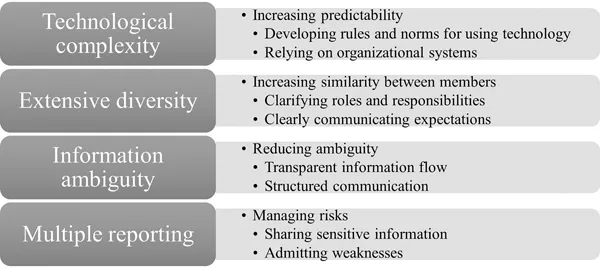
We propose that an effective strategy to alleviate the challenges that remote teams face is by building and maintaining trust. Researchers have demonstrated that by increasing predictability and similarity, and managing ambiguity and risk, trust is an organizational resource vital for remote teams. Figure 1.1 offers an overview of the main challenges that remote teams face and the mechanisms by which trust helps to overcome them.
Figure 1.1 Managing Challenges of Remote Teams by Building Trust.
Relying on technology for communication is a specific characteristic of remote teams that distinguish them from other types of teams. Technological complexity refers to how remote teams use collaborative technology to work and connect (Gibson and Cohen 2003). Through technology remote teams bring together specialists from different cultures and regions with a diverse set of skills, enabling organizations to develop complex products and systems. But skills in using technology differ and also the type of technology used differs according to the type of project or task. Remote team members and project managers must therefore develop strategies for dealing with technological complexity.
While organizational tools and technology training are important to manage technological complexity, trust helps team members manage technological complexity by developing norms and increasing predictability in using technology (e.g., how often members should check email, how fast their response time). Remote teams cannot take for granted that every team member is competent in one technology (this must be discussed and established from the start) and also which technology to use for which type of task and project. For example...
Table of contents
Cover
Half Title
Series Page
Title Page
Copyright Page
Dedication
Table of Contents
List of illustrations
Acknowledgments
1 Introduction
2 Building and maintaining trust in remote teams
3 Trust and culture in remote project teams
4 Discussion
Appendix 1 Observation sheet
Appendix 2 Interview guide
Appendix 3 Case studies
Index
Trusted by 375,005 students
Access to over 1.5 million titles for a fair monthly price.
Study more efficiently using our study tools.
Frequently asked questions
Yes, you can cancel anytime from the Subscription tab in your account settings on the Perlego website. Your subscription will stay active until the end of your current billing period. Learn how to cancel your subscription
No, books cannot be downloaded as external files, such as PDFs, for use outside of Perlego. However, you can download books within the Perlego app for offline reading on mobile or tablet. Learn how to download books offline
Perlego offers two plans: Essential and Complete
Essential is ideal for learners and professionals who enjoy exploring a wide range of subjects. Access the Essential Library with 800,000+ trusted titles and best-sellers across business, personal growth, and the humanities. Includes unlimited reading time and Standard Read Aloud voice.
Complete: Perfect for advanced learners and researchers needing full, unrestricted access. Unlock 1.5M+ books across hundreds of subjects, including academic and specialized titles. The Complete Plan also includes advanced features like Premium Read Aloud and Research Assistant.
Both plans are available with monthly, semester, or annual billing cycles.
We are an online textbook subscription service, where you can get access to an entire online library for less than the price of a single book per month. With over 1.5 million books across 990+ topics, we’ve got you covered! Learn about our mission
Look out for the read-aloud symbol on your next book to see if you can listen to it. The read-aloud tool reads text aloud for you, highlighting the text as it is being read. You can pause it, speed it up and slow it down. Learn more about Read Aloud
Yes! You can use the Perlego app on both iOS and Android devices to read anytime, anywhere — even offline. Perfect for commutes or when you’re on the go. Please note we cannot support devices running on iOS 13 and Android 7 or earlier. Learn more about using the app
Yes, you can access Building Virtual Teams by Catalina Dumitru in PDF and/or ePUB format, as well as other popular books in Business & Business General. We have over 1.5 million books available in our catalogue for you to explore.