Musical Sincerity and Transcendence in Film focuses on the ways filmmakers treat music reflexively—that is, draw attention to what it is and what it can do. Examining a wide range of movies from recent decades including examples from Indiewood, teen film, and blockbuster cinema, the book explores two recurring ideas about music implied by foregrounded musical activity on screen: that music can be a potent means of sincere expression and genuine human connection and that music can enable transcendence of disenchantment and the mundane. As an historical musicologist, Timothy Cochran explores these assumptions through analysis of musical style, aesthetic implications, and narrative strategy while treating the ideas as historically-grounded and culturally-situated with conceptual origins often lying outside of film. The book covers eclectic critical terrain to highlight various layers of musical sincerity and transcendence in film, including the nineteenth-century aesthetics of E.T.A. Hoffmann, David Foster Wallace's literary resistance to irony (sometimes called the New Sincerity), strategies of self-revelation in singer-songwriter repertoires, Lionel Trilling's distinction between sincerity and authenticity, theories of play, David Nye's notion of the American technological sublime, and Svetlana Boym's writings on nostalgia. These lenses reveal that film is a way of perpetuating, revising, and critiquing ideas about music and that music in film is a potent means of exploring broader social, emotional, and spiritual desires.
- 204 pages
- English
- ePUB (mobile friendly)
- Available on iOS & Android
eBook - ePub
About this book
Information
1 Enduring romanticism
Spirit-realms, mass-mediation, and the New Sincerity
The text for Franz Schubert’s famous Lied “An die Musik” (1817) frames music as a sonic catalyst of ecstatic imagination capable of lifting listeners out of the tragic present. Schubert sets the first stanza’s description of such transport to a rising melody line that treats music’s “better world”1 as the climax of heightening desire. This yearning melodic ascent enables performers to enact and listeners to feel the text’s philosophy of musical escapism (Example 1.1). Although melodic intensification was a common tool for expressing desire and striving for transcendence in nineteenth-century music, “An die Musik” is noteworthy for its reflexive text, which addresses music directly from within the artform itself. The song is not only a means of experiencing longing musically but also an aesthetic statement that creates awareness of music’s transportative capacity.
When Schubert’s Lied appears in the background of a scene from Wes Anderson’s Moonrise Kingdom (2012), music has already been defined in the film as a means of mental escape, and Schubert’s music reinforces that philosophy. Having just been caught running away with her boyfriend Sam, twelve-year-old Suzy is bathed by her mother, whom she claims to hate. Schubert’s Lied, which plays somewhere in the house, serves spectators familiar with the song as both a symbol of the preteen’s desire to be “carried away” again and a validation of music as a source of desire and transcendence. The self-conscious Lied thus assumes a second layer of reflexivity in the scene as diegetic music comments implicitly on its own power for the young protagonist.
But something odd happens in these nested references to romantic musical aesthetics: the Lied is abbreviated then restarts midway through the scene as a different recording by apparently different performers of a different arrangement. What had begun as a version of Schubert’s song for mixed voices—likely played diegetically by Suzy’s classical-music-appreciating brothers—is replaced by a recording taken from the French film Comme une image (2004)2 that features a shaky female soloist. Moreover, the vocal description of music’s “better world” is replaced by effusive strings that treat the phrase in sequence, an edit of Schubert’s music not reflected in the version on the soundtrack recording. The doubled music with timbral variations creates a rift in continuity that exposes Suzy’s intertextual dependence on preexisting recordings, which leaves her desire for escape vulnerable to alteration or termination with the turn of a knob on the children’s toy record player. Despite the technological mediation of Suzy’s longing, we might also read the change of recordings paradoxically as a disclosure of genuineness. Insofar as “An die Musik” articulates Suzy’s internal longing extrinsically, we can hear progress from the refined version of “An die Musik” to a raw iteration as contrasting layers of Suzy’s selfhood brought to spectatorial consciousness through discontinuity: surface versus depth, constructed versus authentic, polished versus real. This impression of genuineness is reinforced by the string edit which aligns with Suzy’s matter of fact but personal statement: “We’re in love.” The aesthetic yearning of Schubert’s music is thus presented subtly in this scene as both a fantasy to be undercut and a sign of sincerity.
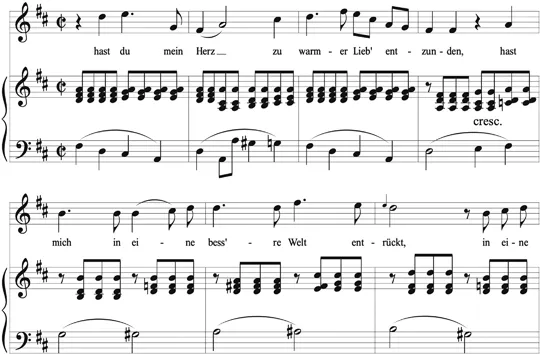
Example 1.1Franz Schubert, “An die Musik,” D. 547, mm. 11–17. Reprint permission rights are granted by LudwigMasters Publications, Inc. Used by Permission. All rights reserved.
Film scores have often been used to create powerfully immersive fantasies of transport like those described in Schubert’s Lied, what Caryl Flinn calls film music’s “utopian function” (1992, 9); but Moonrise Kingdom demonstrates that when these roles are highlighted in film worlds, they ask us to question, reinterpret, and often revalidate music’s transportative power for the present age. If, as Peter Franklin maintains for non-diegetic scoring, “film may be as much about revealing the meaning of music as music being used to explain and provide continuity for cinematic narrative” (2014, 132), then moments in which spectators become aware of music as transcendent escape offer especially rich opportunities to explore how traces of nineteenth-century musical aesthetics continue to appear in film contexts. A still richer claim can be made: implicit revivals of past romantic thought in moments of on-screen listening provide films with mechanisms for exploring and expressing particular cultural values of our own time. Examining the ways source music has been framed as a numinous power of utopian transport in select films of the past thirty years, this chapter will examine how film references to musical experiences interrogated by romantic authors are often means of negotiating late-twentieth-century longing for sincerity amid postmodern irony. Moments of disclosure—like the odd doubling of Schubert’s music in Moonrise Kingdom—reveal how filmmakers continue to frame aspects of romanticism not only as a means of re-enchantment but also as tools for navigating the emotional terrain of honesty, intersubjectivity, and expression in the face of (and sometimes in partnership with) the mediating forces of irony.
Odes to music
Film music historians often comment on the stylistic continuity between late-nineteenth-century symphonic and operatic writing and Hollywood film scores of the 1930s and 1940s (e.g., Steiner, Korngold) (Franklin 2014, 113) as well as the revival of these techniques in the 1980s (e.g., John Williams). The parallels between cinema’s musical means of narration and symphonic poems or Wagnerian music dramas are easy to detect: leitmotivic associations and transformations, “recitative-style underscoring” provided by a string-dominated orchestra in a tonal framework (Cooke 2008, 78),3 and topical significations of heroism and desire, to name a few correlations. Mervyn Cooke suggests that the commercial success of late-romantic styles in Hollywood cinema may be attributed to the use of such techniques in silent film accompaniments of the preceding era (a cinematic bridge between Wagner and Korngold, so to speak) and the communicative efficiency of well-known stylistic associations (2008, 79). Conversely, Richard Taruskin proposes that the success of romantic-era styles in the cinema was not due to their heritage per se but rather the failure of modernism and the way “the ‘serious’ arts […] had lost their ability to communicate with any but snob audiences” (2005b, 552–553). Caryl Flinn offers yet another perspective: that Hollywood sought a “restored plenitude and unity” in the past via romanticism, which had itself involved expressing “desire to exceed contemporary experience, to get beyond the sense of social, economic, and subjective fragmentation or impotence” (1992, 49–50).
Regardless of which historical factor(s) most influenced nineteenth-century music’s afterlife in film, Flinn’s emphasis on the desire for transcendence in the film/romanticism connection is intriguingly holistic as she suggests that not only did composers in the Classic Hollywood tradition borrow musical style and technique from the past; but they also appropriated a philosophical emphasis on music’s power to produce escapist fantasies (1992, 9, 91). The word romantic can refer to a music-historical style period (i.e., the romantic era) as well as a mode of thought and aesthetic assumptions informing nineteenth-century arts and philosophy (i.e., romanticism). Flinn (1992) implies that the two definitions coalesce in traditional Hollywood film scoring. Using language that recalls the text of “An die Musik,” Flinn argues that Hollywood filmmakers have frequently adopted the assumption stemming from romantic aesthetics that music “reveals glimpses of a better, more unified world (or a more profound experience of our own); […] unveils universal truths or essences and opens doors to exotic situations or lands; and […] capture[s] the sense of lost integrity and grandeur” (91). Just as the rising melody of “An die Musik” draws us to reach with the narrator toward “better worlds,” so does music often serve a utopian end in film: it transports spectators emotionally, cultivating desire and fantasy through suggested subject-positions.4
Flinn’s term “utopian function” implies that film composers have historically relied on a calculated musical enchantment of the film experience, but as Flinn’s analyses of music-driven flashbacks in 1940s films demonstrate, characters on screen are just as susceptible to the utopian promises of music as spectators.5 Likewise, various films of the last thirty years demonstrate by highlighting the phenomenology of musical escape reflexively that romantic ideas about musical transport have a reception history beyond film scoring as objects of interrogation and vehicles of expression within film worlds. Film provides a forum in which aspects of romanticism (often detached from romantic-era style) can be investigated and reconfigured for the present. To establish the philosophical foundation for tropes of romantic listening in film, we need to examine the notion of musical transport as it was articulated by late-eighteenth and early-nineteenth-century authors.
“An die Musik’s” commentary on the musical experience reflects its surrounding philosophical climate in which authors like Wilhelm Heinrich Wackenroder and E.T.A. Hoffmann explored music’s power to lift the listener out of mundane, commercialized, rationalized, and language-driven life (Riou 2004, 43; Hamilton 2008, 121–122, 128; Bowie 2009, 247). In an essay published in Wackenroder’s Phantasien über die Kunst (1799) entitled “The Marvels of the Musical Art,” composer Joseph Berglinger esteems music’s power to carry him mentally into an ideal euphoric place that transcends prosaic existence, an attitude that Flinn claims as a pillar of romanticism:6
While others quarrel over invented troubles, or play a desperate game of wit, or brood in solitude misshapen ideas which, like the armor-clad men of the fable, consume themselves in desperation;—O, then I close my eyes to all the strife of the world—and withdraw quietly into the land of music, as into the land of belief, where all our doubts and our sufferings are lost in a resounding sea,—where we forget all the croaking of human beings, where no chattering of words and languages, no confusion of letters and monstrous hieroglyphics makes us dizzy but, instead, all the anxiety of our hearts is suddenly healed by the gentle touch.—And how? Are questions answered for us here? Are secrets revealed to us?—O, no! but, in the place of all answers and revelations, airy, beautiful cloud formations are shown to us, the sight of which calms us, we do not know how;—with brave certainty we wander through the unknown land.(Wackenroder 1971, 179)
In this ode to music, Berglinger avows a musical utopianism shared with “An die Musik,” presenting music as an ideal place free of the ironies, anxieties, and confusions marking communication in normal life. By focusing on a metaphorical location within the listener, Wackenroder is able to frame music as both the catalyst and destination of plenitude. Yet this musical place is more dream than solid ground insofar as its visitors are wanderers who seek answers but find something better than explanations (“the croaking of human beings”): an ineffable calm made possible through aesthetic encounter. John Hamilton notes that elsewhere in Wackenroder’s writings, “Music […] promises a utopian nonverbal language: a language of immediacy, free of all the mechanisms that pose a barrier to one’s experience, free of syntax, semantics, and grammar” (2008, 128). Berglinger’s definition of music as a sonically accessible yet mysterious place (Watkins 2011a, 33) that remaps human language and phenomenology affirms music’s utopian function as an inherent quality of the artform.
Wackenroder’s depictions of musical immediacy have a dark countercurrent that one may not typically associate with the utopian function of Classic Hollywood film scoring. As Richard Littlejohns notes, Wackenroderian musical escape carries “disquieting and ultimately traumatic potential” (2004, 7) insofar as music marshals a sublime, possessive power without moral grounding (2): “to abandon oneself to this ambiguous force is to surrender self-direction and risk possession by an alien power offering aesthetic blandishments that are beyond ethical restraint and ultimately destabilizing” (8). Littlejohns (2004) highlights such instability in the concluding chapter of Phantasien, “A Letter by Joseph Berglinger,” where Berglinger calls the emotional and moral benefit of transportative listening into question (5–6). The character laments “to what foolish thoughts the wanton musical strains can catapult me, with their alluring sirens’ voices” (Wackenroder 1971, 196). Ironically, the land of music appears to be more prison than paradise in these parting reflections. Wackenroder’s (1971) account of Berglinger’s life from an earlier literary collection also emphasizes the threatening control of music over the fictional composer’s mind: he describes emotional withdrawal symptoms that imply the addictive properties of music (150) and frames another ode to music as the outpouring of Berglinger’s obsessive ambitions to become an accomplished composer (152–153). Music’s power to possess and transport makes it a spiritually wondrous yet potentially fearsome, unhealthy, and socially alienating force (Littlejohns 2004, 5–6; Hamilton 2008, 128–129).7
A related narrative trajectory with equivalent metaphors of transport, interiority, and place dominates E.T.A. Hoffmann’s Kreisleriana, another early romantic literary reflection on music’s power published within the larger Fantasiestücke in Callot’s Manier (1814–1815).8 In Kreisleriana, the fictional musician Johannes Kreisler reflects fragmentarily on music’s offer of transcendence in a world of commerce and lowbrow entertainment:
What an utterly miraculous thing is music, and how little can men penetrate its deeper mysteries! But does it not reside in the breast of man himself and fill his heart with its enchanting images, so that all his senses respond to them, and a radiant new life transports him from his enslavement here below, from the oppressive torment of his earthly existence?(Hoffmann 1989, 88)
Kreisler articulates a Berglinger-like binary between the restrictive present and heavenly enchantment of musically navigated interiority. Abigail Ch...
Table of contents
- Cover
- Half Title
- Series Page
- Title Page
- Copyright Page
- Dedication
- Contents
- List of figures
- List of music examples
- Acknowledgments
- Introduction: Musical reflexivity
- 1 Enduring romanticism: Spirit-realms, mass-mediation, and the New Sincerity
- 2 The sounds of sincerity: Hearing post-irony in Indiewood film
- 3 On social alienation and the promises of music
- 4 Performing on musical playgrounds
- 5 “I’m afraid you’re just too darn loud”: The music technological sublime in film
- 6 Searching for lost time in Debussy’s “Clair de lune”
- Epilogue
- Works cited
- Index
Trusted by 375,005 students
Access to over 1.5 million titles for a fair monthly price.
Study more efficiently using our study tools.
Frequently asked questions
Yes, you can cancel anytime from the Subscription tab in your account settings on the Perlego website. Your subscription will stay active until the end of your current billing period. Learn how to cancel your subscription
No, books cannot be downloaded as external files, such as PDFs, for use outside of Perlego. However, you can download books within the Perlego app for offline reading on mobile or tablet. Learn how to download books offline
Perlego offers two plans: Essential and Complete
- Essential is ideal for learners and professionals who enjoy exploring a wide range of subjects. Access the Essential Library with 800,000+ trusted titles and best-sellers across business, personal growth, and the humanities. Includes unlimited reading time and Standard Read Aloud voice.
- Complete: Perfect for advanced learners and researchers needing full, unrestricted access. Unlock 1.5M+ books across hundreds of subjects, including academic and specialized titles. The Complete Plan also includes advanced features like Premium Read Aloud and Research Assistant.
We are an online textbook subscription service, where you can get access to an entire online library for less than the price of a single book per month. With over 1.5 million books across 990+ topics, we’ve got you covered! Learn about our mission
Look out for the read-aloud symbol on your next book to see if you can listen to it. The read-aloud tool reads text aloud for you, highlighting the text as it is being read. You can pause it, speed it up and slow it down. Learn more about Read Aloud
Yes! You can use the Perlego app on both iOS and Android devices to read anytime, anywhere — even offline. Perfect for commutes or when you’re on the go.
Please note we cannot support devices running on iOS 13 and Android 7 or earlier. Learn more about using the app
Please note we cannot support devices running on iOS 13 and Android 7 or earlier. Learn more about using the app
Yes, you can access Musical Sincerity and Transcendence in Film by Timothy B. Cochran in PDF and/or ePUB format, as well as other popular books in Media & Performing Arts & Music. We have over 1.5 million books available in our catalogue for you to explore.