My friend, I do not believe you are a racist.
Melvin Gravely eloquently accomplishes what many have undoubtedly wished to do: talk openly to someone we know about race in the United States today. Gravely uses significant experience as a business and civic leader to express a rare balance in this timely message. Dear White Friend is a forthright, collegial conversation via chapters in the form of letters, each with a combination of personal reflection and meaningful hard facts. Gravely challenges the reader but without judgment or indictment. His depth of thought, deftness of expression, and clear, layman’s terms make for an urgent call to begin to close the gap between races in America. The book presents an invitation to understand three questions at the heart of the issue: What is really going on with race in our country? Why must we care? And what can we do about it together? In the end, Gravely calls on us to ask ourselves, “What is my role in all of this?” After reading Dear White Friend, readers will understand why their answer to his question can change everything.
eBook - ePub
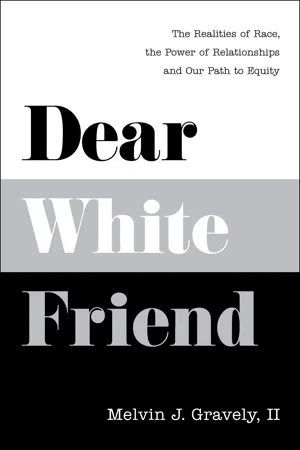
Dear White Friend
The Realities of Race, the Power of Relationships and Our Path to Equity
- 193 pages
- English
- ePUB (mobile friendly)
- Available on iOS & Android
eBook - ePub
Dear White Friend
The Realities of Race, the Power of Relationships and Our Path to Equity
About this book
Information
Print ISBN
9781626348769
Subtopic
Social Science BiographiesLetter 1
To My
White Friend
White Friend
We have been friends for over forty-five years. I have always known of you, but I began to know you personally in late August 1976. That’s when I boarded a bus early in the morning and made the hour-long ride around my hometown of Canton, Ohio, picking up Dewon, Fred, Tracy, Carlos, Jill, Chris, Adrian, and the handful of others who were also on their journey to get to know you. I didn’t know my coriders well at the time, but we would form a unique bond over the next three years. We had things in common, but the most obvious was our race. We were all Black, and someone in our lives (in my case, my parents) had decided we would not go to the predominately Black junior high school a fifteen-minute walk from home. Instead, we would take this hour-long bus ride to your school, Lehman Junior High. We were coming to your school because apparently it was good, and our school was bad. It would not be the last time I received that not-so-subtle message.
Lehman Junior High was a former high school that I always thought had a strange design. In front of the building was a football field with oversized concrete stands for seating. It was a large school that sat up on a hill. The dark weathering on the school’s brick walls made it look even bigger and a bit ominous.
The whole experience of going to Lehman was unnerving. We were entering a place with people we didn’t know who had a set of norms and expectations we would be unfamiliar with, and more than likely completely unaware of. I recall the now-familiar feelings as we walked in for the first time. They were feelings of not belonging, of not sharing a history, and of being primarily defined by my race. I would experience those feelings many times over the years, and would eventually learn to manage them.
• • •
Attending Lehman Junior High School began my indoctrination into your world. From early on, I learned how to be with you. How to navigate through the narrow passage of being Black (because that was obvious), yet not that Black. Not the Black you see as bad and angry and “less than.” Instead, I had to learn how to be if I wanted access to you—your influential relationships, scholarships, recognition, leadership roles, and acceptance in general. Thus, no one wanting to be welcomed into your world talked about race. I, likely unconsciously, made the decision to focus on achievement and therefore play by your rules and align with your expectations. I decided to assimilate.
Before you and I met, I lived in a majority Black world with Black neighbors, Black friends, Black fellow students, and Black church members. Of course, we always knew we were Black, but everyone was Black, so we weren’t constantly identified by our race nor reminded about what being Black meant in our society. My context was Black, which meant I lived among people with whom I shared a history, and I fit in. I belonged. I did not have to labor with how to be or govern myself within unspoken boundaries. For example, I did not have to monitor the inflection in my voice. People saw me as intense and spirited and maybe even obnoxious. Yet no one in my Black world thought I was aggressive because of how I expressed myself. I was just me: Little Melvin to my family; Melvin Jr. to our community.
I was not perfect, but I knew there was nothing wrong with me growing up.
• • •
Today, I don’t question my decisions to make accommodations so I could participate in your world. Quite the opposite. I believe my 45-plus-year journey with you makes me uniquely prepared to have this conversation with you now.
Since we met at Lehman Junior High, I have spent most of my days with you and other White friends. Going to class with you. Doing business with you. Attending meetings with you. Solving problems with you. Laughing, eating, and even traveling with you. We have been friends a long time. Still, you may not even understand why race matters so much to me.
My friend, I am writing you because being Black is central to who I am. It frames the context of my life. Yet the taboo nature of race makes it a topic too sensitive for you and me to discuss—to really discuss with candor, vulnerability, and even love. Can we ever be real friends if we cannot have a healthy conversation about what is core to who I am and how we are together? My answer is no! Without figuring out how to talk about the dynamic of White and Black people, we cannot be the kind of friends I want in my life.
I admit to still being uncomfortable talking to you about race. My indoctrination taught me to ignore the subject and its implications—to just keep moving. For forty-five years, I did just that. But today I feel compelled to engage you in this conversation. The problems created by our inability to talk about race transcend you and me. Of course, it costs us in terms of the quality of our relationship, but you and I are just a micro example of a foundational macro problem that costs us all. It reflects our individual and collective inability, unwillingness, or both to have high-quality conversations about who we are, how we got to this place, and what we can do together going forward.
So much of what we see as dysfunction in communities is rooted in our nation’s history with race. It’s a history that we struggle to explore and, in many ways, that we keep repeating. Things like gaps in wealth, education, and healthcare for Blacks. Basic staples of living such as access to healthy food, clean water, and decent housing. The cost of a swelling and expensive criminal justice system with a track record of disproportionately imprisoning Black people. Inequities in hiring, promotions, and compensation, with Black unemployment at often twice the level of Whites.1 There are real reasons these issues exist, yet even more concerning is why they persist. There are systematic challenges we would rather treat as symptoms than explore deeper in an effort to cure the actual illness. The illness is racism— it is not an overstatement to say intentional racism continues to infect every system in our country. I believe that you and I, because we are friends, can have more meaningful discussions about this challenge.
Yet, because we have notable differences in our journeys, we have different perspectives. I have been wanting to talk to you about my perspective for years. I just kept avoiding it. My excuses were weak. “It’s not the right time.” “What I have to say won’t matter.” The truth is I was afraid of how this discussion would change my status and my trajectory for success. So, I accepted and even at times defended the status quo. I accepted the economic and perceived social gains of my choices.
But no more excuses from me. I won’t pretend I am fearless, but I am resolved to share my perspective and to challenge yours. It is not my goal to make you uncomfortable, but your potential discomfort can no longer be the reason we don’t talk about race.
We have broached this conversation before, but only on the edges. In those moments, my thoughts were incomplete, and my message wasn’t clear. I have shared some thoughts, but they were half-formed and unclear and they likely sounded more like complaints. The result is you leave our conversations with “sound bites” of ideas that may not be what really matters or even what I meant to convey. I realize I owe you my honesty (some of which is filled with emotion), but I also owe you my clarity and depth of thought.
I’m still concerned about myself and my brand, but I’m also worried about your reluctance to study and learn our nation’s history in the context of race. I challenge you to reflect on how each brick that built our amazing country is held together by the mortar of racism. I wonder if your own fears underlie your reluctance. Fears of being seen as a racist, or saying the wrong thing, or even saying the right thing in the wrong way.
Or is it the more deeply seated fear of discovering something that makes you question your long-held beliefs? Or could it be you just don’t want to revisit history because of how its reality makes you feel? I don’t want you to feel attacked and therefore see the need to defend yourself, for that wouldn’t be productive. Yet despite the fears (whatever they might be), this conversation is too important to continue avoiding.
• • •
I approach writing these letters with the level of sensitivity our friendship deserves. I hope they give us the opportunity to focus on their intent and a genuine openness to the perspectives I am sharing. Having an authentic conversation demands we trust each other. I trust you. I hope you trust me enough to read my letters with an open mind.
It can be difficult to hear new perspectives and not minimize them until they fit neatly back into your current beliefs. We all do it, and my letters may occasionally create that urge in you. If so, pause and remember we are friends. I’m simply trying to close the gap between us. After all, I have spent the last forty-five years learning “how to be” with you and hearing your perspective. Now, I invite you to hear and learn mine.
These letters are my way to begin. My friend, please read on.
Letter 2
We Can’t Trust
What We Learned
About Race
What We Learned
About Race
Okay, I admit it. I didn’t really want to go. I was encouraged to attend a two-day seminar because of the desire to raise the profile of racial equity as a priority with my peers in the business community. I believed in the importance of the topic, and with engaging a cross section of civic leaders. I just thought I already knew enough about race and racism and equity. After all, I’ve been Black all my life.
Then it happened. On Monday, September 16, 2019, I realized I could no longer trust what I had learned about race.
The room was set up with forty chairs in a U shape. No tables, which meant there was no place to hide. Nothing between me and the others in this seminar. What had I gotten myself into?
People filled in the seats over the next ten minutes, and I was surprised I knew so few of the participants. The majority of attendees were White and female, and although I don’t remember counting, I learned there were thirty-six women and four men: six African Americans, two Asians, and one self-identified as Hispanic. Most were from not-for-profit organizations, with a handful from major corporations serving in diversity and inclusion roles. “Preaching to the choir,” I thought. Although I was surprised by the mix, I was troubled by the lack of other business and community leaders whom I consider my peers. After all, that was my real reason for being there. Again, I wondered what I had gotten myself into.
• • •
At the front of the room were two additional chairs and two flip chart stands with paper in the opening of the U. A silver-haired White lady in her late sixties or early seventies walked in and took one of the seats. She was comfortably dressed and portrayed an air of conviction about who she was and what she was there to do.
Then a young African American man in his early thirties joined her. He welcomed everyone and introduced himself and his background. The lady stood up next. She gave her introduction and then shared the overarching theme of the two-day session. She said, “Diversity, inclusion, and equity are not as simple as black and white but, at their core, it’s all about black and white— Whites on the top, Blacks on the bottom, and everyone else in between.”
I looked up from what I was writing in the notebook on my lap and listened. “That is the racial construct of our country,” she finished. I missed the next thirty minutes of the session processing what she had just said: “Whites on the top, Blacks on the bottom, and everyone else in between.”
• • •
The session was “Racial Equity Workshop Phase One: Foundations in Historical and Institutional Racism.” It was developed by the Racial Equity Institute (racialEquityInstitute.com) in Greensboro, North Carolina, and hosted in our city by the Greater Cincinnati Foundation.
For two days, the session leaders walked us through the structural components of racism in America. They used historical facts and data supported by clear examples—no anecdotal evidence or speculation. Nor did they issue any blame or judgment. They were matter of fact. Not without energy, but without emotion. They methodically built a framework of evidence contextualizing how our country got to this problematic place on race and why we stay here.
To me, the content was fascinating yet troubling. It was sobering and revealing. This session acknowledged the emotions behind racial equity, yet it also added a means to find clarity and understanding of this complex topic. I have spent much of my career focused on topics related to minority business development, so I thought I understood the racial construct in our country. Suddenly, I was exposed by what I didn’t know. This session woke me up from a slumber of unawareness.
The ending of the training was less satisfying, at least at first. It just ended. There was no call to action. No plan to reconvene or debrief our thoughts. Nothing for us to do with the facts we had heard nor with the feelings most of us were processing.
I felt frustrated. I was awake with new knowledge but no means to share it. So, I spent the next few months wading through what I had learned. Whites on top, Blacks on the bottom, and everyone else in between. I explored the topic further. I read ...
Table of contents
- Cover
- PRAISE FOR Dear White Friend
- Title Page
- Copyright
- Dedication
- Contents
- An Important Note of Introduction
- Letter 1—To My White Friend
- Letter 2—We Can’t Trust What We Learned About Race
- Letter 3—Why Race Is Always on My Mind
- Letter 4—You Are Not a Racist
- Letter 5—Before We Judge
- Letter 6—Care Enough to Ask the Question
- Letter 7—We Have a Different Contract
- Letter 8—Freedom from Oppression Is Not the Goal
- Letter 9—What Does Equity Look Like?
- Letter 10—Racism Makes No Cents
- Letter 11—I Must Admit a Few Things
- Letter 12—What Are We Going to Do About It?
- Letter 13—Cultural Fluency
- Letter 14—Start with Your Own Sphere
- Letter 15—Intentionally Bridging the Gap Between Us
- Letter 16—Invest in Black Entrepreneurship
- Letter 17—It Is Time to Pay It Back
- Letter 18—There Is No Solution to Systemic Racism
- Letter 19—I Have a Plan. Do You?
- Acknowledgments
- Endnotes
- About the Author
Trusted by 375,005 students
Access to over 1.5 million titles for a fair monthly price.
Study more efficiently using our study tools.
Frequently asked questions
Yes, you can cancel anytime from the Subscription tab in your account settings on the Perlego website. Your subscription will stay active until the end of your current billing period. Learn how to cancel your subscription
No, books cannot be downloaded as external files, such as PDFs, for use outside of Perlego. However, you can download books within the Perlego app for offline reading on mobile or tablet. Learn how to download books offline
Perlego offers two plans: Essential and Complete
- Essential is ideal for learners and professionals who enjoy exploring a wide range of subjects. Access the Essential Library with 800,000+ trusted titles and best-sellers across business, personal growth, and the humanities. Includes unlimited reading time and Standard Read Aloud voice.
- Complete: Perfect for advanced learners and researchers needing full, unrestricted access. Unlock 1.5M+ books across hundreds of subjects, including academic and specialized titles. The Complete Plan also includes advanced features like Premium Read Aloud and Research Assistant.
We are an online textbook subscription service, where you can get access to an entire online library for less than the price of a single book per month. With over 1.5 million books across 990+ topics, we’ve got you covered! Learn about our mission
Look out for the read-aloud symbol on your next book to see if you can listen to it. The read-aloud tool reads text aloud for you, highlighting the text as it is being read. You can pause it, speed it up and slow it down. Learn more about Read Aloud
Yes! You can use the Perlego app on both iOS and Android devices to read anytime, anywhere — even offline. Perfect for commutes or when you’re on the go.
Please note we cannot support devices running on iOS 13 and Android 7 or earlier. Learn more about using the app
Please note we cannot support devices running on iOS 13 and Android 7 or earlier. Learn more about using the app
Yes, you can access Dear White Friend by Melvin J. Gravely, II PhD in PDF and/or ePUB format. We have over 1.5 million books available in our catalogue for you to explore.