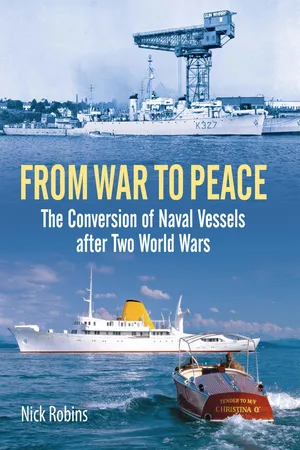
From War to Peace tells the story of the adaptation from White Ensign to Red Ensign, and to flags of other nations, of the numerous classes of naval ships mainly built during the two world wars and surplus to requirements with the advent of peace. It also describes ships sourced from the United States Navy and elsewhere that were converted for commercial use. The most successful classes to transfer to the merchant service were the Hunt-class minesweepers of the Great War, Landing Craft, Tank, the salvage tugs of World War Two, and the wooden-hulled Fairmile launches which became familiar at seaside resorts in the 1950s and ‘60s; and, of course, the MFV classes that helped the fishing industry in the postwar years. The story includes the successful commercial conversions of many of the Flower and Castle Class corvettes and River Class frigates, notably the 1954 conversion of HMCS Stormont to a luxury yacht for the Greek shipping magnate Onassis. It describes why HMS Charybdis became a passenger liner in the Great War, and how HMS Albatross nearly became a luxury liner after World War Two, but in fact was transformed into a very unpopular emigrant ship and ended her days as a floating casino based at Cape Town. The author reveals the military antecedents of numerous commercial vessels that many would have thought were built especially for the service that they later maintained, and it illustrates just how many Royal Navy vessels ended up in private ownership. And the question is asked: if the military had not built so many ships that were eminently suitable for commercial adaptation, would the technical development of merchant shipping have progressed at a faster rate than it did? The answer is a definite ‘no’, and is illustrated in several ways. It was former naval vessels that promoted the early development of the Ro-Ro ferry; former naval ships introduced numerous design innovations, for example, the raised foredeck common for so many years on salvage tugs, and, above all, stripped of their military hardware, ex naval ships provided opportunities for modest investment where otherwise there would have been none. Copiously illustrated throughout, the book tells a fascinating story of invention and ingenious ship conversion, and of pragmatic adaptation in the financially stringent years after two world wars.
- 192 pages
- English
- ePUB (mobile friendly)
- Available on iOS & Android
eBook - ePub
About this book
Information
Table of contents
- Cover
- Title
- Copyright
- Contents
- Preface
- 1 Beat their Swords into Ploughshares
- 2 Conversion from Minor Warship to Merchant Ship
- 3 Examples from the Nineteenth Century
- 4 The Great War – Cruiser to Liner and Minesweepers to Passenger Ships
- 5 Conversion of Smaller Ships after the Great War
- 6 German Naval Vessels – Some Conversions after the Great War
- 7 Second World War Convoy Escorts – Corvettes, Frigates and Patrol Craft
- 8 Other Escort Ships and Escort Carriers
- 9 Landing Craft, Tank and Derivatives from the Second World War
- 10 Landing Ships, Tank
- 11 United States Navy and Royal Canadian Navy Vessels after the Second World War
- 12 Admiralty Fishing Vessels and Tugs, Some Examples
- 13 The Fairmile Launches of the Second World War: Examples from the British Isles
- 14 Minesweepers and Other Small Vessels from the Second World War
- 15 A Valuable Role for Surplus Naval Vessels
- Bibliography
Trusted by 375,005 students
Access to over 1.5 million titles for a fair monthly price.
Study more efficiently using our study tools.
Frequently asked questions
Yes, you can cancel anytime from the Subscription tab in your account settings on the Perlego website. Your subscription will stay active until the end of your current billing period. Learn how to cancel your subscription
No, books cannot be downloaded as external files, such as PDFs, for use outside of Perlego. However, you can download books within the Perlego app for offline reading on mobile or tablet. Learn how to download books offline
Perlego offers two plans: Essential and Complete
- Essential is ideal for learners and professionals who enjoy exploring a wide range of subjects. Access the Essential Library with 800,000+ trusted titles and best-sellers across business, personal growth, and the humanities. Includes unlimited reading time and Standard Read Aloud voice.
- Complete: Perfect for advanced learners and researchers needing full, unrestricted access. Unlock 1.5M+ books across hundreds of subjects, including academic and specialized titles. The Complete Plan also includes advanced features like Premium Read Aloud and Research Assistant.
We are an online textbook subscription service, where you can get access to an entire online library for less than the price of a single book per month. With over 1.5 million books across 990+ topics, we’ve got you covered! Learn about our mission
Look out for the read-aloud symbol on your next book to see if you can listen to it. The read-aloud tool reads text aloud for you, highlighting the text as it is being read. You can pause it, speed it up and slow it down. Learn more about Read Aloud
Yes! You can use the Perlego app on both iOS and Android devices to read anytime, anywhere — even offline. Perfect for commutes or when you’re on the go.
Please note we cannot support devices running on iOS 13 and Android 7 or earlier. Learn more about using the app
Please note we cannot support devices running on iOS 13 and Android 7 or earlier. Learn more about using the app
Yes, you can access From War to Peace by Nick Robins in PDF and/or ePUB format, as well as other popular books in History & Military & Maritime History. We have over 1.5 million books available in our catalogue for you to explore.