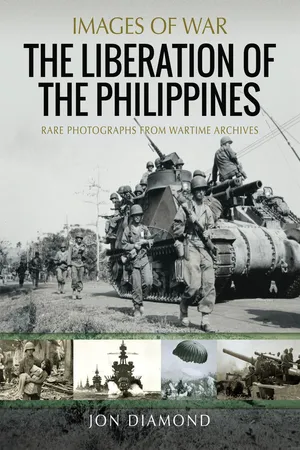
General Douglas A MacArthur, Commander of the Southwest Pacific Area, saw the liberation of the Philippines Archipelago as the launching board for the invasion of the Japanese Home Islands. By late 1944, with the capture of New Guinea and surrounding islands, the US Sixth and Eighth Armies were poised for the challenge. American forces landed on Leyte on 20 October 1944 with the Leyte Gulf naval battle quickly following. By 25 December the island was cleared opening the way for Lieutenant General Walter Krueger’s Sixth Army to invade Luzon on 9 January 1945. Bitter Japanese resistance required Eichelberger’s Eighth Army as reinforcements. Manila finally fell on 4 March. In the meantime Bataan was captured on 16 February and Corregidor on 2 March after a US airborne assault. Fighting continued and MacArthur finally declared the liberation of the Archipelago on 5 July, just a month before the Atom bombs fell on Hiroshima and Nagasaki. This superbly illustrated work in the Pacific War Images of War series leaves the reader in no doubt as to the intensity of the land, sea and air operations required by the Allies to defeat the Japanese.
- 192 pages
- English
- ePUB (mobile friendly)
- Available on iOS & Android
eBook - ePub
About this book
Information
Chapter One
Imperial Japan’s Conquest of the Philippines 1941–42
American Presence in the Pre-War Philippines
On 30 April 1898, Commodore George Dewey’s nine-ship squadron passed Corregidor Island and entered Manila Bay. At dawn the next day, Spanish shore batteries opened fire as the American ships headed towards the Spanish base at Cavite. At nearly 0600 hours on 1 May, Dewey ordered Captain Charles V. Gridley, the commander of USS Olympia (Dewey’s flagship), ‘You may fire when you are ready, Gridley.’ Spain’s twelve-ship force was obliterated during the seven-hour battle, with only one American sailor dying. What began as the American frenzy, fanned by politicians and the press, to liberate Cuba from Spanish oppression and avenge the sinking of the USS Maine, a cruiser, on 15 February 1898 now led President William McKinley’s administration to oust Spain from the Philippines with Dewey’s domination of Manila Bay and Cavite.
American infantry, dispatched under Major General Wesley Merritt (a Civil Warera cavalry officer), in its initial action outside the Western Hemisphere, moved on Spanish-controlled Manila contemporaneous with a growing Filipino insurgency against the Spanish that spread across the archipelago and of which, in the spring of 1898, McKinley was almost unaware. Also, American soldiers – both US Army regulars and volunteers – were wholly unprepared for war in the Philippines from logistics and training standpoints. Filipino independence was declared by Emilio Aguinaldo, chief of the Filipino nationalists, on 12 June 1898 in his home town of Cavite along the southern shores of Manila Bay.
By the early summer of 1898, before Merritt’s infantry arrived, 30,000 Filipinos had laid siege trenches around Manila as the Spanish troops were also prohibited a sea exit by Dewey’s squadron in Manila Bay. One of Merritt’s subordinates was another Civil War veteran Brigadier General Arthur MacArthur, the father of Douglas A. MacArthur. Brigadier General Thomas H. Anderson, another Civil War veteran, was to seize Guam, Spain’s first Pacific colony after its discovery by Ferdinand Magellan in the early sixteenth century. Anderson sailed from San Francisco on 25 May 1898 with 2,500 American troops and once at sea was diverted to Guam, which after its seizure became the first US Pacific possession during this initial military expedition outside American continental limits. Late in June, Anderson’s contingent came ashore at Cavite, prior to a move more proximate to Manila, naming the area Camp Dewey.
Dewey’s informal intelligence convinced him incorrectly that the Filipinos, under their leader Aguinaldo, did not want independence, despite Filipino rebels seizing armaments and ammunition in addition to Spanish prisoners at Cavite. With only 2,000 men under him, Dewey waited for Brigadier General MacArthur and also Greene’s detachments arriving in July 1898 and Merritt’s troops at the end of the month to commence an American offensive on Manila. However, the Filipino rebels wanted to capture Manila from the Spanish without American help, thereby straining the relationship between the two armed actions. Then, on 31 July, Spanish forces shelled and attacked the Americans, killing a dozen, the first US troops to be killed in action in the Philippines.
With some sporadic fighting amid the siege lines of Manila, leaving a few more American soldiers killed in action, US Army infantry entered the city in August 1898. The Treaty of Paris between the US and Spain was signed on 10 December which granted independence to Cuba and made Guam, Puerto Rico and the Philippines American possessions. Nonetheless, US and Aguinaldo’s forces were ready to combat one another as the American occupation force was to soon approach 22,000 troops in the vicinity of Manila. On the night of 4 February 1899, fighting erupted along a 10-mile front separating Nebraska volunteers and Filipino forces near Manila’s Santa Mesa suburb where the Pasig and San Juan Rivers join flowing westward towards the Intramuros or ‘Walled City’. The ‘Philippine Insurrection’ had commenced between the United States and Filipino nationalists, ultimately becoming guerrilla warfare as Aguinaldo left the Manila area for northern Luzon.
On 1 September 1900, William Taft, a future twenty-seventh American president (1909–13) and a Supreme Court Chief Justice (1921–30), along with his fellow commissioners assumed the functions of a legislative body in the Philippines, raising taxes, enacting laws and establishing judicial courts. In July 1902, then President Theodore Roosevelt proclaimed victory over the Filipinos with Aguinaldo’s capture in March 1902 by a contingent of Kansas volunteers led by Colonel Frederick Funston. However, fighting dragged on in other parts of the archipelago with Filipino resistance to American occupation forces, notably on Samar and Luzon. The fiercest resistance came from Muslim rebels on the southern Philippine islands of Mindanao and Jolo. The Spanish referred to the Muslim Filipinos as Moros after the Moors of North Africa. The Moros comprised more than a dozen ethnic groups, each led by a local sultan. The Moros launched massive attacks against the Americans, often wielding only spears and knives.
John J. ‘Black Jack’ Pershing, a cavalryman and regimental quartermaster for the 10th Cavalry comprising African-American ‘Buffalo soldiers’ that fought on Kettle and San Juan Hills in Cuba, gained fame fighting the Moros. He was promoted from captain to brigadier general by President Theodore Roosevelt after his initial battles against the Moros. Pershing subsequently administered the region after a bloody action in 1913. Another senior officer gaining distinction fighting the Moros was Brigadier General Leonard Wood, a Harvard Medical School graduate who earned the Congressional Medal of Honor for his role in the capture of the Apache warrior Geronimo. One of Wood’s lieutenants in the Philippines was another cavalryman, George S. Patton.
The casualties among the American forces in the Philippines were numerous as of 4 July 1902 when Roosevelt proclaimed that the war was over. There were more than 4,000 Americans killed and almost 3,000 wounded, while many became afflicted with lingering tropical diseases. More than 20,000 Filipino soldiers were killed, as well as 200,000 civilians who died from war, famine and atrocities.
Douglas MacArthur was the central military individual in the Philippines before the outbreak of war in the Pacific during the Japanese conquest of the archipelago and throughout the islands’ liberation by US forces in 1944–45. MacArthur graduated from West Point in 1903. His late father was Arthur MacArthur, Jr, who was the commander of US forces in the Philippines from 1898 to 1901. In 1904, Douglas MacArthur was deployed to the Philippines where he first met a prominent lawyer, Manuel Quezon. During the First World War, MacArthur served as a 42nd Infantry Division’s brigade commander and its COS, ending the conflict as a brigadier general with many decorations for valour. In 1930, MacArthur was appointed Army Chief of Staff, a job his famous father never received. In 1935, while remaining on active duty in the US Army, he arrived in the Philippines again to take up President Quezon’s paid position to train the Filipino army with the rank of field marshal. As war with Japan loomed in 1941, the Filipino armed forces remained unprepared for a major war due to inadequate armaments, as well as language and cultural differences among the various native troops.
Outbreak of the Pacific War
Japan was embroiled in a protracted conflict with China since the invasion and annexation of Manchuria in 1931. Japan and the Soviet Union were also involved in an undeclared border conflict in north-east China from 1932 to 1939. A second Sino- Japanese War erupted in early July 1937 after the ‘Marco Polo Bridge Incident’ at Wanping, 15km from Peking. From 1937 to 1939, Japan was on a war footing with more than 1 million troops on the Asian mainland and, thereby, primed for their blitzkrieg across the Pacific and throughout southern Asia, the Philippines, Malaya, Singapore and the Netherlands East Indies (NEI) after the surprise Imperial Japanese Navy (IJN) attack on US military installations at Pearl Harbor, Hawaii, on 7 December 1941, which ceded temporary naval supremacy to the IJN in the Pacific Ocean.
Contemporaneous with Admiral Chūichi Nagumo’s aerial assault on the United States Navy’s (USN’s) Pacific Fleet and army installations on Oahu, both the IJN and Imperial Japanese Army (IJA) conducted offensive operations across Asia and the Pacific spanning 7,000 miles from Singapore to Midway Island (see Map 1). Malaya and Singapore were early targets in Japan’s major southern thrust, with additional operations to seize the Philippine archipelago, Hong Kong and parts of British Borneo. Guam was occupied on 8 December and Wake Island fell on 23 December. When Allied resistance was encountered by the IJA, notably on the Bataan Peninsula and Corregidor Island in the Philippines, these American bastions were simply cut off and bypassed until a lack of supplies and food compelled surrender.
Since US Army and Navy planners believed that the Philippine Islands were not defensible if the Japanese mounted a full-scale attack, military preparations were wholly incomplete before General Douglas A. MacArthur’s arrival in 1935 to command the archipelago’s Filipino-American forces as a field marshal. Over the next six years, the build-up of forces under his leadership was still tardy and unfinished. Prewar American Pacific strategy in 1941 was code-named War Plan Orange (WPO-3). US war planners surmised that the Japanese were intent on landing their assault troops at sites of their choosing along Luzon’s coastline and among other Philippine islands. The planned Filipino-American response was to take up strong defensive positions on the Bataan Peninsula and in fixed fortifications around Manila. WPO-3 envisioned a stockpi...
Table of contents
- Cover
- Title
- Copyright
- Contents
- Acknowledgements
- Abbreviations
- Chapter One Imperial Japan’s Conquest of the Philippines, 1941–42
- Chapter Two Terrain, Weaponry and Fortifications
- Chapter Three Commanders and Combatants
- Chapter Four The American Invasion of Leyte, 20 October 1944
- Chapter Five Luzon’s Recapture and the Liberation of Manila
- Chapter Six Battles for Manila, Bataan and Corregidor, 1945
- Chapter Seven Invasions of the Visayan Group, Mindanao and the Sulu Archipelago, 1945
- Epilogue
- Bibliography
Trusted by 375,005 students
Access to over 1.5 million titles for a fair monthly price.
Study more efficiently using our study tools.
Frequently asked questions
Yes, you can cancel anytime from the Subscription tab in your account settings on the Perlego website. Your subscription will stay active until the end of your current billing period. Learn how to cancel your subscription
No, books cannot be downloaded as external files, such as PDFs, for use outside of Perlego. However, you can download books within the Perlego app for offline reading on mobile or tablet. Learn how to download books offline
Perlego offers two plans: Essential and Complete
- Essential is ideal for learners and professionals who enjoy exploring a wide range of subjects. Access the Essential Library with 800,000+ trusted titles and best-sellers across business, personal growth, and the humanities. Includes unlimited reading time and Standard Read Aloud voice.
- Complete: Perfect for advanced learners and researchers needing full, unrestricted access. Unlock 1.5M+ books across hundreds of subjects, including academic and specialized titles. The Complete Plan also includes advanced features like Premium Read Aloud and Research Assistant.
We are an online textbook subscription service, where you can get access to an entire online library for less than the price of a single book per month. With over 1.5 million books across 990+ topics, we’ve got you covered! Learn about our mission
Look out for the read-aloud symbol on your next book to see if you can listen to it. The read-aloud tool reads text aloud for you, highlighting the text as it is being read. You can pause it, speed it up and slow it down. Learn more about Read Aloud
Yes! You can use the Perlego app on both iOS and Android devices to read anytime, anywhere — even offline. Perfect for commutes or when you’re on the go.
Please note we cannot support devices running on iOS 13 and Android 7 or earlier. Learn more about using the app
Please note we cannot support devices running on iOS 13 and Android 7 or earlier. Learn more about using the app
Yes, you can access The Liberation of The Philippines by Jon Diamond in PDF and/or ePUB format, as well as other popular books in History & Asian History. We have over 1.5 million books available in our catalogue for you to explore.