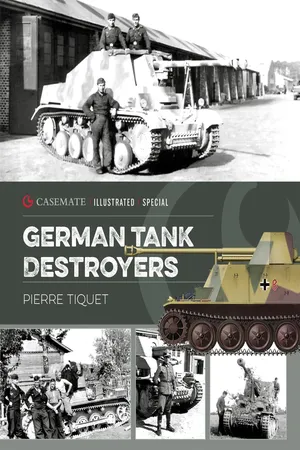
Includes coverage of all the tank destroyers used by the German army including the Hornisse, the Jagdpanzer 38, the Jagdpanzer IV, and the Elefant. From the early days of World War II, it was clear that the Wehrmacht’s antitank units would need to be motorized as existing horse- or automobile-drawn units were too slow to be effective. Initially, antitank guns were mounted onto available, usually obsolete, tank chassis, such as the Panzerjäger I and II. However German engineers would soon turn to the heavy chasses of the Panzer IV, the Panther, and the Tiger for their tank hunters. It became apparent during the invasion of France that enemy antitank guns were both more powerful and better armored, and improvement became a priority during Barbarossa as German units faced off against the new Soviet tanks. The appearance of the Soviet T-34 in July 1941 meant that the Germans had to quickly come up with something equally powerful. The result was the motorized panzerjäger, faster and more mobile than older towed versions. This was followed in 1942 by the introduction of the 7.5cm gun. Further designs and modifications were informed by reports from the front line. Some of these conversions were very successful and resulted in fearsome tank destroyers deployed to great effect by the Wehrmacht. The lightweight Hetzer, for example, was based on a modified Panzer 38(t) and entered service in 1944. This small tank became Germany’s main tank destroyer during the final stages of the war, and would continue in use around the world even after 1945. Though they may not have looked that intimidating, the Landser were soon won over, and were comforted to have something reliable to stand between them and the Soviet tanks. This account, illustrated by hundreds of period photos, examines the development and deployment of various models of tank destroyers during World War II.
- 192 pages
- English
- ePUB (mobile friendly)
- Available on iOS & Android
eBook - ePub
German Tank Destroyers
About this book
Information
°e Panzerjäger Ente, Marder II,
and Marder III
°e idea of adding antitank guns to the frames of old or captured tanks was an intriguing
one—at least, Hitler found it so, as the Führer closely followed technical and mechanical
developments. °e Germans’ early encounters with the T-34 on the Eastern Front
forced them to rethink their lightweight 3.7cm antitank guns, which were only powerful
enough to destroy light and medium-sized armored vehicles. A solution was presented
in the form of the 5cm, and later the 7.5cm, PaK gun.
°e Panzerjäger units were equipped in part with tractored guns and in part with tracked tank destroyers like
the Ente
(the “Duck,” a Panzer I armed with a Czech 4.7cm gun), the Marder I (a 7.5cm gun on the chassis of a
French Hotchkiss), the various models of the Marder II and III, the Jagdpanzer IV, the Hetzer (Jagdpanzer 38),
the Nashorn and the Hornisse, as well as the Ferdinand.
°e disposition of the Panzerjäger units was laid out in
Kriegs
(War) Organization document K. St.
No.1148a, dated February 15, 1942. It defined a Panzerjäger
Kompanie
(company) as having nine tank
destroyers, such as the Marder III equipped with a 76.2mm Russian gun. K. St. No.1149, dated February 1, 1942,
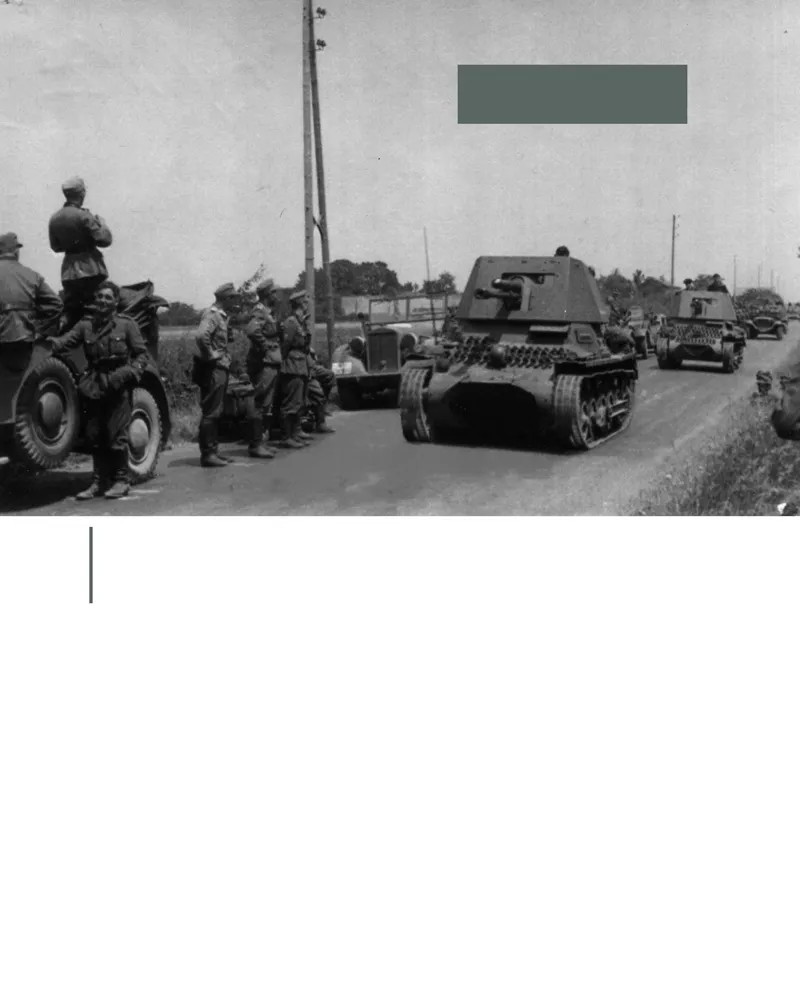
Two Entes passing an infantry column
on a road in France, 1940. The tracks,
typical of the vehicle, are visible.
12
defined a Panzerjäger
Zug
(platoon) as having three Marder II or III tank destroyers, as well as two additional
vehicles to transport munitions, as there was not enough room in the tanks to store extra shells. °e Marder II,
for example, could only carry 30 shells.
During the campaign in France, the German 3.7cm gun soon attracted the nickname “
Heeresanklopfgerat
”—
“army door-knocker device”—due to its failure to pierce the heavy frontal armor of French tanks like the Somua
and B1 bis. Only the German 8.8cm FlaK guns proved capable of destroying these vehicles.
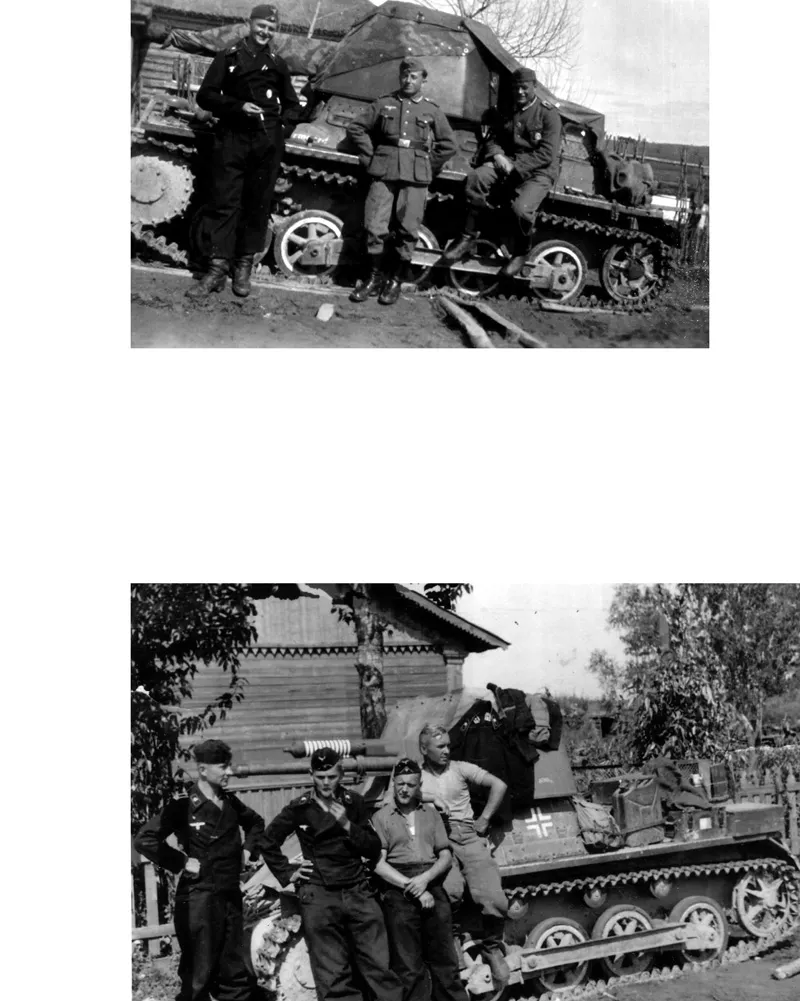
An Ente in Russia, 1941. The men pose for a souvenir photo. A
Zeltbahn
(tarpaulin) covers the vehicle in
lieu of a roof to protect it from the elements.
The crew of this Ente take a break after a battle. Note that the gun barrel already bears 11 victory
rings, displaying the vehicle’s effectiveness in the earlier battles of the war. The T-34s and other heavy
Soviet tanks— the KVs and ISs—had not as yet made an appearance on the battlefield.
13
23...Table of contents
- Cover
- Title
- Copyright
- Contents
- Timeline of Events
- Introduction: Panzerjäger in the Heer and the Waff en-SS
- The Panzerjäger Ente, Marder II, and Marder III
- Jagdpanzers: The Dicker Max and the Sturer Emil
- The Hornisse/Nashorn
- The Hetzer
- The Elefant
- The Jagdpanzer IV/70
- Afterword
- Further Reading
Trusted by 375,005 students
Access to over 1.5 million titles for a fair monthly price.
Study more efficiently using our study tools.
Frequently asked questions
Yes, you can cancel anytime from the Subscription tab in your account settings on the Perlego website. Your subscription will stay active until the end of your current billing period. Learn how to cancel your subscription
No, books cannot be downloaded as external files, such as PDFs, for use outside of Perlego. However, you can download books within the Perlego app for offline reading on mobile or tablet. Learn how to download books offline
Perlego offers two plans: Essential and Complete
- Essential is ideal for learners and professionals who enjoy exploring a wide range of subjects. Access the Essential Library with 800,000+ trusted titles and best-sellers across business, personal growth, and the humanities. Includes unlimited reading time and Standard Read Aloud voice.
- Complete: Perfect for advanced learners and researchers needing full, unrestricted access. Unlock 1.5M+ books across hundreds of subjects, including academic and specialized titles. The Complete Plan also includes advanced features like Premium Read Aloud and Research Assistant.
We are an online textbook subscription service, where you can get access to an entire online library for less than the price of a single book per month. With over 1.5 million books across 990+ topics, we’ve got you covered! Learn about our mission
Look out for the read-aloud symbol on your next book to see if you can listen to it. The read-aloud tool reads text aloud for you, highlighting the text as it is being read. You can pause it, speed it up and slow it down. Learn more about Read Aloud
Yes! You can use the Perlego app on both iOS and Android devices to read anytime, anywhere — even offline. Perfect for commutes or when you’re on the go.
Please note we cannot support devices running on iOS 13 and Android 7 or earlier. Learn more about using the app
Please note we cannot support devices running on iOS 13 and Android 7 or earlier. Learn more about using the app
Yes, you can access German Tank Destroyers by Pierre Tiquet in PDF and/or ePUB format, as well as other popular books in History & European History. We have over 1.5 million books available in our catalogue for you to explore.