"A thoughtful, well-organized overview from the beginning to the twilight days of this iconic airliner" by the highly regarded aviation historian (Large Scale Planes).
In April 1972, after six grueling years of design and development, the then Lockheed California Company (now Lockheed Martin) delivered the most technologically advanced commercial jet of its era, the L-1011 TriStar, to its first client, Eastern Airlines.
To mark the moment, Lockheed decided to make an impressive statement about the capabilities of its new medium-to-long-range, wide-body trijet airliner. It did so in spectacular fashion. Overseen by two test pilots, a total of 115 crew members, VIPs, Lockheed employees, and selected reporters boarded a TriStar at Lockheed's Palmdale plant in California. The subsequent 4-hour, 13-minute flight to Washington Dulles Airport was achieved with virtually no input from the two pilots in the cockpit, the TriStar's Automatic Flight Control System being "engaged from takeoff roll to landing." It was, Lockheed proudly claimed, "the first cross-country flight without the need for human hands on the controls."
On the way to the L-1011's inaugural flight, Lockheed battled through design challenges, financial difficulties, and even international allegations of bribery, with the result that the TriStar, famed for its large, curved nose, low-set wings, and graceful swept tail, remained in production until 1984, by when 250 examples had been built. The toll on Lockheed, however, was too great and after the TriStar it withdrew from the commercial aircraft business.
In this revealing insight into the L-1011, the renowned aviation historian Graham M. Simons reveals the full story of this airliner's design, development and service over the decades since 1970.
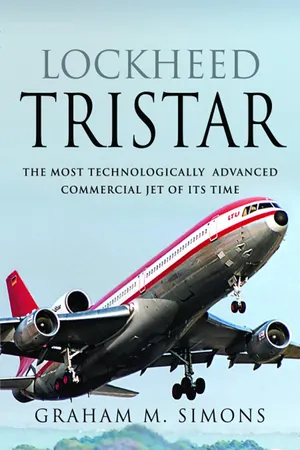
eBook - ePub
Lockheed TriStar
The Most Technologically Advanced Commercial Jet of Its Time
- 256 pages
- English
- ePUB (mobile friendly)
- Available on iOS & Android
eBook - ePub
Lockheed TriStar
The Most Technologically Advanced Commercial Jet of Its Time
About this book
Information
Subtopic
Military & Maritime HistoryChapter One
What came before
The history of Lockheed Aircraft can be traced back to Allan Loughead and his brother Malcolm, who had operated an earlier aircraft company, Loughead Aircraft Manufacturing Company, which was operational from 1912 to 1920. The company built and operated aircraft for paying passengers on sightseeing tours in California and had developed a prototype for the civil market, but folded in 1920 due to the flood of surplus aircraft deflating the market after World War One.
The early venture failed to find a market, and the Loughead Aircraft Manufacturing Company suspended its operations. It was 1920. For six years, the Santa Barbara factory lay dormant following the failure to find an S-1 Sport Plane market.
There was much confusion as to how the brothers’ last name was spelt. Allan once explained the apparent confusion over the spelling of the name. ‘The true pronunciation of our name is Lock-heed, but so many people pronounced it Logheed, we decided to legalise the phonetic spelling.’
The brothers separated. Malcolm Lockheed left the company to develop an invention of his own for the automobile world, an idea for a superior brake. He worked out a method for putting brakes on all four wheels of an automobile. The system worked by hydraulic pressure from a small pump mounted on the brake pedal, pushing the fluid to work the brakes in each wheel. Its use - with minor variations - can be found on virtually every vehicle today. The company he founded, Lockheed Hydraulics, became a world-wide subsidiary of the Bendix Corporation.
Meanwhile, Allan Lockheed entered the real estate business but stayed with his dream of building a better aircraft. But he had no money and no aircraft to make. More discouraging was the fact that nobody wanted any new machines. He still had faith that the right design would catch the public’s attention. At least, he believed from talking with flying men that there could be a market developed if a designer could come up with the right kind of product.
Fred S Keeler, a Burbank businessman, who had also invested in Malcolm Lockheed’s brake venture, was one of those who expressed a great deal of interest. He offered to put up all but $2500 of a stock subscription for $25,000. Allan Lockheed himself put up the other $2500, and they formed a new company known as the Lockheed Aircraft Company in December 1926. Operations began in a small building at Sycamore and Romaine Streets in Hollywood.
Allan (left) and Malcolm Lockheed at the controls of the Lockheed F-1 flying boat. (Lockheed)

Keeler became President, Allan Lockheed the vice-president and General Manager. They immediately hired back Jack Northrop, who had previously worked for the Lockheed brothers, and left to join Douglas Aircraft Company as Chief Engineer. Allan Lockheed - the name had been officially changed - and Northrop worked tirelessly on a new concept which they felt would create its own demand.
In the factory on Romaine and Sycamore in Hollywood, construction was started on the new Lockheed-Northrop design, a high-wing, ultrastreamlined monoplane built around a moulded plywood monocoque fuselage, similar to the construction used in the S-l sports machine.
Construction of the company’s first aircraft, the beautifully streamlined Vega cantilever monoplane began. While the Vega was under construction, the Lockheed Aircraft Company succeeded in selling it to George Hearst Jr, the wealthy publisher of the San Francisco Examiner, who wished to enter it in the August 1927 Oakland-to-Honolulu Dole Derby. Following flight trials and modifications to its vertical surfaces, the aircraft, flown by John Frost and Gordon Scott, took off from Oakland on 16 August 1927, bound for Oahu. Although the first Vega disappeared on its way to Hawaii, its advanced design had already attracted other customers and the Lockheed Aircraft Company was forced to move to larger quarters in the partly occupied building of the Mission Glass Works on Empire Avenue in Burbank in March 1928. The company completed four more Vegas and began the construction of the Air Express and Explorer. Off Empire Avenue behind the factory, a narrow piece of land some 1,500 foot long was graded to serve as its airstrip.
The single-spar wooden wing of the new aircraft was a radical design departure. There were no struts to support it. By the year’s end, reported sales exceeding one million dollars.
Three months after the move to Burbank, Jack Northrop and Ken Jay left the company and were replaced by Gerald F ‘Jerry’ Vultee, chief engineer, and Whitley C Collins, as secretary/treasurer. Going on from success to success while being flown by many of the most famous pilots of the time, the hand-built Vegas were produced at a remarkably high rate - two in 1927, twenty-nine in 1928 forty during the first six months of 1929 with many more under construction. Besides, the company completed two Air Expresses in 1928 and five of this type during the first six months of 1929. The first Explorer, which had been started in 1927, was also completed during the first half of 1929. From 1926 to 1928, the company produced over eighty aircraft and employed more than 300 workers who, by April 1929, were building five aircraft per week.
The company was making money as long as Allan Lockheed retained control. But the money interests completely disregarded internal recommendations. Mercilessly, stockholders began to milk the thriving company of dividends. The treasury ran dry. No money was provided for research. Its engineers and designers, who had built the reputation with continued improvements and new designs, were not allowed to maintain the pace. And in aviation, there is an axiom that has never failed to prove true - ‘keep five years ahead of the times, or you lose your shirt’. Lockheed had its five years ahead with its ‘Vega’ series and the other stars that followed the line, for all came from the same basic moulds. But for five years, it stood still. Engineers had stretched to the limit the basic wooden fuselage common to the Vega, Sirius, Air Express, Altair and the Orion.
With business booming and a healthy cash flow fuelled by a steady stream of orders, Fred Keeler saw an opportunity of realising a large profit by selling the Lockheed Aircraft Company while the going was good. Over the protest of Allan Lockheed, Keeler began in April 1929 to negotiate the company’s sale with Edward S Evans, the president of Detroit Aircraft Corporation. The sale agreement, which became final in July 1929, said much for Keeler’s business acumen as three months later, the 1929 stock market crash plunged the USA into the Great Depression, and the bottom fell out of the aircraft market.
Upon acquiring eighty-seven per cent of the assets of Lockheed in July, the Detroit Aircraft Corporation - a Michigan holding corporation with controlling interest in various aviation ventures including aircraft manufacturers Ryan and Eastman, Grosse Isle Airport in Detroit, the Park Air College in East St Louis, and other entities - reorganised the company as a division. To head the new Lockheed Aircraft Corporation, the Detroit group sent Carl B Squier, the founder of one of its other subsidiaries, Eastman Aircraft, as general manager and retained Jerry Vultee as chief engineer. It appeared that the change of owners was not going to affect the business, and the operationally independent Burbank team went on producing their own designs.
Besides producing these well-established types, the sale provided much-needed cash to the Detroit Aircraft Corporation after the stock market crash. Lockheed introduced the Sirius, the Altair and the superb Orion. Most of these aircraft were built with the company’s traditional plywood monocoque fuselages. But, beginning in February 1932, when the first DL-1 Vega was completed in Michigan, Detroit Aircraft Corporation made nine Vegas and one Sirius with a metal fuselage of Detroit construction and Lockheed-built wooden wings. Detroit, using the same combination, also built the XP-900 two-seat fighter prototype in 1931. Initial design work for an Army observation biplane and an exceptionally clean flying-boat was also undertaken, but lack of funds prevented the realisation of these projects.
Despite this flurry of activity amid the Depression, the future looked bleak for Lockheed as rising losses from its parent company’s other operations drained it of its profit. Finally, having lost $733,000 in 1929 and seeing its stock, with a par value of fifteen dollars plummet to twelve cents, the Detroit Aircraft Corporation could no longer survive. On 27 October 1931, it went into receivership with its Lockheed Aircraft Corporation subsidiary being placed under the aegis of the Title Insurance and Trust Company of Los Angeles. With Carl Squier remaining as general manager, a skeleton workforce built two more Orions and one Altair but, on 16 June 1932, the doors were finally locked.
Only five days after the Title Insurance and Trust Company had shut the company’s doors, acting as receivers, a new Lockheed Aircraft Corporation was born. Led by Robert Ellsworth Gross, a thirty-five-year-old San Francisco investment broker, a group of investors submitted to the US District Court in Los Angeles a $40,000 bid for the defunct company’s assets. There being no other bids, District Judge Harry Holzer accepted Gross’ offer on its presentation, on 21 June 1932. Four investors now owned Lockheed: Walter T Varney, the owner of Varney Speed Lines, who provided $20,000; Mr and Mrs Cyril Chappellet contributed $10,000; and R C Walker and Thomas Fortune Ryan III, who each provided $5,000. The investors acquired physical assets worth $129,961 as valued by the receivers, including work in progress, raw material, machine tools, office and engineering equipment, and furniture. At thirty cents in the dollar, it was not a bad investment if you had confidence in the aviation business at a time when the country was at the bottom of the Great Depression.
Lockheed used concrete moulds to form the early single-engined aircraft designs from the Vegas to the Orions. It was a similar process to what English company De Havillands used later to produce aircraft such as the Mosquito and Hornet. (Lockheed)


the company headquarters at Burbank in 1928. The site was to evolve into the Lockheed Air Terminal, and later into that of the Lockheed-California Company.

the narrow fuselage and cantilever wing of the Lockheed Vega is very noticable in this photograph of one machine under construction.
A native of Boston, Massachusetts, Bob Gross had stepped out of college into the investment business, putting to use his Harvard degree. In 1928, at the height of aviation’s Lindbergh’ boom,’ he had invested in the Stearman Airplane Company and later formed the Viking Flying Boat Company with his brother Courtland. In 1932 he was associated with Walter T Varney in operating the Varney Speed Lines, which was flying West coast passengers in the fast Lockheed’ Orions’. When they heard of the Lockheed situation, Gross, Varney, and Stearman decided to raise capital and buy the Lockheed Company. So it was that day in July of 1932 that Gross appeared in a Los ...
Table of contents
- Cover
- Title
- Copyright
- Contents
- Acknowledgements
- Introduction
- Chapter 1 What Came Before
- Chapter 2 Genisis of a Giant
- Chapter 3 Choice of Powerplant
- Chapter 4 Finance - and Problems
- Chapter 5 Build
- Chapter 6 Rollout and Flight Test
- Chapter 7 TriStars on Tour!
- Chapter 8 On Board the L-1011
- Chapter 9 Into Service!
- Chapter 10 Later Models, and ‘Active Control’
- Chapter 11 The RAF, and Marshall Aerospace
- Chapter 12 Accidents and Incidents
- Chapter 13 TwiLight of the TriStar
- Bibliography
Trusted by 375,005 students
Access to over 1.5 million titles for a fair monthly price.
Study more efficiently using our study tools.
Frequently asked questions
Yes, you can cancel anytime from the Subscription tab in your account settings on the Perlego website. Your subscription will stay active until the end of your current billing period. Learn how to cancel your subscription
No, books cannot be downloaded as external files, such as PDFs, for use outside of Perlego. However, you can download books within the Perlego app for offline reading on mobile or tablet. Learn how to download books offline
Perlego offers two plans: Essential and Complete
- Essential is ideal for learners and professionals who enjoy exploring a wide range of subjects. Access the Essential Library with 800,000+ trusted titles and best-sellers across business, personal growth, and the humanities. Includes unlimited reading time and Standard Read Aloud voice.
- Complete: Perfect for advanced learners and researchers needing full, unrestricted access. Unlock 1.5M+ books across hundreds of subjects, including academic and specialized titles. The Complete Plan also includes advanced features like Premium Read Aloud and Research Assistant.
We are an online textbook subscription service, where you can get access to an entire online library for less than the price of a single book per month. With over 1.5 million books across 990+ topics, we’ve got you covered! Learn about our mission
Look out for the read-aloud symbol on your next book to see if you can listen to it. The read-aloud tool reads text aloud for you, highlighting the text as it is being read. You can pause it, speed it up and slow it down. Learn more about Read Aloud
Yes! You can use the Perlego app on both iOS and Android devices to read anytime, anywhere — even offline. Perfect for commutes or when you’re on the go.
Please note we cannot support devices running on iOS 13 and Android 7 or earlier. Learn more about using the app
Please note we cannot support devices running on iOS 13 and Android 7 or earlier. Learn more about using the app
Yes, you can access Lockheed TriStar by Graham M Simons,Graham M. Simons in PDF and/or ePUB format, as well as other popular books in Technology & Engineering & Military & Maritime History. We have over 1.5 million books available in our catalogue for you to explore.