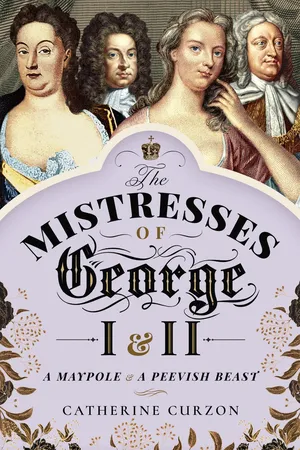
When George I arrived in England he found a kingdom in turmoil. Mistrustful of the new monarch from Hanover, his subjects met his coronation with riots. At George’s side was his mistress, Melusine von der Schulenberg, whilst his ex-wife languished in prison. Known as the Maypole thanks to her eye-catching figure, Melusine was the king’s confidante for decades. She was a mother to his children and a queen without a crown. George II never forgave his father for tearing him from his mother's arms and he was determined to marry for love, not duty. Though his wife, Caroline of Ansbach, proved to be a politically gifted queen, George II turned to another for affection. She was Henrietta Howard, the impoverished Countess of Suffolk, and she was desperate to escape her brutish husband. As the years passed, the royal affair became a powerplay between king and queen and the woman who was mistress to one and servant to another. Melusine and Henrietta's privileged position made them the envy of every courtier. It also made them a target of jealousy, plotting and ambition. In the tumultuous Georgian court, the bedroom and the throne room weren't so far apart.
- 216 pages
- English
- ePUB (mobile friendly)
- Available on iOS & Android
eBook - ePub
About this book
Information
Act I
Ehrengard Melusine von der Schulenberg, Duchess of Kendal
(25 December 1667–10 May 1743)
The Girl from Emden
On Christmas Day 1667, in the town of Emden, Brandenburg, Ehrengard Melusine von der Schulenberg was born. Why her parents, Gustavus Adolphus, Baron von der Schulenberg, and his wife, Petronella Ottilia von Schwencken, chose Melusine as a middle name is lost to the mists of time, but it was the name by which she was always known. The other Melusine was a figure of ancient mythology, a freshwater mermaid of fairy blood who ensnared monarchs and heroes throughout history and whose story was told in innumerable legends from folklore across the continent. Perhaps the future for the little girl born in Emden was written in her name.
Melusine von der Schulenberg, of course, was no creature of myth and legend, nor did she exist only in the pages of folklore. Instead she was a flesh and blood woman, a minor noble who, through her intimate relationship with King George I, rose higher than she might ever have dreamed. She left behind the genteel, ennobled poverty of her roots to forge a life of notoriety as the woman who sat as close to one of the most powerful thrones in the world as any uncrowned, unmarried mistress could hope to get. Melusine was set to become a queen in all but name.
There was little that was remarkable about the young Melusine’s formative years, certainly nothing that would mark her out as a social climber to be watched as she navigated the road to St James’s Palace. In fact, this apparent lack of ambition, coupled with an ability to know just what was required of her and when, was precisely what later endeared Melusine to the taciturn, sullen George Louis in Hanover. As we shall learn, the first Georgian king didn’t look for a challenging partner, nor one who would be minded to argue with him, or even worse, a woman who might be driven to strike out on her own. George Louis’ upbringing had forged a phlegmatic, emotionally withdrawn man whose outbursts of temper were rare but violent. His dedication to improving his family name and territorial fortunes was matched only by his ambition, which he had inherited from his ruthless father. When George Louis’ wife, Sophia Dorothea, proved to be as emotional as he was repressed, it set the stage for disaster. Melusine, as we will see, was far better suited to George Louis than his wife would ever be.
But all of that is for later.
Melusine’s mother, Petronella Ottilia, could trace her noble Westphalian line back through the generations to the thirteenth century, so whilst the family may not have had much money to burn nor the finest estates to call their own, they had something that was valued even more highly within their circle: good breeding. The blood of a respected noble line could plug the gaps left by a lack of ready cash and with his marriage to Petronella Ottilia, Gustavus Adolphus was able to bask in her reflected familial glory. But Gustavus Adolphus was no slouch himself. With his heart set on a political career he joined the household of the Elector of Brandenburg, where he soon acquired a reputation as a man who could get things done. Eventually Gustavus Adolphus would rise to the esteemed rank of privy councillor, but his stellar career meant that he was rarely at the family home in Emden. Instead the management of the household was left in the more than capable hands of Petronella Ottilia.
Gustavus Adolphus and Petronella Ottilia had nine children, three of whom died in infancy. Melusine was their fourth child and second daughter, and just like noble young ladies before her had been for generations, she was to be trained in all the skills necessary to make her way in the world. The seventeenth century was not a time when women were expected to forge ahead alone. Instead their prospects – especially if they were of noble stock like Melusine – came from their value as a bride. With her excellent heritage and her father’s secure and respected position in Brandenburg, Melusine’s value could not be underestimated. She spent her childhood being educated in the necessary feminine arts that would stand her in good stead for the throne room and the drawing room alike, preparing for the life that would one day await her. Melusine was in training to become a wife.
Though Petronella Ottilia oversaw her daughter’s early education, Melusine had only a few scant years to spend with her mother. Petronella Ottilia died just a week after she delivered her last child in 1674, leaving her children motherless. Melusine was only six, and the death of her mother created a yawning chasm at the heart of the castle in Emden.
Melusine’s early life really couldn’t have been any more different from that of the woman who would later become her perceived rival, Sophia Dorothea of Celle. Sophia Dorothea was George I’s cousin and eventually his wife, though they hated each other with a white-hot passion. Whilst Melusine had grown up motherless in a far from fairy tale castle among siblings who clung together after the loss of their mother, Sophia Dorothea had everything that Melusine did not. She was an only child, raised as a princess in a glittering castle that sat at the heart of a duchy that overflowed with wealth. Sophia Dorothea was the centre of attention and loved to be paraded through the streets in ribbons and silks by her adoring mother, where she was showered with gifts and shown off to the crowds who gathered to catch a glimpse of the pretty princess. Years later though, George Louis’ sour-faced dislike of too much show and flightiness would be one of the things that drew him to Melusine, even as he kept his wife at arm’s length. And when even that wasn’t far enough, locking her away and trying to forget about her became his preferred solution.
With the untimely death of Petronella Ottilia, the foundations were laid for one of the tightest-knit families that could be found amongst the inner circle of Hanoverian royalty. Years later, when Melusine bore George Louis three children, her siblings would raise them as their own without balking. These weren’t brothers and sisters riven with rivalry and clawing to outdo one another, but a little group that forged itself from grief. It was a support system that the House of Hanover would never be able to match as long as George I and George II sat at its head.
Over the years that have passed since Melusine’s death, many have concluded that her primary motivation was financial. She was depicted as a venal, conniving shrew who had set out to capture a man with money and power – and succeeded. Of course, this is more than a little simplistic, but there were many reasons to become a mistress. In some cases, it was a desire for influence or cash whilst in others, it was a question of genuine affection, and though Melusine certainly enjoyed money, there was more to her relationship with King George I than that. Though I hesitate to focus too much on the death of Petronella Ottilia, it is not far-fetched to speculate that losing her so early might well have played a part in the decisions Melusine took later. Having such unbreakable bonds with her siblings meant she had always known the security that came with having a family to rely on. In allying herself so firmly to George Louis she maintained that sense of security not just financially, but socially too. The couple were so well-matched in temperament that Melusine’s position was virtually – though not completely – unchallenged from the off, and it gave her back the rock-solid foundations that must have seemed to be crumbling when Petronella Ottilia passed away.
Baron von der Schulenberg eventually married again and embarked on a second family with his new bride, but this is no sorry tale of a wicked stepmother. In fact, the children of von der Schulenberg’s second marriage were welcomed into the close-knit group that had already formed. Yet the von der Schulenberg children were all growing older and setting out on lives of their own. The boys entered the military2, a natural berth for young men of such noble blood, whilst the girls were embarking on lives as wives and mothers. For Melusine, however, no suitors came calling. Though her family was well-respected, it was also far from unique or particularly special, and she was just one of innumerable, accomplished young ladies of marriageable age in Europe. There was little to distinguish Melusine from any other potential brides and unlike Sophia Dorothea, she was neither a princess nor in possession of a massive dowry and a future fat inheritance. If no likely husband came calling though, Gustavus Adolphus was certainly not about to keep Melusine at home forever. Instead, he fell back on his electoral connections and went searching for a position for his daughter that might expose her to eligible suitors, whilst at the same time providing her with a station of her own.
In 1690 he found it. Melusine was to travel to Hanover, where she would become a maid of honour to Duchess Sophia, wife of Duke Ernest Augustus. It was a substantial step up the social ladder and one that would, Gustavus Adolphus hoped, bring his daughter into the purview of a whole new selection of would-be bridegrooms. We must now leave Melusine behind for a little while. It’s time to learn more about the world in which she was to flourish in Hanover.
The Electorate
If you wanted to reach the top in seventeenth century Europe, you had to be adept at all sorts of games. From war to diplomacy and everything in between, there was a lot to play for, and for ambitious rulers, the richest rewards were there for the taking.
One such ruler was Ernest Augustus, Duke of Brunswick-Lüneburg. Alongside his three brothers and fellow dukes, Christian Louis, George William, and John Frederick, Ernest Augustus ruled the Duchy of Brunswick-Lüneburg. The division of territories between the four brothers had led to a fractious and sometimes strained state of affairs and though each sibling hoped to one day be the man who would unite the lands of Brunswick-Lüneburg under one ruler, in the end that role fell to Ernest Augustus. The reason behind this was simple: Ernest Augustus was the only brother whose marriage produced a son and heir to inherit the duchy3. It helped that he was also a man of unfettered ambition who was happy to push his brothers aside to realise it.
Ernest Augustus’ wife, Sophia of the Palatinate,4 was a woman with plenty of ambition of her own. She was the daughter of the short-lived Frederick V, who was Elector Palatine until his death in 1623, and who ruled as King of Bohemia for just fifteen months. His tenure was so short that it earned him the nickname, the Winter King. Brief though his time in the spotlight was, Frederick’s laurels paled in comparison next to those of his wife, Elizabeth Stuart. The Winter Queen had hit the dynastic jackpot: she had ancient royal blood flowing through her veins.
Elizabeth Stuart was the daughter of King James I and, like her eventual son-in-law, Ernest Augustus, she thrived on ambition. Elizabeth’s own marriage didn’t go quite as she had hoped and instead of ruling a kingdom, as befit the daughter of a monarch, she ended up joining her husband in exile when the armies of the Holy Roman Empire banished the Winter King from Bohemia. The royal family left in such haste that they didn’t even manage to pack all of the crown jewels and fled for a new life at The Hague without them.
Branded a yellow-bellied coward, the decline in Frederick’s health and fortunes was swift. His lands were seized, his titles stripped from him, and he was left at the head of a powerless court-in-exile, from which he and Elizabeth made occasional abortive attempts to regain the favour of the Holy Roman Emperor and win back all that they had lost. Though the Palatinate lands and electorate would eventually be returned to the family after a fashion, Frederick didn’t live to see it. Always subject to melancholy, he sank into a deep depression following the tragic death by drowning of his eldest son and never quite recovered from the shock. He died three years later of a fever, aged just 365.
Though Frederick was gone, his widow was far from beaten. From her exile in The Hague, Elizabeth Stuart indulged her love of politics and entertained visiting nobles from across Europe until her daughter, Sophia, observed that for all their illustrious visitors, “at our court we often had nothing to eat but diamonds and pearls”6. The family’s coffers were as empty as its larders, but Elizabeth couldn’t sell those diamonds and pearls, because they were vital to keeping up the illusion that a king’s daughter needed to preserve. She had to look the part, even if she was starving.
When the monarchy in England fell and Elizabeth’s brother, King Charles I, lost his head, the Protectorate understandably declined to offer any financial help to the exiled royal widow. Instead Elizabeth was cut adrift and, having come to rely upon wealthy royalists for support, found those sources of income were also now denied to her. In England, the estates and interests of her rich friends were being seized, leaving those benefactors who had once lived in lavish style and funded the exiled court of the Winter Queen to join her in penury. Elizabeth surveyed her options and decided that there was only one thing for it. She set out to find a rich husband for her daughter, with all the steely determination of a general planning a military campaign.
Elizabeth’s hope was that Sophia would snare Charles, Prince of Wales, and future king7, but it wasn’t to be. Though the prince came to The Hague and charmed the young lady, it soon became apparent that he had no interest in marriage. All he wanted was money, and that was the one thing that the exiled court couldn’t offer him. So Charles went on his merry way and as belts tightened still further in The Hague, Sophia left her mother’s side and travelled to Heidelberg, where she was to be a long-term guest of her brother, Charles I Louis, Elector Palatine, and his wife, Charlotte. It was during this trip that the young Winter Princess witnessed the damage that could be wrought by an unhappy marriage. She watched in horrified fascination as her brother and sister-in-law were alternately at war or in bed, their relationship fiery in all senses of the word.
Eventually the marriage of Charlotte and Charles Louis broke down irretrievably after Charlotte tried once too often to physically assault her husband’s beloved mistress, Marie Luise von Degenfeld. After nearly biting through Marie Luise’s finger and attacking her with a knife, Charlotte turned on Sophia, who she falsely accused of having an incestuous affair with Charles Louis. It was the final straw. The couple eventually divorced and Marie Luise was able to marry her man. It was a lesson Sophia would keep in mind when her own son’s marriage began to bow under the weight of unfulfilled expectations.
It was at the fiery Heidelberg court that Sophia finally met the man who would become her husband. Charles Louis hosted a visit by George William and Ernest Augustus, two of the Dukes of Brunswick-Lüneburg, and she hit it off with Ernest Augustus from the start. Sadly, it seemed as though it had come too late. Charles Louis was actually in the midst of negotiating a betrothal between his sister and Adolph John I, Count of Zweibrücken-Kleeburg, brother of King Charles X Gustav of Sweden. The widowed count was noted for his unusual appearance, particularly what Sophia described as a “long pointed chin like a shoehorn” and though she was in no hurry to become his bride, Sophia, Charles Louis and Elizabeth alike recognised that such a financially shrewd marriage might be enough to save the family from its hardships. The fact that Adolph John I was brother to a king was the cherry on top.
Terms for the Swedish marriage were still being discussed when much to everyone’s surprise, George William of Brunswick-Lüneburg made a counter-offer. Just like Sophia’s family, the party-loving duke needed money and the Hanoverian estates had agreed to award him a generous allowance on condition that he marry. He snatched Sophia from beneath Adolph John I’s pointed chin and she was delighted. She far preferred the garrulous George William to her Swedish suitor and later recalled that when the proposal was received, “unlike the heroine of a novel, I did not hesitate to say yes”8. The marriage was on.
Yet even as Sophia was planning her wedding, George William was getting cold feet. No sooner had he secured the answer to his proposal than he received an unexpected increase in his allowance anyway, no marriage required. Now he could easily afford the lifestyle he wanted, and the last thing he needed was a bride to curb his fun. Unthinkably, George William off...
Table of contents
- Cover
- Title
- Copyright
- Contents
- Illustrations
- Acknowledgements
- Introduction
- Act I: Ehrengard Melusine von der Schulenberg, Duchess of Kendal
- Act II: Henrietta Howard, Countess of Suffolk
- Afterword
- Bibliography
- Plates
Trusted by 375,005 students
Access to over 1.5 million titles for a fair monthly price.
Study more efficiently using our study tools.
Frequently asked questions
Yes, you can cancel anytime from the Subscription tab in your account settings on the Perlego website. Your subscription will stay active until the end of your current billing period. Learn how to cancel your subscription
No, books cannot be downloaded as external files, such as PDFs, for use outside of Perlego. However, you can download books within the Perlego app for offline reading on mobile or tablet. Learn how to download books offline
Perlego offers two plans: Essential and Complete
- Essential is ideal for learners and professionals who enjoy exploring a wide range of subjects. Access the Essential Library with 800,000+ trusted titles and best-sellers across business, personal growth, and the humanities. Includes unlimited reading time and Standard Read Aloud voice.
- Complete: Perfect for advanced learners and researchers needing full, unrestricted access. Unlock 1.5M+ books across hundreds of subjects, including academic and specialized titles. The Complete Plan also includes advanced features like Premium Read Aloud and Research Assistant.
We are an online textbook subscription service, where you can get access to an entire online library for less than the price of a single book per month. With over 1.5 million books across 990+ topics, we’ve got you covered! Learn about our mission
Look out for the read-aloud symbol on your next book to see if you can listen to it. The read-aloud tool reads text aloud for you, highlighting the text as it is being read. You can pause it, speed it up and slow it down. Learn more about Read Aloud
Yes! You can use the Perlego app on both iOS and Android devices to read anytime, anywhere — even offline. Perfect for commutes or when you’re on the go.
Please note we cannot support devices running on iOS 13 and Android 7 or earlier. Learn more about using the app
Please note we cannot support devices running on iOS 13 and Android 7 or earlier. Learn more about using the app
Yes, you can access The Mistresses of George I and II by Catherine Curzon in PDF and/or ePUB format, as well as other popular books in History & Historical Biographies. We have over 1.5 million books available in our catalogue for you to explore.