eBook - ePub
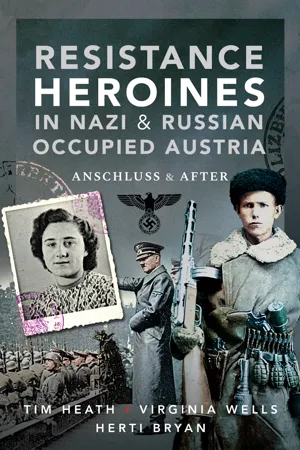
Resistance Heroines in Nazi & Russian Occupied Austria
Anschluss & After
- 224 pages
- English
- ePUB (mobile friendly)
- Available on iOS & Android
eBook - ePub
Resistance Heroines in Nazi & Russian Occupied Austria
Anschluss & After
About this book
Austria's Anschluss - its 'annexation' - saw no gunfire, no bloodcurdling screams of Stukas overhead or the rumble of heavy artillery when German troops marched in on 12 March 1938. It was no 'Blitzkrieg' on the contrary, some Austrians even welcomed the 'invaders' and the opportunity to unite the ethnic German peoples under the rule of Austria's most infamous son, Adolf Hitler. Austria's wealth of natural and mineral resources were especially useful to support the Third Reich's aggression in Europe. The Nazis were keen to exploit these assets and many Austrians benefited from increased employment. However, any initial euphoria was soon replaced by fear and anxiety as the brutal reality of the new regime became apparent. Here is the remarkable story of Herti Bryan who, as a young child, witnessed the totalitarian nightmare of Hitler's dream for world domination. Standing up for what she believed to be right, Herti acted courageously to frustrate the occupying Nazis. In addition to Herti's story, we learn of the experiences of Milly Keller and Hilde Schubert who shared contempt for the Nazi occupiers. The three girls vividly describe their different experiences during the war, although there is a striking similarity in the even greater terror they were subjected to under the Russian 'liberators'. In this volume the lives of Herti, Milly and Hilde come together to reveal an astonishing picture of life in occupied Austria. Drawing on unimaginable fortitude, these girls defied domination and fought fearlessly, risking their own lives, to carry out their moral obligation to humanity. This is their story, in their own words and told for the first time.
Information
Topic
StoriaSubtopic
Donne nella storiaChapter 1
An Age of Innocence
Herti’s early life and her memories of growing up in a loving family are especially vivid. As she revisits the past, the joy of recalling her happy childhood is evident in her expression and the details are as clear today as they were so long ago:
I was just three years old when my mother sent me on an errand to the corner shop. I remember looking back to see her smiling face as she watched me from the window. There are other glimpses of memory from the time we lived in this flat on the outskirts of Graz but in August 1932 we moved to a villa in another suburb of the city. Graz is a beautiful university city, in the south of Austria very near what is now the border with Slovenia, and I remember it as my tranquil home base for the early years of my life. To the north the mountains loomed: I remember hiking with my parents, having packed up my own little rucksack – off we would go in the early morning and return late in the afternoon or evening. We picked berries or mushrooms and occasionally would rescue injured animals. One young woodpigeon we nursed back to full health and, though it flew out of our garden eventually, it always returned to us and stayed for several years. In the winter it always snowed heavily – I would take my sleigh as far into the hills as I could manage and then enjoy a fast ride down the glistening slopes.
My early childhood was indeed idyllic. I was extremely happy and so blessed to have parents I adored and who loved me so much, as well as having wonderful grandparents, aunties and uncles who loved and spoilt me. As an only child I was very much indulged – we were such a close family and getting together for Easter and summer vacations were annual rituals that we all looked forward to. My parents and I would take the train from Graz to Mödling, before making the three-mile journey to Laxenburg, where my grandparents lived. Laxenburg was on the outskirts of Vienna and was where the Royal Palace was situated – a magnificent building set in beautiful parkland. My grandparents had a bakery – I can so easily recall the wonder of this place. My senses were overwhelmed by the amazing aromas coming from the hot ovens and it seemed I was surrounded by the most wonderful textures and tastes of delicious bread, rolls, cakes and confectionery. This was, indeed, heavenly.
Grandmother was truly ‘grand’ – an imposing Victorian figure who managed this thriving home and business with my grandfather. The bakery was renowned and successful meaning they could employ a number of permanent staff members as well as help in the house. There was a housekeeper, cook and stable boy who lived in accommodation at the back. In addition to the main house and bakery, there was a pigsty and a yard with geese and chickens. The stables housed the horses. My parents and I had our own room in the main house, but there was nothing I loved more than going to the adjoining shop to sample the delights on offer and to visit the bakery kitchen down the backstairs. Here I would watch as batches of bread were removed from the ovens on long poles. Often, I would be allowed to help with the bread making: I would be put in a high chair to reach the worktop and would do my best to knead the dough. Somehow my finished rolls were never as light, fluffy and good-looking as the professionally made ones but they tasted extra good to me and caused much fun and laughter.
Everyone at the Laxenburg house worked hard but it was always enjoyable and these were truly happy times. Grandmother served in the shop every morning but at 11 a.m. she would take her seat in her large, comfy armchair and ask Julie, the housekeeper, to bring her favourite zabaglione – a delicious dessert made from whisked egg yolks and sweet wine, served in a glass with dainty finger biscuits. She would invite me to share this treat with her, though my mother felt it inappropriate for a young child. Grandmother, however, thought a small amount of wine would do no harm so disregarded my mother’s wishes and we shared our secret indulgence! To this day I enjoy making lovely zabaglione on special occasions and I will always choose it if it is on the dessert menu in a restaurant.
The bakery was extremely popular, not least because it was the only one for many miles around. Most of the bread was made during the night. At midnight my grandfather would start the process then, after a little sleep, he would get up again at 4 a.m. to continue. At 6 a.m. the bread was loaded onto carts and the daily deliveries would begin to the surrounding villages and towns and, as the Emperor’s Summer Palace was close by, this important ‘customer’ was on the delivery round. There were very few cars or vans in the early 1930s so the journey by horse and cart was slow but soothing. I often accompanied my grandfather or uncle on their rounds, and, towards the end of the day, lulled by the gentle rhythm of the horse’s hooves, we would fall asleep leaning against each other. Fortunately, the horse knew its way home and would return us safely to the house, pulling up in the stable yard behind the bakery.
However, when I was 5 years old, in 1934, my grandfather had a stroke and died. A year later my dear grandmother also died. Needless to say, the whole family was shocked by their loss – they had built the business into a very successful enterprise and had given our close-knit family a sound foundation. However, we carried on without them and my two uncles continued to run the bakery just as they always had and, amazingly, it has remained as a family business to this day. Though it was a tragedy to lose our beloved family members, in hindsight it was perhaps a good thing that neither of my grandparents ever had to hear the greeting ‘Heil Hitler’ as soldiers entered the shop or to witness the events of the next few years, which threw our lives into chaos.
About the same time that my grandparents died, I started school and I remember being very excited when the morning in September arrived for my first day. As the school was some distance from home, I travelled by tram in winter but always cycled when the warmer weather arrived. I loved school and learning so many new things. Every day was an adventure. I felt like a free spirit when cycling home, knowing that there would be more fun things to do with my family at home. I was truly blessed to have such loving parents and such a happy, secure home life – every day was special and I felt I was living in a fairy tale. In spite of the loss of my grandparents, my parents were able to show me – through their own strength – their powerful sense of commitment to each other and our family. I learnt from them the fundamental ideals that I have valued throughout my life and I have never doubted for a moment that these are the values that are worth fighting for.
I loved Sundays when my father, a police officer, was not on duty. In the mornings we would visit the cathedral in Graz city centre and listen to the beautiful music which, to this day, I regard as the best sound in the world. Afterwards, we would go to one of the many cafés and enjoy a leisurely coffee and a long chat. One of my favourite cafés was just a short walk from the cathedral and was situated on the first floor above an exclusive shop that sold luxury leather handbags and luggage. The café was beautifully furnished with soft red velvet seats. There would be a pianist playing and I would jump up to dance as soon as I heard it. The atmosphere was happy and lively, people laughed and applauded as I entertained them with my dancing – how could life be any more wonderful? I loved music so much that, when I was about 8, my parents bought me a baby grand piano and arranged for me to have private piano lessons. I practised hard and by the following Christmas had become quite proficient. After our Sunday morning special time together, Father and I would return home to a delicious meal lovingly prepared by my mother. In the afternoons we would often be joined by friends of my parents for a game of cards and Mother’s fabulous home-baked cakes and coffee. By evening I was tired and ready for my comfy bed.
Each season held its special magic – life was full with so many things to do. In winter the snow fell for days on end which meant I would walk to school instead of going by tram. I recall the bright light of a snowy morning, the freezing cold, the fun of playing in the snow and sledging as well as the way the damp clumps of melting snow would thump as they fell from the rooftops or overhanging branches. Rushing home from school, I would snuggle by the log fire, listening to stories that my mother never tired of telling me while she sewed, making dresses and coats for me or keeping busy with some beautiful embroidery.
Christmas each year was celebrated in the traditional Austrian way. Whereas in the UK Father Christmas arrives during the night on Christmas Eve to deliver presents to well-behaved children, in Austria Santa visits during the early evening of 6 December. St Nicholas, dressed as Santa Claus, arrives accompanied by ‘Krampus’ who is dressed as a scary beast. These visitors come to each house and, if the children have been good, Santa Claus will hand out oranges, sweets and nuts which he carries in a huge sack. Krampus, on the other hand, will frighten any children who have misbehaved by chasing them with rusty chains and bells. How I dreaded the arrival of Krampus – until I realized that Santa had been told I had been a good girl again that year. In Austria children receive their main gifts on Christmas Eve rather than on Christmas Day. It is the belief that the ‘Christkind’ brings the presents to the children and puts them under the Christmas tree. The Christkind is a sprite-like child, usually depicted with blond hair and angelic wings. Clearly there is a similarity between the Christkind and the infant Jesus, whose birthday is to be celebrated, but sometimes it appears to be a specific angel bringing presents, which is often seen accompanying the image of baby Jesus in processions. Of course, children never actually see the Christkind and parents reinforce the message that presents are only brought to children who are not over-curious. When the parents say they think the Christkind may have visited, the whole family enters the living room together, where the Christmas tree has been decorated in readiness, for the opening of the presents – or Bescherung. Every year, I would spend Christmas Eve with my aunties in town whilst my parents decorated a very large tree and arranged the presents. I could scarcely wait to get home, full of excitement and anticipation of the joys that would greet me. As there was no public transport after midday on Christmas Eve, we would eagerly trudge back through the snow, in a magical, wonderful, silent world lit only by the starry sky which we would gaze at, searching for a glimpse of the Christkind flying towards my house. Arriving home, we entered the welcoming warmth. My parents opened the door to the living room and there was the Christmas tree, glistening with real candles and decorated with biscuits and sweets wrapped in pretty paper. Underneath the branches were the presents and, oh what a joy it was to discover the treasures that were there each year. I would rush quickly to the piano and play ‘Silent Night’, my aunties and parents singing along – this was the true beginning of another wonderful Christmas. Then it was time for a light fish supper and a play with my presents before bedtime. Christmas Day itself was a quiet family day when I would play with my new toys and mother would cook a delicious dinner. The next day we would go to a traditional children’s matinée theatrical performance. How I adored these Christmases and the memories of such happy times come flooding back in my mind as each new Christmas comes around. But, as we celebrated Christmas and welcomed the New Year of 1938, little did we know just how drastically our lives were about to change in a matter of a few months.
Chapter 2
A Dark Omen
In the wake of the First World War the former Austro-Hungarian Empire was effectively dissolved in favour of the state of Austria, comprising the largely German-speaking peoples of the former empire. Austria became constituted as a parliamentary democracy, the two dominant political elements in Austria at that time being the socialists represented by the Social Democratic Workers Party and Conservatives represented by the Christian Social Party. Naturally, the SDWP gained a major portion of support from the working-class areas of Austria’s cities, while the Conservatives built on the support of the rural populations and the upper classes. The Conservatives also maintained a close alliance with the Roman Catholic Church which had some of the country’s leading clerics within its ranks.
Mirroring most of the nascent European democracies of the time, politics in Austria began to embrace a highly ideological thesis. Both the socialist and conservative movements were far more than merely political parties: both possessed far-ranging power structures, which included their own independent paramilitary forces. For example, the Conservatives formed the Heimwehr (Homeguard) in 1921–1923 and, in direct retaliation, the Social Democrats created paramilitaries called the Republikanischer Schutzbund (Republican Protection Association) after 1923. In a chilling similarity to the social and political events which would later tear Germany apart, violence would break out between these two forces especially at political rallies.
The first major confrontation involving these paramilitary groups took place in early 1927, when members of the Hermann Hiltl’s Frontkämpfervereinigung (Front Fighters Union – a group affiliated with the Conservative camp) shot and killed an 8-year-old boy and a war veteran marching with the Schutzbund in a peaceful counter-demonstration in Schattendorf, a town in the district of Mattersburg, in the Austrian state of Burgenland. In July, three defendants in the court case which followed were acquitted, which led to outrage in the left-wing camp. On 15 July 1927, a general strike occurred, and demonstrations took place in the capital. Trouble rapidly broke out and, following the storming of a police station, security forces began opening fire upon demonstrators. An angry mob then set fire to the Justizpalast (palace of Justice) in response to the indiscriminate shooting. The reason this building was targeted was the fact it was viewed by many as a symbol of a flawed and partial judicial system. Altogether, 89 people lost their lives in this outbreak of violence (85 of the victims being demonstrators) in what became known as the July Revolt and hundreds of others were injured. Strangely, the violence abated rapidly, and the quarrelling factions took their fight back into the political arena and off the streets.
This was by no means the end of the First Republic’s problems which seemed to worsen with each coming year. The Great Depression which blighted world society from 1929 well into the 1930s hit Austria hard. As with Germany the effects of high rates of unemployment, particularly among the poor and working classes, combined with hyperinflation would prove disastrous for many. In order to define the effects of hyperinflation upon a country like Austria one should imagine a basic everyday commodity such as a loaf of bread which, virtually overnight, became unaffordable to many. Austria’s paper currency, as in Germany, became so worthless that it was often used in place of coal to burn on fires. This hyperinflation was the catalyst for mass social discontent which would have far-reaching consequences for Austria as an independent nation.
Austria’s association with Adolf Hitler’s Third Reich was formed over the months following the Austrian civil war. In reality, it was hardly a civil war within the usual context, but more a series of skirmishes which took place between 12 and 16 February 1934. The skirmishes came in the form of pitched battles between the two opposing political ideologies of fascism and socialism. The troubles began in Linz, soon spreading to the cities of Vienna, Graz, Bruck an der Mur, Judenburg, Wiener Neustadt and Steyr. Trouble also flared up in some of the industrial cities of eastern and central Austria.
* * *
Herta Juliana Bryan (née Krause) was born on 21 February 1929 in the city of Graz, the second largest city in Austria. Her parents were Karl Krause, born on 15 August 1893 in Krieglach, Styria, and Anna Krause (née Busch), born on 1 September 1902 in Pfaffstatten, Lower Austria. One of Herti’s early recollections of her pre-Anschluss life in Austria was of the troubles which flared in February 1934. Herti recalls:
A hint of things to come occurred in 1934 when I was about 5 years old. I had been playing on my tricycle in the garden one sunny morning when I heard loud banging noises. Immediately my mother called me into the house and we both sat behind a door, aware that guns were being fired around us. Frightened, we clung to one another as the bullets ricocheted off the surrounding walls. Gradually the gunfire diminished and after about an hour (though it seemed longer) it stopped completely. When Father arrived home, anxious about our welfare though unaware of exactly what had been happening to us, he was so relieved to find us safe and unharmed. I learned later that this was a failed coup d’état by the Austrian Nazis, and, though quickly suppressed, it was to foreshadow future events.
Several hundred people including paramilitaries, members of the security forces and civilians lost their lives in this brief yet violent conflict, with over a thousand suffering wounds of varying degrees. The Austrian authorities were anxious that no such uprising should be allowed to occur again: subsequently the punishments administered to those convicted of having taken part in the troubles were justly severe. The authorities put on trial and executed nine Schutzbund (Austrian paramilitary organization) leaders under the provisions of martial law. American journalist and author John Gunther reported that Schutzbund members received what he termed ‘mercilessly severe’ sentences. In addition, over 1,500 arrests were made. Prominent Socialist political leaders such as Otto Bauer, an Austrian Social Democrat, were forced into exile. Bauer was considered one of the leading thinkers of the left-socialist Austro-Marxist grouping. Bauer was also an inspirational figure for both the New Left and Eurocommunist movements whose aim was to find a ‘Third Way’ to democratic socialism.
In the wake of the troubles the Austrian government acted quickly to prohibit the Social Democratic Party and its affiliated trade unions altogether. In May the Conservatives replaced the democratic constitution with a corporatist constitution modelled along the lines of Benito Mussolini’s Fascist Italy; thus, the socialists coined the phrase ‘Austrofascism’ although the underlying ideology was essentially that of the most conservative elements within the Austrian Catholic clergy, a feature inconsistent with both Italian Fascism and Nazism. The Vaterländische Front, or Fatherland Front, was the ruling political organization of Austrofascism. The ethos of this Fatherland Front claimed it to be a non-partisan movement with the sole aim of uniting all the people of Austria, overcoming all political and social divisions in the country. The Fatherland Front was fully aligned with the Catholic Church and did not advocate any racial ideology, as would the later Italian Fascism. It advocated principally Austrian nationalism and independence from Germany on the basis of protecting Austria’s Catholic religious identity from what many Austrians felt was a Protestant-dominated German state.
The Heimwehr (Home Guard), the nationalist paramilitary group operating within Austria during the 1920s and 1930s in much the same way as the Freikor...
Table of contents
- Cover
- Title
- Copyright
- Contents
- Introduction
- Prologue
- Chapter 1 An Age of Innocence
- Chapter 2 A Dark Omen
- Chapter 3 Anschluss
- Chapter 4 Dangerous Times
- Chapter 5 A Bloody Nose
- Chapter 6 Limbo
- Chapter 7 Resistance
- Chapter 8 The Russian Terror
- Chapter 9 Getting Away
- Chapter 10 Working Towards My Future
- Chapter 11 The Girl with The Golden Smile
- Chapter 12 An Inglorious End
- Epilogue: My Wonderful Life
- Afterword
- Acknowledgements
- Plates Section
Trusted by 375,005 students
Access to over 1.5 million titles for a fair monthly price.
Study more efficiently using our study tools.
Frequently asked questions
Yes, you can cancel anytime from the Subscription tab in your account settings on the Perlego website. Your subscription will stay active until the end of your current billing period. Learn how to cancel your subscription
No, books cannot be downloaded as external files, such as PDFs, for use outside of Perlego. However, you can download books within the Perlego app for offline reading on mobile or tablet. Learn how to download books offline
Perlego offers two plans: Essential and Complete
- Essential is ideal for learners and professionals who enjoy exploring a wide range of subjects. Access the Essential Library with 800,000+ trusted titles and best-sellers across business, personal growth, and the humanities. Includes unlimited reading time and Standard Read Aloud voice.
- Complete: Perfect for advanced learners and researchers needing full, unrestricted access. Unlock 1.5M+ books across hundreds of subjects, including academic and specialized titles. The Complete Plan also includes advanced features like Premium Read Aloud and Research Assistant.
We are an online textbook subscription service, where you can get access to an entire online library for less than the price of a single book per month. With over 1.5 million books across 990+ topics, we’ve got you covered! Learn about our mission
Look out for the read-aloud symbol on your next book to see if you can listen to it. The read-aloud tool reads text aloud for you, highlighting the text as it is being read. You can pause it, speed it up and slow it down. Learn more about Read Aloud
Yes! You can use the Perlego app on both iOS and Android devices to read anytime, anywhere — even offline. Perfect for commutes or when you’re on the go.
Please note we cannot support devices running on iOS 13 and Android 7 or earlier. Learn more about using the app
Please note we cannot support devices running on iOS 13 and Android 7 or earlier. Learn more about using the app
Yes, you can access Resistance Heroines in Nazi & Russian Occupied Austria by Tim Heath,Virginia Wells,Herti Bryan in PDF and/or ePUB format, as well as other popular books in Storia & Donne nella storia. We have over 1.5 million books available in our catalogue for you to explore.