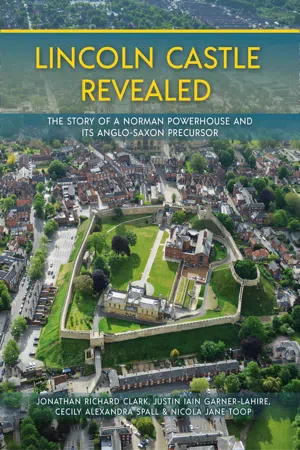
eBook - ePub
Lincoln Castle Revealed
The Story of a Norman Powerhouse and its Anglo-Saxon Precursor
- 256 pages
- English
- ePUB (mobile friendly)
- Available on iOS & Android
eBook - ePub
Lincoln Castle Revealed
The Story of a Norman Powerhouse and its Anglo-Saxon Precursor
About this book
This book tells a new story of the royal castle of Lincoln in the north of England, how it was imposed on the late Anglo-Saxon town, and how it developed over the next 900 years in the hands of the English king or his aristocratic associates, leaving us a surviving monument of three great towers, each with its own biography. Led by FAS Heritage, archaeologists, architectural historians and a large cohort of the general public have combined to produce a revealing and accessible account of the story of Lincoln Castle and a reborn historical attraction for the city of Lincoln.
Information
Subtopic
British HistoryIndex
Social Sciences
Aerial view of Lincoln Castle and Lincoln Cathedral looking south
1 The campaign to reveal Lincoln Castle
Introduction
The purpose of this book is to present the results of a campaign of archaeological work carried out as part of the Lincoln Castle Revealed project, which oversaw a £22m restoration of the castle site. The project was far reaching in its ambition and was conceived to renew the profile of the castle; it left few structures untouched. As a result, the discoveries from the archaeological campaign are as varied as they are compelling, and the ruins and artefacts recovered document events and lives reaching far into the distant past of the city.
Roman archaeology includes new sightings of the 1st-century fortress and succeeding colonia, late Roman traders’ houses and a townhouse, which gave up one of its mosaics in 1846 to Victorian prison builders. The city-wide boom of the 10th century was represented with evidence for late Saxon housing, craftworking and the discovery of a lost church or chapel including an undisturbed sarcophagus burial. A further eight burials were also found and bioarchaeological science has provided detailed evidence about life and death in Lincoln before the Norman Conquest.
For the medieval castle, revised biographies of East and West Gate, the Lucy Tower, the Observatory Tower and Cobb Hall have been made possible. These iconic structures have also been related to the remains of long-lost buildings rediscovered in the castle bailey, including the Great Hall where Henry II and his retinue feasted, the lost South Gate, and stable range with brewhouse, horse mill and hay loft.
Opportunity
Initiated in 2009, the Lincoln Castle Revealed project was designed to conserve and restore the medieval castle structures and to enhance public enjoyment of the wider site. The completion of the project was timed to celebrate the 800th anniversary of the sealing of the Great Charter at Runnymede on the 15th June 1215.
The project oversaw the conservation and repair of the fabric of the castle walls, towers and gates including the creation – for the very first time – of a continuous wall-walk around the castle walls. Another key part of the project was to build a bespoke space to exhibit the Lincoln copy of Magna Carta and the Charter of the Forest. The exhibition space – named The David PJ Ross Magna Carta Vault after its principal sponsor – was to be semi-subterranean, requiring excavation of a large area to a depth of 4 m, one of the largest excavations ever seen in the Upper City. Conservation, and opening up to the public some of the 18th- and 19th-century buildings in the bailey was also undertaken, including the Georgian gaol range and bathhouse, and the Victorian prison.
In the years leading up to 2009, a foundation of work had already been laid down. A Conservation Plan had been prepared bringing together existing knowledge on the castle site.1 An archaeological study of the Lucy Tower was undertaken in 2008 to inform conservation and options for the wall-walk design (Illus. 1).2 Archaeological trenches and boreholes were undertaken in the old car park area in 2009, in advance of the construction of the Heritage Skills Centre, which forms a separate but complementary element of the Lincoln Castle Revealed project.3 Management of the slopes of the Lucy Tower motte both inside and outside the castle walls was also needed. Archaeological work in advance of slope restoration required trenches within the grounds of Castle Moat House which identified parts of the Roman legionary defences and the remains of the lost West Chamber of the Lucy Tower.

Illus. 1. Location of archaeological interventions during the campaign
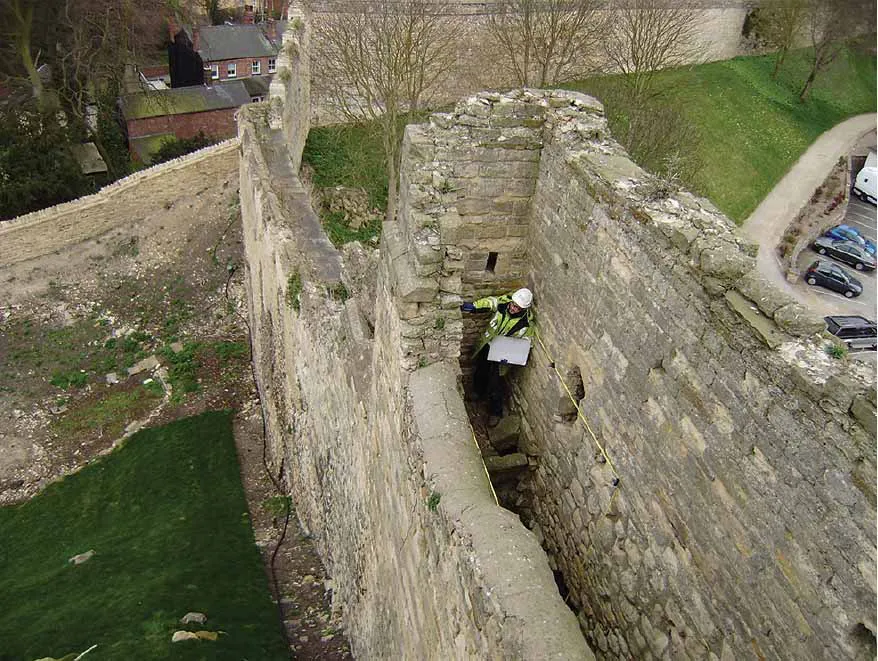
Illus. 2. Archaeologist, Richard Jackson, recording stonework in the west wing of the Lucy Tower
Before the restoration of the walls began in 2010, all medieval fabric which had survived heavy restoration of the late 18th century onwards, was recorded stone-by-stone (Illus. 2). Large areas of the south, east and west walls, the Lucy Tower, the lower levels of the Observatory Tower, Cobb Hall and East and West Gates were painstakingly recorded. The results of this recording are to be found as the inside covers of this book and can be studied in relation to each chapter (see Frontispiece and Endpiece).
By 2010 the full project was underway and the team of archaeologists from FAS Heritage was working closely with a team of architects, structural engineers and conservation stonemasons. The project presented a variety of challenges in terms of logistics and engineering. Construction of the new wall-walk access point in the Masons’ Yard took the form of a spiral staircase and lift; the foundations were excavated in advance of construction (Illus. 3). This intervention provided a stunning window into the five metres of archaeological strata beneath the castle’s east wall. A hitherto unknown late Saxon church or chapel lay awaiting discovery, including a sealed burial in a stone sarcophagus. Often found in disturbed condition, this extremely rare untouched discovery required excavation at a depth of 3 m below ground level and captured the attention of the city and county.
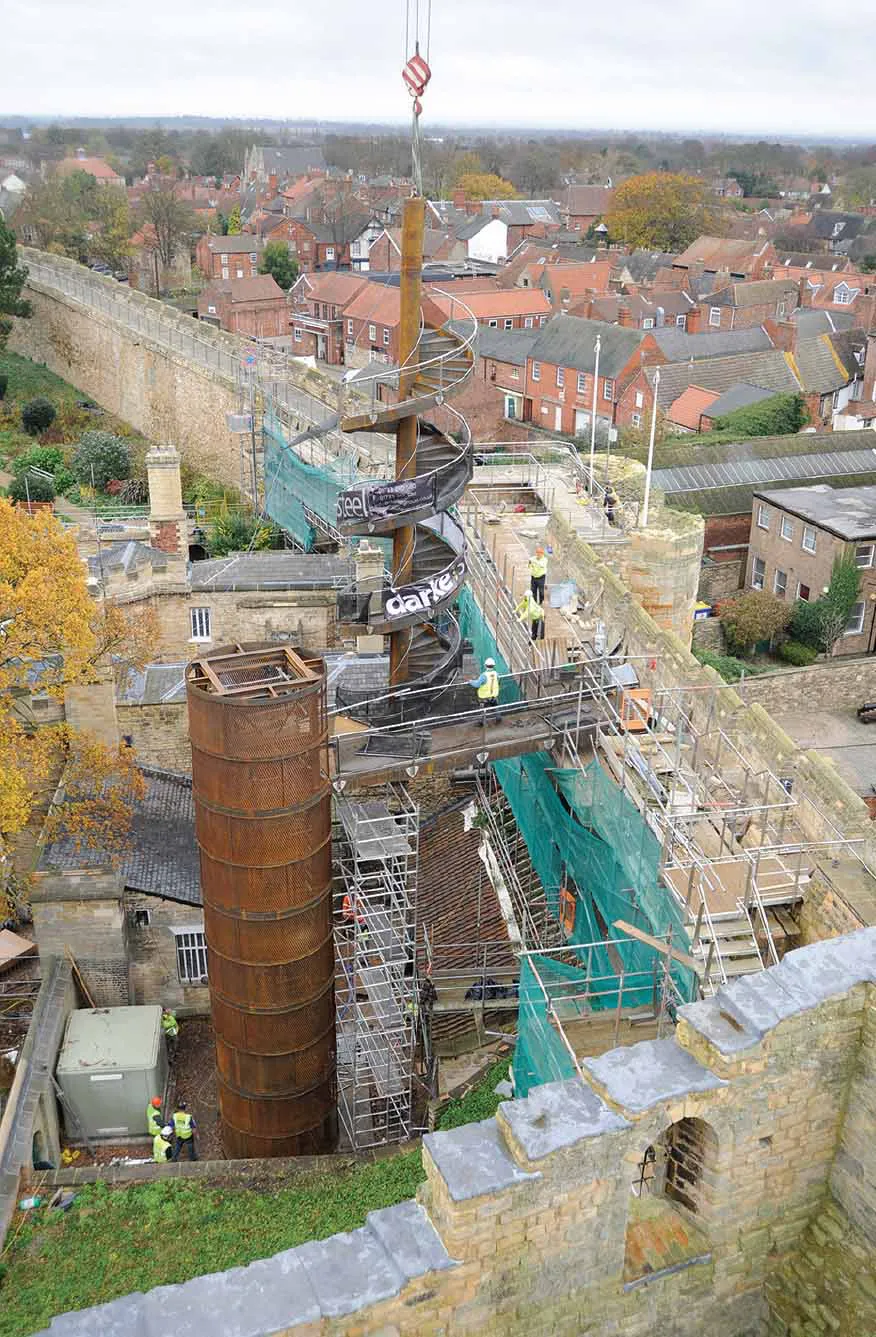
Illus. 3. Lifting the spiral stair over East Gate
Excavation within the former Eastern Courtyard of the Victorian prison, required in advance of the construction of the Magna Carta Vault, was begun in the long, hard winter of 2012 and completed in the hot summer of 2013. This element required the reduction of ground level by 4 m in an area surrounded by important historic buildings, which were underpinned as excavation exceeded even the depth of Georgian basement level.
As well as the restoration of the castle walls including the wall-walk and the Magna Carta vault, the Georgian gaol and the Victorian prison were to be exhibited to the public requiring careful conversion of parts of the buildings preceded by historic building recording. The old bathhouse was restored, the north gardens re-landscaped and basement storage within the Crown Court was reorganised, all under archaeological supervision.
Lincoln Castle was designated as a Scheduled monument in 1915, bringing its protection under the auspices of the Secretary of State. All works at the castle were consented to and guided by Historic England. A key condition of consent was that the results of the archaeological campaign be published. The results, a refreshed history of the south-west quarter of the Upper City from the Roman era to the Victorian age and beyond, are presented in this book.
Research incentives
Lincoln Castle has long fascinated scholars and visitors alike, and there was good reason for placing the archaeological works at the forefront of the Lincoln Castle Revealed project. From the outset, the desire to conserve the monument was placed equally with the desire to explore and understand it better. Having captivated the attention of many historians and archaeologists, surveys, plans and studies of Lincoln Castle had on one hand established a general level of agreement regarding the broad history of the site.4 On the other hand, there remained a notable level of controversy, especially regarding dating the form and structures of the early castle development. The first publication dedicated to ‘The early history of Lincoln Castle’ exemplified the range of ongoing debate and ideas.5 The Lincoln Castle Revealed project thus provided an opportunity to examine this intriguing combination of consensus and controvers...
Table of contents
- Cover
- Title
- Copyright
- Contents
- List of illustrations
- List of tables
- Foreword
- Preface
- Acknowledgements
- Picture credits
- 1. The campaign to reveal Lincoln Castle
- 2. The Roman fortress and colonia
- 3. The city beneath the castle
- 4. The early castle and the Lucy Tower
- 5. The castle gates and walls
- 6. The Observatory Tower
- 7. Cobb Hall and the last flowering of the medieval castle
- 8. Lincoln Castle recreated
- 9 Legacy
- Digest of evidence
- Bibliography
Trusted by 375,005 students
Access to over 1.5 million titles for a fair monthly price.
Study more efficiently using our study tools.
Frequently asked questions
Yes, you can cancel anytime from the Subscription tab in your account settings on the Perlego website. Your subscription will stay active until the end of your current billing period. Learn how to cancel your subscription
No, books cannot be downloaded as external files, such as PDFs, for use outside of Perlego. However, you can download books within the Perlego app for offline reading on mobile or tablet. Learn how to download books offline
Perlego offers two plans: Essential and Complete
- Essential is ideal for learners and professionals who enjoy exploring a wide range of subjects. Access the Essential Library with 800,000+ trusted titles and best-sellers across business, personal growth, and the humanities. Includes unlimited reading time and Standard Read Aloud voice.
- Complete: Perfect for advanced learners and researchers needing full, unrestricted access. Unlock 1.5M+ books across hundreds of subjects, including academic and specialized titles. The Complete Plan also includes advanced features like Premium Read Aloud and Research Assistant.
We are an online textbook subscription service, where you can get access to an entire online library for less than the price of a single book per month. With over 1.5 million books across 990+ topics, we’ve got you covered! Learn about our mission
Look out for the read-aloud symbol on your next book to see if you can listen to it. The read-aloud tool reads text aloud for you, highlighting the text as it is being read. You can pause it, speed it up and slow it down. Learn more about Read Aloud
Yes! You can use the Perlego app on both iOS and Android devices to read anytime, anywhere — even offline. Perfect for commutes or when you’re on the go.
Please note we cannot support devices running on iOS 13 and Android 7 or earlier. Learn more about using the app
Please note we cannot support devices running on iOS 13 and Android 7 or earlier. Learn more about using the app
Yes, you can access Lincoln Castle Revealed by Jonathan Clark,Justin Garner-Lahire,Cecily Spall,Nicola Toop in PDF and/or ePUB format, as well as other popular books in Social Sciences & British History. We have over 1.5 million books available in our catalogue for you to explore.