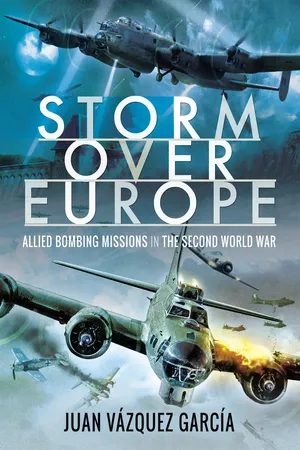
A view of British and American WWII bombing raids with over 250 color images, diagrams, and operational maps: "An excellent entry-level introduction." —
Air Power History
Following the Battle of France in 1940, British Bomber Command launched its response to the then-almighty Wehrmacht. Sadly, its beginnings were not at all promising: Its resources were limited and the twin-engine aircraft in service had a very limited load capacity, as well as being vulnerable to the Luftwaffe.
The progressive entry into service of the great four-engine planes would change the situation, but the great problem of nighttime raids, such as correctly identifying targets and a precise launching of the bombs, would never be adequately resolved. This extensively illustrated history offers a detailed look at this aspect of military aviation history.
- 160 pages
- English
- ePUB (mobile friendly)
- Available on iOS & Android
eBook - ePub
About this book
Information
Print ISBN
9781526740984
Subtopic
20th Century HistoryPART ONE
Night Devils: British
Bomber Command
1
The Origins of Bomber Command
The first strategic bombings in history date back to early in the First World War, when the British Royal Naval Air Service attacked Zeppelin bases at Cologne and Düsseldorf towards the end of 1914, to which the Germans responded by attacking Dover and Erith. But these operations were on a very small scale indeed, limited by the resources available at the time.

Trenchard’s theories would remain valid for decades. But he was short-sighted when it came to identifying and addressing the air force’s shortcomings in the 1930s. A large proportion of the budget was spent on extravagant clubs and quarters for officers rather than on aircraft.
The raids made by Zeppelins and, in particular, the German heavy bombers Gotha and Giant over British territory were a foretaste of what strategic bombing would be like in the next war. Given the limited effectiveness of existing defences against this threat, it was believed that the only effective response was to fight fire with fire. And so what was needed was a specialized and independent structure, which in time led to the creation of the Royal Air Force in April 1918 and, in June of the same year, of the Independent Air Force, the first unit set up specifically for strategic bombing.
The first aircraft with strategic capacity was the Handley Page 0/400, capable of carrying 1,500 kg of bombs. The new doctrine already had many staunch supporters, Trenchard, who would be head of the Air Staff for ten years, being one of them. Convinced that the only effective response was counter-attack, he claimed that the effect on morale of the bombings was greater than the purely physical effect. According to him the only aircraft capable of winning a war were heavy bombers and fighters were no more than mere elements of propaganda. For Trenchard, true air superiority consisted of being able to carry a larger bomb payload further than the enemy.

One of the first strategic bombers, a 1916 German Gotha.
During the twenties and thirties there was a constant stream of studies and debates on the true potential of strategic bombing, with each country reaching its own conclusions. Germany, after the experience of tactical bombing during the Spanish Civil War, decided to forgo the development of a truly strategic bomber in favour of optimizing their medium bombers. The United Kingdom fell somewhat behind in terms of weapons technology with the result that in the early 1930s its air force could only be described as mediocre in the extreme.
In 1932, Prime Minister Baldwin declared that, since bombers would be unstoppable, the only possible response was counter-attack, for which a special unit would have to be developed. It would be another four years before Bomber Command was set up, with very limited resources. A simulation conducted during the 1938 Munich crisis showed that neither the number nor the quality of the British bombers was sufficient to constitute an effective force.
But the philosophy behind the creation of Bomber Command, under a single independent command and with the sole purpose of attacking strategic targets, was clearly different from German thinking at the time. It was to be an offensive force whose mission would be to identify targets, develop the technology required to destroy them, and train aircrews to carry out that mission. Among the first targets identified were communications hubs in Germany, synthetic fuel production facilities, and the many industrial plants in the Ruhr Valley.
FIRST STRATEGIC BOMBERS
The first aircraft used by the British to attack strategic targets was the De Havilland DH-9, a light bomber capable of carrying bombs of up to 250 kg, which proved to be of very limited value.
The first truly strategic bomber was the Handley Page 0/400, capable of carrying up to 1,650 kg of bombs with a range of over one thousand kilometres. It was followed by the Vickers Vimy, able to reach Berlin with a 1,200 kg bomb payload, but they were completed too late to play any part in the war. The Vickers Virginia was the standard heavy bomber of the RAF between 1924 and 1937. In this period the aircraft was constantly developed until the final version could carry nearly 1,500 kg of bombs with a range of 1,600 km. It had a top speed of 175 km/h and a service ceiling of 4,800 m. Despite its long service life it was not so different from the 1917 Vimy.


The Vickers Virginia was the main British bomber with strategic capacity for over a decade.
By 1936, long-range four-engine aircraft had been commissioned but their development and delivery were suffering from significant delays. Also, coincident with the war in Spain, there was a certain degree of political pressure calling for priority to be given to Fighter Command, resulting in the appearance of the Hurricane and, especially, the excellent Spitfire. These fighters, used as interceptors, would spearhead Britain’s air defence, which in 1939, thanks to the development of radar, was one of the most advanced in the world.
However, the Air Staff continued to study plans for strategic offensives, known as Western Air Plans, with the aim of attacking Germany’s synthetic oil industry, its hydroelectric plants and its transport network, while undermining the morale of the German population.
Strangely, these plans failed to take into sufficient account the problems posed by the technical limitations on navigation, target identification, or, of course, the ability to hit any targets with a minimum degree of accuracy. Neither did they consider the effectiveness of the new generation of fighters against bombers, even though the British air force had already developed the Spitfire. Throughout the war the strategists clung to a belief in the self-defensive capacity of close formations in daytime operations and in the ability to avoid enemy fighters and return home on night raids.

The Ruhr was the principal target of the British long-range bombing strategists during the 1930s.
PORTAL
Charles Portal flew on combat missions during the Great War and was one of the first airmen to bomb German territory. During the 1930s he was one of the architects of the expansion of the RAF and in April 1940 he became head of Bomber Command.
Highly appreciated by his colleagues, Portal had a reputation for being straightforward and honest. Very shy, he liked to dine alone at his London club every day. A staunch defender of strategic bombing, he continued to support it and the men who carried it out when he was appointed Chief of Air Staff in October 1940, a position he held until the end of the war.

The start of the war appeared to prove the pre-war theorists right, especially after the invasion of Poland and the period known as the Phoney War in which there were scarcely any operations and it seemed as if there would be plenty of time to make thorough preparations for any future conflict.
Despite the appeals and declarations of the first weeks of the conflict calling for the civilian population to be respected, soon both sides began to blur the boundaries between military and civilian targets. However, Bomber Command was initially limited by political and legal constraints, reflecting the British idea that indiscriminate bombing was a sign of barbarity while targeted bombing was a sign of civilization. But, over and above any ideological reasons, at the start of the war there were serious reasons of a more material nature for not engaging in a campaign of indiscriminate bombing. First and foremost among those reasons was a lack of the required equipment.
In September 1939 Bomber Command had 33 squadrons and nearly 500 aircraft of all types, divided into five groups spread over the south of England. Ten were equipped with the Fairey Battle, a light tactical bomber which would be shot out of the sky in the first days of the western campaign. Another six squadrons had the twin-engine Blenheim IV, also a tactical bomber. The rest flew twin-engine Hampden, Whitley and Wellington bombers, all poorly suited to a strategic offensive. Many long months would have to pass before the first four-engine bombers entered service. Only the Wellington was capable of carrying out missions of any importance; they would still be making up half the bombing force in 1942 and various versions would remain in service until the end of the war.

The effects of an on-target raid.
TWIN-ENGINE BOMBERS
During the three first years of the war most ...
Table of contents
- Cover Page
- Title
- Copyright Page
- Contents
- PART ONE: NIGHT DEVILS: BRITISH BOMBER COMMAND
- PART TWO: STORM OVER EUROPE: THE USAAF
- Bibliography
Trusted by 375,005 students
Access to over 1.5 million titles for a fair monthly price.
Study more efficiently using our study tools.
Frequently asked questions
Yes, you can cancel anytime from the Subscription tab in your account settings on the Perlego website. Your subscription will stay active until the end of your current billing period. Learn how to cancel your subscription
No, books cannot be downloaded as external files, such as PDFs, for use outside of Perlego. However, you can download books within the Perlego app for offline reading on mobile or tablet. Learn how to download books offline
Perlego offers two plans: Essential and Complete
- Essential is ideal for learners and professionals who enjoy exploring a wide range of subjects. Access the Essential Library with 800,000+ trusted titles and best-sellers across business, personal growth, and the humanities. Includes unlimited reading time and Standard Read Aloud voice.
- Complete: Perfect for advanced learners and researchers needing full, unrestricted access. Unlock 1.5M+ books across hundreds of subjects, including academic and specialized titles. The Complete Plan also includes advanced features like Premium Read Aloud and Research Assistant.
We are an online textbook subscription service, where you can get access to an entire online library for less than the price of a single book per month. With over 1.5 million books across 990+ topics, we’ve got you covered! Learn about our mission
Look out for the read-aloud symbol on your next book to see if you can listen to it. The read-aloud tool reads text aloud for you, highlighting the text as it is being read. You can pause it, speed it up and slow it down. Learn more about Read Aloud
Yes! You can use the Perlego app on both iOS and Android devices to read anytime, anywhere — even offline. Perfect for commutes or when you’re on the go.
Please note we cannot support devices running on iOS 13 and Android 7 or earlier. Learn more about using the app
Please note we cannot support devices running on iOS 13 and Android 7 or earlier. Learn more about using the app
Yes, you can access Storm Over Europe by Juan Vázquez García in PDF and/or ePUB format. We have over 1.5 million books available in our catalogue for you to explore.