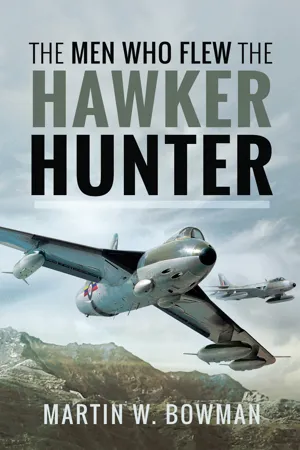
Features a wealth of first-hand testimony drawn from pilots who flew the outstanding Hawker Hunter.
If ever there was a real pilot's aeroplane it was the Hunter, an outstanding multi-purpose aircraft which excelled in the roles of interceptor fighter, ground attack, reconnaissance, research vehicle and two-seater trainer, not to mention its dramatic displays in formation aerobatic performances. The Hawker Hunter is one of the world's greatest aircraft. For decades pilots have enthused about it, extolling the virtues of its smooth, aerodynamic lines, 4 x 30mm cannon, Rolls-Royce Avon engine, and its outstandingly honest handling characteristics combined with a lively performance. Who can ever forget the glory days of the unforgettable aerobatic displays with the Black Knights, Black Arrows, and Blue Diamonds? This book vividly recalls operations in Europe with Fighter Command and 2nd TAF, and in Cyprus, the Middle East and the Far East, where Hunters in the ground-attack role operated against rebels in Aden and Malaysia respectively. The Hunter was undoubtedly a classic thoroughbred of its time from the stables of one of the finest fighter manufacturers in the world. Here, we read the details of it's fascinating story, told from the perspective of the men who actually flew this outstanding aircraft through history.
- 304 pages
- English
- ePUB (mobile friendly)
- Available on iOS & Android
eBook - ePub
The Men Who Flew the Hawker Hunter
About this book
Information
Chapter 1
Hunter Hysteria
…there has been a tendency to bestow a personality upon the machine; this is only really credible when bestowed by the men who built and flew it. The Hunter has been a long-serving and faithful workhorse, a beast admired and respected by most and perhaps hated by a few. It certainly had its tribulations in its early days, now almost forgotten, but these were overcome – they had to be, for after the disastrous eclipse of the Supermarine Swift, the Hunter was the only British fighter on the horizon.
Certainly as time passed this very beautiful aeroplane began to acquire a kind of charisma. It was as if the meticulous design treatment by the dedicated team, led by a man who possessed a unique appreciation of beauty and grace in the flying machine, was being reflected in the behaviour of the Hunter. The pilots quickly learned how to get the best from their aeroplanes and became their staunch advocates. And long after individual aircraft had passed their predicted fatigue life (the ‘threescore years and ten’ of the aeroplane), Hunters were being painstakingly refurbished and sent into the air again. There are numerous instances in which individual Hunters have flown with three or four different air forces of the world and at least one has flown with no fewer than seven! Little wonder that something of a mystique can be detected in the ‘character’ of the Hunter. In at least one air force Hunters served for almost fifty years before being finally retired. Unquestionably this will not be matched by any other front-line aeroplane in history.’
Francis K. Mason1
British fighters had been among the world’s finest during World War Two. Many of them, such as the Hawker Hurricane and the Typhoon rocket-firing fighter, were the result of the design teams headed by Sydney Camm, born on 5 August 1893; a man who had been Hawker’s chief designer since 1925. During his employment at Hawker he was responsible for the creation of 52 different types of aircraft, of which a total of 26,000 were manufactured. Among his early designs were the Tomtit, Hornbill, Nimrod, Hart and Fury. At one time in the 1930s 84 per cent of the aircraft in the RAF were of Camm design. His greatest post-war creation, the Hunter, beckoned, but bringing this project (and others) to fruition would prove difficult. In 1945 Britain had emerged impoverished and austere from five years of war while the United States and the Soviet Union gained new dominance, both politically and militarily. British politicians tried forlornly to resuscitate and transform the economy but deprivation and sacrifice could not be remedied overnight or even over a period of years. America gave Europe aid, but Britain’s overall economic situation, in the aviation industry certainly, was one of under investment and low priority. ‘Make do and mend’, an attitude reminiscent of the period immediately after the First World War, was the order of the day.
America had no such military aircraft replacement problems and her aviation industry, profiting hugely with data from captured secret German jet designs and advanced wing technologies, forged ahead with second-generation jet fighters and bombers. In Britain innovative design and aircraft production went largely un-rewarded and under-funded. When the Government did get involved, generally it was to meddle and confuse the situation. Fortunately, British aircraft designers and engine makers had lost none of their genius and invention - far from it. At their companies’ expense, they began producing advanced commercial and military designs that would compete with and in many cases beat, the rest of the world. The onset of the Cold War between east and west, first with the Soviet Blockade of Berlin in 1948 and then war in Korea, which began in 1950, concentrated minds wonderfully on both sides of the Atlantic. (America would later fund production and deliveries of aircraft like the Hunter, to nations outside the Communist Bloc.) Churchill and the Conservatives were returned to power in 1951 and the climate began to change from austerity to more sunlit uplands whose warm glow lit up the design offices and production lines of Hawker, de Havilland, Gloster and Supermarine, to name but a few.
Actually, the change in direction had begun a few years before. ‘Thank God for the Navy’ Camm had written in August 1946. Once again the senior service provided the catalyst and much needed salvation for Britain’s post-war aircraft industry. On 27 July 1946 the first prototype Supermarine Attacker, a 1944 design earmarked originally for the RAF, flew at Chilbolton. In August 1951 it became the first jet aircraft to enter service with the Fleet Air Arm. By 1955 no piston-engined aircraft would be in first-line squadron service with the Royal Navy. In February 1946, three prototypes of Hawker’s first jet fighter, the P.1040, which was adapted for carrier-based interception, were ordered. The first P.1040 prototype flew at Boscombe Down, Wiltshire, on 2 September 1947 powered by a 4,500lb thrust Nene I, which produced a maximum speed of about Mach 0.77 (510 mph). An increase in speed and performance only resulted when Camm forged ahead with plans for a swept-wing design, designated the P.1047, powered by a more powerful Nene engine. The new wings had a sweepback of 35 degrees on the quarter chord and a thickness ratio of 0.10. The P.1040 meanwhile went on to become the Sea Hawk, the first production F.1 flying in November 1951. Hawkers built just 35 Sea Hawks before full-scale production passed to Armstrong Whitworth Aircraft Ltd at Baginton, Coventry.
In November 1946 Specification E.38/46 was issued by the Ministry of Supply for two swept wing examples, designated the P.1052, powered by the 5,000lb thrust Nene 2. The new design promised a maximum speed in excess of Mach 0.86 (560 mph at 36,000 feet) but happily, they proved capable of speeds up to Mach 0.90 (595 mph at 36,000 feet). All-swept tail surfaces and a straight-through jet-pipe helped improve the P.1052’s performance and handling. But by the end of 1947 Camm and his design team knew that to overcome the lead set by Supermarine, they would have to design a new aircraft, one which could accommodate the new 6,500lb Rolls-Royce A.J.65 axial-flow turbojet. This engine would soon become world famous as the Avon.
At Richmond Road, Kingston-upon-Thames, Camm now turned his attention to a new design borne out of the P.1052 to meet Specification F.3/48, issued to Hawker early in 1948 for a single-seat, cannon armed, day interceptor fighter powered either by a Rolls-Royce Avon or Armstrong Siddeley Sapphire engine. The new interceptor had to be capable of Mach 0.94 (620 mph at 36,000 feet, 724 mph at sea level) and have an endurance of sixty minutes. No final decision had been made on the type of guns. They would either be four 20mm Hispano or two new 30mm Aden cannon. An ejection seat would be mandatory and provision had to be made for a future radar-ranging gunsight. The main characteristics of the original P.1067 design included an Avon engine mounted in the fuselage amidships with annular nose air intake and exhausting through a long jet pipe in the extreme tail. The wing was swept back 42½ degrees on the quarter-chord and a straight-tapered tailplane was mounted on top of the fin, though this was later deleted at the P.1067/5 stage.
In 1949 four 30mm Aden cannon armament fit was adopted, cleverly mounted with their magazines in a removable gun-pack located behind the cockpit. Though the German Me 262 jet fighter of WW2 had been armed with four cannon and both the Gloster Javelin and DH.110 were being developed to include four Adens, the P.1067 was the only single-seat, single-engined fighter in the world designed to carry four cannon. In May 1950 the Ministry of Supply announced that the 30mm Aden would be abandoned because of cost considerations, but six weeks later the Ministry decided to go with the original specification of four 30mm Aden cannon. Indecision initially surrounded the choice of the engine to power the P.1067. Hawker’s chief rival, the Supermarine Swift, would be powered by the Rolls-Royce Avon, as would the English Electric Canberra twin-engined bomber. In the event, WB188, the first of the three P.1067 prototypes and WB195, would be powered by the Avon, while the Sapphire would power WB202.
Work on the three prototypes continued throughout 1950-51 and Hawker Chief Test Pilot, Trevor Sidney Wade DFC AFC and his assistant, Squadron Leader Neville Duke, waited in the wings to fly the first of the breed. Wade was born on 27 January 1920 and was educated at Tonbridge School. He left school at 18, learned to fly at Gatwick and joined the Royal Air Force Volunteer Reserve. By the time the Battle of Britain had started Wade was with 92 Squadron flying the Supermarine Spitfire. In the Battle of Britain and subsequent operations he destroyed seven enemy aircraft. In 1941 he was awarded a DFC for his efforts during the first part of the war and achieving seven confirmed victories After a course at the Central Flying School in October 1941 he became a pilot-gunnery instructor at the Central School of Gunnery. He was then appointed as OC Flying at the Air Fighting Development Unit at Duxford. For his work at the AFDU he was awarded the Air Force Cross. At the end of the war Wade joined the staff of The Aeroplane magazine but within a year he had joined Hawker Aircraft as an assistant to the Chief Test Pilot Bill Humble. When Humble became a sales manager Wade became the Chief Test Pilot. In May 1949 he set a speed record between London and Paris in the Hawker P.1052 jet. ‘Wimpy’ Wade, who was married with three children, was killed on 3 April 1951 when the P.1081 - the experimental ‘all- swept’ development of the P.1052 he was flying crashed near Lewes in Sussex. The cause of the accident was never fully established.
“Neville Duke, who would in any case have shared with Wade much of the early flight testing of the P.1067”, Frank Mason was to recall in his book Hawker Hunter: Biography of a thoroughbred 2: “was now appointed Chief Test Pilot. In many respects the tall, slim Duke was the antithesis of the stocky, ebullient Wade, yet both shared a characteristic finesse in their flying. Duke possessed a rare degree of tact when it came to a discussion of a matter with the design office, although for all his inherent shyness and reserve there were seldom instances of prolonged disagreement, and if a compromise was found to be the only solution, the remedy tended to favour the pilot. That Duke was a magnificent, analytical pilot was unquestioned - probably one of the greatest of all British pilots.”3
Born on 11 January 1922 in Tonbridge, Kent and educated at the Convent of St. Mary and The Judd School in Tonbridge, Neville Duke DSO OBE DFC** AFC FRAeS started working as an auctioneer and estate agent before attempting to join the Fleet Air Arm on his 18th birthday. He was rejected and joined the RAF instead as a cadet in June 1940. In World War II Duke was the most successful Western Allied ace in the Mediterranean Theatre and was credited with the destruction of 27 enemy aircraft. Duke returned to the UK and took up a position as test pilot for Hawkers in January 1945. He attended No.4 Course at the Empire Test Pilots’ School at Cranfield in 1946 and then joined the RAF’s High Speed Flight unit, commanded by Teddy Donaldson. It was Donaldson who set a new official world air speed record on 7 September 1946, later being the first man to officially break the 1,000 km/h barrier. After demonstrating a Gloster Meteor at an air display in Prague, he was presented with the Czech War Cross for his wartime service. Duke was awarded the Air Force Cross recognising his test flying from 1947–1948 at the Aeroplane and Armament Experimental Establishment at Boscombe Down, where he flew research flights to explore aircraft performance at high Mach numbers and high altitudes. Duke resigned from the RAF in August 1948, joining the Royal Auxiliary Air Force, flying Spitfires and Meteors from Biggin Hill. He was CO of 615 Squadron in 1950 and 1951, whose honorary air commodore was Winston Churchill. Duke joined Hawker as an assistant chief test pilot in 1948. He was to recall: ‘The P.1067 seemed to be a pilot’s aeroplane, all the way from the drawing board to roll-out of the prototype - it looked right on paper and in form. It felt right, too, in the cockpit, which was just snug enough to make the pilot feel entirely a part of the aeroplane. The cockpit was slightly narrow at the shoulders, which gave the snug effect common to British fighters and the seating position gave the pilot a commanding view of the outside world and a feeling that the aeroplane was an extension of oneself.
“By the standards of the day” wrote Frank Mason4, the P.1067 was a long time coming to the flight stage, more than three years elapsing between project design and first flight. The reasons for this delay have been explained, and the prototype emerged a very different aeroplane from that first envisaged early in 1948. It emerged as a surpassingly beautiful aeroplane in a world already becoming increasingly accustomed to stark angularity in high speed aeroplanes.
Towards the end of June 1951 the finishing touches were being put to the first prototype, WB188, and the whole aircraft was given a glossy pale green paint finish. It was then dismantled and loaded on to a lorry, starting out from Kingston in the early hours of the 27th, and arriving at the Aeroplane and Armament Experimental Establishment at Boscombe Down, Wiltshire, later the same day. The next day the Hawker Resident Technical Officer (RTO) endorsed the flutter clearance, and on the 29th WB188 was given full design clearance for flight.
The choice of Boscombe Down for the P. 1067’s first flight was made on account of the lack of adequate facilities yet installed at Hawker’s new test field at Dunsfold, Surrey. The old airfield at Langley, Buckinghamshire, which had proved entirely adequate during the war, and had sufficed for aircraft like the Sea Fury, was unsuitable for jet aircraft (owing mainly to its proximity to London-Heathrow airport) with the result that much of the Sea Hawk flying was carried out from the airfield at Farnborough, Hampshire, until Dunsfold could be made ready.
Even before WB188 was ready to fly, Hawker had received an Instruction to Proceed on preparations for production (on 20 October 1950), and on 14 March 1951 a contract was raised by the Ministry of Supply to cover the production of 198 aircraft at Kingston at a unit cost initially estimated at £172,000 including powerplant. With the certainty of further production orders in the offing, the Hawker Siddeley Group Board of Directors decided to close down production of the Sea Hawk at Kingston and transfer all future development of this aircraft to Sir W.G. Armstrong Whitworth Aircraft Ltd, at Coventry. In the event only 35 production Sea Hawks were completed at Kingston.
Returning to WB188 at Boscombe Down, the aircraft was reassembled during 28-30 June, the first flight engine being received and installed at the same time. The first engine run was carried out on 1 July and weighing to check all-up weight and centre of gravity position was completed two days later. Thus far progress towards the first flight had been trouble-free, but on the 8th, during the initial taxiing runs, Duke experienced trouble with the differential wheel braking system, a problem that occupied Dunlop for ten days before the snag was rectified.
On 20 July, however, Duke expressed himself satisfied with the feel of the aircraft after a number of fast runs along the runway and, after checking the fuel state at 220 gallons, flew WB188 off the ground for a 47-minute flight over Wiltshire, Hampshire and Dorset. During this first flight he took the aircraft up to about 32,000 ft and performed a series of fairly gentle manoeuvres before descending to 10,000 ft to carry out stalls at various flap settings and with undercarriage up and down. At no time did he attempt transonic flight, but kept his speed below Mach 0.88. On landing Duke reported that he was delighted with the new aeroplane and remarked that it handled beautifully. At first, on checking the fuel consumption during the flight, doubt was cast on the consumption figures provided by Rolls-Royce, until it was discovered after several further flights that the rear fuselage fuel tank has been leaking a significant quantity of fuel in flight. Duke also gave his opinion that the centre of pressure seemed slightly far aft for comfort and, following confirmation by wind tunnel tests, it was found possible to move this forward.
Flying by WB188 continued during August and early the following month Duke flew it at the Society of British Aircraft Constructors’ display at Farnborough. For all the disruption caused by the attendance at this show to the flight schedule, Duke nevertheless managed to combine useful development work with his characteristically polished flying displays.
Much of October was spent on performance measurement, Duke doing about nine hours’ flying in WB188 before the aircraft was completely dismantled for inspection, to carry out a number of minor modifications and to install a production R.A.7 Avon engine with variable swirl. The first prototype did not fly again until the end of April 1952 by which time an extensive programme of strength testing of a structural specimen had been completed.”5
Corporal ‘Dave’ Stint an engine fitter on 56 Squadron RAF Waterbeach who spent 3½ years during January 1954-September 1959 recalled that following the demise of the Swifts Mk.1 and 2 in 1955 the squadron was equipped with Sapphire-engined Hunter Mk.5 aircraft. ‘Reliability of the Mk.5 suffered badly in the first year or so, mainly due to the engine fuel control components. However, reliability rocketed with disbandment of 63 Squadron and some of the Avon-engined Mk.6 aircraft were used to re-equip 56 Squadron.’
By the end of June 1951 meanwhile, WB188 was almost ready for the first flight and it was painted a glossy pale duck egg green finish to mark the occasion. On 27 June WB188 was dismantled at Kingston and transported to the Aeroplane and Armament Experimental Establishment at Boscombe Down, preparatory to the first flight. Neville Duke carried out WB188’s first engine run on 1 July.
On 20 July flew the prototype off the ground for a 47-minute flight. Two months later Duke was making high-speed passes in excess of 700 mph at the Farnborough Air Show, as he recalls:
‘In 1951 I had to fly two aircraft at Farnborough, for after “Wimpy” Wade was killed there had been insufficient time to obtain another pilot, or either ‘Frank’ Murphy or ‘Frank’ Bullen (company test pilots) to convert to the P.1052. I flew this aircraft and also the P.1067 - the Hunter prototype. This was the best SBAC display I can recall. We felt that Hawkers had it all their own way on this occasion, for there was nothing to touch the P.1067 for speed or grace of line.’
Hawker Experimental Test Pilot Alfred William ‘Bill’ Bedford and later Chief Test Pilot, 1951-67, writing in 1981, recalled: ‘Neville Duke made the Hunter’s maiden flight from Boscombe Down on 20 July 1951 and he played a vital part in the flight development programme. He deservedly hit the headlines with his stimulating Hunter demonstrations in the early 1950s and by gaining the world speed record. Thus Neville and the Hunter became almost as synonymous as Sydney Camm and Hawker Aircraft Ltd were. ‘It was my privilege to join Hawker as an Experimental Test Pilot under Neville in 1951 sharing the Hunter programme and taking over from him as Chief Test Pilot from 1956 to 1967; thus the Hunter became an essential part of my life and one that I always reflect on with some pride and pleasure.’6
Hunter development was slow because of the many problems encountered. The aircraft did not have an airbrake and considerable time and effort were expended in developing one and finding a suitable location for it. Problems wer...
Table of contents
- Cover
- Title
- Copyright
- Contents
- Acknowledgements
- Chapter 1: Hunter Hysteria
- Chapter 2: Noble Endeavours
- Chapter 3: Hunter Heyday
- Chapter 4: Tiger Tiger
- Chapter 5: Here Come the ‘Black Arrows’
- Chapter 6: Diamonds with Twelve Aces
- Chapter 7: Into The Remote Places
- Chapter 8: Home Thoughts From Abroad
- Chapter 9: Sabre Slayer
- Chapter 10: Hunters for Export
- Chapter 11: Sic Transit Gloria
- Endnotes
- Plates
Trusted by 375,005 students
Access to over 1.5 million titles for a fair monthly price.
Study more efficiently using our study tools.
Frequently asked questions
Yes, you can cancel anytime from the Subscription tab in your account settings on the Perlego website. Your subscription will stay active until the end of your current billing period. Learn how to cancel your subscription
No, books cannot be downloaded as external files, such as PDFs, for use outside of Perlego. However, you can download books within the Perlego app for offline reading on mobile or tablet. Learn how to download books offline
Perlego offers two plans: Essential and Complete
- Essential is ideal for learners and professionals who enjoy exploring a wide range of subjects. Access the Essential Library with 800,000+ trusted titles and best-sellers across business, personal growth, and the humanities. Includes unlimited reading time and Standard Read Aloud voice.
- Complete: Perfect for advanced learners and researchers needing full, unrestricted access. Unlock 1.5M+ books across hundreds of subjects, including academic and specialized titles. The Complete Plan also includes advanced features like Premium Read Aloud and Research Assistant.
We are an online textbook subscription service, where you can get access to an entire online library for less than the price of a single book per month. With over 1.5 million books across 990+ topics, we’ve got you covered! Learn about our mission
Look out for the read-aloud symbol on your next book to see if you can listen to it. The read-aloud tool reads text aloud for you, highlighting the text as it is being read. You can pause it, speed it up and slow it down. Learn more about Read Aloud
Yes! You can use the Perlego app on both iOS and Android devices to read anytime, anywhere — even offline. Perfect for commutes or when you’re on the go.
Please note we cannot support devices running on iOS 13 and Android 7 or earlier. Learn more about using the app
Please note we cannot support devices running on iOS 13 and Android 7 or earlier. Learn more about using the app
Yes, you can access The Men Who Flew the Hawker Hunter by Martin W. Bowman in PDF and/or ePUB format, as well as other popular books in History & Military Biographies. We have over 1.5 million books available in our catalogue for you to explore.