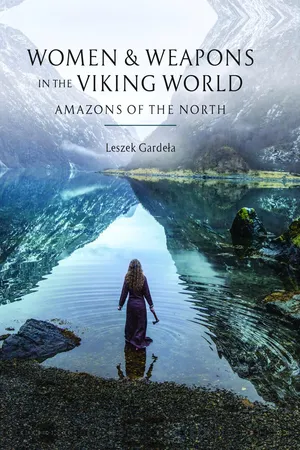
The Viking Age (c. 750–1050 AD) is conventionally seen as a tumultuous time when hordes of fierce warriors from Scandinavia wreaked havoc across the European continent and when Norse merchants travelled to distant corners of the world in pursuit of slaves, silver, and exotic commodities. Until relatively recently, archaeologists and textual scholars had the tendency to weave a largely male-dominated image of this pivotal period in world history, dismissing or substantially downplaying women's roles in Norse society. Today, however, there is ample evidence to suggest that many of the most spectacular achievements of Viking Age Scandinavians - for instance in craftsmanship, exploration, cross-cultural trade, warfare and other spheres of life - would not have been possible without the active involvement of women. Extant textual sources as well as the perpetually expanding corpus of archaeological evidence thus demonstrate unequivocally that both within the walls of the household and in the wider public arena women’s voices were heard, respected and followed. This pioneering and lavishly illustrated monograph provides an in-depth exploration of women's associations with the martial sphere of life in the Viking Age. The multifarious motivations and circumstances that led women to engage in armed conflict or other activities whereby weapons served as potent symbols of prestige and empowerment are illuminated and interpreted through an interdisciplinary approach to medieval literature and archaeological evidence from Scandinavia and the wider Viking world. Additional cross-cultural excursions into the lives and legends of female warriors in other past and present cultural milieus - from the Asiatic steppes to the savannas of Africa and European battlefields - lead to a nuanced understanding of the idea of the armed woman and its embodiments in Norse literature, myth and archaeological reality.
- 216 pages
- English
- ePUB (mobile friendly)
- Available on iOS & Android
eBook - ePub
About this book
Information
Topic
Sciences socialesSubtopic
Histoire de l'Europe médiévaleChapter 1
Introduction: the methodological and theoretical framework
Over the last several years we have been the hearers and witnesses of a surge of exciting discoveries shedding new light on the lives of Viking Age women. In particular, the 2017 re-interpretation of a richly furnished chamber grave Bj. 581 from Birka in Uppland, Sweden, formerly hailed as the grave of a high-ranking male warrior, created quite a commotion in the field of Old Norse and Viking studies: as a result of aDNA analyses, the occupant of the grave was identified as biologically female. Immediately after the release of the first academic paper discussing the implications of this re-assessment – provocatively entitled ‘A Female Viking Warrior Confirmed by Genomics’ – international media picked up the topic and turned it into a global sensation. While numerous history afficionados enthusiastically welcomed these new results, others began to wonder if the Birka case provided actual proof of the existence of ‘Viking warrior women’ or if the data had been stretched or even deliberately manipulated to fit a particular agenda or vision of the past. In the context of our current Digital Age it should not come as a surprise that alongside heated debates among non-professional history enthusiasts in social media, the first lengthy academic responses to the new interpretation of Bj. 581 were also published online on private websites and blogs. It soon became clear that members of the international scholarly community were divided in their opinions regarding the identity of the individual from Birka; while some accepted at face value the idea that this person was an active warrior, others remained sceptical and reserved.
This book offers a new approach to the broad theme of women and weapons in the Viking world. However, in exploring the intricacies of female participation in martial activities and in discussing the multifarious circumstances that led human and supernatural women to take up arms, it aspires to be more than a study of medieval female warriors. By adopting an interdisciplinary methodology, involving first-hand investigations of archaeological finds and thorough analyses of textual sources, cross-cultural phenomena and folklore, an argument is proposed that Viking Age women’s associations with weapons were remarkably nuanced and extended beyond the spheres of conflict and war. In the following pages we will encounter women who used weapons as potent symbols manifesting inheritance, authority and power, and we will investigate the lives and deeds of ambiguous female characters who used weapons in ritual practices enabling them to invoke fear, transform their appearance and see into the future.
One of the main entryways into these complex topics and pre-Christian worldviews from which they arise is the exploration of mortuary remains; somewhat paradoxically, careful analyses of the burial record allow the most intimate insight into the lives of past individuals, providing us with rich details concerning the deceased themselves and the world(s) they were immersed in. We shall therefore begin this study with a journey into the world of the dead.
Entering the Viking world … of the dead
There is a general consensus in today’s international research on funerary archaeology that graves can provide valuable insights into many aspects of life in the past and that they have the capacity to convey important information not only about the fluid notions of social status, identity, migration, economy, cultural interaction, ritual practice and religious belief, but also about the biological condition of the deceased person and of the wider society they were immersed in.1 Since a substantial part of the present monograph will deal with finds from Scandinavian funerary contexts, especially from Sweden and Norway, it is essential to begin with an outline of the past and present research trajectories pertaining to this material.
The aforementioned site of Birka on the island of Björko on Lake Mälaren in Uppland, Sweden occupies an iconic place in Viking studies. In the late 1800s, a man of many talents named Hjalmar Stolpe (1841–1905) arrived on Björko to study amber and was immediately drawn to the numerous mounds that dotted its landscape (Fig. 1.1).2 Intrigued by what they could hold, Stolpe soon began his excavations that led to the discovery of dozens of opulently furnished Viking Age graves. Before long, the island of Björko turned out to be identical with Birka, an important Viking Age port-of-trade mentioned in several medieval textual sources including Rimbert’s Vita Anskarii and Adam of Bremen’s Gesta Hammaburgensis Ecclesiae Pontificum.3

Fig. 1.1. Hjalmar Stolpe (1841–1905). Public domain.
In the course of his work, Stolpe introduced innovative methods of excavation and recording. Today, in addition to an impressive collection of finds encompassing literally thousands of objects, the documentation from his work at Birka consists of notebooks, separate notes, sketches and plans. It is worth pointing out that Stolpe was one of the first European archaeologists to use graph paper to record graves and their contents in situ.4 Detailed plans of the Birka burials, showing their internal structure, the position of the human remains and the accompanying artefacts are invaluable sources of information for any studies of Viking Age mortuary practices. One could only wish other sites discovered across Scandinavia in the nineteenth century would be documented to equally high standard.
Although many positive things can be said about Stolpe’s excavations at Birka, in approaching his findings today, it is essential to be critically aware of some of the more problematic aspects of his work – aspects that, to a certain extent, may also influence the scholarly perception and interpretation of the contents of the famous chamber grave Bj. 581.
According to surviving records, Stolpe was not always present at the site and recorded some of the Birka finds after they had been excavated by his peasant workers, meaning that (due to the workers’ lack of professional expertise or ‘archaeological awareness’) some details of the discovered graves might have been omitted or simply ‘lost in translation’. Furthermore, it is now a well-known albeit disturbing fact that in the course of his work at Birka, Stolpe used dynamite, for instance to make his way through the tight stone packaging that covered some of the burial chambers. Notably, this was also the case with Bj. 581; the grave was marked by a stone so large that it was impossible to move it by hand and thus Stolpe had to blow it to pieces.5 It is unknown whether (or to what extent) this procedure damaged the grave’s contents.

Fig. 1.2. Holger Arbman (1904–1968). Public domain.
As the years went by, scholars working with the Birka material relied heavily on Stolpe’s documentation, sometimes adding their own observations or amendments to it. In the 1940s, Swedish archaeologist Holger Arbman (1904–1968) released a two-volume catalogue of the Birka graves excavated by Stolpe, a truly massive publication which still today forms the standard reference work for anyone dealing with the mortuary archaeology of this site (Fig. 1.2).6 Arbman’s catalogue includes numerous grave plans reproduced in black-and-white on the basis of Stolpe’s field drawings (many of which were originally made in colour). However, as some scholars have critically noted, ‘not all the drawings are accurate reproductions of Stolpe’s sketches and they do not necessarily represent the contents of the boxes correctly [i.e. boxes with the archaeological finds stored in museum collections today – LG]’.7 In 2018, Fedir Androshchuk published a critical response to the 2017 paper on the re-interpretation of Bj. 581, where he noted a number of divergences that exist between the different plans of this grave.8 However, these issues were soon clarified in a 2019 study by Neil Price et al. who demonstrated convincingly that there are no reasons to doubt the integrity of the grave’s contents.9 We will consider this case in more detail in Chapter 4, but it is important to keep these various nuances in mind.
Since the twentieth century, many Viking Age burial sites have been discovered in Sweden.10 Interdisciplinary research projects have also led to new observations regarding the structure and extent of the Birka cemeteries and to the re-excavation of some of the graves originally discovered by Stolpe.11 New insights into the life and death of Sweden’s Viking Age population have also been gained as a result of osteological, isotope and genetic analyses.12 Regional studies, such as the important work of Fredrik Svanberg from 2003, focusing specifically on south-east Scandinavia have certainly helped to embrace and comprehend a substantial body of the available data, at the same time introducing interesting interpretational perspectives.13 Although these different studies have certainly nuanced our understanding of the diversity and meaning of mortuary practices in this part of Scandinavia, we still have to wait ...
Table of contents
- Front Cover
- Half-Title Page
- Title Page
- Copyright Page
- Dedication
- Table of Contents
- List of figures
- List of tables
- Acknowledgements
- 1. Introduction: the methodological and theoretical framework
- 2. Historiography
- 3. Women and weapons in medieval textual sources
- 4. Women and weapons in Viking archaeology: the burial evidence
- 5. Interpreting the arsenal of armed women
- 6. Women and weapons in Viking Age iconography
- 7. Women with weapons: a cross-cultural phenomenon
- 8. Amazons of the North? Women and weapons in the Viking world
- Appendix
- References
- Back Cover
Trusted by 375,005 students
Access to over 1.5 million titles for a fair monthly price.
Study more efficiently using our study tools.
Frequently asked questions
Yes, you can cancel anytime from the Subscription tab in your account settings on the Perlego website. Your subscription will stay active until the end of your current billing period. Learn how to cancel your subscription
No, books cannot be downloaded as external files, such as PDFs, for use outside of Perlego. However, you can download books within the Perlego app for offline reading on mobile or tablet. Learn how to download books offline
Perlego offers two plans: Essential and Complete
- Essential is ideal for learners and professionals who enjoy exploring a wide range of subjects. Access the Essential Library with 800,000+ trusted titles and best-sellers across business, personal growth, and the humanities. Includes unlimited reading time and Standard Read Aloud voice.
- Complete: Perfect for advanced learners and researchers needing full, unrestricted access. Unlock 1.5M+ books across hundreds of subjects, including academic and specialized titles. The Complete Plan also includes advanced features like Premium Read Aloud and Research Assistant.
We are an online textbook subscription service, where you can get access to an entire online library for less than the price of a single book per month. With over 1.5 million books across 990+ topics, we’ve got you covered! Learn about our mission
Look out for the read-aloud symbol on your next book to see if you can listen to it. The read-aloud tool reads text aloud for you, highlighting the text as it is being read. You can pause it, speed it up and slow it down. Learn more about Read Aloud
Yes! You can use the Perlego app on both iOS and Android devices to read anytime, anywhere — even offline. Perfect for commutes or when you’re on the go.
Please note we cannot support devices running on iOS 13 and Android 7 or earlier. Learn more about using the app
Please note we cannot support devices running on iOS 13 and Android 7 or earlier. Learn more about using the app
Yes, you can access Women and Weapons in the Viking World by Leszek Gardeła in PDF and/or ePUB format, as well as other popular books in Sciences sociales & Histoire de l'Europe médiévale. We have over 1.5 million books available in our catalogue for you to explore.